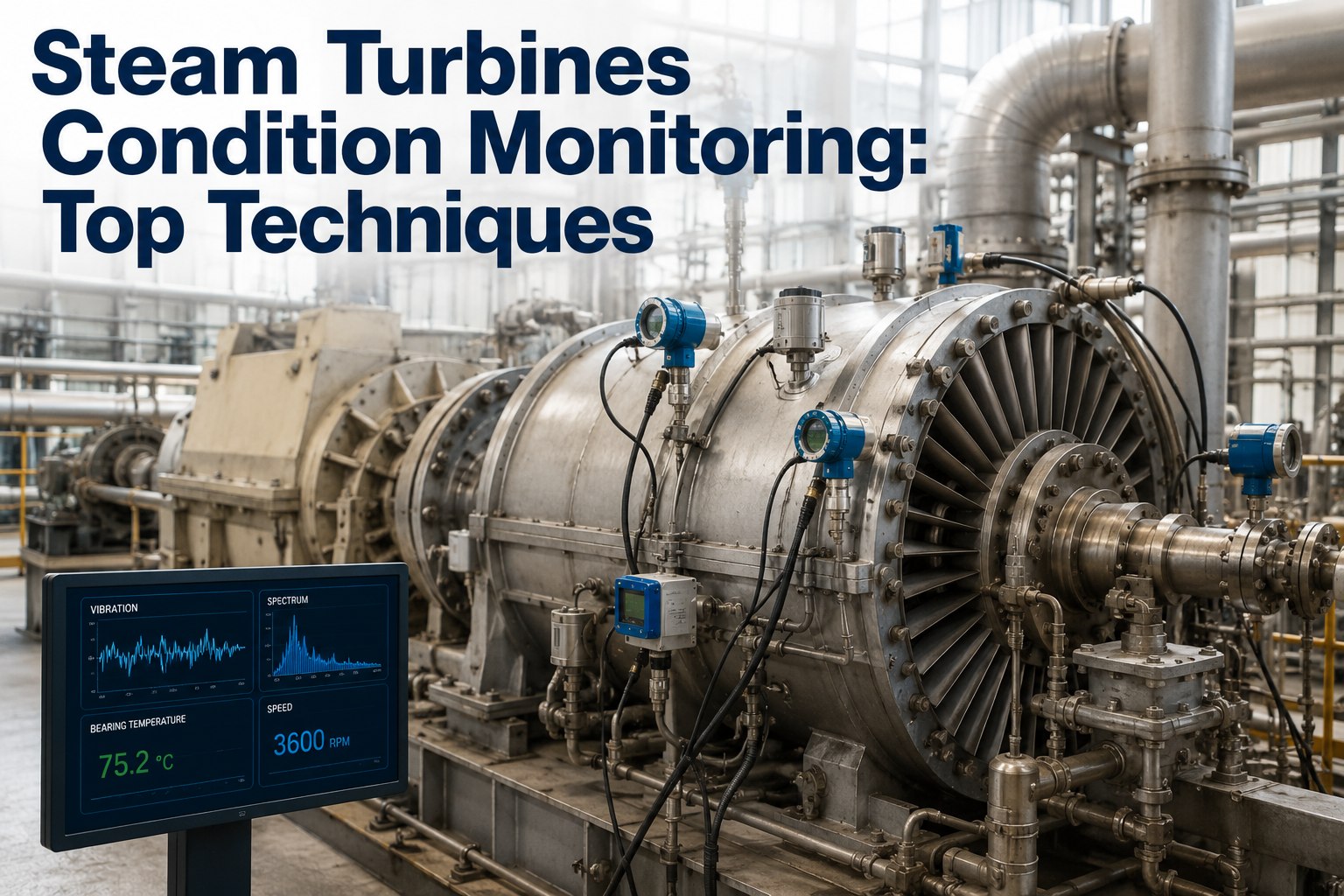
The largest categories of fossil steam turbine unavailability — LP blade failures, HP and LP bearing problems, generator vibration, and main stop valve faults — share one characteristic: every failure mode produces detectable signals weeks before the forced outage. Shaft vibration trending, bearing temperature logging, oil analysis, valve stroke timing, and blade borescope findings all carry 4–12 weeks of advance warning. The gap between those signals and a maintenance action is closed by a CMMS that connects them. Start monitoring turbine condition in Oxmaint free.
Steam Turbine Maintenance: Blade Inspection, Bearing Monitoring and Overhaul Planning
Five maintenance domains — HP/IP/LP blades, journal bearings, lube oil system, stop and control valves, overhaul planning — each with specific detection methods, alert thresholds, and CMMS-triggered work orders.
Steam Turbine Maintenance System Overview
A complete steam turbine maintenance programme spans five domains. Each domain has its own failure mechanism, detection method, inspection frequency, and CMMS trigger. All five connect in Oxmaint as one turbine asset record — vibration trends, oil analysis results, valve stroke times, blade inspection findings, and overhaul milestones in one place.
Blade Inspection: HP, IP, and LP Failure Mechanisms
Borescope · PAUT root attachment · wet-steam SCC · LP last-stage bladesLP last-stage blades are the highest-consequence component in the steam path: they operate in the wet-steam zone where stress corrosion cracking initiates at pitting sites, carry the longest chord span in the train, and reach tip speeds above 500 m/s at full load. A blade liberation in the LP section cascades damage through all downstream diaphragms, nozzle assemblies, and the condenser. HP and IP blades fail through leading-edge erosion from steam impurity carryover and fatigue at fir-tree root attachments — both detectable by borescope before casing removal. Sign up for Oxmaint to configure blade inspection work orders with operating hours triggers.
Bearing Monitoring: Vibration Signatures and Eccentricity Trending
1× 2× sub-synchronous · eccentricity position · thrust axial · 4–12 week lead timeShaft vibration measured by X-Y proximity probes at each journal bearing is the most reliable early indicator of mechanical degradation — imbalance, misalignment, bearing wear, seal rub, and blade damage each produce distinct frequency patterns detectable 4–12 weeks before forced outage severity. Eccentricity position (the steady-state location of the shaft centre within bearing clearance) reveals sustained preloads from misalignment, thermal bowing, or seal contact that vibration amplitude alone does not capture. Book a demo to see bearing trend record configuration in Oxmaint.
Connect historian data to predictive work orders in 2–4 weeks
Oxmaint connects to existing SCADA, DCS, and historian systems via OPC-UA, Modbus, and BACnet without replacing any current infrastructure. Vibration trends, bearing temperatures, and oil analysis results all in one turbine asset record.
Lube Oil System: Varnish Detection, Contamination Control and Analysis Programme
MPC varnish · water ingress · Fe/Cu wear metals · servo valve correlationVarnish — insoluble deposits from thermal oxidative oil degradation — is the leading cause of servo valve spool stiction in turbine governor systems. It appears in oil analysis months before any functional problem is visible. A main stop valve whose stroke time is increasing concurrently with rising MPC varnish index has a servo valve contamination problem, not a mechanical valve problem. Without a CMMS linking these two data streams they stay in separate logs. Sign up for Oxmaint to configure oil analysis records correlated with valve test history per turbine asset.
Above 25: evaluate varnish removal treatment. Inspect governor servo valves concurrently — spool stiction passes room-temperature test but binds at operating temperature.
Source investigation required: seal steam condensate ingress or oil cooler tube leak. Both need separate corrective work orders beyond the oil replacement.
Rising Fe trend across two consecutive quarterly samples indicates babbitt wear — often detectable before vibration amplitude rises above alert threshold. Act on the trend, not the absolute value.
Increase indicates oxidation. Decrease indicates dilution. Both affect oil film thickness in journal bearings and directly impact vibration signature at all load conditions.
Valve Testing: Main Stop Valve and Control Valve Maintenance
Quarterly full stroke · linearisation calibration · annual trip test · seat erosionMain stop valve failures rank in the top five fossil turbine unavailability causes. A stop valve that is not periodically stroked will seize in the open position from deposit build-up on stem and guides — the test that prevents this takes 15 minutes quarterly and produces a stroke time record that trends valve condition across years of service. Any increase in stroke time concurrent with rising MPC varnish is a confirmed actuator contamination finding. Book a demo to see valve test scheduling in Oxmaint.
Condition-Based Overhaul Planning: Extending Intervals from 5 to 8 Years
−24 month scope · long-lead procurement · borescope confirmation · no outage surprisesPlants running continuous vibration trending, quarterly oil analysis, and annual borescope inspection can extend major overhaul intervals from the traditional 5-year OEM recommendation to 7–8 years — because they are monitoring actual condition rather than inferring it from elapsed time. The critical discipline is not the monitoring itself: it is the work scope assessment 24 months before the planned outage, which provides the lead time to procure parts with 6–18 month OEM manufacturing lead times. Sign up for Oxmaint to track overhaul planning milestones per turbine asset.
Work Scope Assessment from Condition Data
Review vibration trends, oil analysis history, and last borescope findings. Identify any long-lead items — HP blade sets (6–18 months), thrust bearing assembly (3–6 months), stop valve internals (4–8 weeks). Generate procurement work orders with 18-month target delivery. This step is the one that converts outage surprises into planned scope.
Long-Lead Parts Procurement
Issue purchase orders for HP blade sets, thrust bearing components, and valve internals identified in the scope assessment. OEM lead times of 6–18 months mean this procurement cannot be deferred to −12m without creating outage duration risk. Plants that discover these scope items at casing opening pay both the part cost and the outage extension penalty.
Annual Borescope Scope Confirmation
Conduct annual HP/IP borescope to confirm or modify the scope assessment findings. New findings at this stage can still be accommodated within the procurement lead time for most items. Finalise contractor mobilisation plan and specialist bookings. Any vibration anomalies in the last 12 months reviewed against scope.
Work Package and Contractor Finalisation
Finalise work packages, scaffold drawings, and specialist contractor bookings. Confirm parts delivery schedules against outage start date. Identify any remaining procurement gaps. LOTO procedures linked to each work package in Oxmaint.
Pre-Outage Baseline and Consumables
Complete pre-outage vibration baseline measurement — documents exact condition entering the outage for post-overhaul comparison. Confirm all gaskets, seals, and packing stock against work scope. Final quarterly oil analysis before shutdown. Book a demo to see overhaul milestone tracking in Oxmaint.
Steam Turbine PM: Frequency, Method, Alert Threshold, and CMMS Action
Each row configures as a triggered PM in Oxmaint — calendar, operating hours, or sensor alert. Start free to begin building your turbine PM schedule.
| Parameter / Task | Frequency | Method | Alert Threshold | CMMS Action |
|---|---|---|---|---|
| Shaft vibration — all bearings | Continuous | X-Y proximity probes | Rising trend above established baseline | Trend alert → investigation WO |
| Bearing temperature per bearing | Continuous | Embedded RTD | +8°C above thermal baseline | Temperature alert → lubrication check WO |
| Axial thrust position | Continuous | Axial proximity probe at NDE | Any deviation beyond operating band | Urgent engineer notification |
| Lube oil full analysis | Quarterly | Lab: MPC, water, Fe/Cu, viscosity | MPC >25 or Fe rising trend | Result alert → WO + root cause |
| Main stop valve stroke test | Quarterly | Full stroke with time measurement | Stroke time above OEM specification | Slow stroke → valve inspection + production coordination |
| Control valve linearisation | Each planned outage | Position feedback calibration | Deviation from reference curve | Recalibration WO before outage end |
| HP/IP borescope — blades | Annual | Digital or fiber optic borescope | Any erosion, cracking, or deposit | Finding → scope addition to next outage WO |
| LP blade DPT inspection | Major overhaul | Dye penetrant at last-stage blades | Any indication → PAUT follow-up | Blade replacement WO before return to service |
| Overhaul scope assessment | 24 months before outage | Condition data review + borescope | Any long-lead item identified | Assessment → procurement WO at 18-month lead |
Swipe to view all columns
Frequently Asked Questions
How do you distinguish rotor imbalance from misalignment in a turbine vibration spectrum?
Imbalance produces 1× dominant radial vibration with in-phase readings within 30–40° across the coupling — amplitude is relatively load-independent and typically worsens after blade replacement or scale deposit change. Misalignment produces 1× and significant 2× with substantial axial vibration (axial amplitude exceeding 50% of radial is a misalignment indicator) and approximately 180° phase opposition across the coupling. Misalignment symptoms typically worsen with thermal growth at full load. Phase analysis across the coupling takes 30 minutes with a portable analyser and definitively separates the two causes. Perform phase analysis before scheduling the corrective action — balancing for imbalance, laser alignment correction for misalignment — to ensure the right repair is applied. Sign up free to configure vibration diagnostic records in Oxmaint.
What is the correct response when turbine lube oil varnish MPC exceeds 25?
When MPC exceeds 25, the diagnostic sequence is: first, identify the root cause — excessive reservoir temperature above 65°C, micro-dieseling from entrained air, or severely depleted antioxidant additives. Second, evaluate whether electrostatic precipitator filtration, balanced charge agglomeration, or resin adsorption treatment can be applied in-service, or whether a full oil flush and replacement is required. Third — and critically — inspect all servo valves in the governor and stop valve actuator system regardless of current functional test results. Varnish-affected spools pass a room-temperature functional test and still bind at operating temperature. A stop valve whose stroke time is increasing concurrently with rising MPC has a servo valve problem, not a mechanical valve problem. Book a demo to see how Oxmaint correlates oil analysis with valve test records.
What scope items are most commonly discovered as surprises at steam turbine casing opening?
The three most common unplanned scope discoveries are: blade root cracking found at PAUT inspection requiring blade set replacement (6–18 month lead time); thrust bearing babbitt wear beyond refurbishment tolerance requiring full replacement (3–6 months lead time for matched assembly); and main stop valve seat erosion requiring machined seat insert replacement rather than field lapping (4–8 weeks). All three are preventable surprises. Blade root cracking is detectable from vibration trend and annual borescope. Bearing wear is detectable from oil analysis wear metal trending and eccentricity position trending. Valve seat condition trends in quarterly stroke time measurements. Plants that find these as surprises at casing opening are not running the monitoring programme that converts them from outage duration penalties into planned procurement items. Every surprise scope addition costs both the part and the outage schedule extension. Start free to begin continuous turbine condition monitoring.
4–12 weeks of advance warning — if you are trending the right parameters
Blade inspection records, bearing vibration trends, oil analysis, valve stroke times, and overhaul planning milestones — all linked in Oxmaint. Connects to existing SCADA and historian data without replacing any sensors.