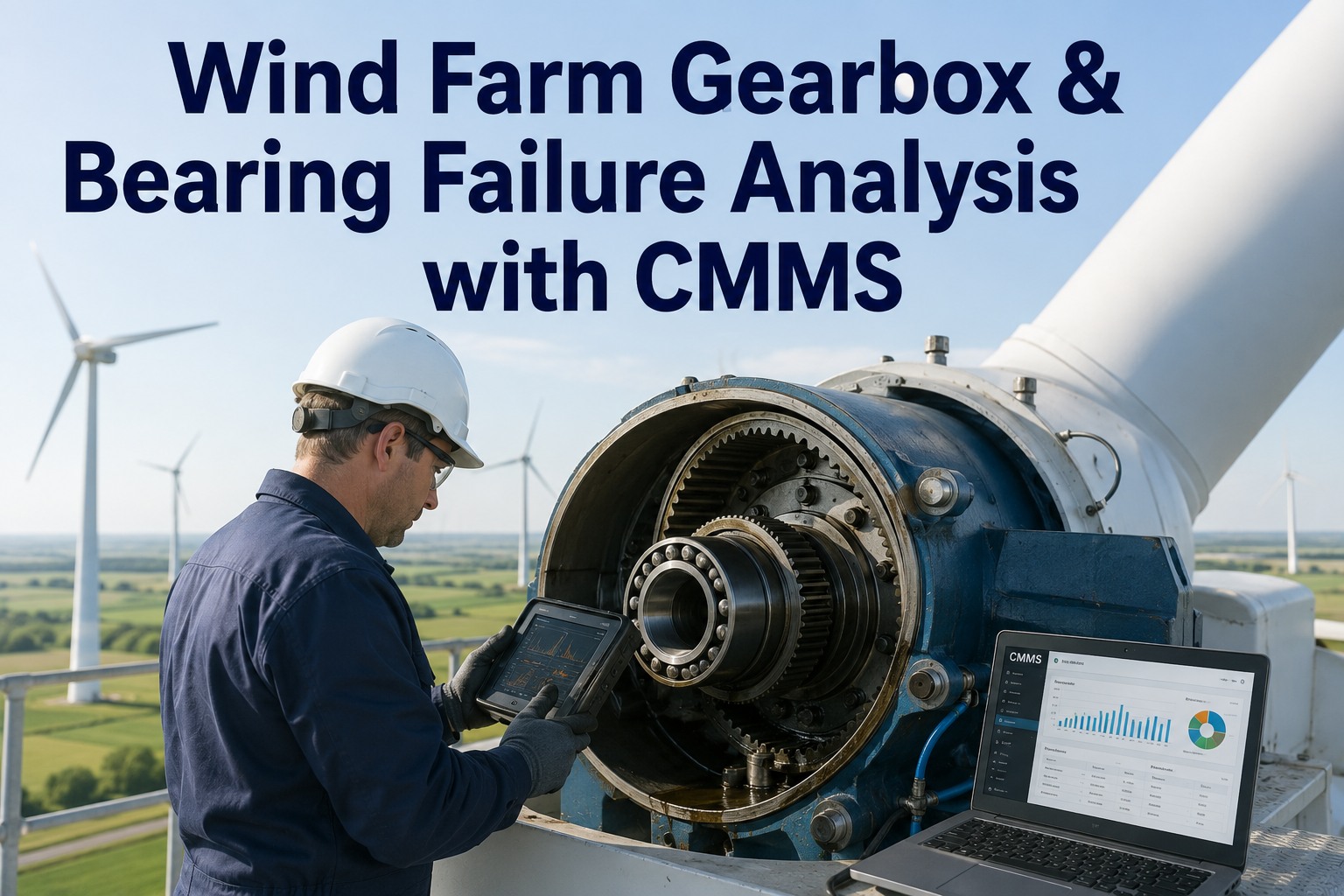
Wind turbine gearbox failure and bearing failure together account for the largest share of unplanned downtime cost in wind farm operations, with a single gearbox replacement routinely exceeding $300K–$500K in crane, parts, and lost-energy revenue. Root cause analysis of these failures — combining oil sample analysis, condition monitoring system (CMS) alarm patterns, and a structured failure mode library — is where the biggest wind turbine reliability gains are unlocked. OxMaint brings gearbox analysis, vibration and oil-analysis workflows, condition-based triggers, and full work-order history into one AI-powered CMMS so maintenance teams can convert early warning signals into scheduled interventions before catastrophic damage occurs. Ready to stop reacting? Start Free Trial and see your asset data in one dashboard today.
Stop gearbox and bearing failures before they cost you a crane mobilisation.
Gearbox failures dominate wind O&M spend — often 25–30% of lifetime maintenance cost. Condition-based monitoring plus a CMMS that triggers intervention at the right moment can cut unplanned gearbox downtime 30–50% and extend asset life by years.
Why wind turbine gearbox failure dominates O&M cost
Gearboxes concentrate high torque, variable loads, and transient events into a compact multi-stage powertrain — making them the single most expensive failure mode on a typical turbine.
White Etching Cracks (WEC)
Microstructural alterations in bearing raceways leading to axial cracks and spalling. WEC accounts for a large share of premature high-speed and intermediate-shaft bearing failures in modern multi-MW turbines.
Macropitting & Surface Fatigue
Progressive material removal at gear tooth contact surfaces under cyclic load. Left unchecked, macropitting accelerates into tooth-tip breakage and full stage failure within months.
Abrasive & Adhesive Wear
Inadequate lubrication film or contamination causes metal-to-metal contact. Lubrication degradation is the root cause behind the majority of avoidable gearbox failures tracked across wind fleets.
Axial & Radial Bearing Cracks
Circumferential and axial cracking on inner rings of planetary and intermediate bearings, frequently tied to transient loads, current passage, and misalignment during transport or installation.
CMS alarm patterns that predict wind turbine bearing failure
A well-tuned condition monitoring system (CMS) on a wind turbine typically provides a 6-to-18-month early-warning window — but only if alarm thresholds are mapped to a failure mode library and routed into a CMMS as actionable work orders.
Baseline & First Indication
Subtle envelope-spectrum elevation at bearing defect frequencies (BPFO, BPFI). Oil sample still within ISO 4406 cleanliness targets but ferrous particle count begins a slow upward trend. CMS issues a low-priority advisory.
Confirmation & Trend Escalation
RMS velocity on the high-speed stage increases 15–25% above baseline. Sidebands appear around gear-mesh frequencies. Oil analysis confirms a rising PQ index — the bearing failure signature is now unmistakable.
Controlled Intervention Window
Shock-pulse and kurtosis values cross yellow thresholds. This is the optimal window for a planned gearbox inspection, bearing replacement, or oil flush — crane can be scheduled in a low-wind season at a fraction of emergency cost.
Catastrophic Failure (If Ignored)
Red alarms, audible knock, oil leakage, or debris in the filter. Secondary damage to gears and shafts is now likely. Costs escalate from a planned $40K bearing swap to a $400K+ full gearbox exchange plus weeks of lost production.
Gearbox oil analysis for wind turbines: what to track
Oil analysis is the earliest and cheapest indicator of gearbox distress. A single 100 mL sample can flag wear-metal escalation, lubricant degradation, and contamination weeks before vibration signatures mature.
| Parameter | What It Reveals | Warning Threshold | Linked Failure Mode |
|---|---|---|---|
| Wear Metals (Fe, Cu, Cr) | Bearing race and rolling-element wear; gear surface fatigue | Trend rise > 2× baseline | WEC, macropitting, abrasive wear |
| PQ Index / Ferrous Debris | Total magnetic particle load — large ferrous debris signals advanced spalling | > 20 ppm or sharp step-change | Bearing crack, gear tooth fracture |
| Viscosity (cSt at 40°C) | Lubricant degradation or wrong oil top-up | ± 10% from nominal grade | Adhesive wear, film breakdown |
| ISO 4406 Cleanliness | Particulate contamination (silica, metallic fines) | Worse than 20/18/15 target | Abrasive wear, accelerated fatigue |
| Water Content (ppm) | Moisture ingress via breather or seal failure | > 200–300 ppm | Hydrogen embrittlement, corrosion pitting |
| Additive Depletion (Zn, P, Ca) | Anti-wear and extreme-pressure additive breakdown | > 25% drop vs. new oil reference | Scuffing, micropitting acceleration |
Worked example: A 120-turbine onshore fleet flags PQ-index escalation on Turbine 37 during a routine quarterly oil sample. OxMaint auto-generates a condition-based work order, the team schedules a borescope inspection during a predicted low-wind week, and a $38K bearing swap prevents a projected $420K gearbox exchange. Total intervention lead time: 11 days; avoided cost: ~$382K.
Turn gearbox failure prediction into scheduled interventions
OxMaint connects condition-monitoring signals and oil-sample results directly to work-order automation — so your team acts on early warnings instead of logging alarms in a spreadsheet nobody opens.
Vibration & CMS Integration
Ingest alarm data from leading CMS platforms. OxMaint maps each alarm to an asset and failure mode, then auto-creates a triaged work order when thresholds are crossed.
Oil-Analysis Workflow Automation
Schedule sampling, receive lab results digitally, and trend wear metals and PQ index per gearbox. Threshold breaches trigger conditional work orders with no manual data entry.
Condition-Based Intervention Triggers
Define multi-sensor logic — e.g., CMS yellow alarm AND PQ index above 20 — that opens a priority work order, reserves crane slots, and checks spare-gearbox inventory in seconds.
Failure Mode Library & RCA
Every work order links to a failure code and root-cause-analysis template. Build a growing knowledge base so recurring bearing failure patterns are recognised faster across the fleet.
The true cost of ignoring wind turbine gearbox analysis
Reactive gearbox replacement is 5–10× more expensive than a planned intervention. The math is simple — and it is why every wind O&M team needs a CMMS that operationalises prediction.
Where P = probability of catastrophic failure if warning is ignored, C = cost. For a single 2 MW turbine: (0.7 × $450K) − $38K − CMMS cost = ~$277K avoided per major event caught.
See OxMaint on your wind assets — book a 30-minute demo.
Walk through a live gearbox failure workflow: CMS alarm to auto-generated work order to crane scheduling. Discover how condition-based maintenance replaces guesswork across your fleet.
Wind turbine gearbox & bearing failure analysis: key questions
What is the most common cause of wind turbine gearbox failure?
Bearing-related failures — particularly white etching cracks (WEC), macropitting, and axial cracking — are the dominant root cause, often accelerated by inadequate lubrication, contamination, or transient loads. Oil analysis and CMS vibration trending catch these modes months before catastrophic damage. Book a Demo to see how OxMaint maps each failure mode to automated work orders.
How does a CMMS help prevent wind turbine bearing failure?
A CMMS like OxMaint connects CMS alarm data and oil-sample results to asset records and automatically generates condition-based work orders when thresholds are crossed. This ensures the 6–18-month early-warning window is actually used for planned intervention rather than lost in spreadsheets, cutting unplanned downtime 30–50%.
How often should gearbox oil analysis be performed on wind turbines?
Most wind O&M programmes sample gearbox oil every 3–6 months, with more frequent sampling on older turbines or those showing trend anomalies. OxMaint auto-schedules sampling intervals per asset, tracks lab results digitally, and flags threshold breaches — so no sample is missed and every result is trended over time.
What does a wind turbine gearbox replacement cost?
A full gearbox exchange on a multi-MW turbine typically costs $300K–$500K including parts, crane mobilisation, and lost-energy revenue during 4–8 weeks of downtime. A planned bearing swap caught early costs roughly $30K–$50K — making early detection and CMMS-driven intervention one of the highest-ROI investments in wind operations.
Can OxMaint integrate with our existing wind turbine CMS?
Yes. OxMaint ingests alarm and trend data from major condition monitoring systems via API and file-based imports, mapping each signal to the corresponding turbine and component. Alarms trigger triaged work orders with failure-mode codes, spare-parts checks, and crane-readiness steps — all inside one CMMS. Start Free Trial to connect your first assets.
Stop gearbox failures before they reach the crane.
Deploy OxMaint to turn CMS alarms, oil-analysis trends, and failure-mode data into condition-based work orders that save hundreds of thousands per avoided event.
Free 14-day trial · No credit card