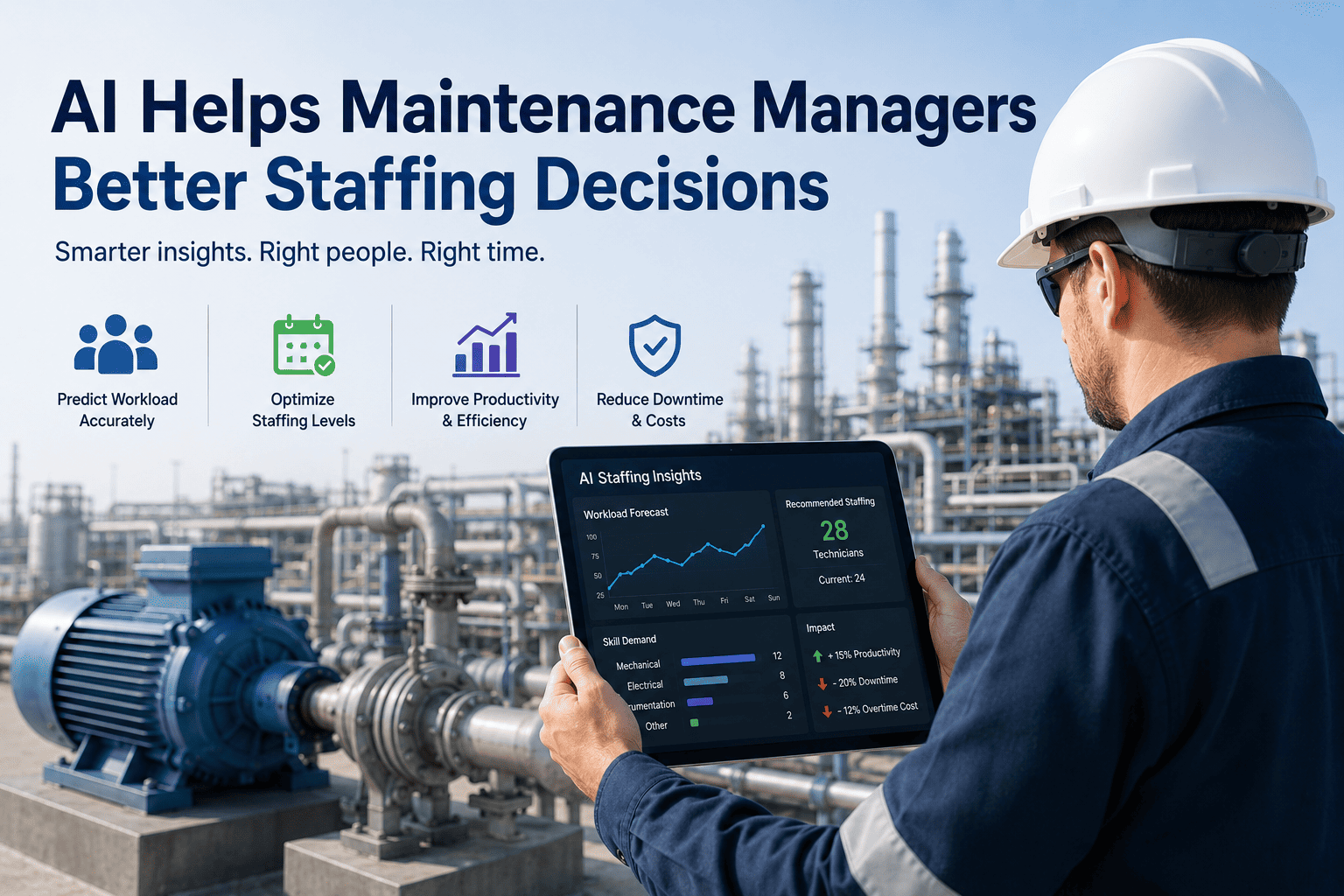
AI helps maintenance managers make better staffing decisions by analyzing real workload data, technician skill profiles, and maintenance demand patterns — replacing the instinct-and-spreadsheet approach that leaves teams either overstaffed on quiet days or overwhelmed during peak failure periods. When AI handles workforce optimization, managers stop firefighting and start leading.
See how Oxmaint AI analyzes your workload and schedules your team more effectively — live on your data in 30 minutes.
- ✓ AI matches work orders to technician skills automatically
- ✓ Workload balancing across shifts, sites, and teams in real time
- ✓ Predictive demand forecasting — staff before the spike, not during it
Trusted by 1,000+ maintenance teams across 9 industries · Live in days, not months
What is AI-driven maintenance staffing — and why is it replacing manual scheduling?
AI maintenance staffing uses machine learning to analyze historical work order volume, asset failure patterns, technician certifications, current workload, and shift availability — then recommends the right staffing levels, skill mix, and work order assignments before problems occur. It replaces the reactive, experience-based scheduling that leaves managers perpetually behind demand.
Traditional maintenance scheduling is a guessing game: managers estimate next week's workload based on last week's experience, assign jobs based on who's available rather than who's qualified, and scramble when three reactive jobs land on the same shift. The cost is overtime, quality errors from mismatched skills, and technician burnout. AI changes the equation by making demand predictable.
With predictive maintenance AI forecasting failures 2–4 weeks in advance, maintenance managers finally know what's coming — and can staff accordingly. Teams using predictive maintenance platforms reduce overtime costs by 20–35% in the first year, simply because work arrives planned, not as emergencies — start a free trial to see your workload forecast, or book a demo to walk through AI staffing with your team structure.
8 dimensions of AI-powered maintenance workforce management
Demand Forecasting
AI analyzes historical work order volume by day, week, and season — combined with predictive failure alerts — to forecast maintenance demand 2–6 weeks ahead. Managers staff for actual demand, not guesses.
Skill-Based Assignment
Every work order is matched to the nearest available technician with the required certification and competency level. AI prevents over-qualification waste and under-qualification errors simultaneously.
Workload Balancing
AI monitors active WO queues across the team in real time and redistributes when one technician is overloaded while another has capacity — without a manager manually reviewing individual schedules.
Shift Optimization
Historical patterns reveal which assets fail most frequently on which shifts. AI recommends shift composition — how many and which skill types — to minimize overtime and maximize first-time fix rates.
Multi-Site Coordination
For organizations running multiple facilities, AI identifies where specialist technicians are most needed across sites — enabling dynamic deployment rather than siloed headcount planning per location.
Contractor Trigger Logic
AI identifies when internal capacity will be exceeded by planned PM schedules and predictive alerts — and flags the window when contractor resources should be engaged, before the crunch hits.
Technician Performance Analytics
Work order completion rates, mean time to repair by technician and asset type, and first-time fix rates give managers objective data for coaching conversations, training prioritization, and performance reviews.
Skills Gap Identification
By analyzing which work orders are consistently escalated or take longer than benchmarks, AI identifies specific skill gaps — so training investment goes exactly where it delivers the most operational return.
Oxmaint's smart work order management powers skill-based routing automatically — start free or book a demo.
6 staffing failures that cost maintenance operations the most
Reactive Overtime Spirals
When reactive work lands unpredictably, managers authorize overtime to absorb the surge. Without demand forecasting, this cycle repeats monthly — budgets erode and technicians burn out.
Mismatched Skill Assignments
Without AI routing, the available technician gets the job — not the right one. Overqualified techs are wasted on low-complexity tasks. Underqualified techs take twice as long and escalate more frequently.
Invisible Specialist Bottlenecks
Critical certifications — electrical HV, confined space, crane inspection — are held by a small number of techs. When their queues are full but not visible, WOs stack without a manager knowing until the delay is severe.
PM Deferrals Under Reactive Pressure
When reactive work floods the schedule, PMs get deferred to "next week" indefinitely. Each deferral increases failure probability. AI staffing protects PM completion rates by forecasting and reserving capacity in advance.
No Visibility Into Technician Capacity
Managers assign work based on who answered the radio, not who has the lowest queue depth. AI provides real-time capacity visibility across the entire team — so assignments are data-driven, not availability-driven.
Training Budget Wasted on Wrong Skills
Without performance data, training spend goes to whoever requests it or whoever the manager remembers. AI analytics identify actual skill gaps from work order patterns — directing training investment where it reduces the most downtime.
Oxmaint's analytics and reporting gives managers real-time technician capacity data — book a demo to see your team's workload visualized.
How Oxmaint AI turns maintenance staffing from reactive guesswork into proactive planning
Predictive Demand Forecasting
IoT sensor data and ML models flag equipment likely to fail 2–4 weeks ahead. Maintenance managers see upcoming work volume before it becomes an emergency — and staff accordingly. See Predictive Maintenance →
AI Work Order Routing
Every auto-generated work order is matched to the nearest available technician with the right certification — no manager intervention. Routing considers skill, location, and current queue depth simultaneously. See Work Order Management →
Real-Time Capacity Dashboard
Managers see every technician's current queue, active WO, and estimated completion time in one view — enabling instant rebalancing when reactive work arrives without warning. See Analytics →
PM Schedule Protection
AI reserves technician capacity for scheduled PMs before reactive work fills the queue — so preventive maintenance completion rates stay high even during busy reactive periods. See Preventive Maintenance →
Multi-Site Workforce Visibility
For multi-site operations, Oxmaint shows workload and specialist availability across all locations — enabling dynamic deployment of scarce certified technicians where they're most needed. See All Features →
Technician Performance Analytics
MTTR by technician, first-time fix rates, and escalation frequency give managers objective performance data — enabling coaching decisions, training prioritization, and skills gap closure. See OEE Analytics →
Manual maintenance scheduling vs AI-optimized workforce management
| Staffing Decision | Manual / Reactive | AI-Optimized (Oxmaint) |
|---|---|---|
| Workload forecasting | Estimate based on last week's experience | ML demand forecast 2–6 weeks ahead from failure predictions |
| Work order assignment | Whoever is available gets the job | AI routes to nearest certified tech with lowest queue |
| Overtime management | Authorized reactively when surge arrives | Planned and minimized by forecasting demand in advance |
| PM completion rate | PMs deferred when reactive work surges | AI protects PM capacity — completion rates stay consistent |
| Technician capacity visibility | Manager estimates based on verbal check-ins | Real-time queue depth dashboard for every technician |
| Training investment | Based on requests or manager preference | Skills gap analysis from WO performance data |
| Contractor engagement | Called in during crisis when capacity fails | AI flags contractor need 2–3 weeks before capacity crunch |
See what AI staffing optimization could save your operation — use the ROI Calculator or book a demo.
What AI staffing delivers to maintenance operations in year one
Ready to optimize your maintenance workforce? Run the free ROI Calculator or start a free trial.
AI maintenance staffing — questions managers ask before switching
How does AI decide which technician to assign to a work order?
AI assignment considers three factors simultaneously: skill match (does the technician have the required certification for this work order type?), proximity (which qualified technician is physically closest to the asset?), and queue depth (which qualified nearby technician has the lowest active work order count?). The result is a routing decision that maximizes utilization and minimizes travel time without any manager input. See how Oxmaint routes work orders →
Can AI maintenance staffing tools integrate with existing HR and payroll systems?
Leading AI CMMS platforms can export work hour data, overtime reports, and technician productivity metrics in formats compatible with major HRIS and payroll platforms. Verify that the specific integration — bi-directional or export-only — matches your system. Oxmaint integrates with SAP and major ERP platforms natively, and can export staffing data for payroll and HR analysis. See SAP Integration →
How far in advance can AI forecast maintenance workload for staffing purposes?
Workload forecasting accuracy depends on the quality and volume of sensor data and historical work order records. With rich sensor feeds, Oxmaint's predictive AI flags equipment failures 2–4 weeks in advance — enabling staffing decisions at that horizon. Seasonal and scheduled PM workload can be forecast further out based on historical patterns. The more data the system has, the longer and more accurate the forecast window becomes.
What data does an AI CMMS need to optimize technician scheduling?
At minimum: a technician skills and certifications register, historical work order data (volume, type, completion time, asset), and current shift schedules. IoT sensor data unlocks predictive demand forecasting. The more complete your asset register and work order history, the more accurate AI staffing recommendations become. Oxmaint can import historical data from most legacy CMMS platforms during onboarding — book a demo to discuss your data migration.
Your Maintenance Team Deserves Better Scheduling Than a Whiteboard and a Gut Feel
AI staffing optimization isn't about replacing maintenance managers — it's about giving them the demand visibility, skill-match routing, and performance data to lead proactively instead of firefighting daily. Oxmaint puts those tools in your hands from day one.
- ✓ Predictive demand forecasting — know what's coming 2–4 weeks out
- ✓ AI work order routing — right tech, right task, right time, automatically
- ✓ Real-time capacity dashboard — full team visibility in one screen
Trusted by 1,000+ maintenance teams · Live in days · 62% average downtime reduction