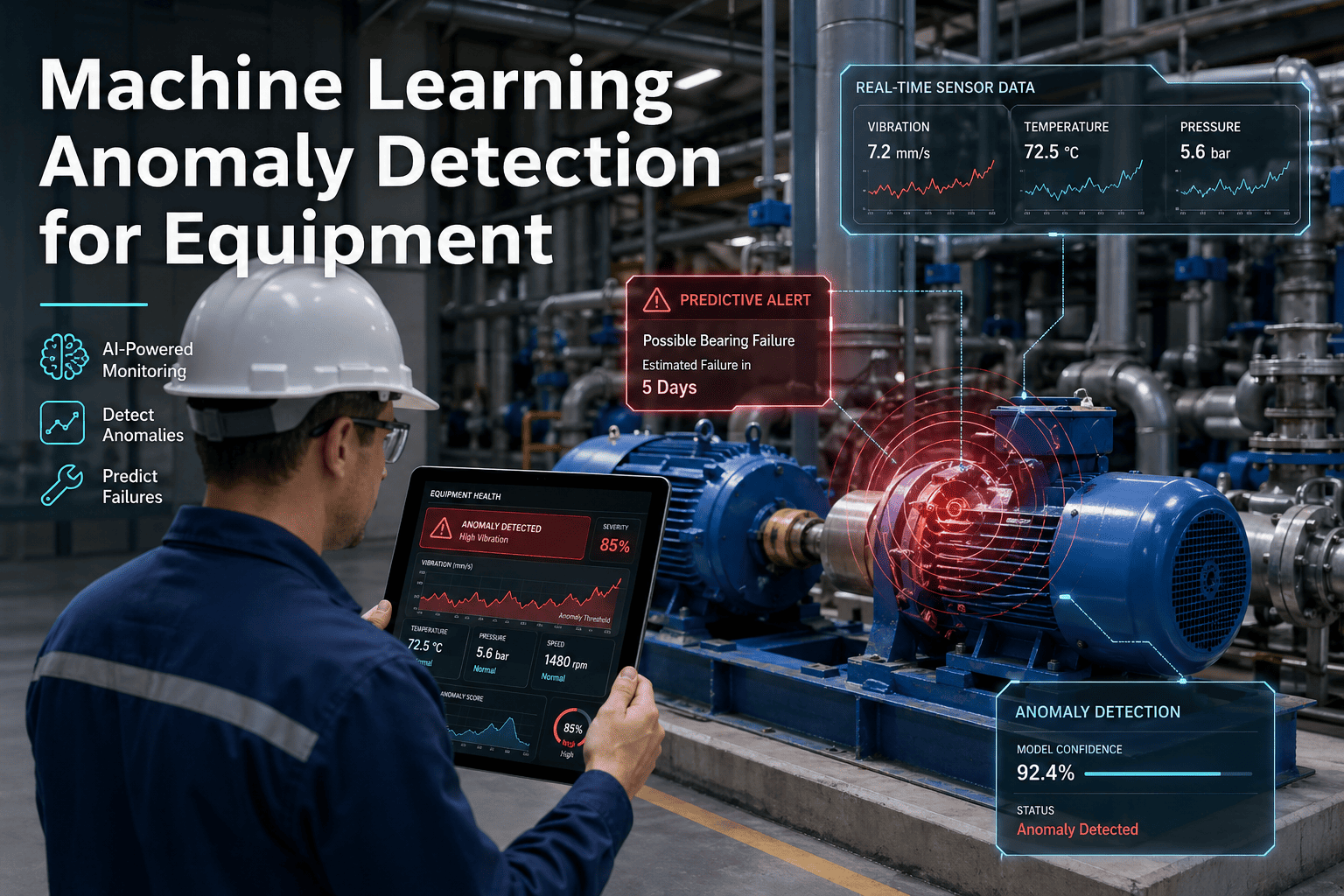
Your machines are already telling you they're about to fail. AI predictive maintenance in manufacturing listens, learns, and alerts your team weeks before breakdown — turning $260K/hour disasters into low-cost planned repairs. U.S. manufacturers lose an estimated $50 billion annually to unplanned downtime, with the average factory facing 800 hours of equipment downtime per year. Each hour of unplanned downtime now costs at least 50% more than it did in 2019. AI-powered predictive maintenance uses IoT sensors, machine learning algorithms, and real-time data analytics to detect equipment degradation weeks before failure — scheduling repairs during planned windows at a fraction of the emergency cost. Schedule a demo to see AI predictive maintenance with real-time anomaly detection running on your manufacturing data.
UPCOMING OXMAINT EVENT
AI Predictive Maintenance: Eliminate Downtime Before It Starts
Join OxMaint's expert-led session covering how AI-native predictive maintenance — including real-time anomaly detection, sensor-to-work-order automation, and CMMS-driven reliability — transforms your maintenance strategy from reactive to predictive.
✓ Live AI anomaly detection walkthrough
✓ Q&A with OxMaint's maintenance AI specialists
✓ Real-world breakdown prevention case studies
✓ Actionable predictive maintenance roadmap you can use immediately
$260K
Per Hour Lost
Average cost of unplanned downtime in manufacturing facilities
70%
Fewer Breakdowns
Reduction in equipment failures with AI-powered predictive maintenance
800 hrs
Annual Downtime
Average equipment downtime per manufacturing plant every year
$97B
Market by 2034
Global predictive maintenance market growing at 24.3% CAGR
The $50 Billion Problem: Why Reactive Maintenance Is Bleeding Your Factory Dry
Unplanned downtime is manufacturing's most expensive silent killer. The average large manufacturing plant loses $253 million per year due to unplanned downtime, and the hourly cost has roughly doubled between 2019 and 2024. In the automotive sector, a single idle production line costs up to $2.3 million per hour. Even in lower-cost sectors like consumer goods, hourly losses average $39,000. The average facility now experiences 25 downtime incidents monthly — each lasting approximately 4 hours of lost production. Equipment failure alone accounts for 80% of all unplanned downtime events, with base component failures — bearings, seals, motors, and belts — being the primary culprits. These are exactly the failures AI predictive maintenance was built to prevent. Sign up free and see how OxMaint eliminates surprise breakdowns with AI-driven work orders.
Automotive Manufacturing
Up to $2.3M per hour
Robotic lines, paint systems, press shops — every second counts
Oil & Gas / Process
~$500K per hour
Costs have more than doubled in just two years
General Manufacturing
$260K per hour avg.
800 hours of annual downtime = $50B lost across U.S. sector
What Is AI Predictive Maintenance — And How Does It Actually Work?
Traditional maintenance follows two outdated models: reactive (fix it after it breaks, accept catastrophic downtime) or preventive (service on a fixed calendar, replace parts that still have thousands of hours of life left). Both waste money. AI predictive maintenance is fundamentally different — it uses IoT sensors, machine learning algorithms, and real-time analytics to monitor equipment health continuously. The system detects vibration anomalies, temperature drift, pressure fluctuations, and acoustic patterns that signal degradation 14–60 days before functional failure. Your team repairs the right equipment at the right time, during a planned window, at a fraction of the emergency cost.
01
Sense & Collect
IoT sensors capture vibration, temperature, pressure, current, and acoustic data from every critical asset — continuously and in real time, including legacy equipment via non-invasive clamp-on sensors.
02
AI Analysis
Machine learning models compare live readings against learned behavioral baselines to detect micro-anomalies invisible to human inspection. Edge AI eliminates cloud latency for millisecond decisions.
03
Predict & Alert
AI estimates remaining useful life and projects a failure window — e.g., "Motor bearing #7: outer race defect detected — 18–24 days to functional failure." Accuracy exceeds 92% by month 12.
04
Auto Work Order
CMMS auto-generates a prioritized work order with diagnosed failure mode, parts (stock verified), labor estimate, and recommended repair window aligned with the next planned maintenance slot.
Reactive vs. AI Predictive: The Side-by-Side Reality Check
The gap between reactive and predictive maintenance isn't marginal — it's the difference between a $320,000 emergency CNC spindle replacement and a $55,000 planned repair. Here's how the two approaches compare across every dimension that matters to your bottom line.
✕Equipment runs to failure — unplanned production stops
✕Emergency repairs cost 3–10× more than planned work
✕Average 4-hour recovery per incident plus cascade delays
✕Rush-shipped parts at premium prices; overtime labor
✕Customer orders missed — trust eroded, contracts at risk
✓AI detects anomalies 14–60 days before functional failure
✓Repairs scheduled during planned windows — zero lost production
✓Reduces breakdowns by up to 70% and maintenance costs by 25%
✓Parts pre-ordered at standard cost; labor scheduled efficiently
✓OEE improves; delivery commitments consistently met
One Prevented Breakdown Pays for a Full Year of CMMS. OxMaint connects to your equipment sensors and turns raw vibration, temperature, and pressure data into predictive work orders — automatically, before production is affected.
Start Free Trial
Schedule a Demo
Emergency vs. Planned Repair: The 5–10× Cost Multiplier
Every unplanned equipment failure carries a cost measured in lost production hours, premium repair charges, rush-shipped parts, overtime labor, and downstream delivery penalties. The gap between emergency and planned repair cost is the entire business case for AI predictive maintenance. These figures include total incident cost — not just parts and labor.
Motor / Bearing Assembly
Emergency: $85,000
Planned: $12,000
You save: $73,000 per incident
Conveyor Drive System
Emergency: $150,000
Planned: $22,000
You save: $128,000 per incident
CNC Spindle Replacement
Emergency: $320,000
Planned: $55,000
You save: $265,000 per incident
Industrial Compressor
Emergency: $200,000
Planned: $30,000
You save: $170,000 per incident
Which Manufacturing Sectors Benefit Most from AI Predictive Maintenance?
AI predictive maintenance delivers ROI across every production environment — but some sectors see outsized returns due to higher downtime costs, tighter compliance requirements, or more complex equipment. Here's where the biggest impact is documented.
Downtime cost: Up to $2.3 million per hour on high-volume production lines.
AI monitors: Robotic arms, stamping presses, paint systems, weld cells, and conveyor drives for vibration, thermal drift, and torque anomalies.
Impact: 30% reduction in maintenance costs and 40% improvement in equipment uptime documented at leading automotive plants.
Compliance risk: FDA 21 CFR Part 11 demands full maintenance traceability. Equipment failure can trigger batch rejection and regulatory action.
AI monitors: Clean room HVAC, bioreactors, fill-finish lines, sterilization equipment, and cold chain systems.
Impact: 100% audit-ready maintenance logs with every predictive action tagged to regulatory requirements automatically.
Spoilage risk: Refrigeration or conveyor failure means destroyed inventory and potential recall events.
AI monitors: Compressor health, conveyor belt wear, packaging line pressure, and mixing equipment vibration patterns.
Impact: Zero spoilage from equipment failure; 98%+ line availability with predictive scheduling during cleaning shifts.
Yield risk: Clean room contamination from HVAC drift or micro-vibration in wafer handling destroys entire production batches worth millions.
AI monitors: Environmental sensors, vacuum systems, chemical delivery, plasma chambers, and precision motion stages.
Impact: Yield protection at scale — detecting sub-threshold contamination risks before they affect product quality.
Documented ROI: The Numbers That Justify Immediate Action
AI predictive maintenance ROI isn't theoretical — it's documented across hundreds of manufacturing facilities. The payback period is typically under 12 months, with a single prevented major breakdown often covering the entire annual platform cost. Here's what manufacturers are reporting.
Fewer equipment breakdowns with AI-powered condition monitoring
Reduction in total maintenance costs — parts, labor, and emergency spend
Increase in overall equipment uptime and availability
Less spend on replacement parts — fix before failure means less damage
Getting Started: Your 3-Phase Implementation Roadmap
You don't need a fully connected smart factory to begin. The most successful implementations start small — proving value on 5–10 critical assets before scaling plant-wide. Here's the practical roadmap that works even with legacy equipment and limited budgets.
Phase 1
Assess & Prioritize
- Identify your top 5–10 critical assets where downtime hurts most
- Calculate current downtime cost per asset using MTBF and MTTR data
- Map existing sensor infrastructure and identify gaps
- Set baseline OEE metrics for before/after comparison
Phase 2
Deploy & Connect
- Install non-invasive sensors — vibration, temperature, current monitors
- Connect sensor feeds to CMMS platform via OPC-UA, Modbus, or MQTT
- Train AI on 30–60 days of baseline data for your specific equipment
- Begin predictive alerts in advisory mode — validate before automating
Phase 3
Scale & Optimize
- Activate automated work order generation on validated equipment
- Integrate with inventory management for auto parts ordering
- Extend coverage to BOP, HVAC, and auxiliary systems plant-wide
- Track MTBF, MTTR, and OEE improvements to prove ROI to leadership
By month 3, your critical assets are monitored and generating predictive alerts. By month 6, AI accuracy exceeds 90% on your specific equipment. By month 12, most manufacturers document full ROI payback from prevented breakdowns alone. Start your free trial and have your asset hierarchy loaded within the first week.
OxMaint Handles All of This — Out of the Box. Sensor integration, AI-driven work orders, inventory management, and compliance tracking on one platform. Go live in 2 weeks. No rip-and-replace. Works with legacy equipment.
Start Free Trial
Schedule a Demo
The 2026 Advantage: Why Now Is the Inflection Point
The predictive maintenance market is projected to grow from $17.1 billion in 2026 to $97.4 billion by 2034 — a 24.3% CAGR. Two-thirds of maintenance teams plan to adopt AI by the end of 2026, yet less than one-third have fully implemented it today. This is the competitive window. Manufacturers who act now gain the data advantage — every month of sensor data improves AI prediction accuracy, creating a compounding moat that late adopters cannot quickly replicate.
Edge AI + 5G
Processing at the device eliminates cloud latency. Paired with 5G, decisions like throttling operations or rerouting work happen in real time at the point of data generation.
Digital Twins
AI-powered virtual replicas simulate multiple failure modes and rare events, improving prediction accuracy and system resilience without risking actual equipment.
Generative AI
Creates synthetic datasets replicating rare failure scenarios, overcoming data scarcity. Auto-generates maintenance procedures and surfaces troubleshooting steps at point of work.
Supply Chain AI
AI models analyze consumption patterns and lead-time variability to set dynamic safety stocks — reducing inventory value by 18% and rush freight fees by 44%.
Your Equipment Is Already Talking. Start Listening.
OxMaint gives manufacturing teams AI-powered predictive analytics, automated work orders, and real-time equipment monitoring to eliminate surprise breakdowns — so every production hour is profitable.
Frequently Asked Questions
Does AI predictive maintenance work on older or legacy equipment?
Yes. You don't need brand-new smart machines. Non-invasive sensors — clamp-on vibration monitors, external temperature probes, magnetic current sensors — can be retrofitted to virtually any equipment, including 20+ year old machines, without modifying wiring or control systems. Some of the highest ROI comes from monitoring aging assets that are most failure-prone.
Start a free trial to see how OxMaint works with your existing equipment.
How long before AI starts making accurate failure predictions?
Most AI models need 30–60 days of baseline data to learn normal equipment behavior for your specific operating conditions. Early anomaly alerts start appearing within the first month. By month 6–12, prediction accuracy typically exceeds 90%. OxMaint accelerates this timeline with pre-trained models for common manufacturing equipment types including motors, pumps, compressors, and conveyor systems.
What's the realistic cost to get started with AI predictive maintenance?
A pilot program covering 5–10 critical assets typically costs $5,000–$25,000 including sensors and software. Given that a single prevented breakdown can save $50,000–$500,000 depending on the equipment, most manufacturers see full payback within the first incident avoided. OxMaint offers a free trial so you can load your asset hierarchy and evaluate the platform before committing budget.
Book a demo to discuss pricing for your plant size.
How does OxMaint integrate with existing SCADA, DCS, and PLC systems?
OxMaint connects with major industrial control platforms via standard protocols including OPC-UA, Modbus, MQTT, and REST APIs. It integrates with Siemens, Allen-Bradley, Emerson, Honeywell, and other DCS/SCADA systems. Sensor data flows directly into the CMMS, triggering AI analysis and automated work orders without requiring manual data transfer or duplicate monitoring dashboards.
Is this only for large enterprises, or can mid-size manufacturers benefit?
Mid-size manufacturers often see the fastest ROI because they have fewer redundant production lines — meaning a single machine failure has an outsized impact on total output. AI predictive maintenance scales to any plant size, and cloud-based platforms like OxMaint eliminate the need for heavy upfront infrastructure investment. Two-thirds of maintenance teams across all sizes plan to adopt AI by end of 2026.
Start free and scale as you prove value.