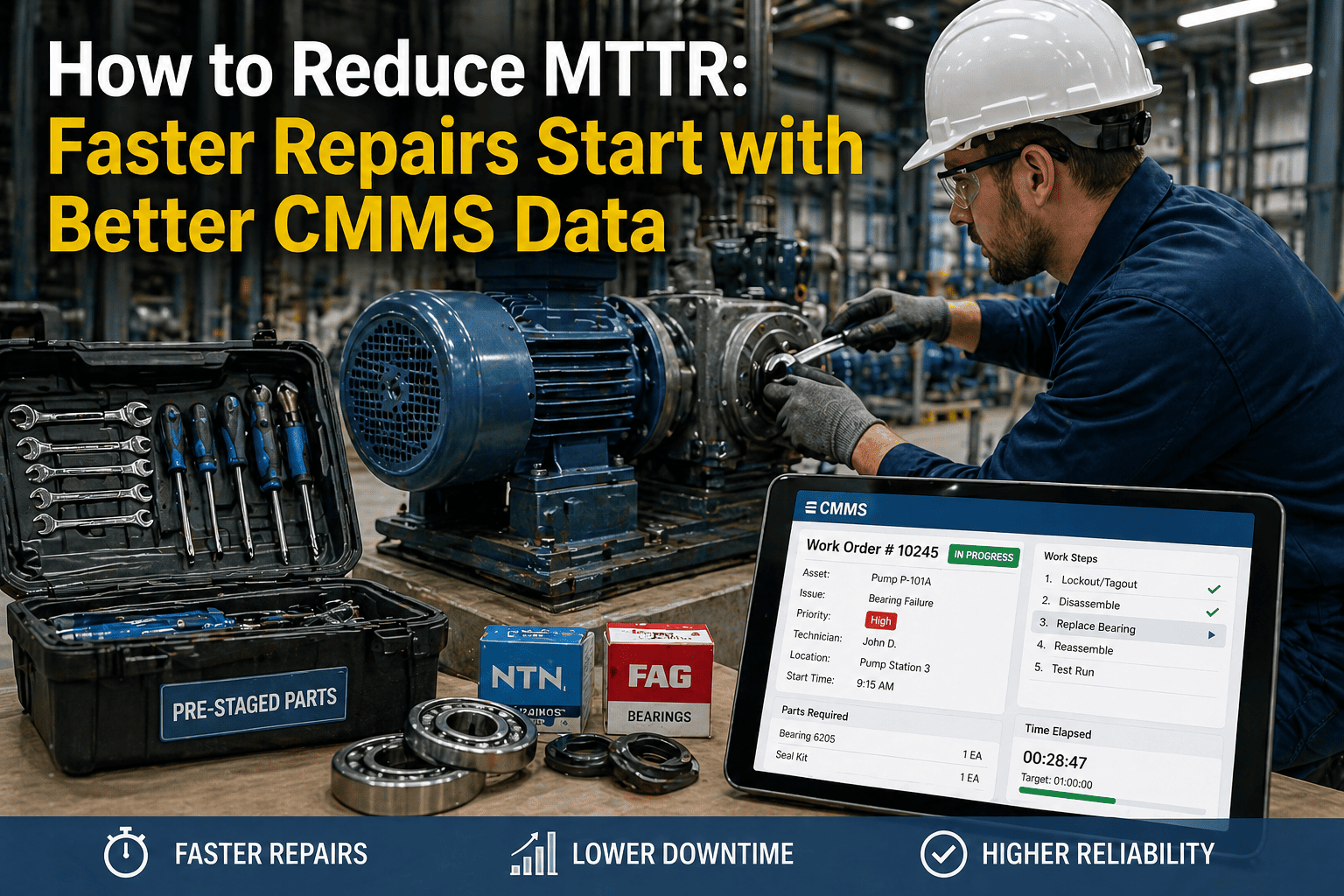
When a critical asset fails, the clock starts immediately — and every minute of repair time has a measurable cost. In discrete manufacturing, the average unplanned downtime event costs $260,000 per hour according to Aberdeen Group. Yet most maintenance teams have never mapped exactly where that repair time goes — from the moment a fault is detected to the moment the asset is confirmed back in service. Mean time to repair is not a fixed property of your equipment. It is a property of your processes, your information systems, and how quickly the right people get the right data. Facilities that measure and actively manage MTTR reduce unplanned downtime by 40 to 60 percent within the first year — not by hiring faster technicians, but by eliminating the delays, information gaps, and waiting time that inflate every repair. Start a free trial and see where your repair time is actually going, or book a demo to walk through Oxmaint's MTTR reduction workflow with our team.
Reduce MTTR: Proven Ways to Speed Up Maintenance Repairs
Every minute of repair time has a measurable cost. Oxmaint compresses each stage of the repair cycle — from fault detection to asset confirmation — so your team spends less time recovering and more time preventing.
Know Your MTTR. Then Cut It — Systematically.
Oxmaint timestamps every stage of every work order automatically — detection, dispatch, diagnosis, repair, verification. You get the MTTR breakdown by asset, area, and failure mode. No manual log required.
What Is MTTR — And What It Actually Measures
Mean time to repair is the average elapsed time from the moment an asset failure is detected to the moment the asset is confirmed operational and returned to service. It is calculated as total repair downtime divided by the number of repair events over a given period — expressed in hours or minutes per event.
MTTR is not a measurement of how long the physical repair takes. It measures the entire repair cycle — including detection delay, notification time, technician travel, parts procurement, the actual fix, and confirmation testing. Most teams underestimate their true MTTR by 15 to 30 percent because they log completion time rather than fault detection time. Oxmaint timestamps both — automatically — from the moment a fault report is submitted to the moment the work order is closed and verified. Start a free trial to see your true asset-level MTTR figures for the first time, or book a demo and we will walk through what MTTR improvement looks like for your equipment type.
MTTR measures the full repair cycle, not just wrench time. A world-class MTTR target for most industrial assets is under 90 minutes. The global average sits at 3.4 hours — driven by information gaps and parts delays, not technical complexity.
The 4 Stages Where MTTR Gets Inflated — And Where Oxmaint Cuts Each One
Understanding MTTR reduction means understanding where time goes at each stage of the repair cycle. Oxmaint compresses all four stages simultaneously through connected workflows, mobile-first data access, and automatic parts visibility.
Failures go unreported for hours. Operators unsure of the reporting process. Verbal handovers miss failures across shift changes.
Mobile fault reporting takes under 60 seconds. QR code asset scanning means no searching for asset IDs. Fault reports auto-route to the correct technician or supervisor.
Technicians arrive without asset history, prior failure patterns, or maintenance records. They diagnose from scratch every time, even on recurring failures.
Full asset history on the technician's mobile device — prior failures, repair procedures, parts used last time, and failure mode frequency. Diagnosis time drops 50 to 60 percent on recurring failure types.
Technicians physically search the storeroom. Part is either missing or unknown to be available. Emergency purchase orders are raised for parts that were in the building all along.
Live spare parts inventory linked to asset records — technician sees part availability and location before arriving at the asset. Minimum stock alerts prevent stockouts on high-failure-frequency items.
Paper work orders require supervisor sign-off in person. Asset return to service is verbal. No automatic update to MTTR records or maintenance history.
Digital closure with technician signature and test result entry on mobile. MTTR is automatically updated the moment the work order closes. Asset status updates instantly in the operations dashboard.
6 Operational Problems That Keep Your MTTR High
No Asset History at the Point of Repair
When technicians arrive at a failed asset without its service history, failure log, or prior repair procedures, diagnosis becomes exploration. Studies show that access to fault history alone reduces diagnosis time by 47 percent for recurring failure modes.
Slow Fault Reporting Chains
In facilities relying on verbal or paper-based fault reporting, average detection-to-dispatch time exceeds 45 minutes. Shift changes mask failures entirely. Some faults are not reported until the next inspection — hours later.
Spare Parts Not Linked to Assets
When spare parts inventory is managed separately from asset records, technicians search physically — and often find nothing. Emergency orders are placed for parts that are already in the storeroom under a different name or location label. This alone accounts for 20 percent of average MTTR in facilities without CMMS.
Work Orders Without Priority Clarity
When every open work order looks the same, technicians work by habit or proximity — not by criticality. A minor PM gets attended before a production-critical fault. MTTR on the critical asset climbs while low-priority tasks get closed first.
Repeat Failures on the Same Assets
When root causes are not documented and analysed, the same failure recurs on the same asset. Teams close work orders without capturing failure mode data — so the next technician faces the same diagnostic uncertainty as the first. Repeat failures account for 15 to 25 percent of total emergency work order volume in most facilities.
MTTR Measured Late or Not at All
Most maintenance teams report MTTR monthly — from manually assembled data that is 10 to 20 days old by the time it is reviewed. Improvement actions are taken against data that no longer reflects reality. Teams that cannot see their MTTR live cannot improve it in real time.
How Oxmaint Reduces MTTR at Every Stage of the Repair Cycle
Oxmaint's MTTR reduction approach works across the full repair cycle — not just the wrench time. Six connected capabilities compress the total elapsed time from fault to confirmed asset return.
Mobile Fault Reporting — 60 Seconds
Any team member can submit a fault report from a mobile device in under 60 seconds using QR code asset scanning — no asset ID lookup, no paper forms. The fault is immediately visible to the maintenance manager and auto-routed to the right technician by skill and location.
Full Asset History on Mobile
Technicians access the complete repair history, prior failure modes, step-by-step repair procedures, wiring diagrams, and parts lists for every asset — directly on their mobile device at the asset location. No returning to the office, no searching binders, no calling the supervisor for history.
Live Spare Parts Inventory
Oxmaint links spare parts inventory to asset records — so before a technician arrives at a failed asset, they know which parts are required, whether they are in stock, and exactly where they are stored. Parts searches are eliminated. Emergency procurement events drop by 60 to 70 percent.
Priority-Ranked Work Order Queue
Every open work order carries a priority score — critical, high, medium, or low — visible in every technician's mobile queue. Production-impacting faults surface to the top automatically. Technicians never have to guess which job to tackle next, and supervisors see real-time queue status without phone calls.
Repeat Failure Detection and RCA
Oxmaint automatically flags any asset that generates a second unplanned work order within 30 days — triggering a root cause prompt before the third failure occurs. Failure mode data captured at work order closure feeds the Pareto analysis that shows which specific failure types are driving the most MTTR hours per asset class.
Live MTTR Dashboard — By Asset and Area
MTTR is calculated automatically from every closed work order — updated in real time, broken down by asset, failure mode, technician, and area. Managers see MTTR trends as they develop, not 10 days after the period they cover. Improvement actions are taken when they can still influence the current period's performance.
Before Oxmaint vs. After Oxmaint: The MTTR Difference
| Repair Stage | Before Oxmaint | After Oxmaint |
|---|---|---|
| Fault detection and reporting | 30 to 90 minutes from failure to notification — longer on night shifts and during shift changes | Under 5 minutes — mobile QR code reporting, instant routing to technician and supervisor |
| Technician dispatch | Phone calls, verbal handovers, unclear priority — technician may not be dispatched immediately | Auto-dispatch with asset location, priority flag, and asset history delivered to technician's mobile |
| Diagnosis time | 45 to 120 minutes — technician works without prior failure history, procedures, or parts information | 10 to 30 minutes — full failure history and repair procedures on mobile before arriving at the asset |
| Parts search and retrieval | 20 to 90 minutes physical search — parts found at wrong location or not in stock at all | Parts location and stock level confirmed from mobile before the technician leaves for the storeroom |
| Actual repair execution | Proceeds without step-by-step guidance — risk of incorrect repair and return-to-fail | Step-by-step procedure on mobile — checklist completion required before work order can be closed |
| MTTR measurement | Manually calculated monthly from handwritten logs — underestimates true MTTR by 15 to 30 percent | Auto-calculated from work order timestamps — accurate to the minute, updated in real time per asset |
What Faster Repairs Actually Deliver — In Numbers
Achieved through faster fault reporting, instant asset history access, and live parts inventory — without adding technician headcount.
When spare parts are linked to asset records in Oxmaint, technicians know availability before they search — eliminating the largest source of parts-related MTTR delay.
Failure mode capture at work order closure and automatic repeat-failure flagging eliminate the repeat breakdown patterns that inflate average MTTR across an asset fleet.
Oxmaint customers consistently reduce MTTR from the 3 to 5 hour industry average to under 90 minutes within 12 months of deploying the full work order and parts workflow.
Frequently Asked Questions
How does Oxmaint calculate MTTR automatically — do technicians need to log times manually?
No manual time logging is required. Oxmaint timestamps each stage of the work order automatically — the moment a fault report is submitted, the moment a work order is accepted, the moment work begins, and the moment the order is closed and verified. MTTR is calculated from these system timestamps — not from technician entries — which eliminates the 15 to 30 percent underestimation that occurs when teams log completion time rather than true fault start time. The result is a MTTR figure you can trust and trend over time. Start a free trial to see MTTR calculated automatically from your first week of work orders, or book a demo to walk through the work order timestamp flow.
Can Oxmaint show MTTR broken down by asset class and failure mode — not just a plant average?
Yes. Oxmaint calculates MTTR per individual asset, per asset class, per failure mode, and per area — all from the same work order data. The MTTR dashboard allows you to filter by date range, asset category, technician, or failure code to identify exactly which combination of asset type and failure mode is driving the most repair time. For most facilities, three to five specific failure modes on two or three asset classes account for more than 60 percent of total MTTR hours. Oxmaint surfaces these patterns automatically so you know where to focus the improvement effort — not just what the overall average is.
Does the mobile app work offline — for areas with no connectivity?
Yes. Oxmaint's mobile app is designed for industrial and commercial environments where connectivity is inconsistent. Work orders, asset history, repair procedures, and parts information are cached on the device and accessible without an active connection. Completed work orders sync automatically when connectivity is restored — so technicians working in basements, plant floors, or remote utility areas never lose data or face a blank screen at a critical moment. This is a core requirement for industrial deployment and is built into the Oxmaint mobile platform as standard, not an add-on.
What is the realistic MTTR improvement timeline for a new Oxmaint customer?
Most Oxmaint customers see measurable MTTR improvement within the first 30 to 60 days — primarily from faster fault reporting and technician access to asset history on mobile. The more substantial reductions from parts inventory integration and repeat failure elimination typically materialise over 90 to 180 days as the system accumulates enough failure history to identify patterns. Facilities starting from a 3 to 5 hour average MTTR consistently reach the 90 to 120 minute range within 12 months using Oxmaint's full workflow — mobile reporting, asset history, live parts, priority queue, and live MTTR dashboard in combination. Start a free trial to begin building that history from day one, or book a demo to map out the MTTR improvement roadmap for your facility type.
Every Minute Your Assets Are Down Has a Price. Start Cutting That Time Today.
Oxmaint compresses every stage of the repair cycle — from the first fault alert to the verified asset return — using mobile workflows, live asset history, connected parts inventory, and automatic MTTR calculation that requires zero manual data entry from your team.