Facility Manager Skills 2026: Tools, Technology & Trends

Connect with Industry Experts, Share Solutions, and Grow Together!

Join Discussion Forum
facility-manager-skills-tools-2026

The facility manager role in 2026 looks fundamentally different from what it was five years ago. Reactive maintenance logs, paper-based inspections, and monthly reports assembled in spreadsheets are no longer competitive. Buildings are smarter, compliance requirements are tighter, and ownership groups expect portfolio-level performance data on demand. The managers who thrive are those who have built competency across a new stack of tools and skills — and who use platforms like Oxmaint to connect that stack into a single operating view. Start a free trial to see how Oxmaint supports the modern facility manager's workflow — or book a demo to explore how teams in your sector are using it today.

Facility Management · 2026 Skills Guide
Facility Manager Skills, Tools and Technology in 2026
The definitive career and competency guide for modern facility and operations professionals
FM
2026
CMMS
IoT
BMS
ESG
Data
CapEx
68%
FM Roles Now Require CMMS Proficiency
Up from 41% in 2021 — CMMS is no longer optional for facility roles
4.8x
Reactive vs Preventive Cost Gap
Emergency repairs cost 4.8x more than the same work done preventively
$84B
Smart Building Market by 2028
Facility managers who understand BMS and IoT systems lead the highest-growth segment
34%
Energy Cost Reduction Potential
Facilities using integrated BMS and CMMS reduce energy costs by up to 34% vs unmanaged buildings
What Does a High-Performing Facility Manager Actually Do Today?
01
Manages Assets, Not Just Buildings
High-performing FMs track asset condition scores, maintenance histories, and replacement timelines — not just whether the lights work. Every major asset has a documented lifecycle plan.
02
Makes Data-Driven CapEx Cases
Budget proposals are backed by documented cost trends, not just age. A replacement request supported by 3 years of maintenance cost data gets approved significantly faster than one based on intuition.
03
Leads Compliance Proactively
OSHA, building safety regulations, GMP compliance, and ESG reporting are managed through digital records — not scrambled together before audits. Audit-ready documentation is maintained continuously.
04
Reports to Stakeholders in Real Time
Portfolio-level performance data is available on demand for ownership groups and investors. The FM does not spend days assembling reports — they share a live dashboard link.
8 Skills Every Facility Manager Needs in 2026
Tier 1 — Essential
CMMS Platform Proficiency
Managing work orders, PM schedules, asset records, and technician workflows inside a computerised maintenance management system. Without this, everything else is slower and more expensive.
68% of FM job postings now list CMMS experience as required
Tier 1 — Essential
Preventive Maintenance Planning
Building and managing PM schedules that keep assets reliable and compliant. Understanding PM compliance rates, failure modes, and how to adjust frequencies based on asset performance data.
Planned maintenance costs 4.8x less than reactive — PM planning is a direct budget lever
Tier 1 — Essential
Compliance and Audit Documentation
Digital inspection management, digital signatures, GMP-compliant records, and audit-ready documentation that satisfies regulators in the USA, UK, UAE, Australia, and Germany without manual compilation.
Non-compliance fines in commercial facilities average $42,000 per incident in regulated sectors
Tier 1 — Essential
Budget and CapEx Management
Building maintenance budgets from asset cost data, presenting CapEx proposals with evidence, and forecasting 5–10 year replacement cycles to avoid capital surprises.
FMs who present data-backed CapEx cases report 3.2x faster board approval
Tier 2 — Competitive Advantage
BMS and Smart Building Systems
Reading and configuring Building Management Systems for HVAC, lighting, and energy control. Understanding how BMS integrates with CMMS to trigger maintenance based on sensor data, not schedules.
BMS-integrated facilities reduce energy costs by 20–34% vs manually managed buildings
Tier 2 — Competitive Advantage
IoT and Sensor Data Interpretation
Understanding vibration, temperature, and pressure sensor data to identify asset deterioration before failure. Knowing when a reading is normal variance vs an early warning that needs a work order.
IoT-informed maintenance reduces unplanned downtime by up to 25% in commercial facilities
Tier 2 — Competitive Advantage
Sustainability and ESG Reporting
Tracking energy consumption, carbon footprint, and ESG KPIs per property and portfolio. UAE Vision 2030, UK building regulations, and Australian sustainability frameworks all require documented evidence.
ESG-capable FMs command 18–24% higher compensation in commercial real estate markets
Tier 2 — Competitive Advantage
Data Analysis and KPI Reporting
Reading MTBF, MTTR, PM compliance, OEE, and cost-per-asset data to identify trends, build cases, and brief stakeholders. The ability to tell a story from a dashboard is now a core FM skill.
FMs who report data-led performance are promoted 2.1x faster than those who report activities
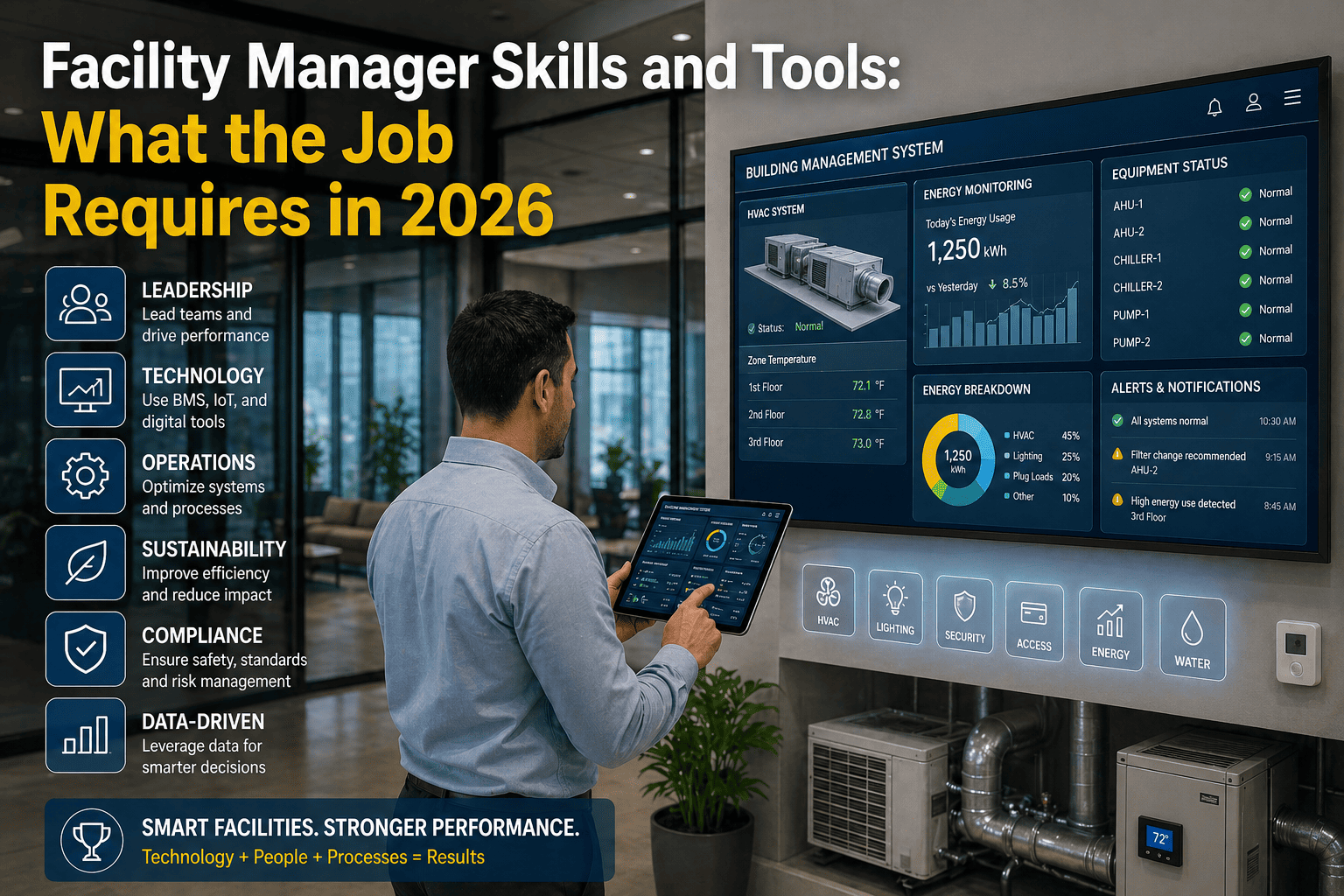
The Tools That Define the Modern FM Tech Stack
Core Platform
CMMS — Computerised Maintenance Management System
The operational centre of gravity for every high-performing FM team. Work orders, PM schedules, asset records, technician workflows, parts inventory, and compliance documentation — all in one system. Without a CMMS, every other tool produces data that goes nowhere.
Oxmaint: Full asset registry, PM scheduling, work order management, CapEx forecasting, multi-site portfolio reporting
Integration Layer
BMS — Building Management System
Controls HVAC, lighting, access, and energy systems. When integrated with a CMMS, BMS sensor alerts trigger work orders automatically rather than waiting for manual inspection or user complaint.
Typical platforms: Siemens Desigo, Honeywell Forge, Johnson Controls Metasys, Schneider EcoStruxure
Data Layer
IoT and SCADA Integration
Real-time sensor data for vibration, temperature, pressure, flow, and power. SCADA systems are standard in industrial FM. IoT retrofits are increasingly cost-effective for commercial facilities managing 10+ critical assets.
Oxmaint integrates with IoT and SCADA to trigger condition-based maintenance from live sensor readings
Execution Layer
Mobile-First Field Tools
Technicians need to close work orders, complete inspections, and capture parts usage from the asset — not back at a desk. Mobile-first CMMS apps reduce reporting lag, improve data accuracy, and remove the paper trail problem entirely.
Oxmaint: Mobile-first across iOS and Android, with offline capability for basement and plant room environments
Where Most Facility Managers Are Falling Behind
Most Common Gap
Still Managing by Spreadsheet
Asset histories in Excel, PM schedules in Outlook, parts tracking in a shared folder. This approach breaks down the moment a team member leaves or a second site is added. It also makes audit preparation a crisis every time.
Competitive Gap
No Asset-Level Cost Data
Budget managed as a department total means high-cost assets stay invisible until they cause a crisis. FMs without asset-level cost visibility cannot build credible CapEx cases or justify preventive investment.
Career Gap
Reporting Activities, Not Outcomes
Monthly reports that list completed work orders do not tell ownership groups what they need. Decision-makers want uptime, cost trends, compliance status, and asset condition — not job counts.
Technology Gap
BMS and CMMS Not Connected
Most facilities have both a BMS and a CMMS that do not talk to each other. Energy alarms are never linked to maintenance work orders. Sensor data sits in a separate system that nobody in maintenance reads regularly.

Oxmaint closes these gaps with a single platform for asset management, PM scheduling, compliance documentation, and CapEx reporting. Start a free trial and see the difference in your first week — or book a demo to walk through how it replaces your current spreadsheet and paper workflow.

Facility Manager 2020 vs 2026 — What Changed
FM Role in 2020
Reactive — responding to complaints and failures
Paper-based inspection records and work orders
Monthly spreadsheet reports for management
Budget managed as a single department total
CapEx based on asset age and vendor recommendation
Compliance prepared manually before each audit
BMS operated by specialist contractor only
Single-site focus with limited portfolio visibility
FM Role in 2026
Predictive — acting on data before failures occur
Digital inspections with mobile sign-off and auto-records
Live KPI dashboards shared on demand with stakeholders
Cost tracked per asset — high-cost assets flagged automatically
CapEx backed by documented asset cost history and condition scores
Audit-ready documentation maintained continuously by the CMMS
BMS integrated with CMMS to auto-generate sensor-triggered work orders
Multi-site portfolio managed from one platform with cross-property benchmarking
25%
Asset Uptime Improvement
Teams using standardised CMMS and KPI dashboards outperform peers by 25% in asset uptime
20%
Cost Efficiency Gain
Facilities using data-driven maintenance programmes achieve 20% better cost efficiency vs reactive peers
34%
Energy Cost Reduction
BMS and CMMS-integrated facilities reduce energy spend by up to 34% across managed assets
2.1x
Faster Career Progression
FMs reporting outcome-based KPIs rather than activity lists advance 2.1x faster in their careers
Frequently Asked Questions
What CMMS skills are most important for facility managers to develop in 2026?
The highest-value CMMS skills are: building and managing PM schedules that are tied to asset records rather than just calendar intervals; using work order data to track maintenance cost per asset over time; generating KPI reports (MTBF, PM compliance, planned vs reactive ratio) that stakeholders and ownership groups can act on; and using the platform's CapEx forecasting tools to build evidence-backed replacement cases. These four skill areas consistently separate FMs who are seen as strategic contributors from those who are seen as operational coordinators. Start a free trial and explore each of these capabilities in a live Oxmaint environment.
How does BMS integration with a CMMS actually work in practice?
When a BMS sensor detects an anomaly — a chiller running outside its temperature range, an AHU fan drawing elevated current — the integrated CMMS receives that alert and automatically creates a work order linked to the relevant asset record. The technician sees the alert on their mobile device, arrives with the asset's full maintenance history already loaded, and closes the work order with their findings. The result is condition-based maintenance that responds to actual asset behaviour rather than calendar schedules. Oxmaint supports IoT and SCADA integration to enable this workflow — the same platform manages both the alert and the resulting work order. Book a demo to see the integration flow in practice.
What sustainability and ESG skills do facility managers need right now?
The most immediately valuable ESG competencies are: tracking energy consumption per asset and property using metered or BMS-sourced data; maintaining digital records of maintenance activities that support carbon reporting frameworks; and being able to report ESG KPIs at a portfolio level for investor and regulatory audiences. In the UAE, UK, and Australia in particular, sustainability documentation is now a standard part of facility management accountability. FMs who can produce structured ESG reports from their CMMS data — rather than assembling them manually from spreadsheets — are significantly more competitive for senior roles and multi-site positions.
How should a facility manager choose between different CMMS platforms in 2026?
The most important evaluation criteria are: asset hierarchy depth — can it track at the Portfolio, Property, System, Asset, and Component level rather than just work orders; mobile capability — do technicians genuinely use it in the field or does it require a desk; CapEx reporting — can it generate replacement forecasts from actual cost history rather than just age; and multi-site readiness — can you benchmark performance across properties in one view. Most legacy CMMS platforms were built for single-site work order management and require significant configuration to deliver asset-level intelligence. Oxmaint was built from the ground up for multi-site commercial and industrial portfolios with condition-based tracking at every asset level. Start a free trial and compare it against your current platform with your own data.
Oxmaint · Built for Modern Facility Managers
The Platform Behind the Skills Every High-Performing FM Uses in 2026
CMMS, asset lifecycle tracking, PM scheduling, compliance documentation, CapEx forecasting, and portfolio-level reporting — all in one mobile-first platform built for multi-site commercial and industrial facilities.
By Jack Edwards

Experience
Oxmaint's
Power

Take a personalized tour with our product expert to see how OXmaint can help you streamline your maintenance operations and minimize downtime.

Book a Tour

Share This Story, Choose Your Platform!

Connect all your field staff and maintenance teams in real time.

Report, track and coordinate repairs. Awesome for asset, equipment & asset repair management.

Schedule a demo or start your free trial right away.

iphone

Get Oxmaint App
Most Affordable Maintenance Management Software

Download Our App