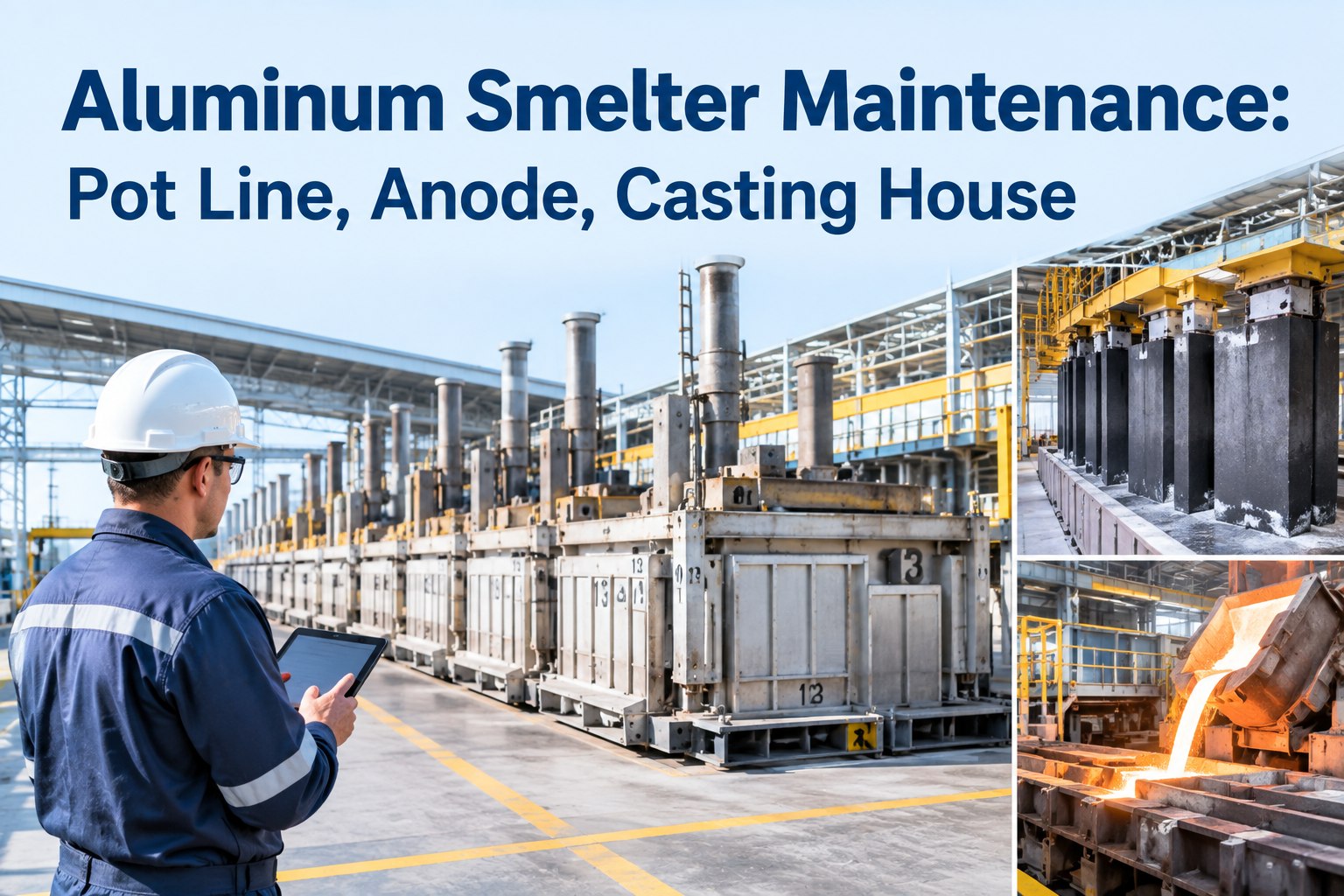
An aluminum smelter is the one plant that can never fully stop. The reduction cells run molten around the clock, and if a pot line goes cold the electrolyte freezes solid — turning a maintenance event into a capital catastrophe that can take a cell out of service for good. That single fact shapes every maintenance decision in the smelter: the work happens on a live, molten, electrically energized process that tolerates no true shutdown. This guide covers aluminum smelter maintenance across its three domains — the pot line, anode production, and the casting house — and the reliability discipline that keeps a Hall-Héroult operation running. Start free on OxMaint to build your smelter program, or book a demo.
Pot Line · Anode · Rodding · Casting House
Aluminum Smelter Maintenance
A 24-hour discipline on a molten process that never stops — where a maintenance miss can freeze a pot line and end a cell's life.
24/7
Continuous molten operation — the pot line can never be allowed to freeze
3
Maintenance domains — pot line reduction, anode production, casting house
~960°C
Operating temperature of the electrolyte the whole plant is built to hold
Live
Work performed on an energized, molten process — the defining maintenance constraint
Why Smelter Maintenance Is Unlike Any Other Plant
Most plants can be shut down, isolated, and worked on cold. A smelter cannot. The Hall-Héroult reduction process runs continuously at high temperature and high amperage, and the cost of stopping it is not lost production — it's a frozen pot, a destroyed cell lining, and a rebuild. Maintenance therefore happens around a running process: hot, energized, and unforgiving of a missed step. Three constraints define the discipline, and no generic maintenance program accounts for all three.
No True Shutdown
The pot line runs molten 24/7. Let it freeze and the cell is lost. Every task is planned around keeping the process alive, not stopping it.
Extreme Environment
High heat, molten metal, fluoride chemistry, and magnetic fields punish equipment and shorten component life far beyond normal industrial wear.
Live Electrical Process
The cells carry enormous DC current. Work happens near an energized bus and molten bath — safety and procedure discipline are inseparable from maintenance.
The Three Maintenance Domains
A smelter is really three plants in one, each with its own equipment, failure modes, and rhythm. A reliability program has to treat them distinctly — the potroom's continuous molten operation is a different world from the casting house's batch pours.
01
Pot Line / Reduction
Continuous · Molten
The reduction cells and everything serving them — potshells, bus bars, alumina feeders, tapping and anode-change equipment, fume and gas-treatment systems. The molten heart that must never stop.
02
Anode Production & Rodding
Baking · Rodding
Carbon anode manufacture — the baking furnace, and the rodding room that attaches and reclaims anode assemblies. Feeds the pot line its consumable carbon on a relentless cycle.
03
Casting House
Batch · Finishing
Molten metal from the pots cast into ingots, billets, or slabs — holding furnaces, casting machines, and handling. The finishing end where product quality is made or lost.
Domain 1 · Pot Line — Keeping the Molten Heart Alive
The pot line is where smelter maintenance is hardest and highest-stakes. Everything here is about keeping the cells running within their operating window while servicing the equipment that feeds, taps, and contains them — all live.
Potshell & Lining
Cathode lining wear and potshell integrity determine cell life. Monitoring for lining degradation and shell distortion is the core long-cycle reliability task.
Bus Bar & Electrical
The high-current bus and connections carry the process amperage. Thermography on joints catches the hot connections that waste energy and threaten continuity.
Alumina Feeders
Point feeders must dose alumina precisely to keep the bath in balance. A stuck feeder upsets cell chemistry — a high-frequency PM item.
Tapping & Anode-Change Gear
The cranes and tools that tap metal and change anodes are heavy-duty, high-cycle, and safety-critical. Their reliability directly gates potroom operation.
Fume & Gas Treatment
The gas-treatment center scrubs fluoride emissions — an environmental-compliance system whose uptime is not optional.
Superstructure & Covers
Anode beams, jacks, and cell covers exposed to constant heat and fluoride attack. Corrosion and thermal degradation are relentless here.
Map the Whole Smelter as One Asset Hierarchy — Free Forever
Pot line, anode plant, and casting house share molten metal and a common reliability fate — but usually live in separate logs. Load all three into OxMaint as one asset hierarchy with PM tuned to the smelter's punishing environment. No card, no time limit.
Domain 2 · Anode Production & Rodding
The pot line consumes carbon anodes continuously, so anode production runs on a cycle that can't fall behind. Two maintenance areas keep that supply flowing — the baking furnace that hardens the carbon, and the rodding room that assembles and reclaims the anode-rod assemblies.
Anode Baking
The Baking Furnace
A ring furnace that bakes green anodes to hardness over a controlled thermal cycle. Refractory condition, firewall integrity, burner and fan reliability, and draft control all govern anode quality — and a furnace upset ripples straight into pot-line performance.
Rodding Room
Rodding & Reclaim
Where spent anode butts are stripped and fresh anodes are cast onto rods with molten iron (thimble casting). Handling equipment, the casting station, and stub cleaning are high-cycle, heavy-duty assets whose downtime starves the pot line of anodes.
Domain 3 · Casting House
The casting house turns molten aluminum into shippable product, and it's where maintenance most directly touches product quality. A holding-furnace or casting-machine problem doesn't just cause downtime — it scraps metal. This is batch, quality-critical work distinct from the potroom's continuous flow.
Holding & Melting Furnaces
Temperature control and refractory condition keep metal at cast quality. Burner, control, and lining upkeep are the reliability core.
Casting Machines
DC casting, billet, or ingot lines with tight dimensional and cooling control. Machine condition maps directly to product yield and scrap rate.
Metal Handling & Launders
Crucibles, launders, and transfer systems that move molten metal. Refractory wear and blockage risk make these high-attention assets.
Cooling & Water Systems
Direct-chill casting depends on reliable cooling water. A cooling failure mid-cast is both a quality and a safety event.
The Reliability Discipline That Ties It Together
Three domains, one operation — and the thread that keeps all of it running is a maintenance discipline built for a process that can't stop. Four principles separate a smelter that runs from one that firefights.
01
Condition Over Calendar
In an environment this punishing, fixed intervals miss. Thermography, vibration, and lining monitoring catch degradation the calendar can't predict.
02
Criticality-Ranked
Anything that threatens pot-line continuity outranks everything else. The freeze risk sets the priority order across all three domains.
03
Work-Around-Running
Tasks planned and sequenced to service equipment without interrupting the molten process — the defining planning skill of a smelter.
04
One Connected Record
Pot line, anode, and casting reliability data in one system — so a pattern in one domain is visible to the whole operation.
How OxMaint Runs the Smelter Program
All three domains sit in one asset hierarchy, with PM tuned to the smelter's heat-and-fluoride environment and criticality ranked against the freeze risk — so the pot line, anode plant, and casting house are one reliability picture instead of three disconnected logbooks.
Hierarchy
Whole Smelter, One Map
Pot line, anode production, and casting house carried as one asset hierarchy from cell to casting machine.
PM
Environment-Tuned Cadence
Schedules set for heat, fluoride, and high-cycle wear — not the manufacturer's clean-plant default interval.
Condition
Thermography & Monitoring
Bus-bar thermography, lining and refractory monitoring feeding work orders before degradation becomes failure.
Criticality
Freeze-Risk Priority
Assets ranked so anything threatening pot-line continuity is always serviced first.
Mobile
Potroom Execution
Technicians run rounds and close work orders from the floor — capture where the heat and the work are.
Report
Cross-Domain Reliability
MTBF, PM compliance, and downtime across all three domains in one view for the reliability lead.
Run the Smelter as One Reliability Operation
Free forever plan — no card, no time limit. Map pot line, anode, and casting house into one hierarchy, tune PM to the environment, and rank everything against the freeze risk. Or book 30 minutes and we'll map your smelter onto the platform end to end.
Frequently Asked Questions
Why can't an aluminum smelter be shut down for maintenance like other plants?
Because the Hall-Héroult reduction cells run molten and continuously. If a pot line loses power or heat long enough, the electrolyte and metal freeze solid, destroying the cell lining and often the cell itself — a capital loss and a lengthy rebuild, not just lost production. So smelter maintenance is performed around a live, energized, molten process, and every task is planned to keep that process alive rather than stop it.
What are the three main areas of aluminum smelter maintenance?
The pot line (reduction cells and their feeding, tapping, bus-bar, and gas-treatment equipment — continuous and molten), anode production and rodding (the baking furnace that hardens carbon anodes and the rodding room that assembles and reclaims anode-rod assemblies), and the casting house (holding furnaces and casting machines that turn molten metal into ingots, billets, or slabs). Each has distinct equipment, failure modes, and maintenance rhythm.
What makes smelter equipment fail faster than normal industrial gear?
The environment. Sustained high heat, molten metal, aggressive fluoride chemistry, and strong magnetic fields around the high-current cells all attack equipment far harder than ordinary industrial conditions. Cell covers, superstructure, bus-bar connections, and refractory degrade on an accelerated clock, which is why condition monitoring beats fixed calendar intervals in a smelter.
Book a demo to see condition-based scheduling.
Why does anode production reliability matter to the pot line?
Because the reduction cells consume carbon anodes continuously, so the baking furnace and rodding room have to keep a steady supply flowing. A baking-furnace upset affects anode quality that then shows up as pot-line performance problems, and rodding-room downtime starves the cells of the anodes they need. Anode production isn't a side operation — its reliability directly gates the molten heart of the plant.
Why manage all three smelter domains in one CMMS?
Because they're one operation sharing molten metal and a common freeze risk, yet they usually live in separate logbooks that hide cross-domain patterns. One asset hierarchy lets you rank every asset against pot-line continuity, tune PM to the shared harsh environment, and see reliability across pot line, anode, and casting house in a single view — so a developing problem in one domain is visible before it reaches the others.
Start free to build the hierarchy.