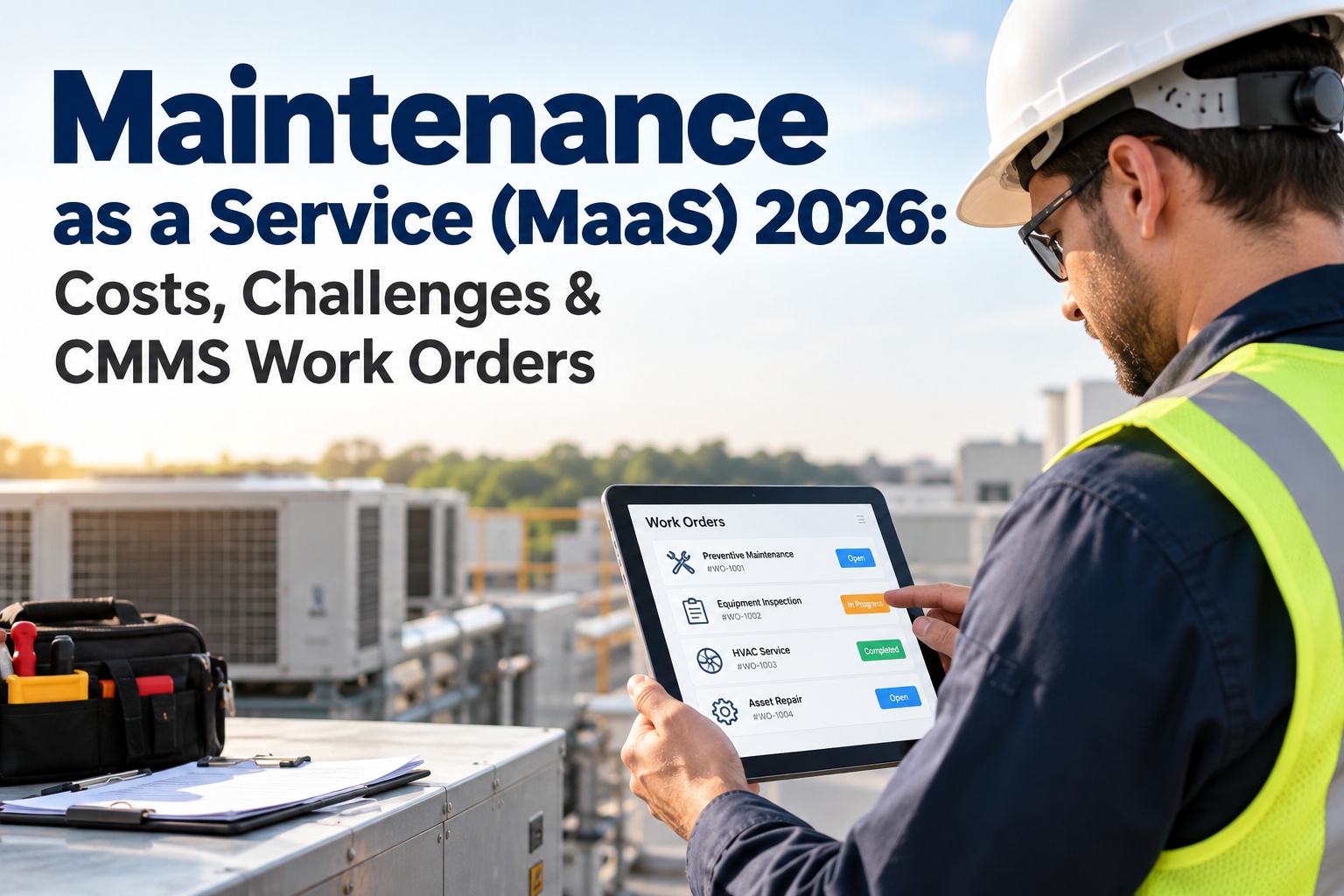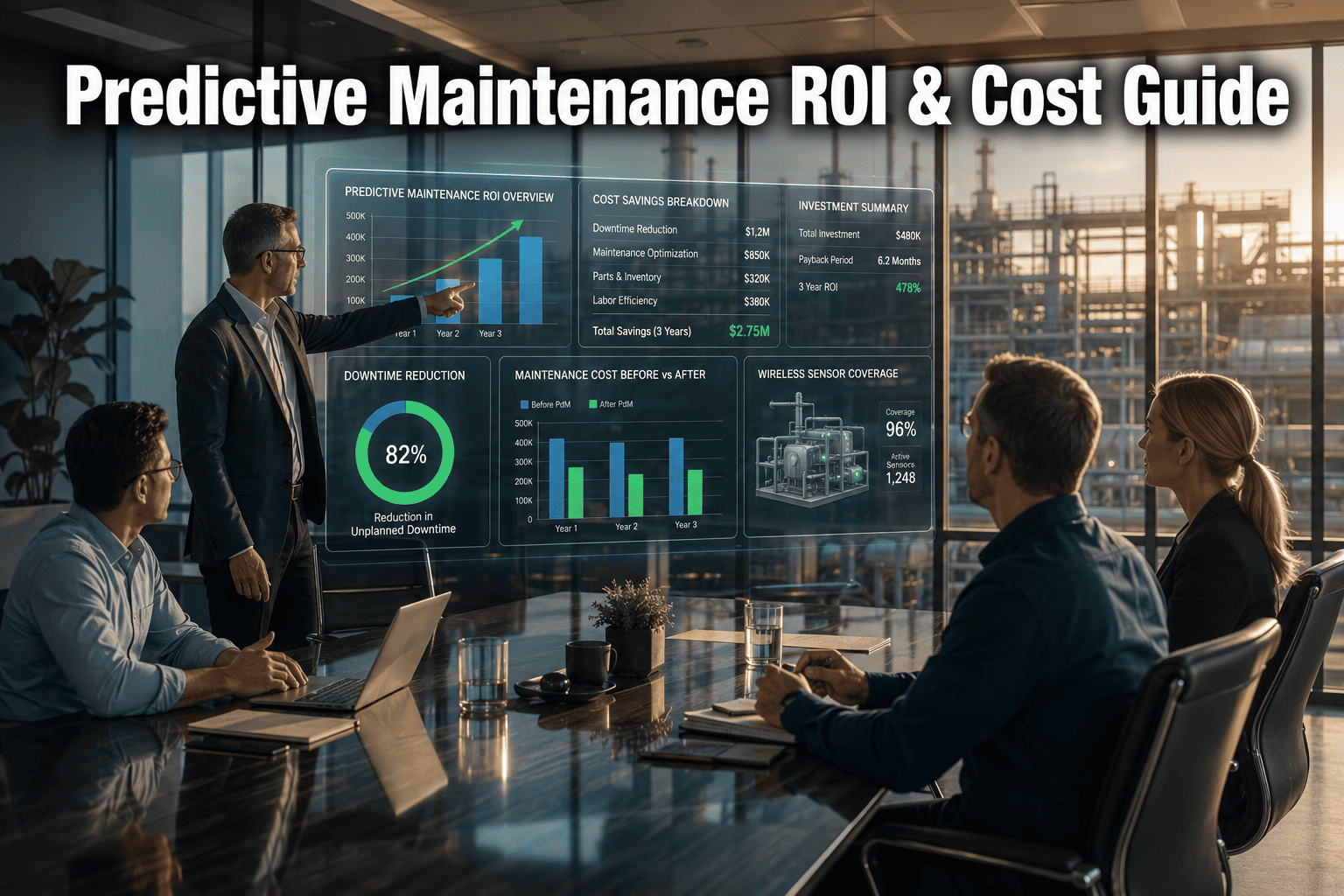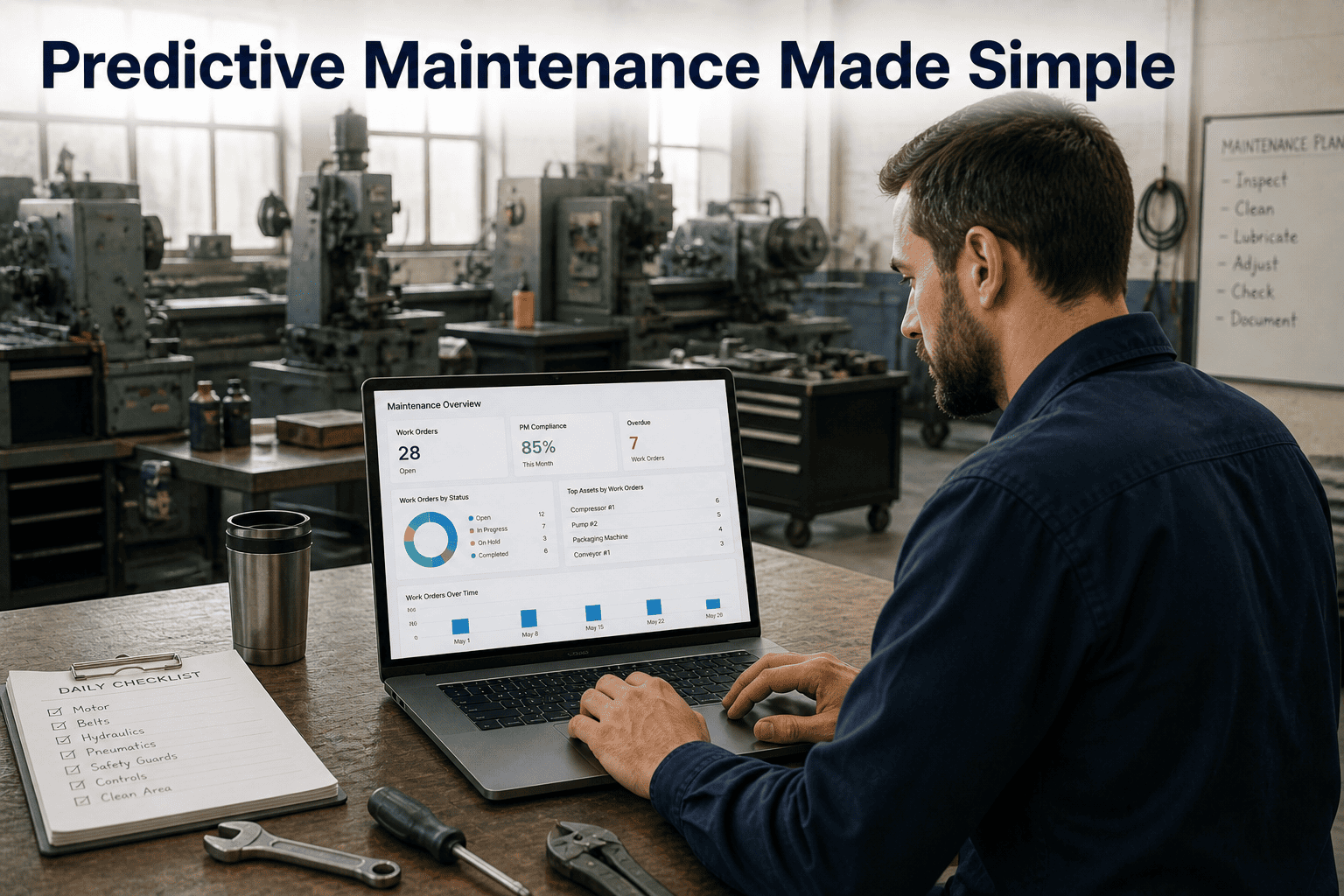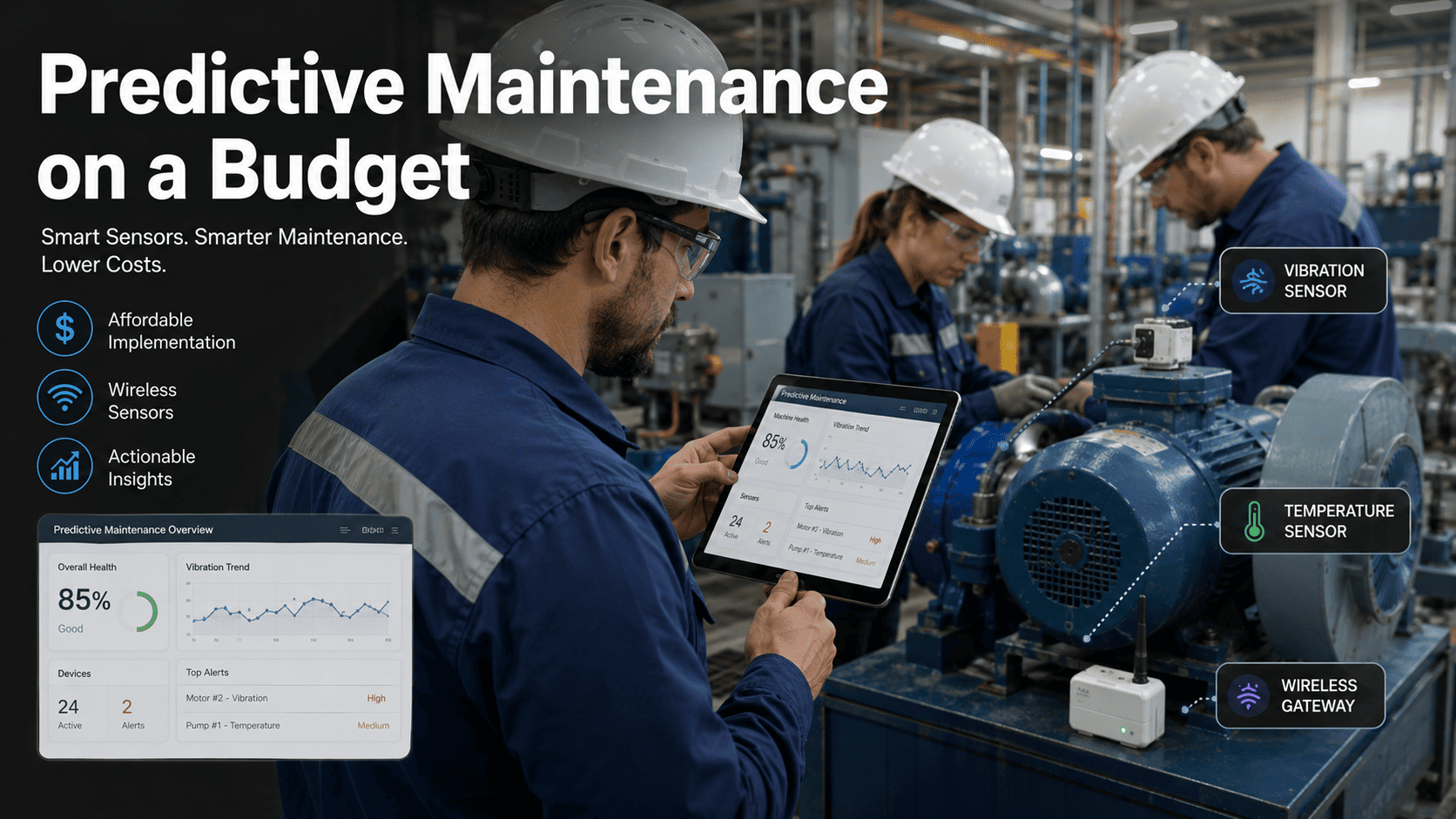
Starting a predictive maintenance program on a tight budget is not a compromise — it is a smarter strategy than the expensive enterprise rollouts that stall after 18 months of implementation. The maintenance teams seeing the fastest ROI are not the ones who bought the most sensors. They are the ones who started narrow, proved value fast, and scaled with data instead of guesswork. The average facility running fully reactive maintenance spends 3–5 times more per repair than one with a functioning predictive program — yet most budget-constrained teams assume PdM is out of reach. It is not. Wireless IoT sensors have dropped to $150–$400 per point. AI-powered CMMS platforms deploy in days, not months. A phased approach targeting your top 10 critical assets can cut unplanned downtime by 62% in the first year on a budget most maintenance departments already have available in emergency repair costs alone. This guide gives you the exact framework — asset prioritization, sensor selection, CMMS setup, and cost benchmarks — to launch a predictive maintenance program this quarter without a capital project approval cycle. Ready to skip the theory and see it on your assets? Start a free trial or book a demo with Oxmaint.
See how much emergency repair cost you can eliminate this quarter — without a six-figure sensor rollout.
- Phased implementation — start with 10 assets, scale with confidence
- Affordable wireless sensors + AI CMMS in one connected platform
- Auto-generated work orders from sensor anomalies, live from day one
1,000+ maintenance teams · No heavy onboarding · Live in days, not months
What Is a Predictive Maintenance Program — and Why Budget Is Not the Barrier
A predictive maintenance program is a structured approach to monitoring equipment condition continuously — using sensors, data, and AI — so you intervene before failure rather than after. The word "program" matters: it is not a one-time sensor installation. It is a repeatable process of measuring, analyzing, deciding, and acting — backed by a CMMS that turns data into work orders automatically.
The budget myth persists because most PdM case studies feature large plants with six-figure sensor budgets and dedicated reliability engineers. But the same outcome is achievable on $15,000–$40,000 for a small-to-mid-size facility when you apply the cardinal rule: start with criticality, not coverage. A program monitoring 10 assets that represent 80% of your downtime risk delivers more value than 100 sensors scattered across the plant with no clear action plan. Oxmaint's predictive maintenance module was built for exactly this model — focused, phased, and affordable from day one.
The 8-Step Framework for Launching PdM on a Budget
Build Your Criticality List
Rank every asset by failure consequence: production impact, safety risk, repair cost, and lead time for parts. Use a simple 1–5 matrix. Your top 10–15 assets are your PdM targets. Everything else stays on calendar-based PM for now — you do not need to monitor everything to see dramatic results.
Document Failure Modes First
Before buying a single sensor, list the 2–3 ways each critical asset fails. A centrifugal pump fails via bearing wear, cavitation, and seal degradation. Each failure mode requires a specific sensor type. Skipping this step is why teams buy vibration sensors for assets that fail electrically — wasting budget and missing actual faults.
Choose Affordable Wireless Sensors
Wireless MEMS vibration sensors ($150–$350/point), clip-on temperature loggers ($80–$200), and ultrasonic spot-check devices ($1,500–$3,000 one-off tool) give you 80% of enterprise-grade monitoring coverage at a fraction of the cost. Battery life of 12–18 months and 10-minute setup per sensor point make them practical for small teams without dedicated instrumentation engineers.
Select a CMMS That Connects the Dots
Raw sensor readings do not stop failures — an AI platform that converts anomalies into work orders does. A CMMS like Oxmaint integrates sensor data with automated work order management, parts inventory, and technician routing. This is the layer most budget programs skip — and why their sensor data sits in a dashboard nobody acts on.
Establish Baselines Before Setting Alarms
Run your sensors for 4–6 weeks without alarms to capture normal operating ranges across all operating modes (full load, low load, startup, shutdown). Alarm thresholds set against real baseline data generate 80% fewer false positives than vendor defaults — which kills team trust in the program within months of launch.
Integrate with Preventive Maintenance Schedules
PdM does not replace preventive maintenance — it upgrades it. Use sensor data to extend or compress PM intervals based on actual condition. A bearing running cooler than baseline after 8,000 hours might not need replacement at the scheduled 10,000-hour mark. That one data-driven decision on a $400 bearing swap saves technician time and eliminates unnecessary parts cost.
Track Every Alert-to-Action Outcome
Record every sensor alert, whether it led to a work order, what was found, and what it would have cost if the asset had failed. This case file is your ROI evidence for expanding the program budget. Three months of documented catches — "sensor flagged bearing anomaly, found inner race damage, avoided $45,000 unplanned outage" — is more persuasive to leadership than any spreadsheet projection.
Scale with Data, Not Ambition
After 90 days, review your ROI, expand sensor coverage to the next tier of assets, and consider adding AI Vision Camera for thermal inspection and corrosion detection. Use Oxmaint's ROI calculator to model the business case for each expansion before committing spend.
This framework is how teams move from reactive firefighting to proactive maintenance without burning budget on a big-bang rollout. Start a free trial and set up your first 10 assets today — or book a demo and we will build this plan for your specific facility.
4 Budget Killers That Derail New PdM Programs
Monitoring Everything at Once
Covering 200 assets in the first phase consumes budget and generates overwhelming data volumes before your team has the process to act on it. The 80/20 rule holds: 20% of your assets cause 80% of your downtime. Start there. Scale after you have proven the value.
Sensors Without a CMMS Integration
Standalone sensor dashboards generate readings that nobody converts to action. Studies show 70% of PdM programs that fail do so not from bad sensor data but from lack of workflow connecting alert to repair. Without a CMMS closing the loop, you have expensive monitoring theater — not a maintenance program.
Ignoring the Spare Parts Equation
Predictive maintenance only works if the right part is available when the sensor flags a developing fault. A program that detects a bearing fault 3 weeks early but has a 6-week lead time on the replacement part delivers zero improvement. Parts and inventory management is as critical as the sensor itself.
No Compliance Documentation Plan
OSHA PSM, ISO 55000, and insurance auditors increasingly expect evidence of condition-based maintenance programs — not just calendar PM records. A PdM program with no audit trail is a missed compliance opportunity and a liability gap. Safety and compliance features in Oxmaint build the audit trail automatically as your program runs. Book a demo to see how.
How Oxmaint Gives Small Teams Enterprise-Grade PdM
94% Accurate Failure Forecasting
Oxmaint's AI analyzes sensor trends from IoT and PLC feeds to predict failures 2–6 weeks early — with 94% accuracy. No data science team required. The AI surfaces what to act on and when, so a small maintenance team operates with the intelligence of a dedicated reliability department.
Sensor Anomaly to Work Order in Seconds
When a sensor trend crosses its AI-learned threshold, a work order is created automatically with asset history, recommended action, and parts checklist — routed to the right technician via QR-scan mobile workflow. No alert falls through the cracks on a weekend shift.
QR-Scan Access for Every Technician
Any technician can scan an asset QR code and see its full sensor history, open work orders, and maintenance schedule on a mobile device. No desktop login, no training delay. Phased programs work because every team member is connected from day one without an onboarding program.
Fast Setup — No Implementation Project
Upload your asset list, register your first 10 critical assets, connect your sensor feeds, and your PdM program is live. Most teams are generating their first AI-driven work orders within 48 hours of onboarding. No consultants, no months-long configuration, no capital approval cycle needed.
ROI Reporting That Builds Program Budget
Analytics and reporting tracks every sensor-triggered intervention, its cost, and the estimated failure cost avoided. After 90 days you have a documented business case for expanding the program — not a projection, a record of actual value captured.
Automatic Audit Trail From Day One
Every sensor reading, alert, and work order is timestamped, searchable, and exportable. ISO 55000, OSHA PSM, and insurance audits pull a report in minutes. The compliance cost of your PdM program is essentially zero — it is built into normal operations through the platform.
Reactive vs Predictive: The True Cost Comparison
| Cost Category | Reactive Maintenance | Predictive Maintenance |
|---|---|---|
| Repair Cost Per Event | 3–5× higher (emergency labor, expedited parts) | Planned intervention — standard rates, stocked parts |
| Downtime Per Event | 8–24 hours average (diagnosis + parts + repair) | 2–4 hours planned (parts staged, tech briefed) |
| Secondary Damage | High — cascade failures common, $50K–$500K events | Minimal — fault caught at early stage, contained |
| Safety Incidents | Elevated — reactive repairs under pressure, shortcuts | Low — planned work in controlled conditions |
| Parts Inventory Cost | Overstocked (fear of stockouts) or zero (hope strategy) | Right-sized — data-driven stocking, auto-reorder triggers |
| Compliance Risk | High — no documented condition monitoring record | Low — automatic timestamped audit trail on every asset |
| Program Cost (annual) | Hidden — absorbed as emergency spend, not tracked | Visible — $15K–$40K initial, 3–5× ROI in year one |
The numbers above are why reactive maintenance is never actually cheaper — it is just budgeted differently. Emergency repair costs are absorbed into operations budgets and never compared against the proactive alternative. Use Oxmaint's ROI calculator to model the real comparison for your facility, or start a free trial and let the data make the case.
These results come from teams that started small, proved value fast, and scaled from there — the exact approach this guide is built around. Book a 30-minute demo and we will map this program to your specific asset mix.
Frequently Asked Questions
How much does it cost to start a predictive maintenance program for a small facility?
Can a small maintenance team run a predictive maintenance program without a reliability engineer?
How long does it take to see ROI from a predictive maintenance program?
What is the difference between predictive maintenance and preventive maintenance on a budget?
Your Budget Is Not the Barrier
Start Your Predictive Maintenance Program This Quarter — Not Next Budget Cycle
Oxmaint gives small maintenance teams the AI, sensor integration, and automated workflows that used to require a six-figure enterprise rollout. Start with 10 assets. Prove value. Scale with confidence. No capital project, no implementation partner, no months of onboarding.
- AI failure prediction on your critical assets from day one
- Auto-generated work orders — sensor alert to technician in seconds
- Full compliance audit trail — ISO, OSHA, insurance-ready automatically
1,000+ teams · 62% less unplanned downtime · Live in 48 hours · No implementation project