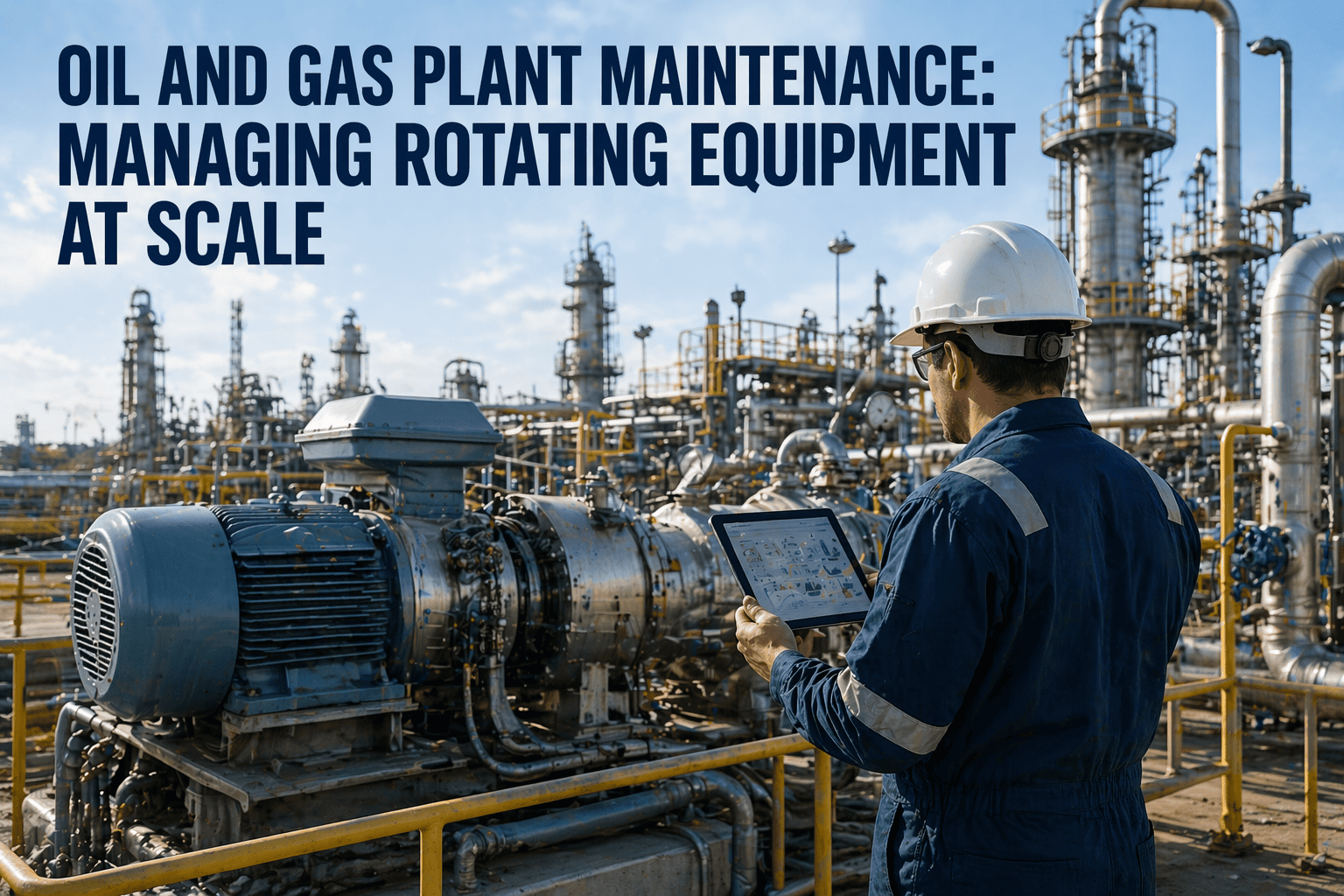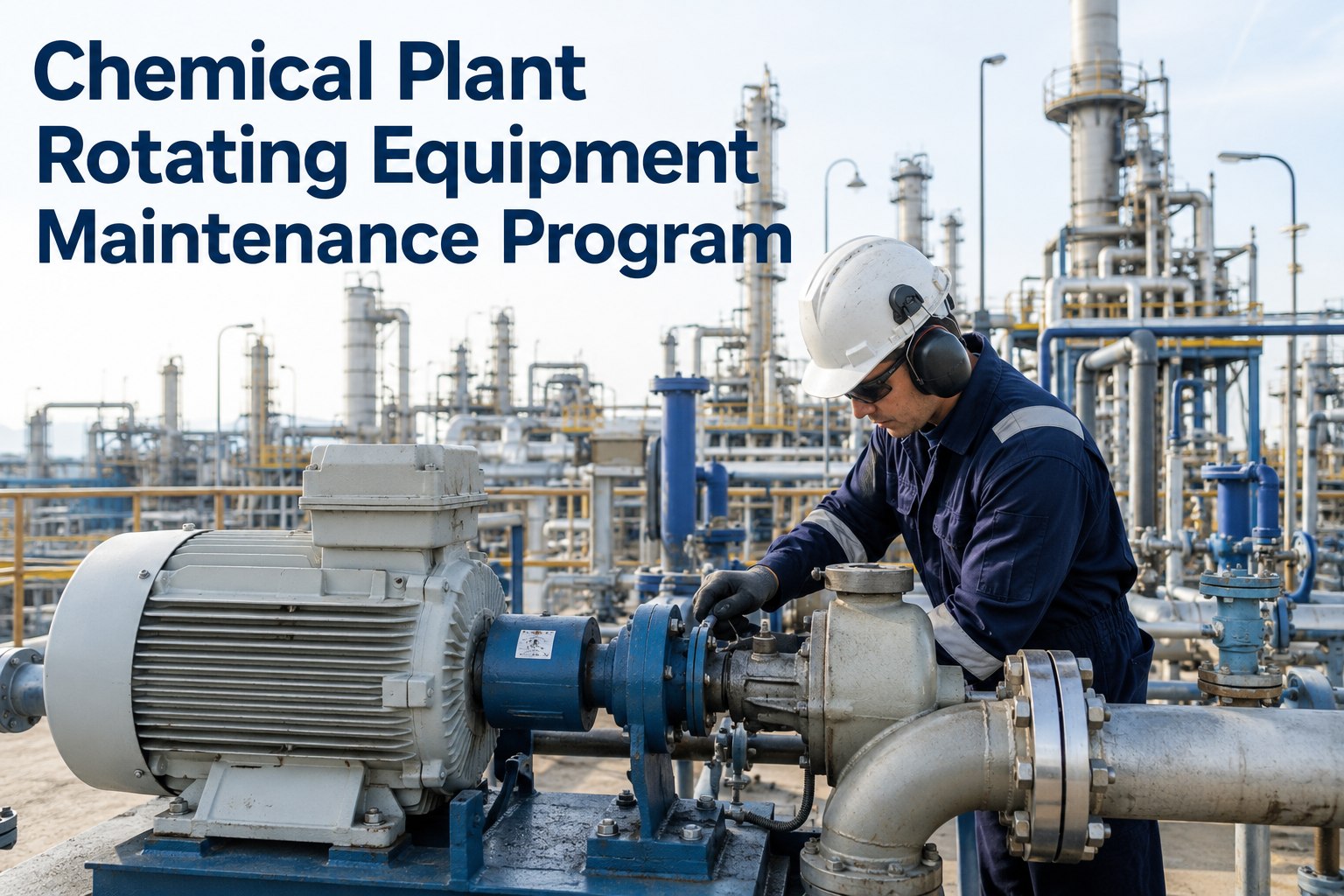
A chemical plant rotating equipment maintenance program is the structured set of pump, compressor and agitator PM tasks, inspection intervals and failure-analysis workflows that keep rotating machinery reliable under PSM and mechanical-integrity standards. In most chemical facilities, rotating equipment accounts for the majority of maintenance spend — and the majority of unplanned downtime — because centrifugal pumps, reciprocating and centrifugal compressors, and agitators fail on predictable patterns that reactive programs never catch. The difference between a plant that compounds reliability value and one that leaks margin is almost always discipline: consistent PM execution, condition monitoring, and a CMMS that turns every work order into failure data. OxMaint's AI-powered CMMS gives chemical plant reliability engineers exactly that structure — and you can Start Free Trial to see it on your own asset list. This guide breaks down the full program: pump reliability, compressor PM, agitator service intervals, and the analytics layer that ties it together.
What does a disciplined rotating equipment program actually look like in a chemical plant?
It looks like every pump, compressor and agitator on a risk-ranked PM schedule, every failure coded and analyzed, and every spare part available before the work order drops. Below is the full framework — plus the CMMS structure that makes it stick at PSM-compliant standards.
Why chemical plant rotating equipment maintenance fails without a program
A single unplanned centrifugal pump failure in a chemical plant costs $15,000–$80,000 in lost production, emergency labor and expedited parts — and that's before you count the safety and environmental exposure of a seal failure on a hazardous service. Yet industry benchmarking consistently shows 40–55% of chemical plant maintenance work is still reactive. The three numbers below explain why that gap persists.
The pattern is consistent across chemical plants of every size: pumps fail on seals and bearings, compressors on valves and lubrication, agitators on gearboxes and shaft seals — and every one of those failure modes is detectable weeks in advance with the right inspection and condition-monitoring cadence. The problem is rarely knowledge; it's execution discipline. That's the gap a purpose-built rotating equipment CMMS closes.
Centrifugal pump maintenance in chemical service: the PM schedule that works
Centrifugal pumps are the highest-count rotating asset in most chemical plants — often 60–70% of the rotating equipment population — and they fail on a short list of repeatable causes. Mechanical seal failures account for roughly 50–60% of pump repairs, bearing failures another 20–25%, and the rest split between coupling, impeller and cavitation damage. A chemical pump maintenance program that targets these failure modes directly can push MTBF from 18 months to 36+ months.
- Check seal flush / quench pressure and flow
- Record suction & discharge pressure vs baseline
- Listen for cavitation or bearing noise
- Check bearing housing oil level and color
- Log vibration by feel / handheld meter at bearing points
- Route-based vibration analysis (ISO 10816 zones)
- Thermography on bearing housings and motor
- Check coupling alignment indicators
- Inspect seal leakage rate against API 682 limits
- Verify lubrication — oil analysis sample on critical pumps
- Full laser alignment check and correction
- Bearing inspection or replacement per condition
- Impeller wear-ring clearance measurement
- Seal replacement on condition or run-hours
- Performance test vs original curve (head/flow/efficiency)
A 180-asset specialty chemical plant running this three-tier pump PM schedule through OxMaint cut seal-related failures 47% in the first year — because every weekly round, monthly vibration route and annual overhaul was auto-scheduled, mobile-executed and failure-coded. The reliability engineer stopped chasing work orders and started reading trends.
Compressor maintenance in a chemical plant: mechanical integrity at PSM standard
Compressors are the highest-consequence rotating assets in a chemical plant — a reciprocating compressor on hydrogen or a centrifugal compressor on process gas can shut down an entire unit, and both sit squarely inside OSHA PSM mechanical-integrity requirements (29 CFR 1910.119). A defensible chemical plant compressor PM program is built on three pillars: condition monitoring, time-based overhaul intervals, and documented inspection history that survives an audit.
| Compressor Type | Key Failure Modes | Core PM Tasks | Interval | PSM / MI Relevance |
|---|---|---|---|---|
| Reciprocating | Valve wear, piston ring wear, packing leaks | Valve inspection, rod-drop monitoring, packing replacement | 4,000–8,000 hrs | High — documented inspection history required |
| Centrifugal | Surge, seal failure, bearing wear, fouling | Continuous vibration, dry-gas seal monitoring, lube oil analysis | Continuous + annual | High — critical machine protection records |
| Screw | Rotor wear, bearing failure, oil contamination | Oil analysis, vibration trend, filter & separator service | 2,000–4,000 hrs | Medium — depends on service criticality |
The audit dimension is where most chemical plants feel the pain. When a PSM auditor asks for the inspection history on a specific compressor, the answer has to be a complete, timestamped record — not a filing cabinet. OxMaint stores every PM, every vibration reading, every oil analysis and every repair against the asset record, so the mechanical-integrity evidence is one click away instead of one week away.
Agitator maintenance: the most neglected rotating asset in the plant
Agitators and mixers rarely get the same rigor as pumps and compressors — yet a failed agitator gearbox or shaft seal on a reactor can be just as costly, and in batch chemical processes it can scrap an entire batch worth $50,000–$500,000. Agitator maintenance deserves its own stream in the program, focused on the three components that actually fail.
Agitator gearboxes fail slowly and expensively. Quarterly oil analysis catches wear metals and contamination 4–8 weeks before failure. OxMaint auto-schedules the sample, stores the lab result against the asset, and flags the trend when iron or particle counts climb.
Mechanical seals on agitator shafts see runout and vibration that pump seals never do. A monthly leakage check plus a full seal inspection at every planned outage prevents the in-batch failure that scraps product. Every inspection is logged and failure-coded in the CMMS.
Corrosive and abrasive chemical service erodes impeller blades and shaft surfaces. An annual dimensional check against baseline tells you whether the agitator still delivers the mixing energy the process needs — before product quality drifts.
The rotating equipment CMMS layer: how OxMaint runs the whole program
A chemical plant rotating equipment program lives or dies on execution discipline — and that's exactly what OxMaint's AI-powered CMMS + EAM platform delivers. Four capabilities map directly to the problems above.
Auto-generate every pump round, compressor inspection and agitator service on calendar, run-hours or condition triggers. Criticality-ranked so the right assets get the right frequency. Outcome: 95%+ PM compliance instead of the 60–70% typical of spreadsheet programs.
Log vibration, oil analysis and thermography readings against each asset; OxMaint's AI flags the trend before failure. Outcome: catch the 70% of rotating failures that show warning signs — cut unplanned downtime 30–50%.
Link seals, bearings and wear parts to each pump and compressor so the part is reserved when the PM drops. Outcome: eliminate the 20–30% of repair delay caused by parts not on the shelf — and stop overstocking the wrong spares.
Every work order is failure-coded, building the MTBF, bad-actor and cost data your reliability program needs — and the mechanical-integrity evidence a PSM audit demands. Outcome: audit-ready in one click, and a reliability engineer who manages by trend, not by memory.
See OxMaint on your rotating equipment — book a 30-minute demo
Bring your pump, compressor and agitator list. We'll show you the PM schedules, condition monitoring and failure analytics on assets that look like yours — and map the ROI for your plant.
Chemical plant rotating equipment maintenance — FAQs
It is the structured set of preventive and predictive tasks, inspection intervals and failure-analysis workflows that keep pumps, compressors and agitators reliable. A good program risk-ranks every asset, schedules PM by calendar, run-hours or condition, and codes every failure so reliability improves over time — all managed inside a CMMS like OxMaint.
Weekly operator rounds (pressures, seal flush, noise, oil level), monthly technician PM (vibration to ISO 10816, thermography, leakage checks), and an annual overhaul-window inspection (alignment, bearings, wear-ring clearances, performance test). Critical or hazardous-service pumps often add continuous vibration monitoring. You can Start Free Trial to build this schedule in OxMaint in under an hour.
Mechanical seal failures cause roughly 50–60% of centrifugal pump repairs, bearing failures another 20–25%, with the remainder split between coupling, impeller and cavitation damage. Almost all of these show detectable warning signs — leakage rate, vibration trend, temperature — weeks before breakdown, which is why condition monitoring pays back so quickly.
OSHA PSM (29 CFR 1910.119) requires documented inspection and testing history on covered equipment, including compressors and pumps in hazardous service. A CMMS stores every PM, inspection, reading and repair against the asset record with timestamps — so the mechanical-integrity evidence an auditor asks for is one click away instead of a week of digging through files. Book a Demo to see the audit report on a sample asset.
Most chemical plants see payback in 3–9 months. The drivers are a 30–50% cut in unplanned downtime, a 3–5x cost avoidance on every failure shifted from reactive to planned, and 10–20% lower spare-parts inventory from asset-linked stocking. A 180-asset plant spending $42K/yr on reactive pump repairs typically recovers $15K–$25K in the first year alone.
Build the rotating equipment program your plant deserves
Pump PM, compressor mechanical integrity, agitator service and the failure analytics that tie it together — all in one AI-powered CMMS. Start free, or book a demo and see it on your assets.