Managing contractor and vendor maintenance work without a CMMS is a compliance and cost disaster waiting to happen — missed deadlines, disputed invoices, unverified labor hours, and audit trails that exist only in someone's email inbox. Organizations today outsource 20–50% of their total maintenance workload, yet most manage that entire contractor ecosystem with spreadsheets, phone calls, and manual purchase orders. The result: accountability gaps, safety violations, and costs that balloon invisibly. A modern CMMS for contractor management closes every one of those gaps — centralizing work order issuance, vendor tracking, compliance documentation, and performance reporting in a single platform. Book a demo to see how Oxmaint manages your entire contractor ecosystem from one dashboard.
See how much contractor cost leakage you can eliminate — in 30 minutes.
- Centralized vendor work orders with real-time status tracking
- Automated compliance documentation and audit-ready reports
- Contractor performance scorecards with cost-per-repair visibility
Trusted by teams managing 10,000+ assets · Live in days, not months
What Is CMMS Contractor and Vendor Maintenance Management?
CMMS contractor and vendor maintenance management is the process of issuing, tracking, and closing work orders assigned to external service providers — all within your computerized maintenance management system. Instead of managing contractors through scattered emails, phone calls, and paper service reports, every job is created, assigned, documented, and measured inside the same platform your internal technicians use. Compliance certificates, service level agreements, invoices, and completion sign-offs are all captured automatically, creating an unbroken audit trail without any manual filing.
The scope goes beyond simple work order handoff. A well-implemented contractor management workflow inside a CMMS covers vendor onboarding and credential verification, job-level communication and progress updates, labor hour verification, parts and materials tracking, SLA compliance scoring, and cost-per-repair benchmarking — giving you the same visibility into outsourced work that you have over your own team. Learn more about how Oxmaint's work order management handles both internal and external workflows in a unified system.
This matters because outsourced maintenance sits in a dangerous blind spot for most operations: it's expensive, compliance-critical, and almost entirely invisible in traditional spreadsheet-based management. AI-native CMMS platforms like Oxmaint now make that blind spot fully transparent — auto-generating vendor work orders from inspection findings, tracking contractor response times in real time, and flagging SLA breaches before invoices arrive. Start a free trial to see contractor visibility in action on your own asset data.
Key Concepts in Contractor Maintenance Management
Verifying contractor insurance, certifications, and safety qualifications before any work order is issued. CMMS stores credentials with expiry alerts so you never dispatch an unqualified vendor to a regulated asset.
Formal, documented job assignments sent digitally to contractors — including scope of work, asset details, safety requirements, expected completion date, and approved labor and materials budget.
Measuring contractor response time, job completion rate, and recall rate against agreed service levels. Automated alerts trigger when deadlines approach or breach, before you're stuck arguing after the fact.
Capturing every safety certificate, permit-to-work, inspection report, and sign-off in a structured, searchable record. Critical for OSHA, ISO, GMP, and Building Safety Act audits involving contractor work.
Cross-referencing contractor-reported hours and parts against work order approvals before invoices are paid. CMMS creates an automatic three-way match: approved scope, reported work, actual invoice.
Aggregating response time, on-time completion, recall rate, and cost variance into a vendor scorecard. Gives you objective data to renew contracts, renegotiate rates, or replace underperforming vendors.
All job-related communication — status updates, clarification requests, photo evidence, sign-off confirmations — logged directly on the work order. Eliminates the "I never got that email" problem permanently.
Comparing contractor cost per repair against internal benchmarks and industry norms, per asset class and per vendor. Identifies which outsourced work should be brought in-house and which contracts to renegotiate.
The Real Pain Points of Managing Contractors Without a CMMS
You issue a work order verbally or by email. The contractor shows up — or doesn't. Work gets done — or doesn't. You find out when production complains or an auditor asks for proof of service. There is no live status, no photo evidence, no digital sign-off.
Contractor invoices arrive with no connection to the original work order. Hours billed don't match what was scoped. Parts charged were never approved. Without a system linking invoice to job record, every dispute becomes a manual investigation costing hours of management time.
OSHA, ISO, and GMP audits require documented evidence of contractor qualifications, permit-to-work compliance, and completed safety procedures. When that documentation lives in emails and paper folders, audits become fire drills — and LOTO violations alone generated 2,443 OSHA citations in 2024.
When contract renewal comes around, you have no objective data — just gut feel and whoever complained loudest. You can't compare vendors by cost-per-repair, SLA compliance, or recall rate. The result: you renew bad contracts and lose leverage with good ones because you have no numbers to negotiate with.
A contractor whose insurance lapsed three months ago is still working on your highest-voltage equipment because nobody tracked the expiry date. When an incident occurs, liability flows directly to the facility. Manual credential management is not an option when assets are regulated and people are at risk.
Contractor jobs managed in one spreadsheet. Internal work orders in another system. Parts pulled from inventory tracked nowhere. The result is duplicated effort, missed handoffs between internal teams and vendors, and a maintenance history that is half the story at best.
These aren't edge cases — they describe daily operations at most facilities managing contractors without a proper system. Oxmaint's inspection management integrates directly with contractor work orders so every outsourced job has a documented, auditable trail — start a free trial or book a demo to see it on your facility.
How Oxmaint Solves Contractor and Vendor Maintenance Management
When Oxmaint's AI Vision Camera or predictive maintenance engine detects a fault requiring specialist expertise, it auto-creates a vendor work order with the asset ID, fault classification, required skill set, and approved labor ceiling — eliminating the manual handoff entirely. See how work order management works.
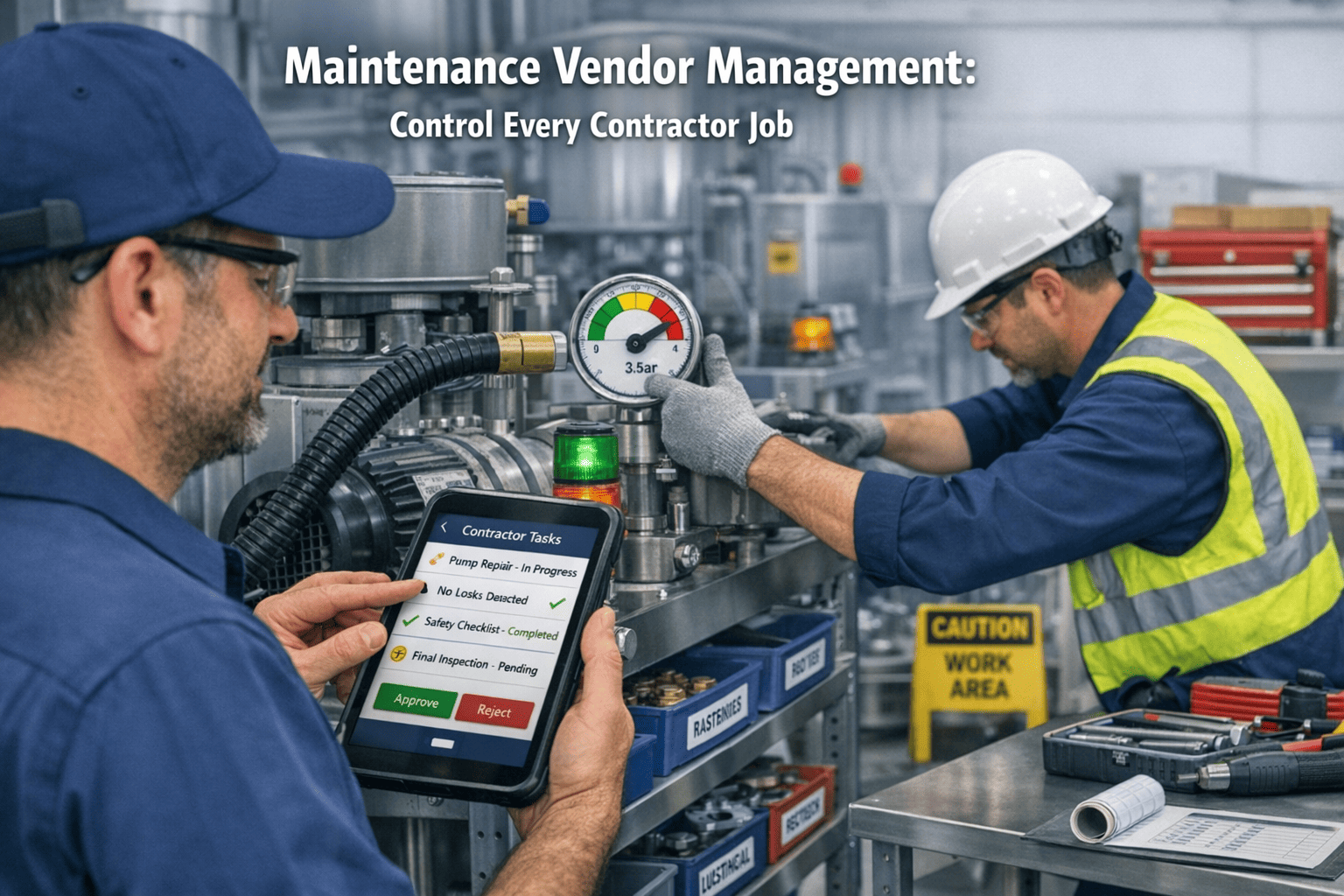
Contractors access their assigned jobs via mobile, update progress, upload photos, and submit completion sign-offs — all within the Oxmaint platform. Your team sees live status on every vendor job, from dispatch to close, without a single phone call.
Contractor certifications, insurance documents, and safety qualifications are stored in Oxmaint with automated expiry alerts. No expired credential clears a work order dispatch. Permit-to-work and LOTO checklists are embedded in job procedures, generating instant audit trails for OSHA, ISO, and GMP compliance.
Contractor-submitted labor hours and materials are automatically cross-referenced against the original work order scope and approved budget before any purchase order is generated. Overages trigger an approval workflow — not a surprise invoice. Connects directly with Oxmaint's parts and inventory management for parts traceability.
Oxmaint tracks every vendor's response time, on-time completion rate, recall rate, and cost-per-repair in real time. Analytics and reporting surfaces vendor scorecards for contract review — giving you the objective data to renegotiate, replace, or reward your contractor partners.
Every contractor job — parts replaced, faults found, procedures followed — is written into the asset's maintenance history alongside internal work. No more fragmented records. When your team picks up after a contractor, they see the full picture instantly — feeding better decisions for predictive maintenance and long-term asset strategy.
Reactive vs. Planned Contractor Management: The Cost Difference
| Management Area | Reactive / Unmanaged | Planned / CMMS-Managed |
|---|---|---|
| Work Order Issuance | Verbal or email — no formal record, scope undefined | Digital WO with scope, budget, SLA, and safety requirements attached |
| Contractor Credentials | Checked at onboarding; never monitored for expiry | Auto-alerts on expiry; work blocked until credentials renewed |
| Job Progress Visibility | Unknown until contractor calls or invoices | Real-time status, photo evidence, and digital sign-off on every job |
| Compliance Documentation | Paper files, email attachments — missing at audit time | Structured, searchable audit trail auto-generated on job close |
| Invoice Verification | Manual check against paper work order — frequent disputes | Automated three-way match: scope vs. reported work vs. invoice |
| SLA Performance | No tracking — you only know when something goes wrong | Real-time SLA dashboard; breach alerts before deadlines pass |
| Asset History | Fragmented — contractor records separate from internal records | Unified — all work written to asset history regardless of who did it |
| Contract Renewal Data | Gut feel; whoever complained loudest wins the argument | Objective vendor scorecard: cost, SLA compliance, recall rate |
ROI and Results: What CMMS-Managed Contractor Programs Deliver
The numbers make the case: CMMS-managed contractor programs don't just reduce paperwork — they cut real costs and close real compliance gaps. Calculate your ROI with Oxmaint's free calculator, or book a demo to map these outcomes to your specific contractor spend.
Frequently Asked Questions
How does a CMMS manage contractor work orders differently from internal work orders?
In a CMMS like Oxmaint, contractor work orders include all the same fields as internal work orders — asset, fault, procedure, parts — plus additional vendor-specific layers: assigned contractor, approved budget ceiling, SLA deadline, required certifications, and a permit-to-work checklist. The contractor receives the job via mobile, updates progress and uploads photos directly on the work order, and submits a digital completion sign-off. Labor hours and materials are verified against the approved scope before any purchase order or invoice is cleared. The result is a documented, traceable job record regardless of whether your team or an external vendor performed the work. Start a free trial to see vendor work orders in Oxmaint.
What compliance documents can a CMMS store and track for contractors?
A CMMS can store contractor insurance certificates, trade licenses, safety certifications, drug test records, and any required training qualifications — with automated expiry alerts so nothing lapses unnoticed. At the job level, it captures permit-to-work forms, lockout/tagout (LOTO) completion records, method statements, risk assessments, and post-work inspection sign-offs. Oxmaint's safety and compliance module generates audit-ready documentation for OSHA, ISO, GMP, and the UK Building Safety Act — structured, searchable, and available instantly when an inspector asks. No more digging through email attachments the day before an audit.
Can a CMMS help reduce contractor invoice disputes and cost overruns?
Yes — this is one of the highest-ROI functions of contractor management in a CMMS. When a work order is issued with a defined scope, approved labor hours, and a parts budget, the system creates an automatic baseline. When the contractor submits their completion report, the system compares reported hours and materials against that approved baseline. Any variance triggers a review workflow rather than flowing directly to payment. Oxmaint connects this process to parts and inventory tracking so every component charged on a contractor invoice has a corresponding stock movement or purchase order. Facilities that implement this three-way match process typically see a 30–40% reduction in invoice disputes.
How do you measure contractor performance using CMMS data?
Oxmaint's analytics and reporting module tracks every vendor against four key performance indicators automatically: response time from WO issuance to site arrival, on-time completion rate against the SLA deadline, recall rate (jobs that required a return visit within 30 days), and cost per repair versus the approved budget. These metrics aggregate into a vendor scorecard that updates in real time. At contract renewal, you arrive with objective data instead of anecdotes — and you can benchmark your top-performing contractors against each other to set realistic SLA targets and negotiate rates from a position of evidence.
Stop Managing Contractors in Your Inbox
Oxmaint gives you full visibility and accountability over every vendor work order — from AI-generated job creation to digital sign-off, compliance documentation, and performance scoring. One platform for your team and your contractors, live in days.
- Automated vendor work orders with SLA tracking and real-time status
- Compliance documentation and credential management built in
- Contractor performance scorecards with cost-per-repair analytics
Trusted by 1,000+ facilities across 9 industries · Live in days, not months · 62% less unplanned downtime