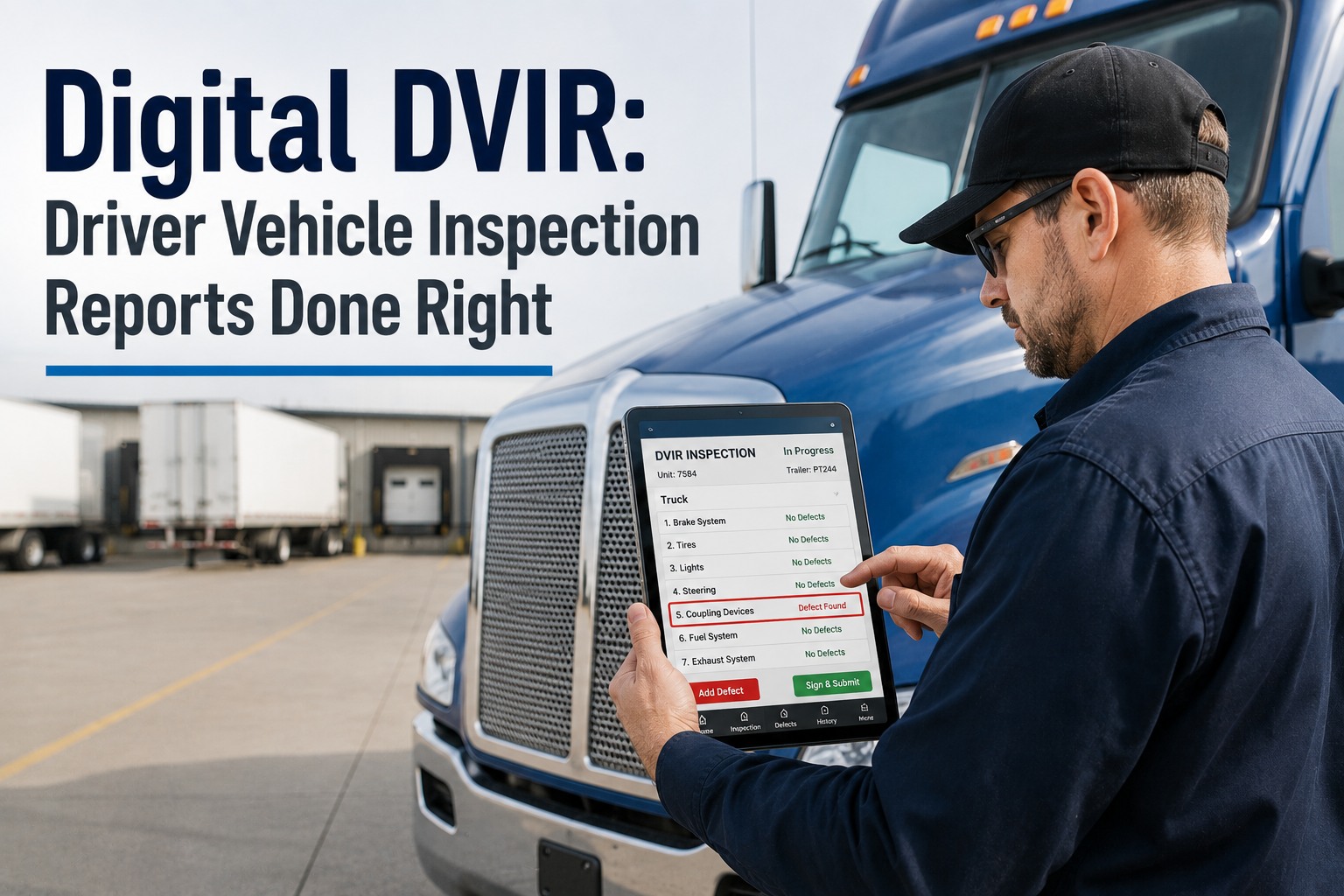
A digital DVIR — Driver Vehicle Inspection Report — replaces paper inspection forms with a mobile vehicle inspection app that captures defects, timestamps, and driver signatures in real time, creating a tamper-proof audit trail for DOT compliance. For fleets still relying on clipboard checklists, paper DVIRs don't survive roadside inspections or litigation the way electronic inspection records do, and defect-to-work-order automation is virtually impossible without a fleet inspection app connected to maintenance. OxMaint CMMS software helps fleet managers deploy a compliant digital DVIR workflow — a mobile driver app, automatic defect-to-work-order conversion, DOT-compliant records, and the CMMS integration that turns a driver inspection report from paperwork into a real safety and reliability control. You can Start Free Trial today or book a 30-minute walkthrough to see it on your assets.
DIGITAL DVIR FOR COMPLIANT FLEETS
Paper DVIRs fail DOT audits. Digital driver vehicle inspection reports don't.
A fleet DVIR built inside OxMaint flags defects the moment a driver taps them, auto-creates a corrective work order, and stores a time-stamped, geotagged electronic inspection report that satisfies FMCSA 49 CFR 396.11 — no filing cabinet, no lost sheets, no disputes.
WHY PAPERLESS WINS
Paper vs digital DVIR: the real cost of a clipboard
Fleets running 80+ power units file over 29,000 paper inspection reports a year. Even a 2% loss rate means 580 missing or illegible DVIRs — and a single missing pre-trip inspection during a DOT audit can trigger fines of $1,000–$3,000 per violation, plus a degraded CSA score.
| Capability | Paper DVIR | Digital DVIR (OxMaint) |
|---|---|---|
| Defect-to-work-order automation | Manual re-entry, 1–3 day lag | Instant auto-creation, zero re-keying |
| Audit trail & retrieval time | Hours in filing cabinets; 4–8% lost | Searchable in seconds, 0% loss |
| Driver completion rate visibility | Unknown until sheets are collected | Real-time dashboard, 95%+ compliance |
| Geotag & timestamp integrity | Easily back-dated or forged | Tamper-proof GPS + server time |
| Corrective-action proof for DOT | Scattered work-order copies | Linked defect → work order → sign-off |
| Cost per inspection (incl. labor) | $2.50–$4.00 per form | $0.35–$0.60 per eDVIR |
Worked example — a 120-truck regional carrier spending roughly $48,000/yr on paper forms, data entry, and lost-defect corrections switched to OxMaint digital DVIR. Within 90 days, defect-report-to-repair time dropped from 2.4 days to 4 hours, roadside violations fell 38%, and the paper handling line item was eliminated entirely — a payback of under 11 weeks.
ROLLOUT IN 5 PHASES
How to deploy a compliant digital DVIR program
A fleet DVIR rollout that sticks follows a disciplined sequence. Skip a phase and you get spotty adoption, incomplete records, and audit gaps. Here is the proven 5-phase path OxMaint fleet customers use to go paperless in 30–45 days.
Week 1 — Map inspection templates to FMCSA 396.11
Build pre-trip and post-trip checklists inside OxMaint that mirror the exact defect categories required by regulation: brakes, steering, lights, tires, coupling, wheels & rims, emergency equipment. Digitize custom items for reefers, tankers, or PTO-driven equipment so every asset type has a purpose-built electronic inspection report.
Week 2 — Provision drivers & vehicles
Assign each driver a mobile app login and pair each truck/trailer to a QR code or NFC tag. A driver scans the asset, the correct inspection form loads automatically — no manual unit-number entry, no wrong-asset reports. Average provisioning time: 3 minutes per vehicle.
Week 3 — Enable defect-to-work-order automation
Configure rules so any defect flagged "vehicle not safe to operate" instantly generates a high-priority work order in OxMaint CMMS, notifies the shop foreman, and locks the asset from dispatch until a mechanic signs off the repair. This is the step that turns DVIR from paperwork into a reliability control.
Week 4 — Pilot with 10–15% of the fleet
Run a controlled pilot to catch friction: form length, signal-dead zones in yards, driver training gaps. OxMaint captures completion rates and defect trends from day one, so you can measure adoption before full rollout. Target benchmark: 92%+ pre-trip completion by end of pilot week 2.
Weeks 5–6 — Full deployment & audit readiness
Roll out fleet-wide, retire paper forms, and brief drivers and shop staff on the new workflow. Every electronic inspection report — pass or fail — now lives in OxMaint with driver signature, GPS location, timestamp, photos, and linked corrective work orders. A DOT auditor can be shown any record in under 30 seconds.
THE CHECKLIST
What a DOT-compliant digital DVIR must capture
Whether you use OxMaint or evaluate any fleet inspection app, these are the non-negotiable data points an electronic inspection report must lock down to satisfy FMCSA 396.11 and survive a compliance review.
Driver & Vehicle Identification
Driver name or ID, CDL number, vehicle/unit number, trailer number(s), date, and odometer/hubometer reading — captured automatically via app login and QR scan.
Defect Categories (396.11 Appendix)
Brake system, coupling devices, exhaust, frame, tires, wheels & rims, steering, suspension, lights, mirrors, windshield wipers, oil pressure, temperature — each as a tappable pass/fail item.
Defect Description & Photos
Free-text or voice-to-text defect notes plus mandatory photos for any "unsafe" flag — giving the mechanic visual context before the truck reaches the bay.
Safe-to-Operate Declaration
A clear yes/no statement: "No defects" or "Defects noted — vehicle is/is not safe to operate," digitally signed by the driver before the trip begins.
Mechanic Repair Sign-Off
For any defect flagged unsafe, the repairing mechanic's signature, repair date, parts used, and a declaration that the vehicle is now safe — linked directly to the originating DVIR.
Tamper-Proof Timestamp & Geo-location
Server-side timestamp and GPS coordinates at submission — preventing back-dated reports and proving the inspection happened at the stated location and time.
HOW OXMAINT HELPS
From driver inspection report to reliability control
OxMaint is not just a DVIR app bolted onto a spreadsheet — it is an AI-powered CMMS and EAM platform. The digital DVIR module feeds defect data straight into work-order management, preventive maintenance scheduling, and predictive analytics, so every inspection makes the next breakdown less likely.
Defect-to-work-order automation
Every flagged defect instantly generates a tracked work order with priority, asset, parts, and labor estimate — cutting defect-to-repair time by up to 85% and eliminating manual re-entry.
Offline-first mobile driver app
Drivers complete pre-trip and post-trip inspections on any phone — even in yard dead zones. Reports sync the moment signal returns, with zero data loss and a 95%+ driver completion benchmark.
Audit-ready compliance vault
Every DVIR, defect photo, mechanic sign-off, and corrective work order is stored in a searchable, time-stamped archive — retrievable in under 30 seconds during a DOT compliance review or legal dispute.
Predictive defect analytics
AI correlates repeated defect types — brake adjustments, tire pressure, lighting — by asset, route, and driver, predicting failures 7–21 days out and cutting unplanned downtime 30–50%.
85%
Faster defect-to-repair
30–50%
Less unplanned downtime
11 wks
Typical payback period
0%
Lost or illegible reports
See OxMaint digital DVIR on your fleet — book a 30-minute demo
We will load your inspection template, pair a sample truck, and show a defect auto-generating a work order in real time. No slide deck, no generic walkthrough — just your workflow, live.
DVIR FAQ
Frequently asked questions about digital DVIR
What is a digital DVIR and is it FMCSA-compliant?
A digital DVIR is an electronic driver vehicle inspection report completed on a mobile app or tablet instead of paper. It is fully FMCSA-compliant under 49 CFR 396.11 and 390.31 as long as it captures the same required defect categories, driver and mechanic signatures, timestamps, and is retrievable for inspection — which OxMaint does automatically with tamper-proof GPS and server-side time stamps.
How does a digital DVIR app handle areas with no cell signal?
OxMaint's mobile vehicle inspection app works fully offline. Drivers complete pre-trip and post-trip inspections in yard dead zones or remote routes; the report, photos, and signature are cached locally and auto-sync the moment the device reconnects — with zero data loss and no duplicate submissions. You can try this on your own devices when you Start Free Trial.
Can a defect flagged during a digital DVIR automatically create a work order?
Yes. When a driver marks a defect as "unsafe to operate," OxMaint instantly generates a high-priority work order in the CMMS, assigns it to the correct mechanic or shop, reserves parts if needed, and blocks the asset from dispatch until the repair is signed off — all without manual re-entry or phone calls.
How long must electronic DVIR records be retained?
FMCSA regulations require motor carriers to retain DVIR records — paper or electronic — for a minimum of 12 months from the date of the report. OxMaint stores every electronic inspection report, defect photo, and linked work order indefinitely in a searchable compliance vault, so a DOT auditor or attorney can retrieve any record in seconds rather than digging through filing cabinets.
How long does it take to switch from paper DVIRs to a fleet inspection app?
Most OxMaint fleet customers go live in 30–45 days: one week to map inspection templates, one week to provision drivers and QR-tag vehicles, one week to enable defect automation, and a 2-week pilot before full rollout. Existing paper templates are digitized directly, so there is no redesign — just a faster, compliant, paperless workflow from day one.
GO PAPERLESS THIS QUARTER
Replace paper DVIRs with a fleet inspection app that actually prevents breakdowns
OxMaint turns every driver inspection report into an automated, audit-ready, reliability-driving control — connected to work orders, PM schedules, and predictive analytics in one AI-powered CMMS.
Free 14-day trial · No credit card