Not every asset in an Aviation & MRO operation deserves the same maintenance attention, and treating them all equally is exactly why maintenance budgets overrun while critical equipment in aviation & MRO still fails. Equipment criticality analysis ranks aviation and MRO critical assets using consequence-of-failure scoring across safety, production loss, environmental impact, repair cost, and regulatory risk, giving your reliability team a defensible, data-driven answer to where the next maintenance dollar should go. By building an aviation and mro equipment risk ranking matrix, you can automatically route Tier 1 work orders to your best technicians, enforce stricter PM schedules on high-risk assets, and eliminate the guesswork that drains resources. OxMaint's AI-powered CMMS makes this ranking operational, and you can Start Free Trial to see it in action.
Which Aviation & MRO assets actually threaten your operation?
In a typical MRO facility, 15% of assets drive 80% of downtime risk, safety exposure, and regulatory penalties. Yet most teams still maintain everything on the same schedule, wasting budget on low-risk equipment while Tier 1 systems fail without warning. OxMaint turns criticality scoring into a live, automated maintenance strategy.
How to rank aviation and mro critical assets by consequence of failure
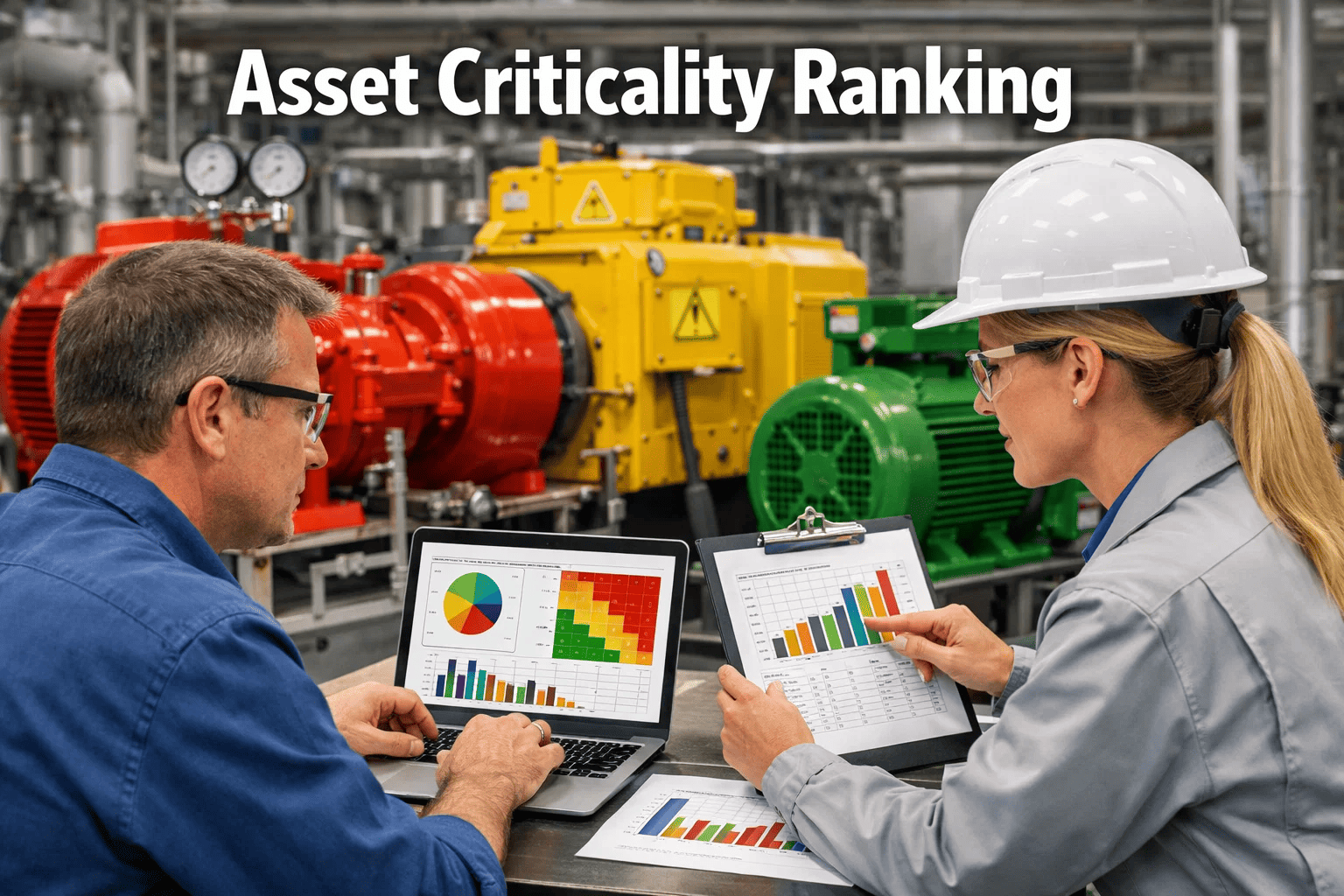
A defensible aviation and mro equipment ranking scores every asset from 1 to 5 across five consequence dimensions. The product of these scores yields a Risk Priority Number (RPN) up to 3,125, which is then mapped to a maintenance tier. This is the backbone of RCM in aviation & MRO and aligns directly with ISO 55000 asset management principles.
Will a failure injure technicians, ground crew, or flight-line staff? Assets near fuel systems, high-pressure hydraulics, or energized test cells carry the highest safety multipliers. A 5/5 safety score means a single failure could cause a lost-time injury or fatality.
If this asset stops, how many aircraft-grounding hours accumulate? A bay door motor failure may delay one aircraft, while a hangar crane failure can block an entire production line, costing $12,000–$50,000 per grounded hour in AOG scenarios.
Fuel farms, chemical storage, and de-icing systems pose spill and contamination risks. A 5/5 environmental score triggers EPA reportable thresholds, mandatory cleanup, and potential facility shutdown exceeding $250,000 in remediation costs.
NDT equipment, autoclaves, and specialized test rigs often have 12–26 week replacement lead times with six- to seven-figure price tags. Long lead times amplify the consequence of failure and push these assets into Tier 1 territory.
Will a failure trigger an FAA, EASA, or C findings citation? Assets tied to airworthiness directives, Part 145 station requirements, or calibrated tooling mandates carry heavy regulatory consequence scores that can suspend an operating certificate.
Multiply all five scores. The resulting RPN determines whether an asset is Tier 1 (essential, highest PM frequency), Tier 2 (standard PM), or Tier 3 (run-to-failure or minimal PM). OxMaint automates this calculation and re-scores dynamically as conditions change.
Aviation and mro essential equipment list: Tier 1 vs Tier 2 vs Tier 3
Below is a representative criticality matrix for an MRO facility. Use it as a template for your own critical asset register. Note how the RPN shifts an asset's tier — and how that tier dictates PM frequency, spare-parts strategy, and technician assignment.
| Asset Category | Example Equipment | Avg RPN | Tier | PM Frequency | Spares Strategy |
|---|---|---|---|---|---|
| Aircraft Jack Systems | 50-ton hydraulic tripod jacks | 1,875 | Tier 1 | Monthly + pre-use | Critical spare on-site |
| NDT & Test Equipment | Eddy current, ultrasonic flaw detectors | 1,600 | Tier 1 | Quarterly calibration | Redundant unit |
| Hangar Crane & Hoists | Overhead bridge cranes, engine hoists | 1,500 | Tier 1 | Bi-monthly | Critical spare on-site |
| Compressed Air Systems | Rotary screw compressors, dryers | 960 | Tier 2 | Quarterly | Standard stock |
| Ground Power Units | Mobile 400Hz GPU converters | 840 | Tier 2 | Quarterly | Standard stock |
| Hangar Bay Doors | Vertical-lift, motor-driven doors | 625 | Tier 2 | Semi-annual | Standard stock |
| Shop HVAC (non-cleanroom) | Rooftop units, exhaust fans | 360 | Tier 3 | Annual | Run-to-failure |
| General Lighting | LED high-bay fixtures | 180 | Tier 3 | None / reactive | Bulk stock |
The cost of not ranking aviation and mro high risk assets
A mid-sized Part 145 MRO facility maintained all 180 assets on identical 90-day PM cycles. Their maintenance team spent 60% of its labor budget on Tier 3 equipment like general HVAC and non-critical lighting — while a Tier 1 hydraulic test stand seized during a certification run.
The test stand failure grounded two aircraft for 11 days, triggered a missed delivery penalty of $38,000, and required an expedited replacement motor that cost $14,500 in premium freight. Total incident cost: $67,500. A proper criticality analysis would have flagged the test stand as Tier 1 (RPN 1,820), increased its PM to monthly, and caught the bearing wear during a routine vibration check.
How OxMaint makes aviation & mro reliability operational
A criticality matrix on a spreadsheet changes nothing. OxMaint embeds tier assignments directly into your daily maintenance workflow — from work-order routing to PM enforcement to real-time risk dashboards. Here is how four OxMaint capabilities map directly to your criticality program.
Automated Tier-Based Work Routing
Tag every asset in your critical asset register with its Tier 1–3 score. OxMaint automatically routes Tier 1 work orders to your most senior, certified technicians and enforces secondary sign-off before closure. No more critical asset repairs assigned to the wrong skill level.
Dynamic PM Schedule Enforcement
OxMaint enforces stricter PM intervals on aviation and mro essential equipment based on live tier assignments. If an asset's risk score changes — say, due to increased utilization or age — OxMaint automatically shortens the PM interval and alerts the reliability team.
Real-Time Risk & Criticality Dashboards
Live dashboards show where downtime risk is concentrated across single or multi-site networks. Drill from facility level to asset level to see which Tier 1 equipment has open work orders, overdue PMs, or rising vibration/temperature trends flagged by predictive analytics.
Spare-Parts Tied to Asset Tier
OxMaint links your spare-parts inventory directly to asset criticality. Tier 1 assets automatically enforce minimum stock levels with auto-reorder triggers, while Tier 3 parts shift to just-in-time purchasing — freeing up working capital without increasing risk.
What changes when criticality drives maintenance strategy
We stopped maintaining every asset like it was the same. OxMaint flagged our 23 Tier 1 assets, auto-routed their work orders to our A-team, and we cut a test-stand failure that was costing us $40K a quarter down to zero in six months.
See OxMaint rank your critical assets — live in 30 minutes
Book a demo and we will run your real asset list through the criticality engine, show you the RPN scores, and map the automated PM and routing changes in real time.
Critical equipment in aviation & mro: frequently asked questions
What is equipment criticality analysis in aviation and MRO?
Equipment criticality analysis is a structured method of ranking aviation and mro critical assets by the consequence of their failure, scoring each asset across safety, production loss, environmental impact, repair cost, and regulatory risk. The resulting Risk Priority Number (RPN) assigns assets to maintenance tiers (Tier 1, 2, or 3) so teams can focus labor and budget where failure matters most. It is the foundation of RCM in aviation & MRO and aligns with ISO 55000 asset management standards.
How do you build an aviation and mro critical equipment list?
Start with a complete aviation and mro equipment inventory, then score each asset 1–5 across the five consequence factors. Multiply the scores to get an RPN, then group assets into tiers: Tier 1 (RPN ≥ 1,500) for essential equipment requiring the strictest PM schedules, Tier 2 (500–1,499) for standard preventive maintenance, and Tier 3 (below 500) for run-to-failure or minimal PM. OxMaint automates this scoring and maintains your critical asset register as a living document — you can Start Free Trial to build yours today.
What is the difference between Tier 1 and Tier 2 equipment in MRO?
Tier 1 equipment has the highest consequence-of-failure score — typically involving safety risk, production-stopping downtime, or regulatory exposure. These assets receive the most frequent PMs, mandatory spare-parts stocking, and are routed to senior technicians. Tier 2 assets carry moderate risk: their failure causes delays or cost but does not immediately threaten safety or compliance, so they receive standard quarterly or semi-annual PMs.
How often should aviation and mro equipment risk ranking be updated?
Criticality scores should be reviewed at least annually, and dynamically whenever operating conditions change — new asset additions, modified production lines, aging equipment crossing utilization thresholds, or regulatory updates. OxMaint re-scores assets automatically when condition data, utilization, or failure history shifts, so your tier assignments never go stale. Schedule a review session via Book a Demo to see dynamic re-scoring in action.
Can OxMaint import an existing critical asset register from spreadsheets?
Yes. OxMaint includes a bulk-import engine that accepts existing asset registers, criticality scores, and PM schedules from Excel, CSV, or legacy CMMS exports. Most facilities are fully migrated and live within 10–14 days, with tier assignments, work-order routing, and PM enforcement active from day one — no spreadsheets or paper work orders required.
Stop guessing where to spend your maintenance budget
Rank your critical equipment in aviation & MRO, automate Tier 1 PM enforcement, and cut unplanned downtime by up to 50% with OxMaint.
Free 14-day trial · No credit card