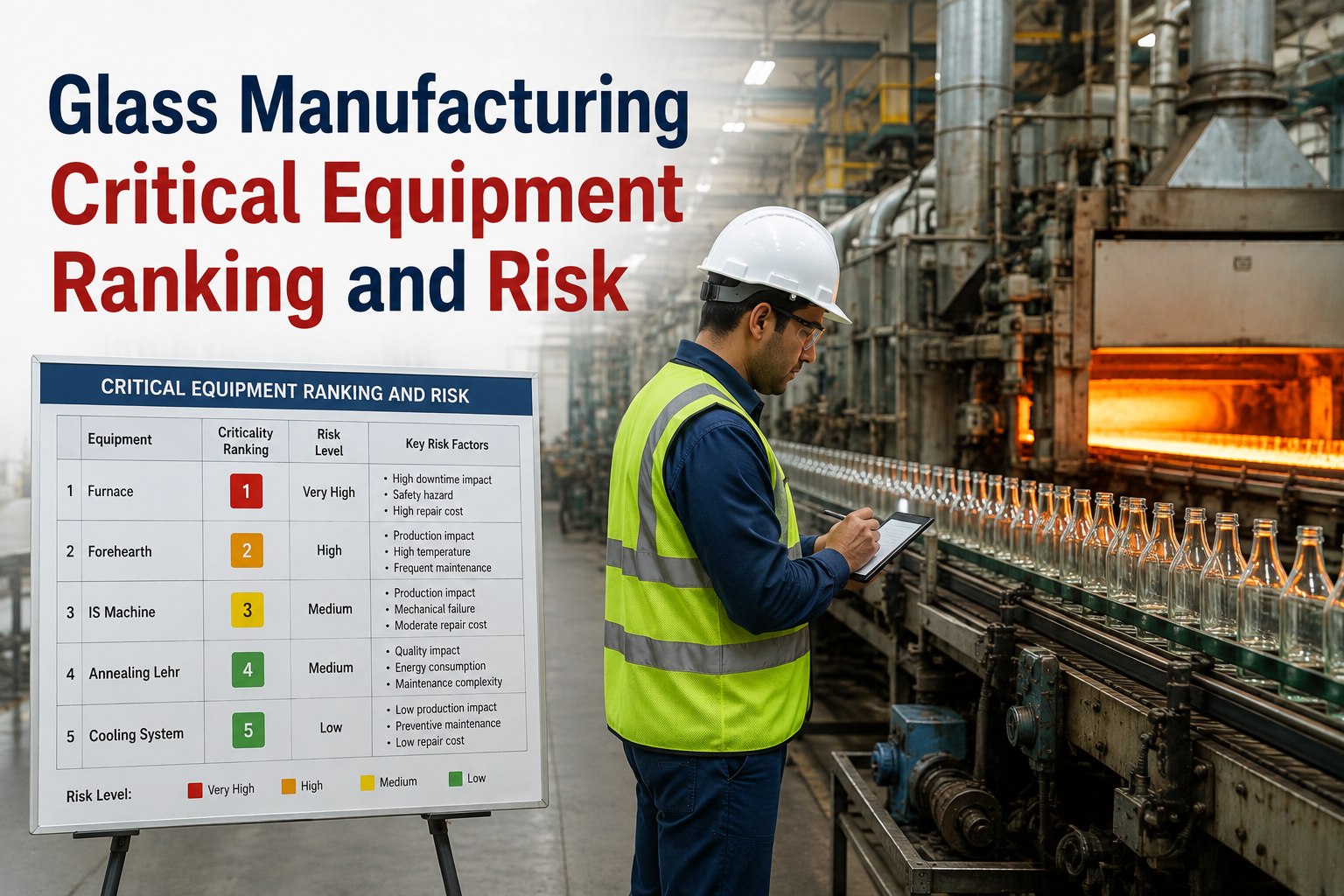
Ranking critical equipment in glass manufacturing by consequence of failure is the single most effective way to prevent catastrophic downtime, protect plant safety, and optimize maintenance spend. In a typical float glass or container glass facility, a handful of high-risk assets—such as the melter furnace, tin bath, and lehr—account for the majority of production loss and safety exposure when they fail. This guide breaks down a data-driven criticality matrix for glass manufacturing essential equipment, showing you exactly how to score asset priority across safety, production, environment, and cost. Build your defensible, Tier 1 equipment inventory today when you Start Free Trial with OxMaint.
EQUIPMENT RISK & CRITICALITY
Which assets threaten your glass plant's survival — and how much is ignoring them really costing you?
Not every motor, pump, and fan deserves the same preventive maintenance attention. Treating all assets equally is exactly why maintenance budgets overrun while Tier 1 equipment still fails. Quantify your true downtime risk and redirect your resources where they matter most.
RANKING METHODOLOGY
How to build a glass manufacturing critical equipment list
Building a defensible critical asset register for glass manufacturing requires scoring every piece of equipment against five operational dimensions. Instead of relying on tribal knowledge or a generic glass manufacturing equipment inventory, a standardized consequence-of-failure scoring system (aligned with ISO 55000 asset management principles) gives your reliability team a mathematical basis for prioritizing work orders and capital expenditures. Score each asset from 1 (negligible) to 5 (catastrophic) across the following criteria, then sum the totals to assign a final priority tier.
CONSEQUENCE OF FAILURE (CoF) SCORING FORMULA
CoF Score = (Safety × 1.5) + Production Loss + Environmental Impact + Repair Cost + Regulatory Risk
Safety is weighted at 1.5x due to the extreme human and liability costs of failures in high-temperature glass environments. Assets scoring 18+ are Tier 1; 12–17 are Tier 2; below 12 are Tier 3.
Safety & Environmental Impact
Assesses the potential for severe burns, toxic gas release (NOx, SOx), molten glass leakage, and catastrophic structural failure. A furnace refractory breach scores a 5, while a broken office HVAC unit scores a 1.
Production Loss & Repair Cost
Calculates the downtime hours and direct material/cost impact. A cold-tank repair on a container glass furnace can halt production for 45+ days and cost over $8M, easily scoring a 5 for both factors.
Regulatory & Compliance Risk
Evaluates exposure to EPA, OSHA, and local environmental permits. Failing a baghouse or electrostatic precipitator risks heavy fines and forced plant shutdowns, pushing the asset into a high-risk tier.
CRITICALITY MATRIX
Glass manufacturing equipment ranking: Tier 1 vs. Tier 2 assets
Applying the consequence-of-failure matrix to a standard float glass plant reveals a stark contrast in asset priority. Your glass manufacturing tier 1 equipment requires predictive maintenance technologies (vibration analysis, thermal imaging, ultrasonic testing) and strict PM adherence. Tier 2 and Tier 3 assets can safely run to failure or utilize basic preventive maintenance, freeing up your best technicians for the high-risk assets. Below is a comparative breakdown of essential glass manufacturing equipment.
| Equipment Category | Key Assets | CoF Score | Tier | Primary Failure Mode |
|---|---|---|---|---|
| Melting & Forming | Melting Furnace, Tin Bath, Regenerators | 23 / 25 | Tier 1 | Refractory failure, glass leaks |
| Annealing & Handling | Lehr, Cooling Fans, Stackers | 17 / 25 | Tier 2 | Belt failure, motor burnout |
| Batch & Cullet | Batch Chargers, Conveyor Belts, Mixers | 15 / 25 | Tier 2 | Wear, jamming, alignment loss |
| Utilities & Power | Air Compressors, Water Chillers, Transformers | 20 / 25 | Tier 1 | Cooling loss, electrical fault |
| Pollution Control | Baghouses, Electrostatic Precipitators | 19 / 25 | Tier 1 | Filter rupture, opacity exceedance |
| General Facility | Office HVAC, Forklifts, Lighting | 6 / 25 | Tier 3 | Run-to-failure acceptable |
SCENARIO
The true cost of misclassified glass manufacturing high risk assets
Consider a multi-plant container glass manufacturer running 180 critical assets. Without a formal criticality matrix, maintenance teams typically distribute PM hours evenly. A 250 HP cooling water pump (Tier 1) receives the same 2 hours of monthly attention as a warehouse exhaust fan (Tier 3). When the pump's bearing seizes due to undetected vibration, the furnace cooling system fails, forcing an emergency furnace tap. The result: 72 hours of unplanned downtime, $3.6M in lost production, and $140K in emergency repair costs. RCM (Reliability-Centered Maintenance) for glass manufacturing prevents this by aggressively shifting maintenance hours toward assets with the highest consequence of failure.
Asset Hierarchy & Data Audit
Upload all equipment into OxMaint, map parent-child relationships, and assign initial consequence scores based on historical downtime data.
Criticality Workshop & Scoring
Reliability engineers and operators finalize the 1–5 scores. Tier 1 assets are tagged for predictive maintenance (PdM) routes; Tier 3 assets move to run-to-failure.
Strategy Realignment
OxMaint auto-routes Tier 1 PMs to senior technicians and enforces stricter completion SLAs. PdM sensors (vibration/thermal) are linked to asset records.
Risk Reduction & ROI
Unplanned downtime drops by 30–50%. Maintenance budgets are reallocated from low-value PMs to predictive analytics, yielding a full ROI within the first quarter.
Stop guessing where your maintenance dollars should go.
See how OxMaint's AI-powered criticality matrix automatically ranks your glass manufacturing equipment and routes work orders to eliminate unplanned downtime.
HOW OXMAINT HELPS
Operationalize your glass manufacturing asset priority with OxMaint
A criticality matrix is useless if it lives in a spreadsheet. OxMaint's AI-powered CMMS and EAM platform turns your glass manufacturing equipment risk ranking into automated, daily action—ensuring your Tier 1 assets get predictive protection while Tier 3 assets don't waste your maintenance budget.
Automated Tier-Based Work Order Routing
Tag every asset with its criticality tier. OxMaint automatically assigns Tier 1 work orders to your most experienced technicians and enforces stricter PM schedule adherence, cutting response times by up to 40%.
Predictive Maintenance Integration
Connect vibration, thermal, and pressure sensors to your high-risk assets. OxMaint's AI analyzes the data streams to predict refractory degradation or bearing failures weeks before they cause unplanned downtime.
Real-Time Risk Dashboards
Replace tribal knowledge with live visibility. Get a centralized dashboard showing exactly where downtime risk is concentrated across single or multi-plant networks, ready for any ISO 55000 audit.
Critical Spare Parts Buffering
Link your Tier 1 assets directly to spare-parts inventory. OxMaint enforces minimum stock levels for high-risk components, ensuring critical parts are always available and eliminating emergency procurement costs.
FAQ
Glass manufacturing critical equipment & risk ranking
What is the most critical equipment in a glass manufacturing plant?
The melting furnace, tin bath (for float glass), and lehr are universally considered the most critical equipment. These assets operate continuously at extreme temperatures, and an unplanned failure can halt production for weeks or months, costing millions of dollars in lost revenue and emergency repairs.
How do you calculate consequence of failure for glass manufacturing assets?
Consequence of failure is calculated by scoring assets 1–5 across safety, production loss, environmental impact, repair cost, and regulatory risk. Safety is often weighted higher. You can build this matrix automatically by mapping your asset hierarchy in OxMaint; Book a Demo to see the scoring engine in action.
What is the difference between Tier 1 and Tier 2 glass manufacturing equipment?
Tier 1 equipment (like furnaces and critical cooling systems) has a catastrophic consequence of failure, halting production and posing severe safety risks. Tier 2 equipment (like batch chargers or lehr fans) causes significant but recoverable production delays. Tier 1 requires predictive maintenance, while Tier 2 typically requires robust preventive maintenance.
How does RCM apply to glass manufacturing reliability?
Reliability-Centered Maintenance (RCM) in glass manufacturing involves identifying the specific failure modes of high-risk assets and applying the right maintenance strategy—predictive, preventive, or run-to-failure. RCM ensures you aren't over-maintaining cheap, non-critical assets while under-protecting the Tier 1 equipment that dictates plant uptime.
Why should we use a CMMS for our critical asset register?
A CMMS like OxMaint operationalizes your critical asset register by tying criticality scores directly to work order routing, PM schedules, and spare parts inventory. This replaces static spreadsheets with a dynamic system that automatically prioritizes high-risk assets, ensuring your maintenance budget is always spent where it reduces risk the most.
READY TO REDUCE DOWNTIME?
Build your defensible equipment criticality matrix today
Join the glass manufacturing reliability teams using OxMaint to protect their Tier 1 assets, cut unplanned downtime by up to 50%, and eliminate maintenance paperwork.
Free 14-day trial · No credit card