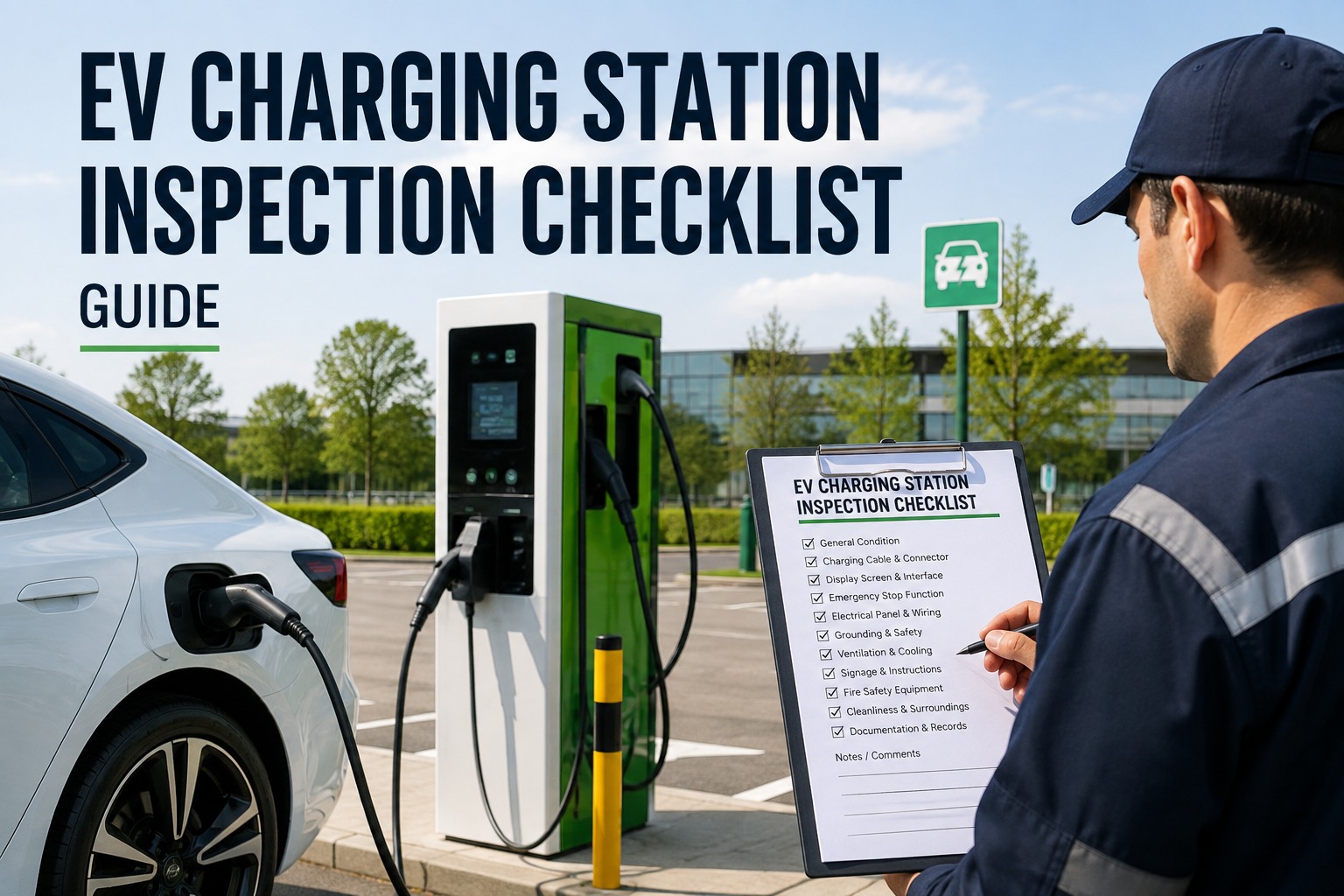
EV Charging Station Inspection Checklist Guide

Connect with Industry Experts, Share Solutions, and Grow Together!

Join Discussion Forum
ev-charging-station-inspection-checklist-guide

A commercial EV charger takes thousands of plug cycles a year, sits outdoors through freeze-thaw cycles and summer heat, handles 240V or up to 800V DC, and is expected to hit 97% monthly uptime per port to keep NEVI funding eligibility. And yet most operators still run inspections from memory, a photocopied form, or "we'll get to it next month" — until a frayed cable causes a GFCI trip that kicks the site offline for a week. This checklist isn't a nice-to-have. Under NEC Article 625, NFPA 70E, SAE J1772/J3068, OSHA 29 CFR 1910.303, and UL 2594, every commercial EV charger has documented inspection obligations, and every skipped step becomes a compliance gap, a safety exposure, or a downtime event waiting to happen. This guide gives you the full checklist — 6 sections, 40+ inspection points, split by inspection frequency, mapped to the actual failure modes each check catches — and shows how OxMaint CMMS turns it into auto-scheduled PM work orders with photo capture, e-signatures, and audit-ready records against every asset. Start free or book a demo to see the full digital checklist live.

Facility Management · EV Infrastructure · Inspection · CMMS 2026

EV Charging Station Inspection Checklist Guide

Complete EV Charging Station procedure for US maintenance teams. OSHA aligned, digital capture with photo proof, e-signatures & audit-ready records. Start free with unlimited chargers and technicians.

6 Sections
Standard inspection sections aligned to NEC 625 & UL 2594
40+ Points
Total inspection checkpoints across a full DC fast charger
97%
NEVI-required per-port monthly uptime threshold
4 Cadences
Daily · Weekly · Monthly · Quarterly · Annual (5 total)

The Inspection Cadence Ladder — How Often Each Check Runs

Not every inspection point runs on the same schedule. Some are daily walk-by checks; some need a licensed electrician annually. Getting the cadence right is what separates a compliant program from a checklist that quietly slips into "annual only" — the fastest path to a NEVI eligibility loss. Below is the standard cadence hierarchy. Sign up free and OxMaint's facility library ships with pre-configured EV charging asset templates for both Level 2 and DC fast chargers — every inspection cadence auto-schedules against every charger the moment you register it, no manual PM creation.

DAILY
Visual Walk-By
2-3 min per charger
Screen operational, cable free of visible damage, holster in place, no obvious vandalism, area free of debris.
WEEKLY
Detailed Visual + Cable
10-15 min per charger
Full cable inspection along entire length, connector pin cleanliness, enclosure integrity, cable management/holster function.
MONTHLY
Connector Pin + Firmware
20-30 min per charger
Contact resistance measurement (mΩ), firmware audit, network connectivity test, OCPP fault log review.
QUARTERLY
GFCI & Cooling (L3)
45-60 min per charger
GFCI function test, air filter service, DC fast charger coolant level/quality, thermal imaging of cabinet.
ANNUAL
Licensed Electrician
2-4 hrs per charger
Ground continuity <0.1 Ω, insulation resistance, torque check all connections, transformer test, full compliance record.

The 6-Section Master Inspection Checklist

Every commercial EV charger inspection organizes into six mandatory sections. This is the same structure used by NEC-aligned inspection programs and NEVI-eligible operators. Each section below lists the checkpoints, the pass/fail thresholds, and the corrective action if the check fails. Book a 30-minute demo and an OxMaint facility specialist will walk this 6-section checklist against your specific charger deployment — Level 2 wall units, DC fast pedestals, or mixed fleet — and show you where automated inspection cadence would tighten your NEVI compliance.

01
Physical & Exterior Condition
Daily / Weekly
  • Enclosure free of cracks, dents, corrosion, vandalism, graffiti
  • Pedestal secure, mounting bolts tight, no ground shift
  • Display screen operational, readable, no cracks
  • Indicator lights functional (power, fault, charging status)
  • Signage present, legible, ADA-compliant (15-48" reach range)
  • Weather seals intact, drainage clear, no water ingress
02
Cable & Connector Integrity
Weekly / Monthly
  • Cable jacket free of cuts, abrasion, kinks, exposed conductors along entire length
  • Strain reliefs intact at both connector and enclosure ends
  • Connector body (J1772, CCS, CHAdeMO, NACS) free of cracks or damage
  • Pin condition — no corrosion, no burn marks, no missing pins
  • Contact resistance measured < OEM spec (typically 5-10 mΩ)
  • Latch mechanism operates smoothly, holds securely under load
  • Cable management/holster supports cable weight off ground
03
Electrical Systems & Power Verification
Quarterly / Annual
  • Input AC voltage within ±10% of rated (per NEC 625)
  • Equipment grounding conductor (EGC) continuity < 0.1 Ω to ground electrode
  • GFCI or isolation monitoring tested and functional
  • Overcurrent protection devices verified — breakers, fuses in spec
  • Insulation resistance ≥ OEM minimum (typically ≥ 1 MΩ)
  • All electrical connections torqued to OEM specification
  • Output voltage/current within manufacturer tolerance
04
Thermal Management & Cooling (DC Fast Only)
Quarterly
  • Air filters clean, unrestricted airflow through cabinet
  • Cooling fans operational, no unusual noise or vibration
  • Liquid coolant level within OEM range (liquid-cooled cables)
  • Coolant quality — no discoloration, no particulates, pH in spec
  • Thermal imaging of cabinet — no unexpected hot spots
  • Cabinet interior temperature within normal operating band
05
Software, Firmware & Network
Monthly
  • Firmware version current to OEM release notes
  • Security patches applied within vendor SLA
  • Network connectivity stable (cellular signal or ethernet uptime)
  • OCPP fault log reviewed, recurring codes flagged
  • Payment/authentication system functional (RFID, app, credit card)
  • Backend session data transmitting to network management platform
06
Safety Systems & Documentation
Weekly / Annual
  • Emergency stop button accessible, functional, tested
  • Arc fault detection system operational (per SAE J1772)
  • Warning labels legible and in place
  • Parking lot condition — no potholes/trip hazards, adequate lighting
  • Inspection record uploaded to CMMS/asset management system
  • Technician e-signature captured on completion
  • Photos of any defects attached to WO record

The 4 Failure Modes This Checklist Actually Prevents

Charger downtime isn't random. Four failure modes account for the majority of unplanned outages in commercial deployments, and each has a preventive signature that this checklist catches early — before the charger goes offline. Below is the failure-mode-to-checkpoint map. Sign up free and OxMaint auto-links every inspection finding to the failure mode it prevents — so your uptime KPIs and PM compliance stay visibly connected in the same dashboard.

01
Cable & Connector Wear
SINGLE MOST COMMON FAILURE
Thousands of plug cycles per year plus weather exposure degrade cable jackets and connector pins faster than most operators track. Frayed sheathing and pin corrosion cause intermittent faults long before hard failure. Caught by: Section 02 weekly inspection.
02
GFCI / Ground Fault Trip
HIGHEST DOWNTIME COST PER EVENT
Compromised insulation or wet connector triggers GFCI, taking the charger offline until manually reset and root-caused. Caught by: Section 02 (cable integrity) + Section 03 (quarterly GFCI test).
03
DC Fast Charger Cooling Failure
LEADS TO POWER DERATING & SHUTDOWN
Blocked air filters, low coolant, or fan failure causes cabinet over-temp — charger derates first, then shuts down. Caught by: Section 04 quarterly cooling inspection + thermal imaging.
04
Firmware & Network Drift
MOST-MISSED FAILURE MODE
Outdated firmware, missed security patches, or cellular signal degradation cause session failures that show up as "user complaint" but never as a hard fault code. Caught by: Section 05 monthly firmware & network audit.

A Paper Checklist Is a Checklist You Can't Prove You Did.

NEVI auditors don't accept "we do it every month." They accept timestamped digital records with technician e-signatures and photo evidence. OxMaint auto-generates every inspection as a work order on the correct cadence, forces photo capture at defined checkpoints, requires e-signature at close, and stores the full history against the charger asset — exportable in one click for any compliance review.

Compliance Standards This Checklist Aligns To

The checklist above isn't opinion — it's built to the letter of the standards US commercial EV operators are legally and contractually bound by. Below is the compliance map. Book a scoping call and an OxMaint compliance specialist will walk your specific charger fleet against these five standards — you'll leave with a gap analysis before you commit to a trial workspace.

NEC 625
National Electrical Code Article 625
Electric Vehicle Charging System Equipment — governs installation, grounding, overcurrent protection, and disconnect requirements.
NFPA 70E
Electrical Safety in the Workplace
Governs safe work practices, PPE requirements, and arc-flash risk assessment for technicians performing charger maintenance.
SAE J1772
AC Charging Connector Standard
Level 1 & Level 2 conductive charge coupler standard — governs connector geometry, pin function, and safety interlock requirements.
OSHA 1910.303
General Electrical Safety Requirements
Federal workplace electrical safety — inspection, maintenance, and hazard mitigation obligations for employers with electrical equipment.
UL 2594
EVSE Safety Standard
Standard for Electric Vehicle Supply Equipment — testing, construction, and performance requirements for commercial charging hardware.

Paper Checklist vs. OxMaint Digital PM Program

Every EV operator starts with a paper or PDF checklist. That works until you have more than 10 chargers, or until you need to prove 97% uptime for NEVI, or until an OSHA inspector asks for 12 months of records. Here's what changes when the checklist lives inside OxMaint. Start free — no credit card, unlimited chargers, unlimited technicians, and the facility library ships with EV charger asset templates pre-configured across all five cadences.

Program Layer
Paper / PDF Checklist
OxMaint Digital PM Program
PM cadence scheduling
Manual — always slipping under other priorities
Auto-generated per charger, per cadence, forever
Field execution
Paper form, half filled in, easy to skip steps
Mobile execution with mandatory fields — can't skip
Photo evidence
Rare — separate camera, separate upload, often lost
Required at defined checkpoints, auto-attached to WO
Technician sign-off
Handwritten signature or initials — hard to verify
E-signature with timestamp and device ID captured
NEVI uptime evidence
Reconstructed under deadline, defensive
Live uptime KPI per port, monthly compliance report
OSHA / NEC audit export
Weeks of binder-searching
One-click export per charger or fleet-wide
Multi-site fleet view
Impossible without central binder consolidation
Fleet dashboard — every charger, every site, one screen

Operators running EV networks that hit 97% uptime consistently don't do it with paper. Start your free forever workspace to digitize your first charger inspection this week, or book a demo to see a live customer EV fleet dashboard before you commit.

"

We operate 62 DC fast chargers across 14 sites — NEVI-funded, so 97% per-port uptime isn't a nice-to-have, it's a funding condition. Our first-year program was a mix of paper checklists, PDFs in a shared drive, and a WhatsApp group. We hit 91% on our worst-performing sites and lost partial reimbursement two months. Rolled OxMaint onto the fleet with pre-built EV charger templates — daily/weekly/monthly/quarterly PMs auto-scheduled, mobile execution with mandatory photo capture, e-signature on close. Six months in, worst-site uptime is 96.4%, best-site is 98.7%, and I can pull a per-port compliance report for any auditor in under 30 seconds. Cable and connector wear catches went up because techs actually complete the checklist instead of skipping the pin check.

EV Fleet Operations Director · 62-Charger DC Fast Network · Western US

Frequently Asked Questions

How often should commercial EV chargers be inspected?
Five cadences: (1) daily visual walk-by, 2-3 minutes per charger; (2) weekly detailed visual plus full cable check, 10-15 minutes; (3) monthly connector pin resistance check plus firmware audit, 20-30 minutes; (4) quarterly GFCI function test, air filter service, and DC fast charger coolant check, 45-60 minutes; (5) annual licensed electrician inspection covering continuity, insulation resistance, and torque of all connections, 2-4 hours. Level 2 chargers can extend the quarterly to semi-annual; DC fast chargers strictly need the quarterly.
What compliance standards does the checklist align to?
NEC Article 625 (Electric Vehicle Charging System Equipment), NFPA 70E (Electrical Safety in the Workplace), SAE J1772 and J3068 (AC and DC charging coupler standards), OSHA 29 CFR 1910.303 (General Electrical Safety Requirements), and UL 2594 (Standard for EVSE). NEVI funding recipients also need to meet the 97% per-port monthly uptime requirement, which is measured directly from OCPP session data. Sign up free to load the standards-aligned checklist.
Can Level 2 and DC fast chargers use the same checklist?
Same 6-section structure, different depth. Level 2 chargers skip Section 04 (thermal management & cooling) since they lack the liquid cooling and forced-air systems of DC fast units. DC fast chargers add cooling system items, higher-voltage electrical testing, and more frequent connector pin resistance measurements (higher current = faster pin degradation). OxMaint's templates ship in both variants and auto-apply the right one based on charger class.
What are the most common EV charger failure modes?
Four dominate: (1) cable and connector wear — the single most common failure due to thousands of plug cycles per year; (2) GFCI/ground fault trips from compromised insulation or wet connectors; (3) DC fast charger cooling failures from blocked filters, low coolant, or fan issues; (4) firmware and network drift that causes session failures without hard fault codes. All four have preventive signatures the 6-section checklist catches.
Does OxMaint integrate with OCPP fault codes from the charger network?
Yes. OxMaint accepts OCPP fault events via API from major charger network management platforms — fault codes auto-generate work orders with priority and full diagnostic context, so a Level 2 GFCI trip or a DC fast charger derate becomes a dispatched WO within minutes instead of a user complaint filed hours later. Uptime KPIs feed the same dashboard as PM compliance.
How does OxMaint help with NEVI 97% uptime compliance?
OxMaint tracks per-port session success rate directly from OCPP data, feeds live uptime KPIs into a monthly NEVI-formatted report, and links every downtime event to the corrective WO that resolved it — auditable evidence that the operator responded per SLA. Combined with the auto-scheduled PM cadence that prevents downtime in the first place, this is how NEVI-funded operators hit 97% consistently. Book a demo to see NEVI-formatted uptime reporting.
Is a credit card or CAPEX approval needed to start?
No. OxMaint's free forever plan requires no credit card, no CAPEX request, and no consulting engagement — you can sign up in under 2 minutes and register your first charger with the 6-section checklist active the same shift. EV charging asset templates ship pre-built for Level 2 wall units, Level 2 pedestals, and DC fast chargers up to 350 kW.

Turn a Paper Checklist Into an Audit-Ready PM Program.

OxMaint auto-schedules every inspection cadence, enforces mandatory field completion, captures photo evidence at every defined checkpoint, and delivers one-click NEVI, OSHA, and NEC compliance exports — from your first charger through a multi-site network. Start free — no credit card, unlimited chargers, unlimited technicians, forever. Or book a demo for a fleet-specific compliance walkthrough.

By William Jerry

Experience
Oxmaint's
Power

Take a personalized tour with our product expert to see how OXmaint can help you streamline your maintenance operations and minimize downtime.

Book a Tour

Share This Story, Choose Your Platform!

Connect all your field staff and maintenance teams in real time.

Report, track and coordinate repairs. Awesome for asset, equipment & asset repair management.

Schedule a demo or start your free trial right away.

iphone

Get Oxmaint App
Most Affordable Maintenance Management Software

Download Our App