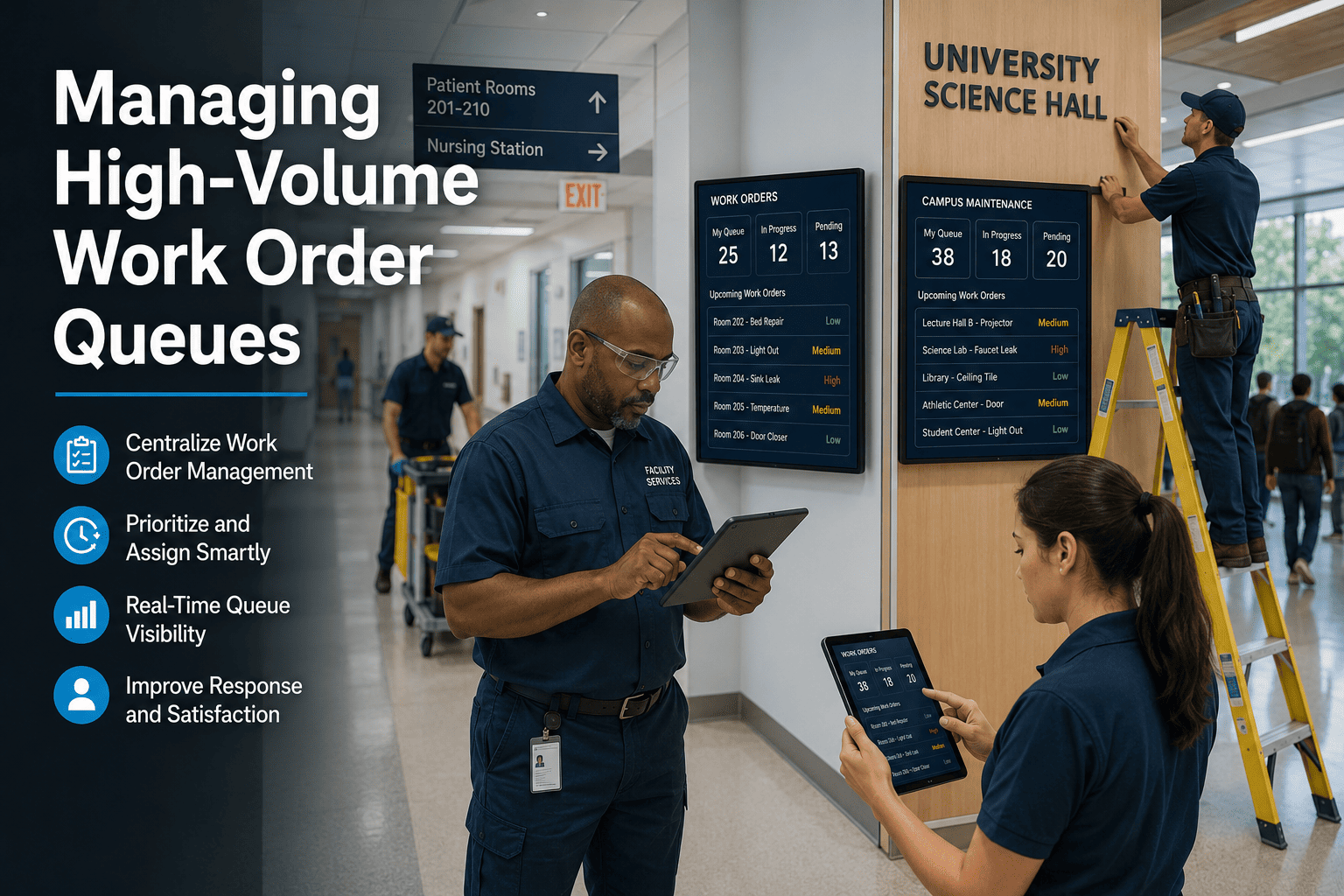
How Healthcare and Education Teams Manage High-Volume Work Order Queues

Connect with Industry Experts, Share Solutions, and Grow Together!

Join Discussion Forum
healthcare-education-mobile-work-order-queue

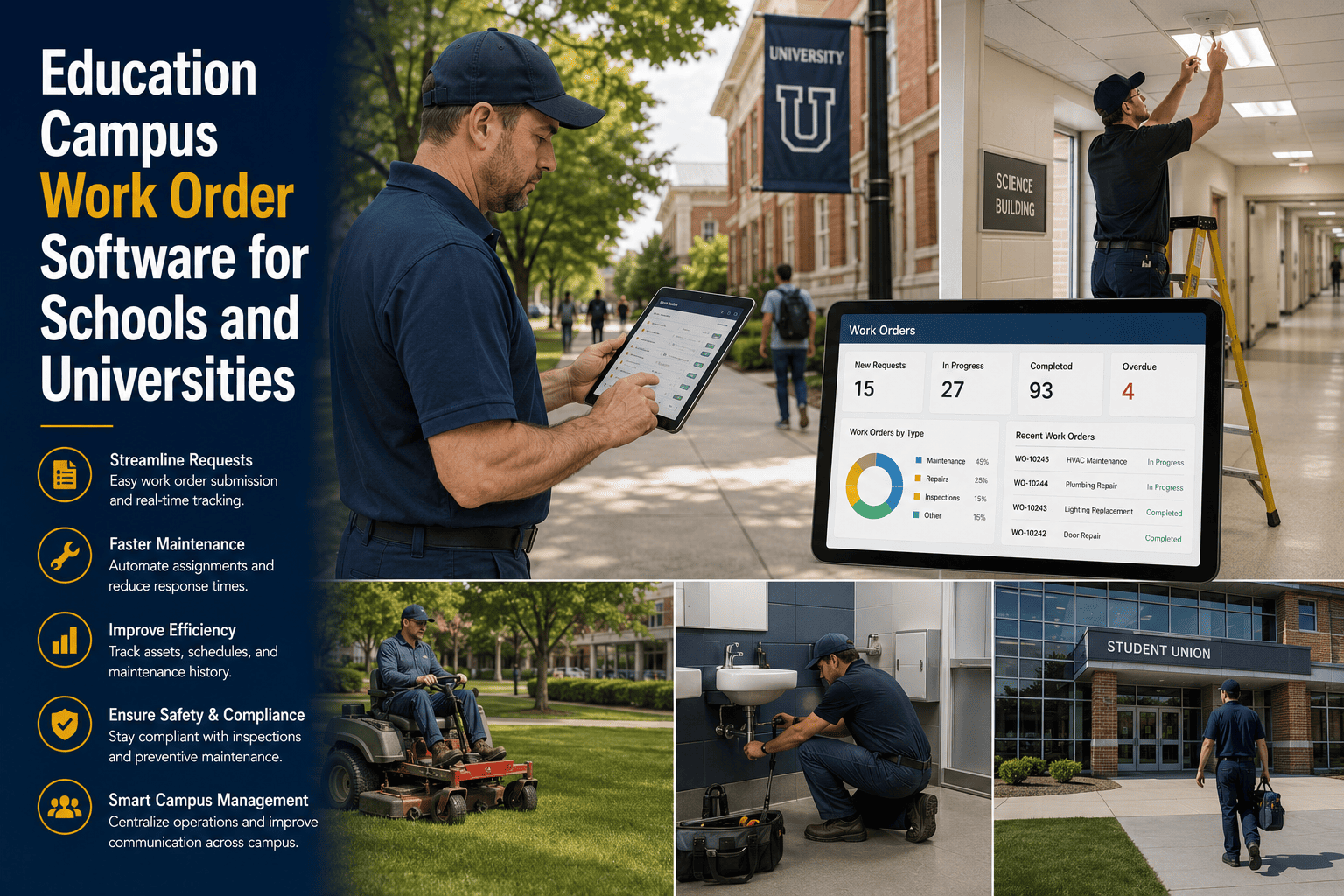
Healthcare facilities and educational campuses share a maintenance pattern almost no other sector has — facility staff who spend their entire shift in motion. Nurses page facilities when an OR door fails. Professors call IT when a lecture-hall projector cuts out. Custodial leads radio when a building chiller throws an alarm. The work orders that result rarely reach the technician through the same channel — and by the time they do, three other tickets have stacked up behind them. The bottleneck is not the work; it is the queue. A mobile work-order queue, surfaced on the technician's phone with prioritization, location context, and one-tap status updates, is what turns a fragmented intake pile into a managed shift. Healthcare and education teams that start a free trial or see Oxmaint in action often discover their average ticket lag drops more from giving technicians a phone queue than from any other operational change.

Healthcare & Education · Mobile Work-Order Queue

The Technician's Phone Is the Operations Hub

When facility teams move all day, the queue has to move with them. Oxmaint's mobile work-order queue replaces dispatch radios, paper slips, and email forwards with a single ranked view of every open ticket — assigned, prioritized, and ready to close from the floor.

Built ForHospitals · Clinics · K-12 · Universities · Research Campuses
WorkflowMobile-first · Priority-ranked · Location-aware
Status CycleAssigned · Acknowledged · In Progress · Closed · Confirmed

9:42
Oxmaint
Queue · 7 open
P1
2 min
OR 4 · Door Seal Alarm
Bldg A · 3F · Surgical Wing
Acknowledge
P2
14 min
ICU · HVAC Temperature Drift
Bldg A · 4F · ICU East
P3
38 min
Lecture Hall 207 · Projector Out
Sciences Bldg · 2F
P4
1h 12m
Dorm 412 · Plumbing Slow Drain
Residence Hall C · 4F
3.4x
faster acknowledgement when work orders surface on technician's phone
68%
of healthcare facility tickets miss their first-response SLA without mobile queue
47 min
average dispatcher-to-technician lag on radio or email workflows
94%
of campus and hospital techs prefer mobile queue over dispatch-based assignment

What a Mobile Work-Order Queue Actually Means in Healthcare and Education

A mobile work-order queue is the technician's live, prioritized list of open tickets — accessible from a phone or tablet, updated in real time as new requests arrive, and ranked by SLA urgency rather than chronological order. It replaces the radio, the dispatcher whiteboard, and the printed-ticket folder with a single source of truth that the technician carries in their pocket throughout the shift.

In healthcare, the queue has to recognize that an OR door alarm cannot wait behind a non-urgent break-room fix from earlier in the morning. In education, the queue has to recognize that a projector outage 18 minutes before a 200-student lecture outranks an HVAC complaint that has been open for two days. Static FIFO queues fail both sectors. A priority-ranked mobile queue is how facility teams stay aligned with what actually matters across the day — and see Oxmaint in action on the device flow your techs will actually use.

Six Capabilities That Define a Working Mobile Queue

A useful mobile work-order queue is not a list of tickets on a small screen. It is a workflow tool with six interlocking capabilities that together turn a phone into a maintenance command interface.

01
Live Priority Ranking
Tickets re-sort as SLA timers tick. P1 emergencies surface at the top regardless of when submitted; aging P3s climb as their deadline approaches.
02
Location Context
Every ticket shows building, floor, wing, and asset on a single tap. Hospital and campus geography means location detail is operational, not decorative.
03
One-Tap Status Updates
Acknowledged, en route, in progress, closed — every state change is one tap. No re-keying ticket numbers, no end-of-shift catch-up paperwork.
04
Photo & Asset Scan
Camera capture and QR scan are native. The asset record opens from a sticker on the equipment. No typing model numbers from memory.
05
Offline-Resilient Sync
Hospital basements and lab buildings have dead zones. The queue holds state offline and syncs the second signal returns — no lost updates.
06
Push-Notification Routing
High-priority tickets push immediately to the on-shift technician closest to the location. Re-routing happens automatically when no acknowledgement in 90 seconds.

Each capability alone moves a metric — together they redefine the shift. Start a free trial to deploy a queue on your team's own devices.

47 minutes
is the average dispatcher-to-technician lag on a radio-based workflow. Mobile queues drop this to under 2 minutes.

Where Healthcare and Education Workflows Break Down

The most damaging failures in hospital and campus maintenance are not about technician skill. They are about information arriving too late, too fragmented, or in the wrong channel.

A
The Dispatcher Bottleneck
All requests funnel through one or two dispatchers who read emails, take calls, and assign tickets manually. At peak, 30+ tickets stack in 90 minutes. Techs see them in the order the dispatcher caught up.
B
Channel Fragmentation
Healthcare staff page facilities. Faculty email IT. Custodial leads radio. Each channel has its own routing rules and lag. Critical work orders get lost between channels every day.
C
No Location Awareness
The ticket arrives without a building, floor, or asset reference. The tech burns 12 minutes walking the wrong wing. Multiply across a shift and the math gets ugly.
D
End-of-Shift Paperwork
Status updates are written down all day and entered into the CMMS at 4:55pm. The dashboard lags reality by 6 to 7 hours. Real-time decisions are impossible.

Each failure type is a workflow problem that mobile queues solve directly — see Oxmaint in action to walk through how your team's specific intake channels would consolidate.

How Oxmaint's Mobile Queue Eliminates These Failures

Oxmaint's mobile work-order queue is purpose-built for the motion-heavy, multi-building workflows that define healthcare and education facility operations.

Multi-Channel Intake Consolidation
Patient pagers, email, web portal, mobile app, and phone tickets all land in the same queue. No channel-by-channel handling required.
Smart Auto-Assignment
Tickets route to the on-shift technician with the right skill set and closest physical location. Manual dispatch becomes the exception, not the rule.
Real-Time Queue Reshuffling
A new P1 ticket bumps lower-priority work down the list automatically. The tech always sees the right next action at the top.
Embedded Asset Context
Building, floor, wing, asset number, last 3 work orders, and PM history visible inside the ticket without separate lookups.
Native Mobile Closeout
Photo, parts used, time spent, and resolution notes captured in the field. Work order closes from the phone — no end-of-shift backlog.
Live Supervisor Visibility
Facility manager sees every open ticket, technician location, and SLA status in real time. Reassignment is one tap.

Six workflow gaps closed in a single mobile interface — start a free trial to deploy the queue on your team's phones this week.

Radio & Email Dispatch vs Oxmaint Mobile Queue

The shift from dispatch-based assignment to mobile-queue self-service is the biggest single workflow change a healthcare or education facility team can make.

Workflow MetricRadio / Email DispatchOxmaint Mobile Queue
Average request-to-acknowledgement time47 minutesUnder 2 minutes
Channel consolidation3 to 6 separate channelsSingle unified queue
Real-time visibilityEnd-of-shift catch-upLive, continuously updated
Location contextVerbal or free-textStructured building / floor / asset
P1 emergency routingPhone call to supervisorPush notification, auto-escalation
Closure documentationEnd-of-shift data entryField closeout with photos
Supervisor reassignmentRadio call, manual updateOne-tap reassign in app

Outcomes Reported by Hospital and Campus Facility Teams

Results from healthcare and education facility teams that converted to Oxmaint mobile-queue workflows within the past 12 months.

73%
reduction in average request-to-acknowledgement time
2.4x
increase in work orders closed per technician per shift
61pts
average lift in nursing and faculty satisfaction with facility response
$520K
average annual labor productivity recovered per 1M sqft of facility

Mobile queues pay back inside the first operational quarter — see Oxmaint in action on your team's actual ticket flow.

Frequently Asked Questions

Does the mobile queue work without a constant data connection in basements or lab buildings
Yes. Oxmaint's mobile app caches the active queue and stores status updates locally when offline. Updates sync automatically the moment connectivity returns. Technicians can acknowledge, update, and close tickets without losing data in dead zones.
Can the queue integrate with our existing patient paging or campus dispatch system
Yes. Oxmaint integrates with hospital paging systems, campus dispatch platforms, and standard email or webhook intake. Tickets from any channel land in the same unified queue with the SLA timer starting at first contact.
How does the queue handle prioritization across very different ticket types
Each ticket is classified into a priority tier — P1 (life safety) through P4 (routine) — based on category, location, and tenant or service-line context. The queue re-sorts continuously, so an OR door alarm always outranks a routine break-room repair regardless of submission order.
Is the system compliant with healthcare data privacy requirements
Yes. Oxmaint supports HIPAA-aligned data handling for healthcare deployments. Patient or student personally identifiable information is not stored in work order records by default, and role-based access controls limit visibility to authorized facility personnel only.
Mobile-first · Priority-ranked · Healthcare and education ready

Put the Queue in the Technician's Pocket. Watch the Shift Change.

Oxmaint replaces dispatcher bottlenecks, fragmented intake, and end-of-shift paperwork with a single mobile work-order queue that ranks every open ticket by priority, surfaces location context, and lets technicians close the loop from the floor.

  • Multi-channel intake into a unified queue
  • Live SLA-ranked prioritization on every device
  • HIPAA-aligned and audit-ready for healthcare
Deployed across acute-care hospitals, ambulatory networks, K-12 districts, and research campuses. Live in days, not months.
By Jack Edwards

Experience
Oxmaint's
Power

Take a personalized tour with our product expert to see how OXmaint can help you streamline your maintenance operations and minimize downtime.

Book a Tour

Share This Story, Choose Your Platform!

Connect all your field staff and maintenance teams in real time.

Report, track and coordinate repairs. Awesome for asset, equipment & asset repair management.

Schedule a demo or start your free trial right away.

iphone

Get Oxmaint App
Most Affordable Maintenance Management Software

Download Our App