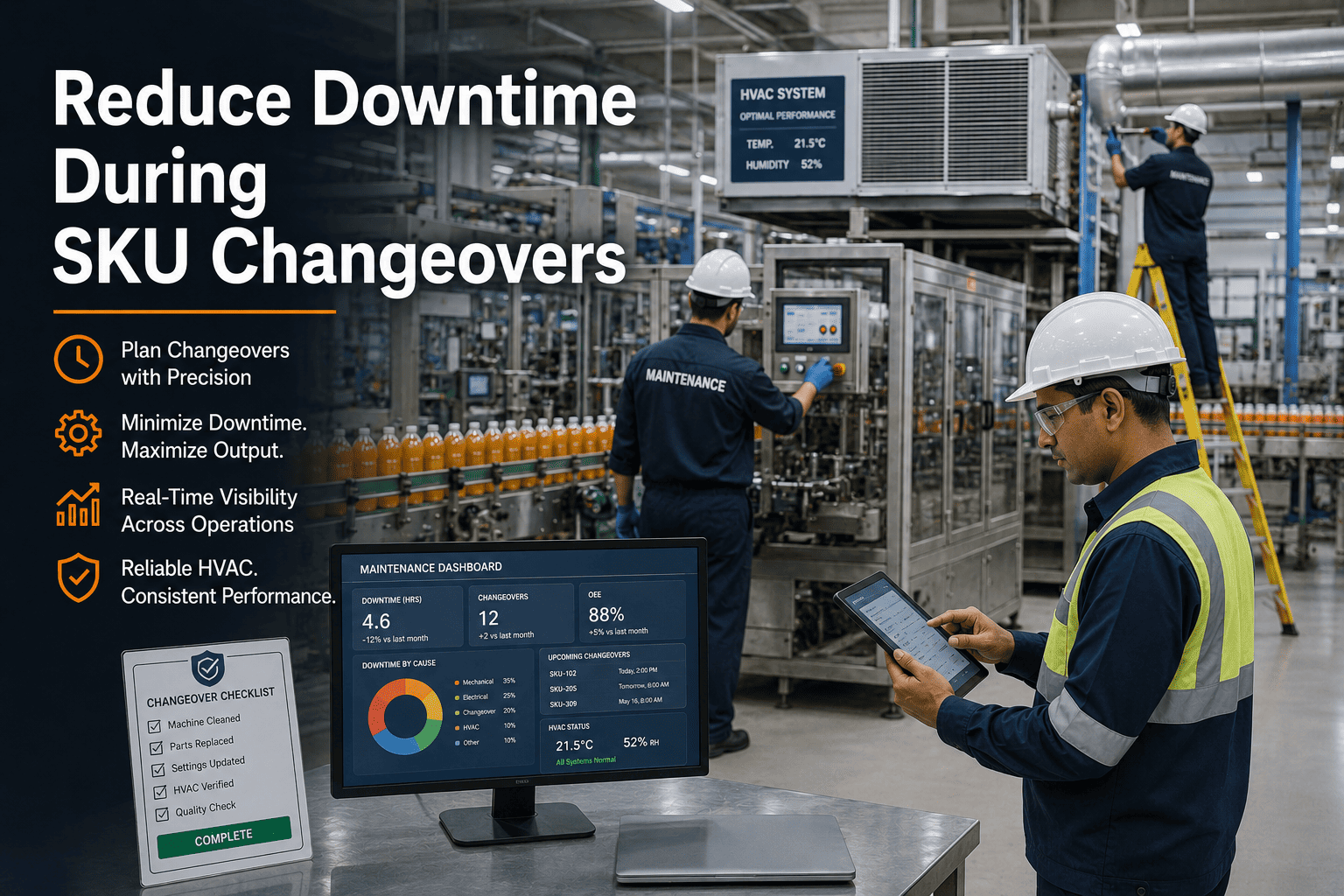
In an FMCG packaging operation, the SKU changeover is the moment maintenance discipline either pays back or breaks down. A line running shampoo bottles at 240 units per minute switching to a 50-mL travel SKU has to swap labels, change format parts, recalibrate fillers, sanitize contact surfaces, and validate the first 50 units — all while HVAC keeps the cleanroom within ISO 8 particulate limits and temperature within plus-or-minus 2 degrees C of setpoint. The teams that get this right run changeovers in 28 minutes; the teams that don't run them in 95. The difference is rarely faster workers — it is sequenced, asset-linked maintenance built into the changeover plan itself, with HVAC, format parts, and sanitation tracked in parallel rather than serially. FMCG operations leaders request a demo or book a demo to see how Oxmaint operationalizes the changeover as a structured maintenance event.
Turn Every SKU Changeover Into a Structured Maintenance Event
Asset-linked changeover sequences with parallel HVAC, format-part, and sanitation tracks. Single-Minute Exchange of Die principles applied to FMCG packaging — with the CMMS as the orchestration layer.
What SKU Changeover Maintenance Actually Requires
SKU changeover maintenance is the structured set of asset-linked tasks that have to complete — in the right sequence, with the right parallelization — between the last unit of one product and the first validated unit of the next. In an FMCG packaging line, that covers format-part swaps (filler nozzles, capper heads, label-feed paths, conveyor guides), HVAC state changes (cleanroom purge, temperature setpoint, humidity adjustment), sanitation procedures (CIP rinse, contact-surface wipe, ATP swab verification), and validation activities (first-article weight check, fill-volume audit, sign-off).
The discipline is well-described by the Single-Minute Exchange of Die (SMED) framework — separating internal from external tasks, converting internal to external where possible, and streamlining the remaining internal work. Where most FMCG operations lose value is in coordination: HVAC, format, and sanitation each get tracked in different systems, so they run serially instead of in parallel. A working changeover program puts all three on the same orchestration layer. Teams that start a free trial can configure their first parallel changeover sequence in under an hour.
The Four Maintenance Tracks That Run Inside Every Changeover
A working FMCG changeover orchestrates four maintenance tracks in parallel. Each track has its own assets, its own checklist, and its own completion gate. The orchestration layer is what keeps them synchronized.
When the four tracks run truly in parallel, the changeover collapses from 95 minutes to under 30. Request a demo to walk through the parallel orchestration on your specific line configuration.
Where FMCG Changeover Programs Actually Break Down
Plants do not fail changeovers because their teams are slow. They fail because the four tracks run in different systems with different supervisors, and someone has to manually reconcile them mid-changeover. Four failure patterns repeat across most lines.
Each pattern is an orchestration gap that a unified CMMS closes — start a free trial to see how Oxmaint pulls all four tracks into a single changeover record.
How Oxmaint Orchestrates the FMCG Changeover
Oxmaint's changeover module is built so the four maintenance tracks share one work-order container, one timeline, and one completion-gate logic — eliminating the manual reconciliation that breaks most lines.
Six capabilities together collapse the changeover from 95 minutes toward the 28-minute benchmark — request a demo to configure the orchestration for your line.
Serial-Task Changeovers vs Oxmaint Parallel Orchestration
The shift from siloed serial tasks to unified parallel orchestration is the single largest operational improvement available to an FMCG packaging line.
| Operational Metric | Serial-Task Changeover | Oxmaint Parallel Orchestration |
|---|---|---|
| Average changeover duration | 75 to 95 minutes | 26 to 32 minutes |
| Track coordination | Manual, supervisor-driven | System-orchestrated |
| Format-part wear visibility | None — treated as commodities | Per-asset PM and cycle history |
| HVAC state change integration | Manual BMS adjustment | Automated via BMS integration |
| ATP swab capture | Paper log, transcribed later | In-app, instant record |
| Validation gate enforcement | Honor-system sign-off | Workflow-blocked until ready |
| SQF / BRC audit prep | 3 to 5 business days | Under one hour |
Outcomes Reported by FMCG Operators Running Oxmaint Changeovers
Results from FMCG packaging operations — personal care, household products, beverage, and confectionery — that activated Oxmaint's changeover orchestration within the past 12 to 18 months.
Structured changeovers pay back within the first operational quarter — request a demo to model the throughput recovery for your specific SKU mix.
Frequently Asked Questions
Does Oxmaint integrate with our existing building management system for HVAC control
How does the validation gate know when format parts and sanitation tracks are complete
Can changeover templates differ by SKU pair
Does the system support allergen-control documentation for SQF and BRC audits
Collapse Every Changeover From 95 Minutes Toward 28
Oxmaint orchestrates format-part swaps, HVAC state changes, sanitation cycles, and first-article validation as one unified work order — with the CMMS as the layer that keeps the four tracks running in parallel and the validation gate workflow-enforced.
- BMS integration across Siemens, Johnson Controls, Honeywell, Tridium
- Format parts modeled as PM-tracked assets
- SQF, BRC, FSSC 22000 audit-aligned record capture