A large chemical plant carries hundreds of shell and tube heat exchangers — preheaters on the feed side, condensers on the overhead, reboilers on the reflux, coolers on the product streams, chillers on the utility loops. Every one of them is a fouling clock that starts the moment it goes into service. TEMA fouling resistance factors run from 0.000044 m2·K/W for clean cooling water up to 0.00088 m2·K/W for crude and vacuum residuals — a twenty-fold range that translates directly into how quickly a bundle plugs, how often it needs cleaning, and when it needs to come out for retubing. Well-maintained bundles run 30+ years. Poorly-maintained ones fail in half that time and cost 10 to 50 times more when they fail unplanned versus when they get replaced during a planned turnaround. That is the reliability arithmetic behind heat exchanger PM in a chemical plant — and it does not run on spreadsheets and a mechanical engineer's memory of which exchanger went last. It runs on a CMMS that trends the overall heat transfer coefficient, schedules turnaround cleanings against the fouling factor, and holds every inspection record from the last cycle. Oxmaint is the maintenance software that does exactly that. Start a free Oxmaint trial to run heat exchanger PM on the CMMS, or book a demo to see the CMMS mapped to your chemical plant's exchanger fleet.
Chemical Plant · Heat Transfer · Exchanger Reliability CMMS
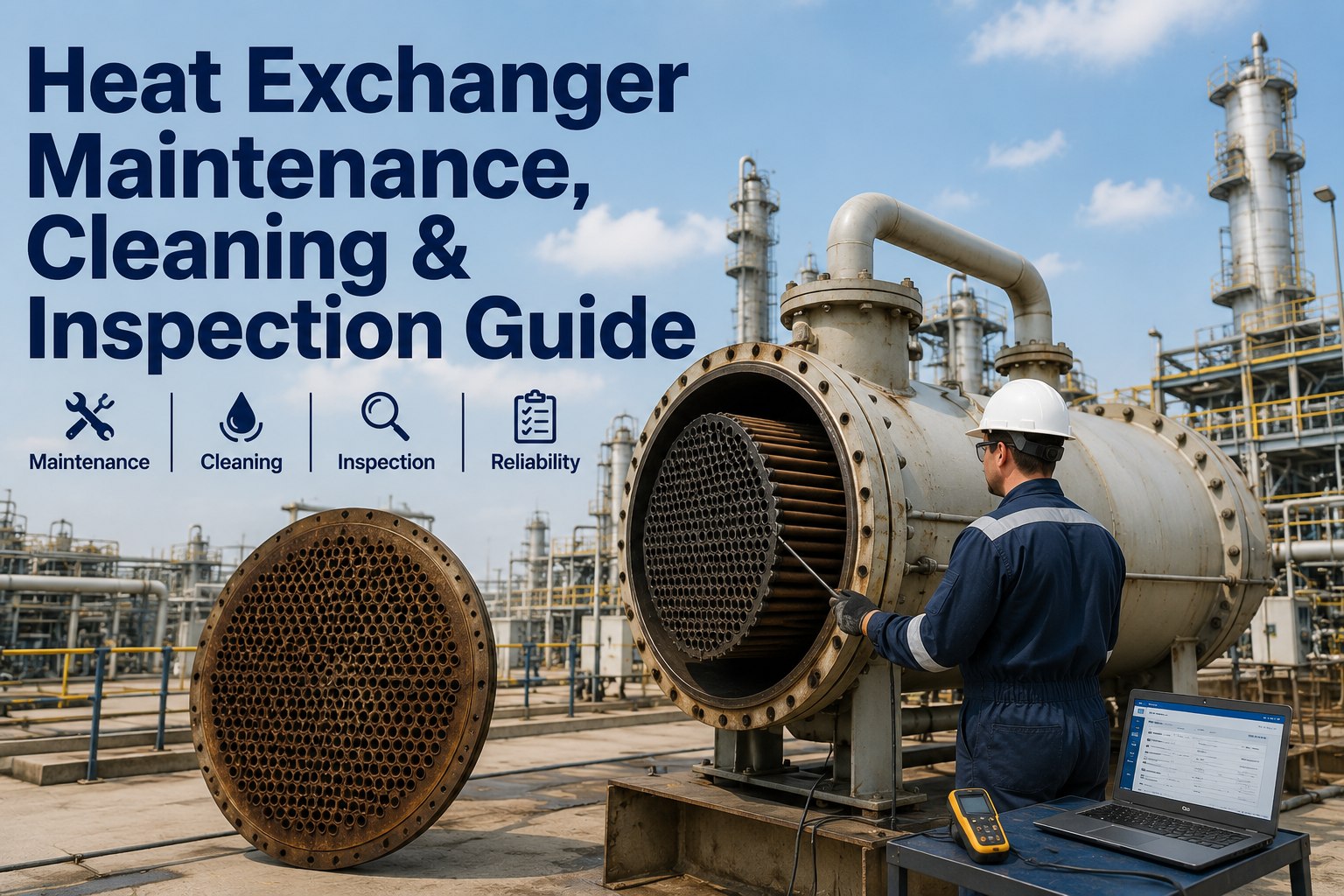
Heat Exchanger Maintenance, Cleaning & Inspection Guide — The 2026 Guide
Every fouling mechanism, every cleaning method, every inspection technique, every PM interval — for the reliability team running shell and tube exchangers across the chemical plant on one CMMS.
-
20×
range in TEMA fouling factors — from clean cooling water to vacuum residuals
-
30+ Yr
bundle life on well-maintained exchangers — versus 15 years on neglected ones
-
10–50×
cost premium on emergency retubing versus planned turnaround replacement
-
18–36 Mo
typical refining and petrochemical turnaround cycle — the main cleaning window
Why Chemical Plants Live and Die on Heat Exchangers
Why the Exchanger Fleet Is the Biggest Reliability Lever in a Chemical Plant
A chemical plant is fundamentally a heat transfer operation. Every reaction step needs feed heating, product cooling, and utility exchange. Any exchanger that loses performance derates the whole unit — reduced throughput, lower conversion, higher energy cost, off-spec product. Four defining conditions make exchanger maintenance the highest-leverage PM program in a chemical plant.
-
01
Silent Performance Erosion
Fouling is invisible. The exchanger keeps working — just less efficiently — until throughput hits the ceiling. Trended U values catch it. Nothing else does.
-
02
Turnaround-Bound Cleaning
Most bundle work happens only during a unit turnaround. Missing the window means running fouled for another 18 to 36 months, or eating the cost of an unplanned outage.
-
03
Failure Cost Asymmetry
A planned bundle replacement runs a defined budget. An emergency retube during production runs 10 to 50 times more once expedited fabrication and forced downtime are counted.
-
04
Long Lead-Time Materials
Cu-Ni, admiralty brass, titanium, duplex stainless bundles run 12 to 26 week lead times. The retubing decision has to be made two turnarounds ahead of the actual work.
The Six Fouling Mechanisms
Every Heat Exchanger Fouls One or More of These Six Ways
Getting the fouling mechanism right is the first step in every cleaning plan — because each mechanism responds to a different cleaning method. Acid dissolves scale but does nothing to biofilm. Hydroblasting shatters hard scale but leaves polymerized product behind. A fouling classification held in the CMMS against every exchanger record drives the correct cleaning selection at every turnaround.
-
M1
Particulate Fouling
Suspended solids deposit on tube walls — silt, catalyst fines, corrosion products. Velocity-dependent. Common in cooling water and raw feed services.
Signature: uniform deposit, low velocity zones
-
M2
Precipitation Scaling
Inverse-solubility salts (CaCO3, CaSO4) precipitate on hot tube walls. Dominant in cooling water and steam-side heat transfer.
Signature: hard adherent scale, hot surfaces
-
M3
Corrosion Fouling
Metal loss from tube surface generates its own deposit — iron oxides, sulfides. Under-deposit corrosion accelerates once the deposit forms.
Signature: pitting under deposit, wall thinning
-
M4
Chemical Reaction
Hot-side polymerization, coking, and thermal cracking. Dominant in refinery preheaters, olefin plant transfer lines, delayed coker feed heaters.
Signature: hard coke, hot spots, high temperature
-
M5
Biological Fouling
Microbial slime, algae, and biofilm formation. Dominant in cooling water systems with insufficient biocide treatment.
Signature: slimy soft deposit, odor, MIC pits
-
M6
Freezing / Solidification
Waxes, paraffins, and high pour-point streams solidify on cold surfaces. Common in crude preheat trains, gas plants, and cold utility services.
Signature: wax deposit, pressure drop spike
Performance Monitoring
The Three Numbers Every Reliability Engineer Trends
Fouling shows up in three specific KPIs before it shows up in production loss. Trending all three against every exchanger's design values is the entire early-warning system. Oxmaint pulls these from process historian data automatically and trends them against the exchanger asset record.
Overall Heat Transfer Coefficient
Calculated from process temperatures and flows. Compared against design value. Declining U ratio flags fouling before throughput impact appears.
Trigger: U / U_design below 0.75
Pressure Drop Trend
Rising pressure drop on either side signals restriction. Combined with U decline confirms fouling. Pressure drop alone can indicate mechanical damage.
Trigger: ΔP more than 1.5× design
Fouling Resistance Factor
Derived from actual U versus design U. TEMA-referenced. Compared against the fouling factor the exchanger was designed for — 0.000044 to 0.00088 m2·K/W.
Trigger: Rf actual over Rf design limit
Trending all three together separates fouling (all three move) from mechanical issues (only pressure drop moves) and instrument drift (only one KPI moves).
The Cleaning Method Decision
Matching Cleaning Method to Fouling Mechanism
The wrong cleaning method wastes a turnaround window, damages tubes, and leaves the exchanger fouled. Four cleaning categories cover the working set — mechanical, chemical, thermal, and online. Below is the working decision matrix Oxmaint stores against every exchanger record, so the correct method is selected before the turnaround, not decided in the field.
| Cleaning Method | Best For | Poor Fit | Typical Use |
|---|---|---|---|
| Hydroblasting | Hard scale, coke, particulate | Soft biofilm, thin-walled tubes | Turnaround, high-pressure jet |
| Mechanical Brush / Lance | Uniform deposits, straight tubes | Hard coke, U-tubes, finned | Turnaround, tube-side access |
| Chemical Cleaning | Scale, corrosion products, complex geometries | Alloy-incompatible chemistry | CIP, closed circulation |
| Thermal / Steam-Out | Light hydrocarbon, wax | Hard mineral scale, coke | Between-batch, mild fouling |
| Online Sponge Ball | Cooling water, biofilm prevention | Heavy fouling, hydrocarbon | Continuous, keeps exchanger clean |
| Combined Mech + Chem | Under-deposit corrosion, mixed fouling | Simple particulate fouling | Turnaround, stubborn deposits |
The Timing Reality
A Cleaning Missed at This Turnaround Means Running Fouled for the Next 18 to 36 Months
Every chemical plant runs on turnaround windows. Miss the exchanger cleaning at this outage and it does not happen again until the next one — and by then the fouling has cost throughput, energy, and product quality on every barrel processed in between. Oxmaint holds the U value trend, the last-cleaning date, and the retubing lead time on every bundle, so no exchanger falls out of the turnaround scope by accident.
The Inspection Escalation Ladder
Four Inspection Techniques That Escalate As Needed
Not every exchanger needs the same inspection scope. A tiered escalation ladder — visual first, non-destructive screening second, high-resolution confirmation third — puts the expensive techniques only where they earn their cost. Oxmaint holds the inspection method against the exchanger tube alloy and history, so the technique selection is right before the bundle is pulled.
Visual & Borescope
Direct visual inspection after cleaning. Borescope for accessible tube runs. Documents deposit character and any obvious wall damage.
Scope: every turnaround, every bundle
ECT / RFT Screening
Eddy current for non-ferromagnetic tubes (Cu-Ni, brass, austenitic SS, titanium). Remote field for ferromagnetic (carbon and ferritic SS). Full-bundle screen for pitting, wall loss, baffle damage.
Scope: critical service, aged bundles
IRIS Wall Thickness
Internal Rotating Inspection System. Ultrasonic wall thickness mapping. Used to confirm and quantify what ECT or RFT flagged in Level 2. High-resolution but slower.
Scope: flagged tubes, retube decision
Hydrostatic Test
Pressure integrity test after any repair. Detects tube-to-tubesheet leaks, shell weld defects, gasket integrity. ASME Section VIII code driven.
Scope: post-repair, pre-service
The PM Cadence
What Happens at Every Interval
Heat exchanger PM runs on multiple parallel clocks — from daily process monitoring through the multi-year turnaround. Oxmaint holds each cadence tier against every exchanger asset and fires the appropriate work order automatically.
-
01
Daily · Process Monitoring
Temperature approach, pressure drop, and U value pulled from historian. Trend alarms surface any KPI moving toward threshold.
-
02
Weekly · External Walk
External corrosion under insulation checks, gasket weep, structural supports, insulation integrity, vibration signatures on tube bundles.
-
03
Monthly · Water Chemistry
Cooling water treatment verification, biocide program, corrosion coupon reading, deposit accumulation sampling on utility loops.
-
04
Turnaround · Full Cleaning & Inspection
Bundle pull if removable, hydroblast or chemical clean, Level 1 to 3 inspection ladder, tube plugging decisions, gasket replacement.
-
05
Multi-Year · Retubing Decision
Retubing planned two turnarounds ahead for long lead-time alloys. Bundle life review against inspection history, tube plug count, and fouling factor trend.
Where Manual HX Management Breaks
Four Gaps Every Reliability Audit Finds First
-
01
U Value Never Actually Trended
The DCS shows the temperatures. Nobody calculates the U value. Fouling develops invisibly for months while the exchanger silently derates the entire unit.
-
02
Cleaning Method Decided in the Field
Contractor shows up at turnaround, looks in the tubes, picks a method. Wrong method wastes the window and leaves the exchanger fouled for the next 18 to 36 months.
-
03
Retubing Decision Made Too Late
Titanium bundles run 26-week lead times. Deciding to retube at the current turnaround means the tubes are not there — either delay the turnaround or run another cycle fouled.
-
04
Inspection Records Cannot Be Found
Last ECT report is in a filing cabinet, or in the contractor's system, or in an email chain nobody archived. Trend analysis on tube wall loss becomes impossible.
Built for Chemical Plants
How Oxmaint Software Runs Heat Exchanger Maintenance
-
Bundle-Level Assets
Every Exchanger Modelled Down to Tube Row
Shell, tube bundle, tube sheets, baffles, gaskets, channel heads — each as its own maintainable component. Tube alloy, count, and plug history on the bundle record.
-
KPI Trending
U Value, Pressure Drop, Rf Auto-Calculated
Process historian data pulls into Oxmaint. U value, pressure drop, and fouling factor calculated per exchanger and trended against design. Alarms fire on threshold breach.
-
Cleaning Method Map
Correct Method Selected Before Turnaround
Fouling classification and cleaning method held against every exchanger. The turnaround scope pulls the right method from the record, not the field decision.
-
Inspection Ladder
Escalation Records Kept Per Bundle
Visual, ECT, RFT, IRIS, hydrotest — every inspection linked to the bundle asset with technician, tube map, findings, and photos. Historical trends visible per tube.
-
Retube Planning
Two-Turnaround Lead Time Alerts
Bundle life trending. Plug-count thresholds. Retube alerts fire two turnarounds ahead of end-of-life, so long lead-time alloys arrive before the turnaround they are needed for.
-
API & ASME Records
Inspection Documentation to Code Standards
API 510, 572, 577, 571 and ASME Section VIII and IX inspection records held to the standard. Reports pull for insurance and jurisdictional inspection on demand.
Measured Outcomes
What Chemical Plants Gain When Oxmaint Runs the Exchanger Fleet
-
30+ Yr
Bundle Life Achieved
Well-monitored, correctly-cleaned bundles reach 30+ years against 15 to 20 typical on manual programs. Direct capex avoidance.
-
Zero
Missed Turnaround Windows
Every exchanger on the correct turnaround scope with the right cleaning method — no forgotten bundles, no last-minute additions.
-
Weeks
Early Fouling Warning
U value trending flags fouling weeks before throughput impact. Enables proactive cleaning between turnarounds where feasible.
-
On-Time
Retube Material Delivery
Two-turnaround lead time alerts eliminate the retubing scramble. Long lead-time alloys arrive before the turnaround they are needed for.
Frequently Asked
Heat Exchanger PM & CMMS Questions
How is the overall heat transfer coefficient calculated?
From the process heat duty divided by the effective heat transfer area and the log mean temperature difference — U equals Q over (A times LMTD). Process temperatures and flows come from the DCS or historian; area is the exchanger design constant. Oxmaint pulls the process values automatically, calculates U, and compares to the design U to derive the fouling factor. Sign up for Oxmaint to run U value trending on every exchanger in the fleet.
Which inspection method is right for which tube alloy?
Eddy Current Testing for non-ferromagnetic tubes — copper-nickel, admiralty brass, aluminum brass, austenitic stainless steel, titanium. Remote Field Testing for ferromagnetic tubes — carbon steel, ferritic stainless. Near-Field Testing for finned tubes where standard ECT is distorted by fin geometry. IRIS ultrasonic wall thickness mapping is used to confirm and quantify what ECT or RFT flags in initial screening.
When should a bundle be retubed versus continued to plug?
The industry rule of thumb is retubing becomes justified when plugged tubes exceed 5 to 10% of the total tube count, when the fouling factor has doubled between two consecutive turnarounds, or when the plug count trend projects out of allowable range at the next turnaround. Long lead-time alloys demand the decision two turnarounds ahead. Book a demo to see bundle life trending and retube alerts in Oxmaint.
Does Oxmaint capture the API and ASME inspection records?
Yes. API 510 (pressure vessels), API RP 572 (pressure vessel inspection), API RP 577 (welding inspection), API RP 571 (damage mechanisms), and ASME Section VIII and IX documentation all captured against the exchanger asset record. Hydrostatic tests, tube plug records, and repair documentation preserved to code standard. Sign up for Oxmaint to run code-standard exchanger documentation on the CMMS.
Monitor · Clean · Extend
Every Fouled Exchanger Cost More on Every Barrel It Processed While Nobody Was Trending the U Value
The fouling was silent. The temperatures shifted a few degrees. The pressure drop crept up. The unit throughput ceiling came down. Nobody caught it because nobody was watching. Oxmaint is the maintenance software that watches — U value, pressure drop, fouling factor, plug count, retubing lead time — on every exchanger, all the time, so nothing derates the plant in the background.