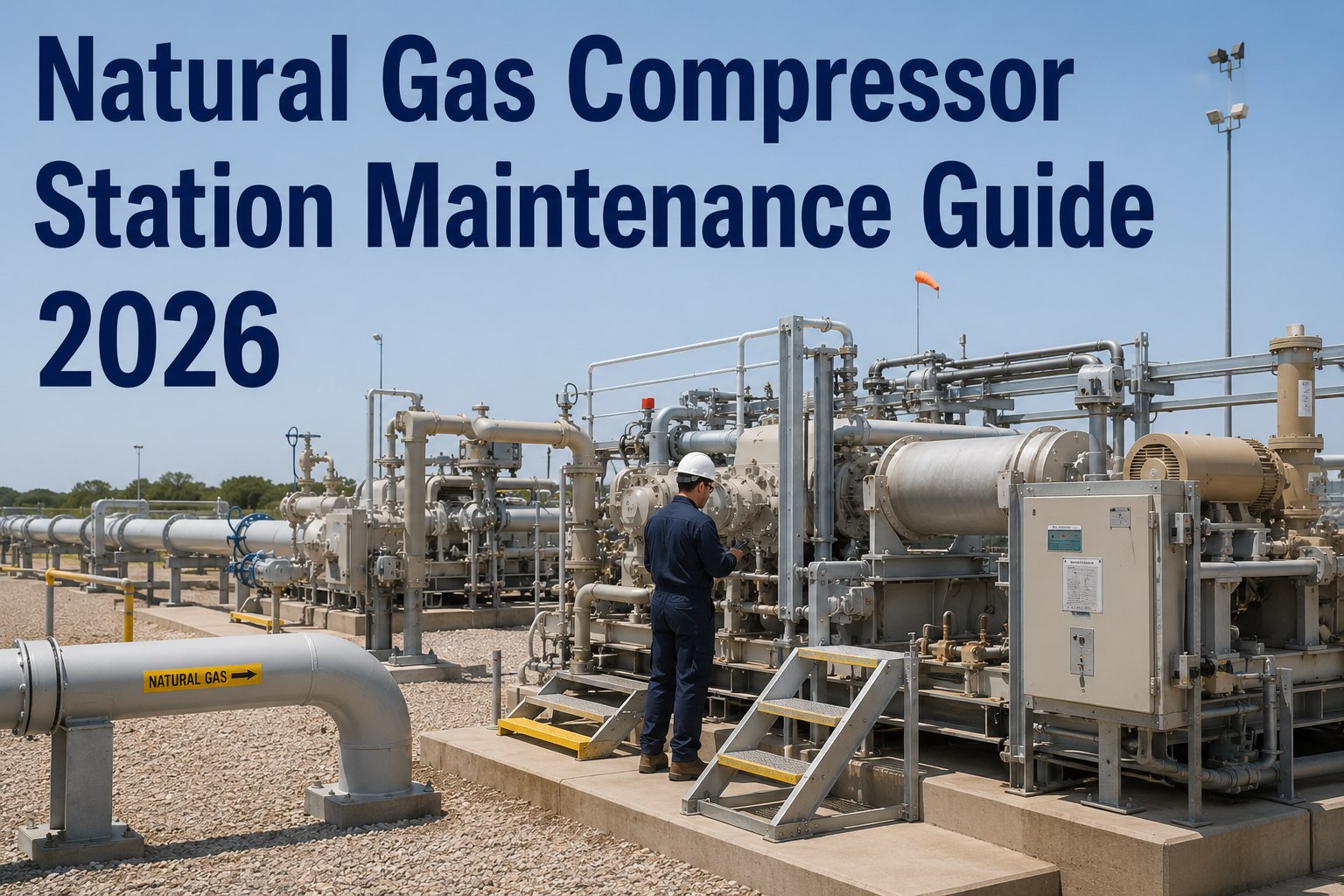
Natural gas compressor station maintenance is the disciplined practice of inspecting, servicing and overhauling reciprocating and centrifugal compressors, suction scrubbers, gas coolers and auxiliary systems to keep pipeline throughput reliable and PHMSA-compliant. A single unscheduled outage at a midsize station can exceed $250,000 in lost throughput and penalties, making preventive maintenance scheduling, mechanical-integrity documentation and real-time asset visibility non-negotiable. This guide walks through the PM routines, compliance workflows and CMMS structure that high-performing oil and gas maintenance teams use to push availability above 98%. If you are ready to replace spreadsheets with audit-ready work-order automation, you can Start Free Trial of OxMaint today.
Compressor Station Reliability Guide 2026
Are unplanned compressor outages draining your pipeline throughput?
Natural gas compressor stations run 24/7 under strict PHMSA mechanical-integrity rules. One missed valve clearance inspection on a reciprocating unit can trigger a cylinder failure that takes a station offline for 72 hours — costing $250K+ in lost gas flow. OxMaint structures your PM schedules, compliance records and predictive analytics so stations stay available and audit-ready.
Preventive Maintenance Strategy
Gas compressor PM schedule: daily, monthly and annual tasks
A station running at 98% availability executes over 1,200 distinct PM tasks per year across its compressor units, scrubbers, coolers and auxiliary systems. Here is the tiered preventive maintenance schedule that reliability engineers use to keep both reciprocating and centrifugal compressors online.
Walkaround inspections & condition logging
- Log bearing temperatures, vibration trends and discharge pressures on every running unit
- Check lube-oil level, pressure and sight-glass condition on reciprocating frames
- Drain liquids from suction scrubbers and after-coolers; record volumes
- Inspect packing vents for gas leakage around compressor rod seals
Filter service & valve diagnostics
- Replace or clean lube-oil filters when differential pressure reaches 15 psi
- Perform acoustic valve-diagnostic sweep on reciprocating cylinder valves
- Calibrate pressure and temperature transmitters against reference gauges
- Inspect coupling alignment on centrifugal compressor driver trains
Predictive monitoring & oil analysis
- Collect lube-oil samples for ferrography, viscosity and water-content analysis
- Review vibration spectral data for emerging gear-mesh or bearing-fault frequencies
- Conduct bore-scope inspection of centrifugal impeller and diffuser passages
- Test emergency shutdown (ESD) and blowdown valve response times
Top-end overhaul & mechanical-integrity review
- Measure piston-rod runout and bump-clearance on reciprocating units; adjust to spec
- Replace compressor valves, piston rings and rider bands per OEM hour-intervals
- Strip and inspect suction scrubber demister pads; pressure-test relief devices
- Conduct PHMSA mechanical-integrity assessment of all pressure-retaining components
Compressor Type Comparison
Reciprocating vs centrifugal compressor maintenance requirements
The two compressor technologies used in gas transmission — reciprocating and centrifugal — demand fundamentally different maintenance approaches, skill sets and parts inventories. Mixing up the PM strategy accelerates wear and invites failures.
| Maintenance Dimension | Reciprocating Compressor | Centrifugal Compressor |
|---|---|---|
| Primary wear parts | Valves, piston rings, rider bands, packing | Journal & thrust bearings, seals, impeller |
| Typical PM frequency | 4,000–8,000 running hours (top-end) | 24,000–48,000 running hours (major) |
| Key diagnostic technique | Acoustic valve analysis, rod drop | Vibration spectrum, shaft orbit analysis |
| Lube oil consumption | Higher — cylinder lube injection rate tuned per gas quality | Low — sealed bearing lubrication system |
| Common failure mode | Valve breakage, packing leakage | Bearing degradation, seal gas failure |
| Major overhaul downtime | 5–10 days per unit | 14–30 days (requires rotor removal) |
| CMMS criticality | High — hundreds of wear parts to track | High — long lead-time spares (rotors, diaphragms) |
Reliability Math
Gas compressor reliability: the downtime cost formula
Reliability teams quantify compressor station risk in dollars per hour of downtime. The formula below shows why a $4,000 valve replacement deferred for one quarter can become a $500,000 catastrophic failure.
How OxMaint Helps
How OxMaint structures compressor station maintenance for oil & gas teams
OxMaint is an AI-powered CMMS and EAM platform purpose-built for asset-intensive operations. For compressor stations, it maps every compressor unit, scrubber, cooler and auxiliary asset into a hierarchy that auto-generates PM triggers, captures PHMSA-ready compliance records and predicts failures before they become outages.
Automated PM scheduling by running hours
OxMaint generates work orders automatically when compressor units hit valve-replacement, oil-sample or major-overhaul intervals — driven by SCADA run-hour feeds. Teams running OxMaint cut missed-PM events by 40–60% and keep availability above 98%.
PHMSA mechanical-integrity documentation
Every inspection, thickness measurement, relief-device test and repair is captured in a tamper-evident audit trail. Generate compliance reports in minutes — not weeks — and pass PHMSA inspections without scrambling for paper records or spreadsheets.
AI-driven predictive failure alerts
OxMaint ingests vibration, temperature and oil-analysis data, then uses ML models to flag bearing degradation, valve leakage or seal-gas failures 7–21 days before failure — enabling planned outages instead of emergency breakdowns that cost 3–5× more.
Spare-parts inventory for long-lead rotors & valves
Track min/max levels for every critical spare — from compressor valves to centrifugal rotors with 26-week lead times. OxMaint auto-creates purchase requisitions when stock drops, so the right part is always on the shelf when the PM window opens.
See OxMaint on your compressor station assets — book a 30-minute demo
Walk through a live PM schedule, mechanical-integrity audit trail and predictive alert workflow configured for a natural gas compressor station. See how fast your team can move from spreadsheets to audit-ready compliance.
Real-World Impact
How a 4-station pipeline operator cut unplanned downtime 38%
A midstream operator managing four compressor stations with 12 reciprocating units was tracking PM schedules across spreadsheets and paper logs. Missed valve inspections caused three unplanned outages in one year totaling $1.1M in lost throughput.
- PM compliance averaged 71% — critical valve swaps missed by 600+ hours
- PHMSA audit prep took 3 weeks of manual record reconstruction
- No visibility into lube-oil trends until failures occurred
- Spare-parts stockouts added 48 hrs to every major repair
- PM compliance reached 96% — zero missed valve inspections
- Audit-ready compliance reports generated in under 30 minutes
- AI alerts flagged 4 bearing faults 12 days avg. before failure
- Unplanned downtime dropped 38%, saving $490K in annual throughput loss
"OxMaint paid for itself in the first quarter. The predictive bearing alert alone saved us a $200K emergency repair and 72 hours of downtime on Station 3."
Frequently Asked Questions
Compressor station maintenance FAQ
What is included in a gas compressor station maintenance program?
A complete program covers daily walkaround inspections, monthly filter and valve diagnostics, quarterly oil analysis and vibration monitoring, and annual top-end overhauls or mechanical-integrity reviews. It also includes suction scrubber maintenance, gas cooler inspection, ESD system testing and full PHMSA documentation of every task. OxMaint structures all of these into automated PM schedules tied to running hours and compliance deadlines.
How often should reciprocating compressor valves be inspected?
Reciprocating compressor valves should undergo acoustic diagnostic inspection every 2,000–4,000 running hours and physical replacement at 8,000–12,000 hours depending on gas quality and manufacturer specs. Deferring valve PM beyond the OEM interval is the leading cause of unplanned reciprocating compressor failures — a single broken valve can damage pistons and cylinders, turning a $4K part into a $50K+ repair. You can Book a Demo to see how OxMaint auto-triggers these intervals from SCADA run-hour data.
How does a CMMS improve PHMSA compliance for compressor stations?
A CMMS like OxMaint creates a tamper-evident record of every inspection, test and repair tied to each pressure-retaining asset — automatically timestamped and assignable to specific technicians. Instead of reconstructing compliance histories from paper logs during a PHMSA audit, operators generate complete mechanical-integrity reports in minutes, with digital signatures, measurement data and corrective-action trails attached to each work order.
What is the difference between preventive and predictive maintenance for gas compressors?
Preventive maintenance is time- or run-hour-based — replacing valves every 8,000 hours regardless of condition. Predictive maintenance uses condition-monitoring data (vibration spectra, oil ferrography, temperature trends) to identify degradation early and schedule intervention only when the asset actually needs it. OxMaint combines both: it auto-schedules PM tasks at OEM intervals while AI models analyze condition data to flag developing failures 7–21 days in advance, cutting unplanned downtime 30–50%.
How long does it take to implement a CMMS for a compressor station?
A typical compressor station CMMS implementation takes 4–8 weeks depending on the number of units, existing asset hierarchy and SCADA integration depth. OxMaint accelerates this with pre-built oil and gas asset templates, bulk asset import tools and guided onboarding — most stations are live with automated PM schedules and work-order generation within 3–4 weeks. Start Free Trial to explore the setup workflow firsthand.
Stop managing compressor station maintenance on spreadsheets
Join the oil and gas reliability teams using OxMaint to automate PM schedules, pass PHMSA audits with one-click reports and predict compressor failures before they cost you $250K+ in downtime. Get started in minutes — no migration fees, no credit card required.
Free 14-day trial · No credit card