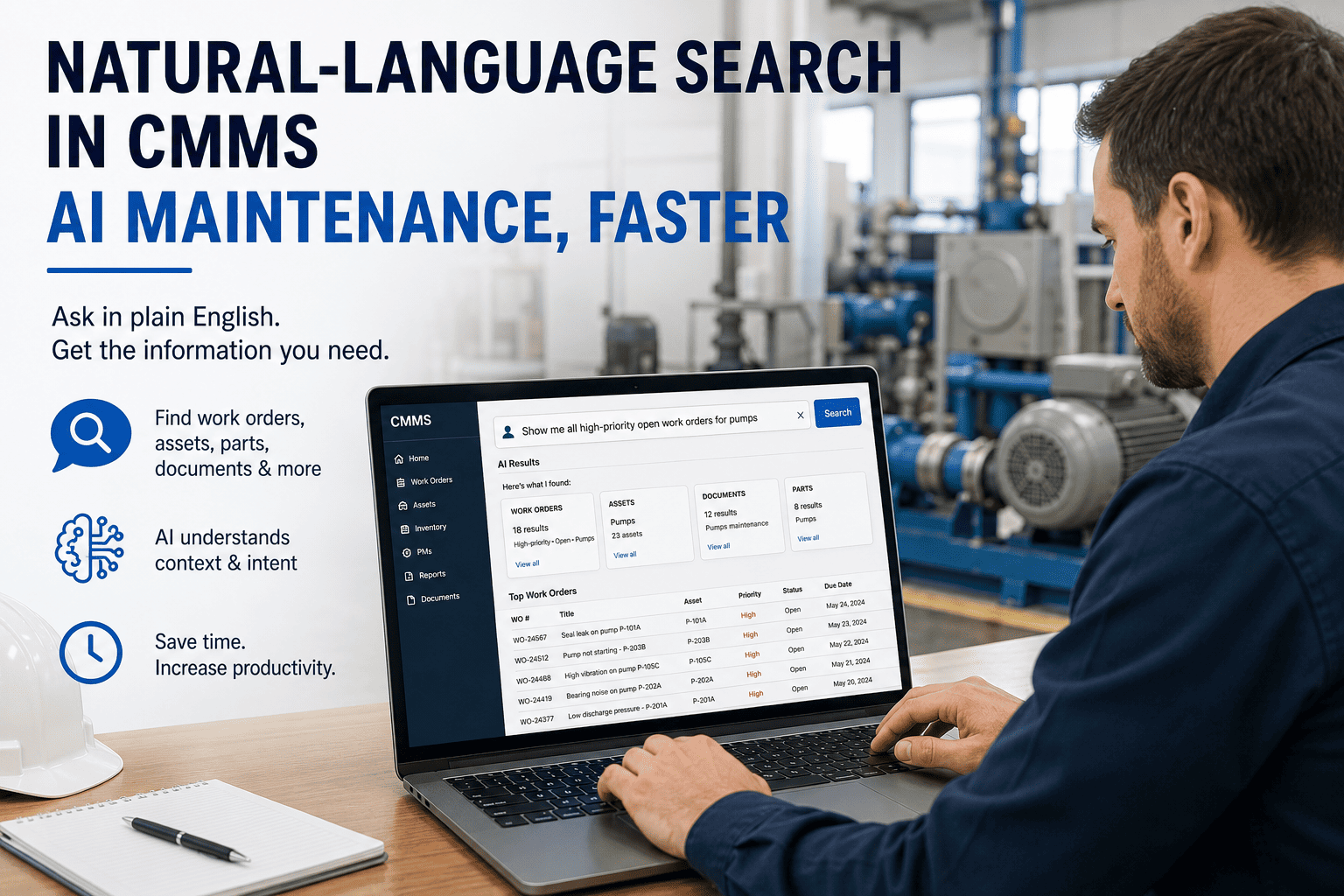
Natural language search in CMMS allows maintenance technicians and managers to find work orders, asset records, manuals, and inspection logs by typing or speaking plain everyday questions — no dropdown menus, no filter chains, no training required. As AI rewrites how teams interact with maintenance software, the platforms that understand how people actually talk are the ones teams actually use.
See Oxmaint's AI search find any asset, work order, or manual in seconds — live on your data.
- ✓ Ask in plain language — AI retrieves the right record instantly
- ✓ No filters, no dropdowns, no CMMS training required
- ✓ Voice and text search across assets, WOs, manuals, and history
Trusted by 1,000+ maintenance teams · Live in days, not months
What is natural language search in CMMS — and why does it matter for maintenance teams?
Natural language CMMS search lets maintenance professionals query their system using conversational phrases — "show me open work orders on Compressor 3 from last week" or "what's the PM schedule for HVAC unit B2" — and receive accurate, contextual results instantly. It removes the barrier between the person who needs information and the system that holds it.
Traditional CMMS search forces technicians to know the exact asset ID, the correct filter sequence, and the specific module where information lives. That's friction that costs real time — especially for new technicians, multi-site teams, and emergency repair situations where minutes matter. Natural language search, powered by NLP and machine learning, understands intent, not just keywords.
The result: faster fault resolution, fewer errors from pulling the wrong manual, and a CMMS that gets used consistently instead of bypassed in favor of a phone call to a senior tech. Teams using AI-driven maintenance platforms report technicians completing tasks 30–40% faster when search works the way they think — start a free trial to test it on your own asset data, or book a demo and ask anything about your facility.
6 capabilities that define intelligent CMMS search
Intent Recognition
NLP models identify what the user is actually asking — not just matching keywords. "Pump vibration problem last month" maps to work orders with vibration fault codes, not every record containing the word "pump."
Entity Extraction
AI identifies asset names, locations, dates, technician names, fault types, and part numbers from natural phrasing — even when spelled informally or abbreviated the way technicians actually write.
Cross-Module Retrieval
A single query searches work orders, asset records, inspection logs, part inventory, manuals, and compliance documents simultaneously — returning ranked results from wherever the answer lives.
Voice Search Integration
Technicians working in gloves, at height, or in confined spaces can speak queries into mobile devices. Voice-to-text converts to a structured CMMS query without the user touching a screen or typing a filter.
Contextual Suggestions
AI surfaces related information alongside the primary result — similar past faults, the relevant PM procedure, parts typically consumed, and the last technician who worked on the asset. One search, complete context.
Continuous Learning
The search model learns from how your team phrases queries, which results they click, and which searches lead to closed work orders — improving retrieval accuracy over time for your specific facility vocabulary.
Oxmaint's AI and automation layer powers natural language search across every module — start free or book a demo.
4 operational failures caused by poor CMMS information retrieval
Procedures Retrieved Too Late
When a technician spends 15 minutes navigating filter menus to find an SOP during an active fault, that delay extends downtime and increases the risk of an incorrect repair sequence. Every minute of search friction is a minute of equipment offline.
Wrong Asset History Pulled
Ambiguous asset naming conventions and poor search mean technicians frequently pull maintenance history for the wrong asset ID. A repair done on the wrong history baseline can miss a recurring fault pattern — and repeat a failure that was already solved.
Compliance Records Buried
During audits, inspectors ask for specific inspection records by date, asset, and inspector. If retrieval requires a trained CMMS administrator and 20 minutes per query, compliance becomes an operational liability — not a managed process.
Knowledge Walks Out the Door
Senior technicians carry equipment knowledge in their heads because retrieving it from the CMMS is too slow. When they leave, that knowledge leaves with them. An AI search system that surfaces institutional knowledge on demand protects against this loss.
Oxmaint's inspection management and asset management modules are fully searchable with natural language — book a demo to see it.
How Oxmaint makes every maintenance record findable in seconds
Ask Anything, Find Everything
Type or speak a query in plain language. Oxmaint's NLP engine parses intent and returns work orders, asset records, part inventory, manuals, and inspection history — ranked by relevance, not alphabetical order. See Work Order Management →
Mobile-First Voice Search
Technicians on the floor speak their query into the Oxmaint mobile app. Voice-to-search converts to a structured CMMS query in under two seconds — no screen navigation, no filter chains. See all features →
Asset History in One Query
Ask "show me everything on Boiler 4 in the last 90 days" and Oxmaint surfaces work orders, parts consumed, inspection findings, and open alerts for that asset — complete context, zero navigation. See Asset Management →
Compliance Records on Demand
Auditors and compliance managers retrieve timestamped inspection records, OSHA documentation, and sign-off histories through a plain-language query — in seconds, not an administrator-hour. See Safety & Compliance →
Parts and Inventory Lookup
Ask "do we have the bearing for Pump 7 in stock" and the system checks inventory, shows quantity, and triggers a reorder alert if below threshold — without opening a separate inventory module. See Parts & Inventory →
Analytics Queries in Plain English
Managers ask "which assets had the most reactive work orders last quarter" and receive a ranked report instantly — no SQL, no report builder, no BI tool. AI interprets the business question and returns the answer. See Analytics & Reporting →
Traditional CMMS search vs AI natural language search
| Task | Traditional CMMS | Oxmaint AI Search |
|---|---|---|
| Find open WOs for one asset | Navigate to WO module → filter by asset ID → filter by status → scroll | Type: "open work orders on Compressor 3" → instant results |
| Retrieve asset maintenance history | Open asset record → scroll to history tab → apply date filters | Ask: "Boiler 4 history last 90 days" → complete timeline |
| Find correct repair procedure | Open documents module → search by asset type → scroll PDF list | Ask: "repair procedure for pump seal failure" → top result |
| Check parts availability | Switch to inventory module → search by part number → check stock | Ask: "do we have the bearing for Pump 7" → stock count instant |
| Pull compliance records for audit | 30–60 minutes manual compilation per audit session | One query → full audit trail generated in seconds |
| New technician onboarding | Days of CMMS navigation training required | Ask questions naturally — productive from day one |
What faster information retrieval delivers to your bottom line
Calculate what faster information retrieval saves your facility — use the ROI Calculator or start a free trial.
Natural language CMMS search — questions maintenance teams ask
What is natural language search in a CMMS and how does it work?
Natural language search in a CMMS uses NLP (natural language processing) to interpret plain-text or voice queries — like "show me overdue PMs on HVAC unit 3" — and retrieve the right records from work orders, asset history, parts inventory, and documents simultaneously. Unlike keyword search, it understands context and intent, so results reflect what the user means rather than just what they typed. See Oxmaint's AI capabilities →
Can maintenance technicians use voice search in a CMMS on mobile?
Yes — modern AI-powered CMMS platforms like Oxmaint support voice-to-search on mobile devices. Technicians speak their query, the app converts it to a structured search, and results appear within seconds. This is especially valuable in environments where typing is impractical: wearing gloves, working at height, or operating in confined spaces. The mobile app works offline for core functions as well.
How does AI search help with CMMS compliance and audit preparation?
AI natural language search allows compliance managers to retrieve specific inspection records, sign-offs, and corrective action documentation in seconds — by simply asking. Instead of manually compiling audit trails, a query like "show all OSHA inspection records for Building C in Q2" surfaces a complete, timestamped document set ready for review. See Safety & Compliance →
Does natural language CMMS search work across multiple sites and languages?
Leading AI CMMS platforms support multi-site search — a single query can return results from assets and work orders across all connected sites, filtered by location if needed. Multi-language NLP support varies by vendor; if your team operates in multiple languages, verify the vendor's NLP models are trained for your primary languages, not just English. Oxmaint operates across 9+ industries and multi-site environments globally — book a demo to discuss your specific configuration.
Stop Losing Technician Hours to CMMS Navigation — Let AI Find It
Every minute a technician spends filtering menus instead of fixing equipment is a minute of productive maintenance time lost. Oxmaint's natural language CMMS search puts the right work order, procedure, history, and parts data in front of your team instantly — by asking, not clicking.
- ✓ Plain language and voice search across all modules — no CMMS training needed
- ✓ Full asset history, procedures, parts, and compliance records in one query
- ✓ AI gets smarter with your facility's vocabulary over time
Trusted by 1,000+ teams across manufacturing, facilities, fleet, healthcare & more · Live in days


.png)


