For a midstream operator, maintaining a pipeline is not the same as proving it is safe. You can grease every valve and run every pump on schedule and still be out of compliance, because pipeline integrity management is a regulated, cyclical obligation: under PHMSA's rules in 49 CFR Parts 192 and 195, you must identify where a leak could affect a High Consequence Area, assess the line pipe on a defined schedule, and remediate what you find within hard deadlines — some measured in days. Miss a reassessment interval or blow a remediation clock and the finding is not a maintenance backlog item, it is a regulatory violation with the pipe still in the ground carrying product. That is what makes this discipline different from ordinary PM: the maintenance work — smart-pig runs, cathodic protection surveys, pig-trap servicing — exists to feed a documented assurance cycle that a regulator audits. This guide covers how to run that cycle and the physical maintenance underneath it. Start a free Oxmaint trial and track ILI intervals, CP surveys, and remediation deadlines in one place, or book a demo to see the integrity cycle and PHMSA deadlines tracked live.
Oil & Gas · Midstream · Integrity Management
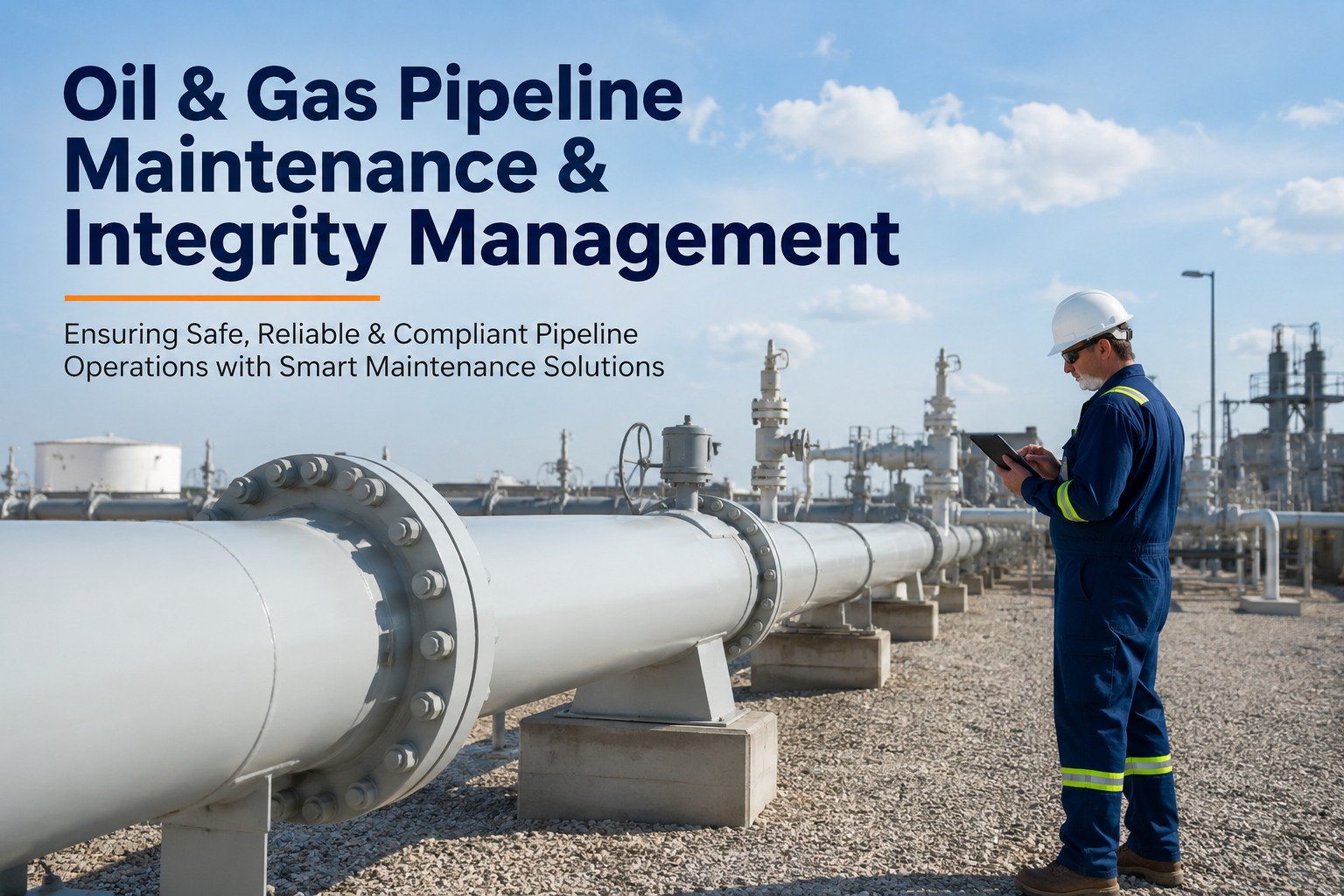
Oil & Gas Pipeline Maintenance & Integrity Management
ILI inspection planning, cathodic protection maintenance, pig launcher servicing, and PHMSA compliance — how midstream operators run the integrity-management cycle, hit reassessment intervals, and close remediation deadlines with a CMMS.
-
Parts 192 / 195
PHMSA rules governing gas and hazardous-liquid pipeline integrity
-
HCA
High Consequence Areas define where the program applies
-
180 days
to discover a condition's severity after an assessment
-
15 mo
maximum interval to re-verify HCA risk factors annually
The Regulated Loop
Integrity Management Is a Continuous Cycle
PHMSA does not ask for a one-time inspection — it requires a continual process of assessment and evaluation. Every covered segment moves around this loop on a schedule, and the CMMS exists to make sure no stage is late. This is the cycle a regulator audits.
-
1
Identify HCAs
Compare pipeline centerlines against PHMSA's mapped High Consequence Areas — populated areas, navigable waterways, drinking-water and ecological zones. Re-verify risk factors annually, not to exceed 15 months. -
2
Assess the Segment
Run the chosen integrity assessment — in-line inspection, pressure test, or direct assessment — against the segment's most significant threats, following the baseline and reassessment schedule. -
3
Discover & Evaluate
Obtain enough information to characterize each anomaly — promptly, and no later than 180 days after the assessment — then classify its severity against the repair criteria. -
4
Remediate on Deadline
Repair each condition on a prioritized schedule — immediate, scheduled 60-day, or 180-day — with pressure reduction and PHMSA notification if a deadline cannot be met. -
5
Reassess & Repeat
Set the next assessment interval from the segment's risk, then loop — integrating new data and re-evaluating threats continually so the cycle never lapses.
Reassessment intervals are risk-based, driven by pipe condition, leak history, design, and the HCA it could affect — not a single fixed number. Book a demo to see the full integrity cycle scheduled per segment.
The Physical Maintenance
Three Pillars That Feed the Cycle
The assessment loop runs on real field maintenance. Three programs do the heavy lifting — each on its own recurring schedule, each generating the data and access the integrity cycle depends on.
-
In-Line Inspection (ILI)
Smart pigging An instrumented smart pig runs through the pipe interior, using non-destructive techniques to find and characterize metal loss, cracks, and dents. The primary assessment method — and the pipe must be made and kept piggable to accommodate the tool. -
Cathodic Protection
Corrosion control Rectifiers and anodes hold the pipe at a protective potential to stop external corrosion. Requires recurring rectifier checks and close-interval surveys — a line without adequate CP carries a materially higher corrosion-risk rating. -
Pig Launchers & Traps
Inspection access Launcher and receiver barrels send and recover cleaning and inspection pigs. Closure seals, pressure-relief, and interlocks need routine servicing — a failed trap is both a safety hazard and a blocked path to the next ILI run.
Cleaning pigs run frequently to clear debris and liquids; inspection pigs run on the assessment schedule — both depend on serviceable traps. Sign up for Oxmaint to schedule CP surveys, pig runs, and trap servicing together.
The Clocks That Bite
Remediation Runs on Hard Deadlines
Once an anomaly is discovered, its severity sets the repair clock. These deadlines are regulatory, not internal targets — missing one means a pressure reduction and a PHMSA notification, not a rescheduled work order. A CMMS ties each condition to its class the moment it is logged.
| Condition Class | Response | What Drives It |
|---|---|---|
| Immediate | Repair at once; reduce pressure until fixed | Defects posing an imminent threat to integrity |
| Scheduled — 60 day | Remediate within 60 days | Significant anomalies below the immediate threshold |
| Scheduled — 180 day | Remediate within 180 days | Conditions requiring timely but not urgent repair |
| Discovery window | Characterize within 180 days of assessment | Time to obtain adequate information on a condition |
| Pressure reduction | Notify PHMSA if it exceeds 365 days | Interim safety measure when a deadline slips |
Deadlines survive a sale: a new operator inherits the prior operator's assessment intervals and pending remediation schedules. Book a demo to see condition classes auto-assign their remediation clocks.
The Audit Is Continuous
The Regulator Does Not Ask If You Fixed It — They Ask You to Prove It
A pipeline integrity program lives or dies on documentation. PHMSA requires operators to gather and integrate every relevant data element per ASME B31.8S, keep a schedule showing when each segment will be reassessed, and demonstrate that discovery, evaluation, and remediation happened inside the deadlines. When ILI results, CP survey readings, anomaly digs, and repair records live in disconnected spreadsheets, assembling that proof for an audit is weeks of work and every gap is a finding. Held in one system, each segment's full assessment-to-remediation history is one export — the evidence an inspector expects, on demand.
Oxmaint for Midstream
How Oxmaint Manages Pipeline Integrity
-
Segment Register
Every Segment, HCA-Tagged
Register each pipeline segment with its HCA status, threats, assessment method, and risk rating — so the covered-segment list stays current and every reassessment is scheduled against the right driver.
-
Assessment Intervals
ILI & Reassessment on Schedule
Track baseline and reassessment intervals per segment with lead-time alerts, so ILI runs, pressure tests, and direct assessments are planned well before the regulatory window closes.
-
CP Surveys
Rectifier & Survey Cadence
Recurring work orders for rectifier readings, annual CP surveys, and close-interval surveys — with readings logged to the segment record so corrosion-control status feeds the risk model directly.
-
Anomaly & Dig Tracking
Condition to Remediation Clock
Log each ILI anomaly, assign its condition class, and attach the immediate, 60-day, or 180-day deadline — with the discovery window tracked and escalation before any clock expires.
-
Facility PM
Traps, Valves & Stations
Preventive maintenance for pig launchers and receivers, block valves, pumps, and compressor stations — with permit-to-work and isolation enforced inside the work order for hazardous field jobs.
-
Audit Records
Full History, One Export
Every assessment, reading, anomaly, and repair tied to its segment and timestamped — so the assessment-to-remediation trail a PHMSA audit demands is generated on demand, not reconstructed from spreadsheets.
Frequently Asked
Pipeline Integrity Questions
What is pipeline integrity management under PHMSA?
It is a comprehensive, regulated program required under 49 CFR Part 195 (§195.452) for hazardous-liquid lines and Part 192 Subpart O for gas transmission. Operators must identify segments that could affect a High Consequence Area, assess them on a risk-based schedule using methods like in-line inspection, then continually evaluate and remediate findings within set deadlines. It is a continuous assess-evaluate-remediate cycle, not a one-time inspection. Sign up for Oxmaint to run the integrity cycle per segment.
How often must a pipeline be reassessed?
Reassessment intervals are risk-based rather than a single fixed number — they depend on pipe condition from prior assessments, leak and operating history, design features, and the consequence of the HCA the segment could affect. The regulations set maximum time limits within which reassessments must occur, and operators must re-verify the risk factors used to identify covered segments at least annually, not to exceed 15 months. Higher-risk segments are reassessed more frequently.
What is the difference between ILI and cathodic protection?
They address integrity from opposite directions. In-line inspection (smart pigging) is an assessment — an instrumented tool runs through the pipe to find and characterize existing defects like metal loss and cracks. Cathodic protection is prevention — rectifiers and anodes hold the pipe at a protective electrical potential to stop external corrosion from forming in the first place. A strong program needs both: CP to prevent corrosion, ILI to verify it is working and catch what gets through. Book a demo to see ILI results and CP surveys on one segment record.
What happens if a remediation deadline is missed?
The operator must reduce operating pressure to maintain safety and notify PHMSA that it cannot meet the evaluation-and-remediation schedule, explaining why and how the change will not jeopardize safety. If a temporary pressure reduction exceeds 365 days, a further notification and additional remedial action are required. Because these are regulatory obligations with real consequences, tracking each condition's class and clock from the moment it is discovered is essential. Sign up for Oxmaint to track every remediation deadline before it slips.
Assess · Evaluate · Remediate · Prove
You Cannot Manage the Pipe Without Managing the Cycle
Every missed reassessment interval, uncharacterized anomaly, and slipped remediation deadline is a regulatory exposure with product still flowing. Oxmaint gives midstream operators one platform to register every segment by HCA, schedule ILI and reassessment on the regulatory clock, run cathodic protection and pig-trap maintenance, tie each anomaly to its remediation deadline, and produce the assessment-to-remediation record a PHMSA audit demands.