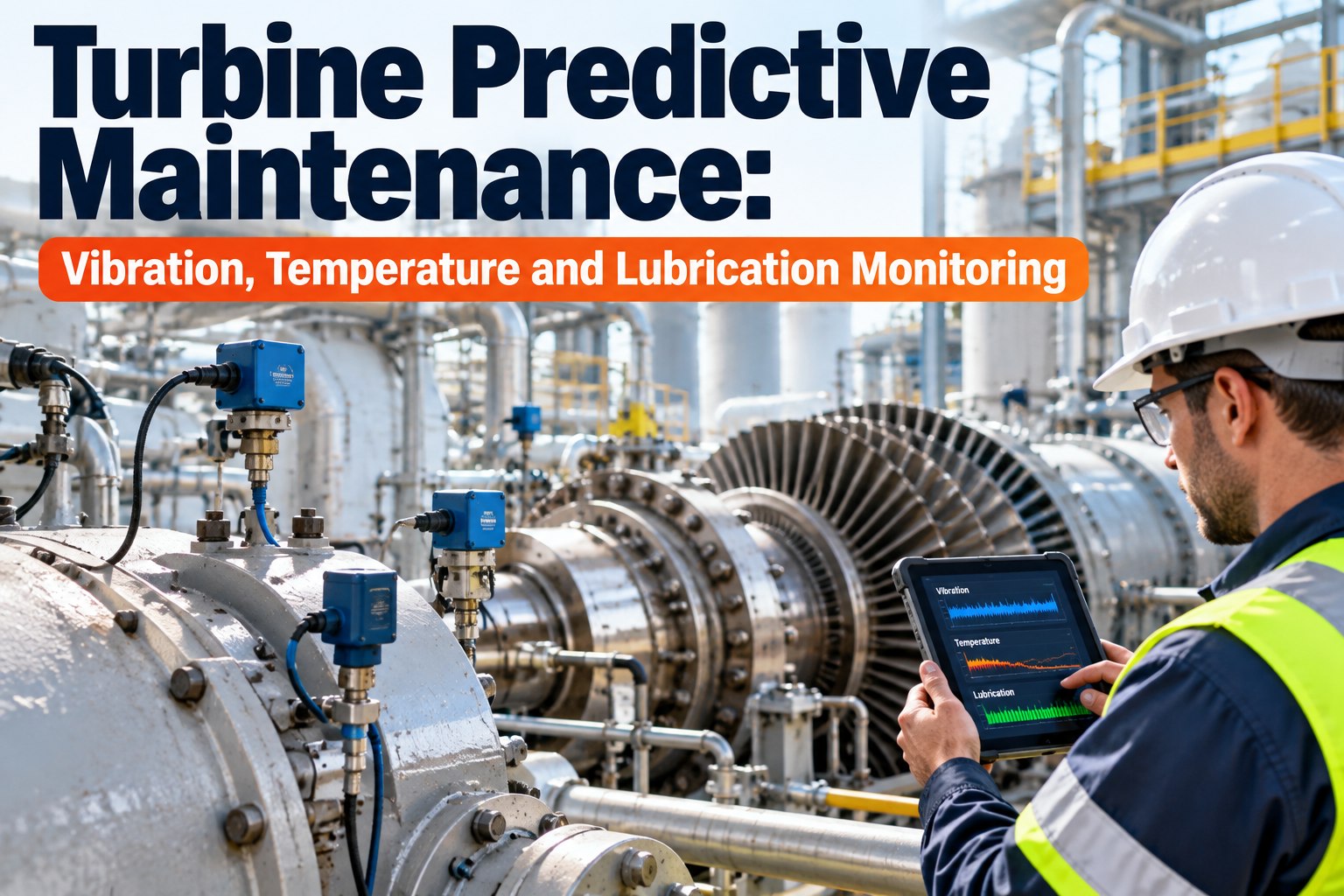
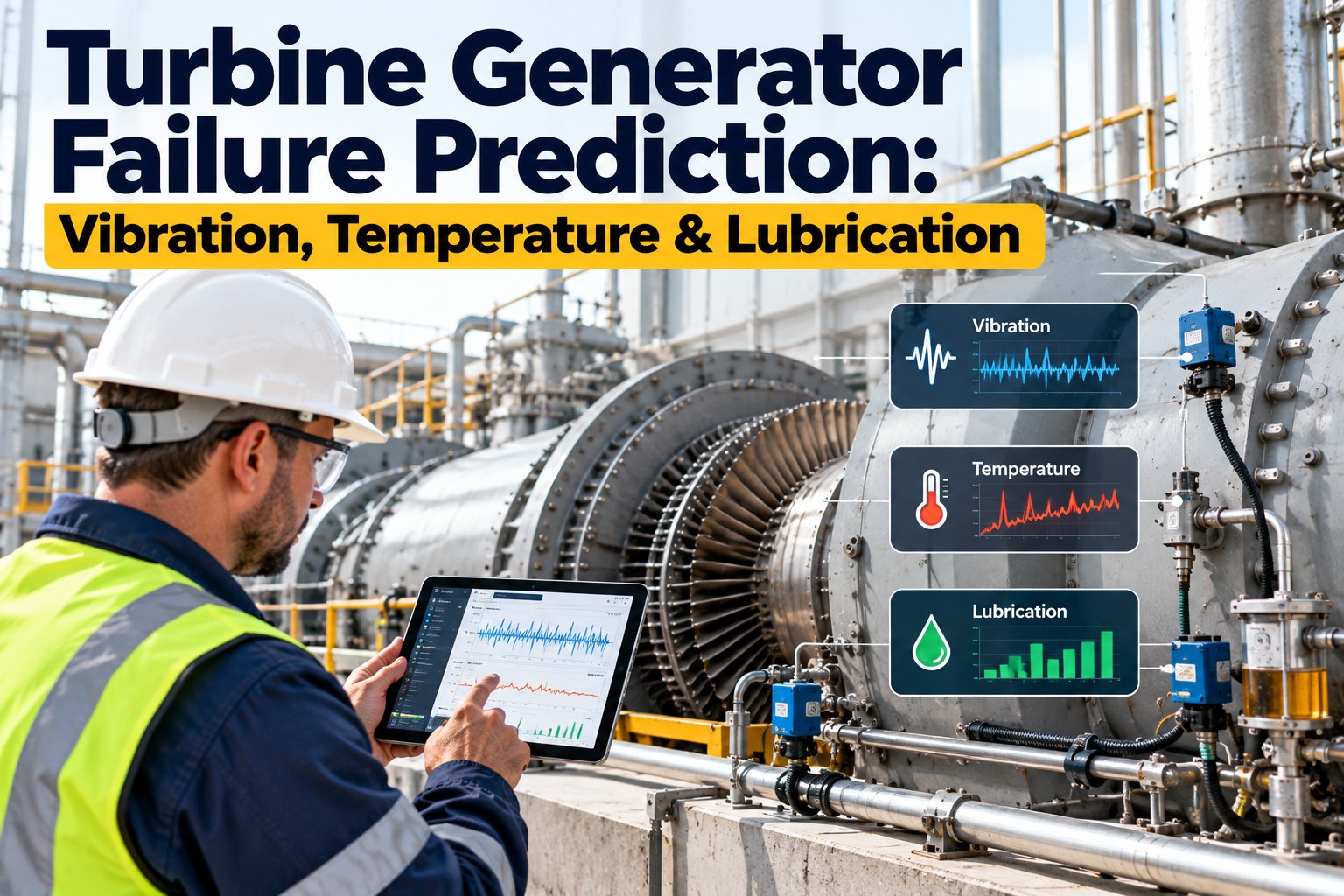
A forced outage on a 250 MW steam turbine costs between $750,000 and $1.4 million per day in lost generation and emergency labour — and 89% of those events were preceded by vibration warning signs that registered weeks earlier on instrumentation already installed on the bearing housings. The signals were there. Nobody owned the trend. ISO 10816-2 sets the criteria for evaluating vibration severity on large land-based steam turbines and generators, with clearly defined Zone A, B, C, and D limits that move a machine from "acceptable for long-term operation" to "vibration is sufficient to cause damage" — and yet most power teams still react to vibration alarms instead of trending them. Reactive failures cost power generators 4.8 times more than planned interventions — start a free trial to see how Oxmaint turns vibration data into scheduled work orders, or book a demo to walk through a live turbine asset condition timeline.
Power Generation · Rotating Equipment · 2026
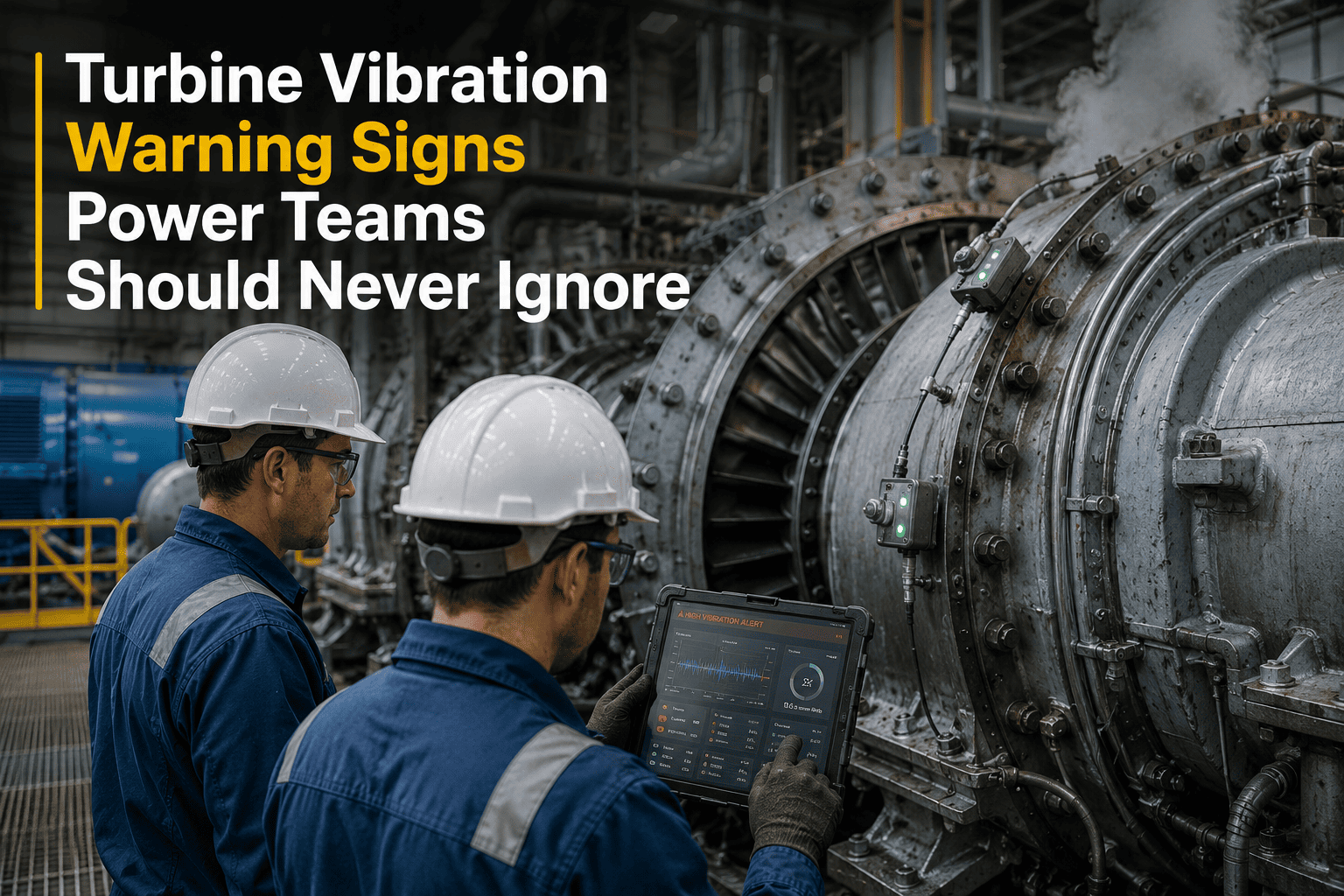
Turbine Vibration Warning Signs Power Teams Should Never Ignore
The early indicators that separate a planned bearing change from a forced outage — and how a CMMS turns vibration data into action.
ISO 10816 alarm bands
Trend-based PM triggers
Forced outage prevention
Stop discovering vibration excursions in the post-event report.
average daily cost of a forced steam turbine outage
89%
of forced turbine outages show vibration warning signs in the weeks before failure
4.8x
cost of reactive turbine repair versus planned, condition-based intervention
4.5 mm/s
ISO 10816 Zone B/C boundary above which most industrial machines require maintenance scheduling
30-90
days typical lead time between first vibration warning and catastrophic bearing failure
Why turbine vibration is the leading early-warning signal
Rotating equipment fails in patterns. Bearings degrade through staged spectral signatures, misalignment produces specific 1x and 2x running-speed peaks, unbalance generates dominant 1x radial vibration, and rubs introduce harmonics that did not exist last month. Each of these signatures appears on the turbine's vibration spectrum days, weeks, or months before the failure becomes catastrophic. ISO 10816-2 defines the evaluation zones for steam turbines above 50 MW at 1,500 / 1,800 / 3,000 / 3,600 RPM, and ISO 10816-3 covers industrial machines from 15 kW upward — between them, every rotating asset in the plant has a defined alarm threshold.
The gap is not measurement — the gap is trend ownership. Vibration data sits in the DCS, the protection system, or a condition monitoring platform that nobody opens until an alarm trips. By that point, the warning window has closed. A CMMS that ingests vibration trend data and converts threshold crossings into scheduled work orders shifts the entire workflow from reactive to condition-based. Try Oxmaint free and trend every bearing in your plant against its ISO 10816 alarm band on day one.
Six vibration warning signs you should never ignore
Band 1
Rising RMS Velocity Trend
A steady week-over-week climb in overall RMS velocity (mm/s) is the single clearest indicator of degrading machine health — and the most ignored.
Band 2
High-Frequency Acceleration Spikes
Acceleration (g) rises weeks before velocity-based readings change. Early-stage bearing race faults show here first — long before audible symptoms.
Band 3
Dominant 1x Running Speed Peak
A growing 1x peak indicates unbalance — caused by fouling, blade erosion, or rotor bow. Left unchecked, it loads bearings and accelerates failure.
Band 4
2x Peak with Axial Component
Misalignment signature. Couplings drift, foundations settle, or thermal growth changes the geometry — all detectable months before the bearing fails.
Band 5
New Harmonics or Sidebands
Frequencies that were not present last month — sidebands around running speed, BPFI or BPFO peaks — signal an evolving fault that needs spectrum analysis.
Band 6
Phase Angle Changes
A shift in phase relationship between bearings while amplitude is stable indicates a cracked shaft or developing rub — and is often the final warning.
Forced outage cost on a 250 MW steam turbine averages $750K to $1.4M per day — and 89% of these events had vibration warning signs weeks earlier.
Why power teams keep missing the warning window
Alarm-Driven, Not Trend-Driven
Most plants react only when the protection system trips. By then, Zone D has been reached and a forced outage is hours away — the warning months are already gone.
Data Locked in the Historian
Vibration trends sit in OSIsoft PI, Wonderware, or a CMS no one opens. Without surfacing those trends to the maintenance team, the data has no operational value.
No Threshold-to-Work-Order Link
Even when a trend is reviewed, no automated path exists to convert a Zone B/C crossing into a scheduled inspection, balance check, or alignment work order.
No Historical Baseline
Without commissioning baselines stored per asset, every reading is judged in isolation. Drift becomes invisible because there is nothing to drift from.
Knowledge Lives with One Engineer
When the vibration specialist retires or rotates out, the entire institutional memory of fleet trends, fault signatures, and intervention thresholds leaves with them.
CapEx Decisions Without Asset History
Turbine refurbishment versus replacement decisions are made on age — not on documented vibration history. The wrong call costs eight-figure CapEx.
The pattern is consistent across every coal, gas, combined-cycle, and nuclear plant we have spoken with — the data is captured, but the workflow does not exist to turn the data into a maintenance decision. Plants that close that gap typically reduce forced outage hours by 60-75% within the first 18 months. Book a demo to see how Oxmaint pulls vibration trends from your existing historian and converts threshold crossings into work orders automatically.
How Oxmaint turns vibration data into preventive action
Asset registry with ISO 10816 bands
Every turbine, generator, BFP, and circulating pump tagged with the correct ISO 10816 part (-2, -3, -4, -7) and Zone A/B/C/D thresholds preconfigured.
Historian and sensor integration
Pulls live vibration data from OSIsoft PI, Wonderware, Ignition, LoRaWAN sensors, or direct DCS feeds — no rip-and-replace of existing monitoring stack.
Trend-based PM triggers
Zone B/C crossings, rate-of-change exceedances, or sustained elevation above baseline auto-generate work orders before alarm thresholds are reached.
Component-level failure history
Every bearing change, balance, alignment, or coupling repair recorded against the asset — so the next vibration excursion is read in the context of full asset history.
CapEx forecasting per turbine
Condition scoring rolls up into 5-10 year CapEx models — turbine overhaul timing forecasted on documented vibration history, not just age.
Mobile-first field execution
Field engineers see the full vibration trend, photo history, and prior work on the asset before touching it — knowledge no longer locked in one person's head.
A Zone B/C crossing (4.5 mm/s RMS on most industrial machines) is the line between "schedule it" and "you will lose the asset."
Reactive turbine maintenance vs condition-based intervention
Outcome Dimension
Reactive (Alarm-Driven)
Condition-Based (Trend-Driven)
Warning window used
Hours to minutes
30-90 days lead time
Cost per repair event
Baseline (4.8x reference)
Approximately 1x baseline
Forced outage probability
High — alarm = trip
Low — planned shutdown
Spare parts readiness
Emergency procurement
Pre-staged, fitted, kitted
Outage duration
Extended (parts + labour wait)
Defined window, predictable
Lost generation revenue
$750K-$1.4M per day
Scheduled into low-demand window
Insurance and warranty position
Weakened — no documented history
Strengthened — full audit trail
CapEx decision confidence
Age-based guesswork
Vibration-history-backed
ROI of condition-based turbine management
60-75%
reduction in forced outage hours within 18 months of trend-based vibration workflow
4.8x
cost differential between planned condition-based work and reactive emergency repair
$3-7M
annual avoided outage cost per 250 MW unit when vibration warnings are actioned in time
22%
lower maintenance budget overall for plants on condition-based versus calendar-based PM
The financial case for condition-based turbine maintenance has been settled for two decades. What has changed is the operational case — modern CMMS platforms now make it possible for plants without a dedicated vibration analyst to operate to ISO 10816 trend discipline. The data already exists in your historian. The workflow is the missing piece. Start a free trial to see how Oxmaint closes that workflow gap.
Frequently Asked Questions
What ISO 10816 thresholds should we use for our turbines
ISO 10816-2 covers land-based steam turbines and generators above 50 MW operating at 1,500 / 1,800 / 3,000 / 3,600 RPM. ISO 10816-3 covers industrial machines above 15 kW between 120 and 15,000 RPM — typical of BFPs, fans, and auxiliary motors. ISO 10816-4 covers land-based gas turbines, and ISO 10816-7 covers rotodynamic pumps. Oxmaint pre-configures Zone A/B/C/D limits per asset class so your team is not setting thresholds from scratch.
How does Oxmaint integrate with our existing vibration monitoring system
Oxmaint connects to industrial historians (OSIsoft PI, Wonderware, Ignition), DCS systems, and wireless vibration sensors through standard APIs or middleware gateways. The existing monitoring stack continues to do the measurement — Oxmaint adds the trend ownership layer that converts a Zone B/C crossing into a maintenance work order automatically.
Can we use Oxmaint without a dedicated vibration analyst on staff
Yes. The platform handles trend monitoring, threshold alerting, and work order generation against ISO 10816 bands by default. A vibration specialist remains valuable for spectrum-level diagnosis of complex faults, but the day-to-day discipline of trend ownership and PM triggering runs without one. Many plants use Oxmaint precisely because they cannot recruit a full-time analyst.
How does this support our CapEx planning for turbine overhauls
Vibration history and condition scoring feed directly into Oxmaint's 5-10 year CapEx models. Turbine overhaul timing is forecasted on documented condition data rather than age alone, which sharpens replace-versus-refurbish decisions on assets where the cost difference can be eight figures. The same data supports investor-grade reporting for plant operators and IPP portfolios.
Decision Point
Stop discovering vibration excursions after the outage report
Every forced outage that begins with a vibration trend is a workflow gap, not a measurement gap. Oxmaint closes that gap — integrating with your existing historian, applying ISO 10816 bands, and turning threshold crossings into scheduled work. Used by power teams managing 10,000+ rotating assets. Live in days, not months.
Real-time asset visibility
Predictive failure alerts
5-10 year CapEx forecasting
See measurable forced outage reduction in your first quarter.