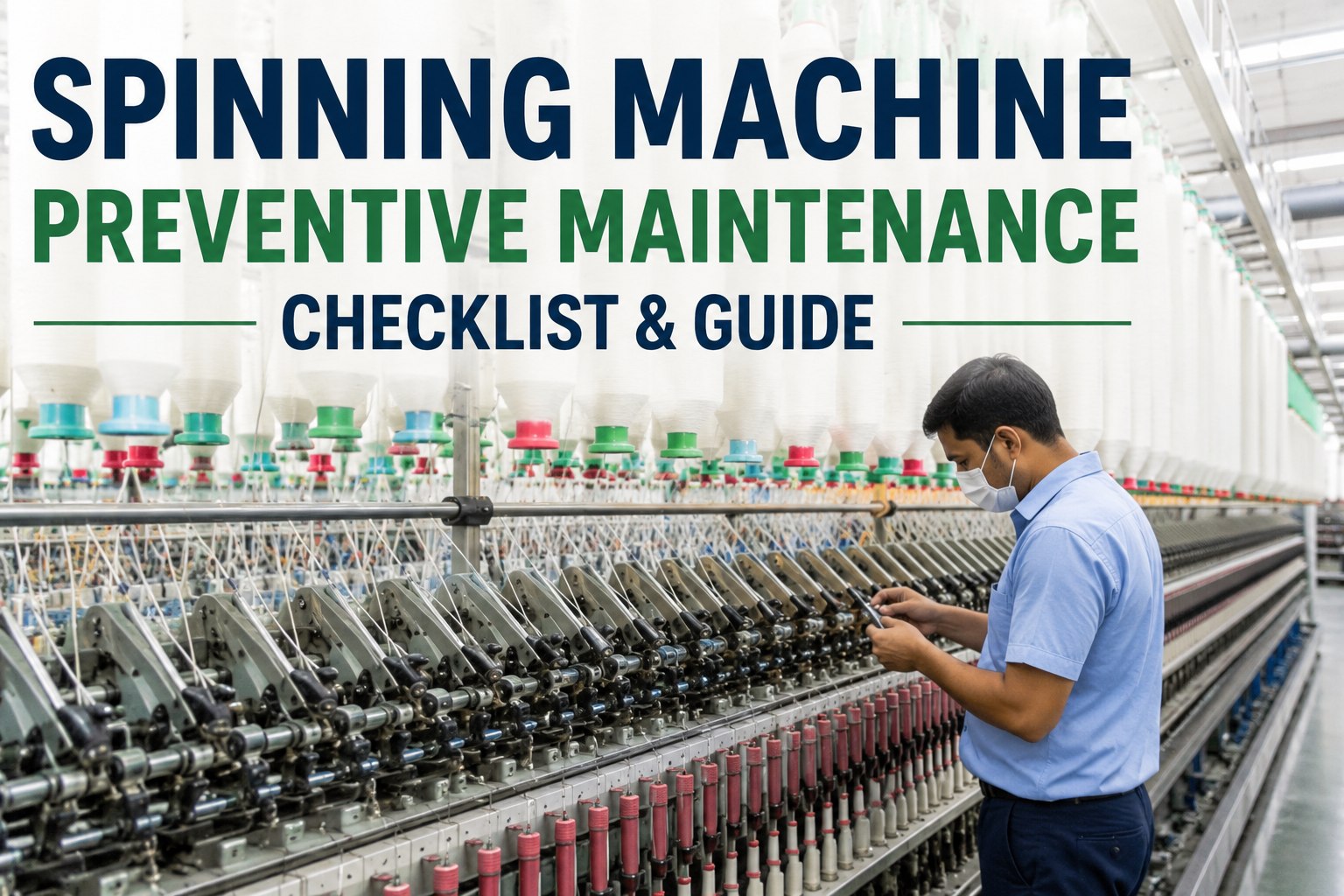
Walk any spinning mill floor at 3 AM and the sound tells you everything. A well-maintained ring frame hums at a steady frequency — 18,000 to 25,000 RPM per spindle, thousands of travelers whispering around their rings at 35 meters per second, drafting rollers pulling roving through their nips in perfect synchronization. A neglected frame sounds different. Louder. Uneven. A traveler that should have been replaced three weeks ago starts chirping. A dry spindle bearing sings a high note it should never sing. Yarn breaks climb from 12 per 1000 spindle-hours to 40. Production efficiency drops from 96% to 82% before the shift supervisor even notices. This is a spinning machine PM checklist built to keep that hum steady — every task, every frequency, every zone — engineered around how OxMaint turns paper checklists into dispatched, tracked, and documented work orders. Book a free demo to see spinning PM run inside OxMaint.
Z1
Creel Zone
Roving bobbin holders, guide rails, tension arms
Guide cleanliness, tension check, breakage log
Daily
Z2
Drafting Zone
Top & bottom rollers, aprons, cradle, cots
Apron wash, roller eccentricity, saddle gauge
Weekly + Quarterly
Z3
Spindle & Ring Zone
Spindles, rings, travelers, separators, balloon controls
Traveler swap, spindle lube, ring cleaning
6-20 weeks
Z4
Winding Zone
Ring rail lift, doffer, underwinding system, cop build
Rail lubrication, doffing cycle, lift mechanism
Monthly
Approximately 150 million ring spindles operate globally — every one running under a PM cadence like this
The commercial reality behind these numbers is stark. A ring spinning frame with 1,200 spindles running at 96% efficiency produces roughly $50,000-$80,000 of yarn per day. Drop that efficiency by 5 points because of skipped drafting maintenance and you have lost $2,500-$4,000 every 24 hours until the discipline returns. That is exactly why the mills consistently in the top efficiency quartile treat PM as a production activity — not a maintenance overhead — and why a CMMS built for the shop floor has become non-negotiable at scale.
6-20
weeks between traveler replacements depending on speed, yarn count, and coating
90%+
machine-related performance achievable on well-maintained ring frames in industrialized mills
<10%
total downtime is the industry-standard target for efficient spinning production
Ring vs Rotor Spinning: Why the PM Approach Diverges
Both technologies convert sliver or roving into yarn, but the mechanics of doing that create very different maintenance rhythms. Ring spinning depends on a mechanical twist system with hundreds of moving contact points per machine — every spindle, every ring, every traveler. Rotor (open-end) spinning uses a rotating cup at 100,000+ RPM to twist fibers aerodynamically, concentrating wear on a much smaller number of high-precision components. The right PM checklist for one is dangerously wrong for the other.
Primary wear parts
Travelers, rings, spindles, aprons
Rotor, opening roller, navel, spinbox
Fastest-wearing component
Traveler (6-20 weeks)
Opening roller (3-6 months)
Rotational speed
18-25k RPM spindle · 35 m/s traveler
80-130k RPM rotor
Lubrication focus
Spindle bearings every 500 operating hours
Rotor shaft bearings + drive belts
Cleaning intensity
Ring/traveler dust, drafting fly
Rotor groove trash, navel deposits
CMMS work order style
Zone-based, checklist-heavy
Position-based, condition-triggered
The Complete Ring Spinning PM Checklist by Frequency
This checklist reflects the maintenance rhythm that consistent-quality mills follow across shift, day, week, month, quarter, year, and long-cycle overhaul horizons. Each block is designed to translate directly into an OxMaint recurring PM work order — with the task list, tools required, safety notes, and completion evidence attached so nothing runs on memory alone.
Every Shift
Visual inspection of running spindles for wobble or unusual sound
End-breakage log per section, flagged if above baseline
Roving package condition check at creel
Cot damage or embedded fly visible during doff
Balloon shape uniformity across spinning positions
Weekly
Top & bottom aprons washed and inspected for glaze or damage
Ring & traveler visual check per position, worn travelers replaced
Cots buffed to restore surface if hardened
Suction tube blockage inspection, filter cleaning
Creel guide bar cleaning to prevent roving damage
Under-frame fly buildup cleared to prevent contamination
Monthly
Drafting roller nip pressure verification with gauge
Ring rail level check across the full length of the frame
Spindle bolster oil level inspected and topped up
Belt tension checked on drafting drive and main motor
Separator blade condition and alignment
Underwinding wire condition on each spindle
Quarterly (3 months)
Full apron replacement cycle for units past 3-month mark
Ring cleaning with prescribed compound, verify inner surface
Draft change gears inspected for wear and backlash
Cradle spring pressure gauge verification
Suction motor bearing inspection and lubrication
Motor thermal readings logged for trending
Semi-Annual (6 months)
Top roller arbor greasing across all drafting units
Spindle and spindle collar truing check
Roller eccentricity measurement per drafting position
Bottom roller setting and saddle gauge alignment
Trough leveling and drainage verification
Flyer cleaning with graphite powder on speed frame
Complete electrical panel inspection and torque check
Annual
Full drafting system overhaul including cot recovering
Ring change decision based on wear measurement
Spindle bearing pack renewal per manufacturer spec
Drive train complete inspection, coupling alignment check
Ring rail lifting cam wear measurement
Insulation resistance test on all motors
Compressed air line audit and dryer service
Overhaul (7-10 years)
Complete replacement of creel, drafting, spindle drive components per OEM kit
Ring change across the entire frame with break-in period planning
Suction zone motor and duct system renewal
Full doffer system reset and calibration to factory geometry
Complete recalibration to bring machine performance to next-decade specification
Sign up free to auto-generate this exact checklist as recurring work orders per machine and per frequency in OxMaint.
Spindle Lubrication: The Heart of Spinning Reliability
A ring spindle runs at 18,000-25,000 RPM continuously — an operating stress profile with almost no equivalent in general industrial machinery. The bolster oil that lubricates the spindle bearing is doing work every second of every shift. Skip the top-up and heat rises. Contaminate the oil with cotton fly and the bearing surface pits. Miss the seal inspection and moisture enters. What follows is either a bearing seizure — with the spindle drop, downtime, and yarn loss that comes with it — or the slower, more expensive failure of the drafting geometry drifting out of tolerance because vibration has increased just enough to matter.
Spindle Lubrication Discipline
1
Bolster Oil Level Check
Verify oil sight glass on every spindle monthly. Top up with OEM-specified grade. Log the volume added — a trending increase signals seal degradation.
2
Full Oil Change
Drain and replace bolster oil every 500 operating hours or per manufacturer recommendation. Filter the drained oil and inspect for metallic particles that indicate bearing wear.
3
Seal & Housing Inspection
Check spindle top seal for cotton fly ingress every quarter. Any brown discoloration around the neck means moisture has entered and the seal needs replacement before bearing damage compounds.
4
Vibration & Sound Baseline
Trend spindle vibration monthly using a handheld meter or the mill's spindle monitoring system. A rising vibration signature always precedes bearing failure by 4-8 weeks.
Drafting System: Where Yarn Quality Is Made or Lost
The drafting zone is where yarn count uniformity is actually created. Fiber slippage in the drafting nips, apron glazing, roller eccentricity, or an uneven cradle spring pressure — any one of these turns a $2.40/kg carded yarn into a $1.80/kg reject in the same shift. The drafting checklist below reflects the discipline that keeps CV% below the specification threshold day after day.
Apron washing & inspection
Weekly
Glazed aprons cause fiber slippage and CV% drift
Cot buffing / recovering
Monthly / 3 months
Hardened cots produce inconsistent nip pressure
Roller nip pressure gauge check
Monthly
Uneven pressure causes count variation across drums
Bottom roller setting / saddle gauge
6 months
Drift creates thick/thin faults in the yarn
Roller eccentricity check
6 months
Eccentricity is invisible until yarn quality drops
Top roller arbor greasing
6 months
Dry arbors seize and damage the top roller bore
Full cradle spring load calibration
Annual
Fatigued springs release nip pressure gradually
Traveler Replacement: The 6-20 Week Rhythm That Sets Yarn Quality
Ring travelers are the single fastest-wearing component on the machine. Each traveler orbits its ring 25,000-40,000 times per minute at 35 m/s, generating heat, wearing against the ring flange, and losing the surface finish that controls yarn tension. Run a traveler beyond its life and every yarn quality metric degrades simultaneously: hairiness rises, tension variation increases, ends-down rate climbs. The replacement rhythm depends heavily on yarn count, spindle speed, and the traveler coating — but the discipline of tracking each set against its baseline life is universal.
Traveler Replacement Cadence · By Application
Fine cotton · 100% cotton · high speed
Coarse cotton · medium speed
Polyester / blends · standard speed
Coated travelers (Sapphire / Onyx / Carbo)
Replacement signals — swap the whole set when any of these appear
Yarn hairiness rising
Ends-down rate climbing
Visible groove wear
Chirping / metallic sound
Balloon shape irregularity
Traveler-ring heat glow
Automate the Traveler Replacement Schedule
OxMaint tracks traveler set installation dates, calculates due-by dates per machine and yarn count, and generates the replacement work orders before quality metrics start to drift. See it against your spinning mill in a 30-minute live walkthrough.
Rotor Spinning PM: Different Machine, Different Rules
Rotor spinning removes the traveler and ring from the equation entirely, but that does not mean less maintenance — it means different maintenance. The rotor itself runs at 80,000-130,000 RPM inside a spinbox that must remain contamination-free to produce yarn without periodic count deviation. The rotor groove collects trash particles from the fiber stream, the navel wears from continuous yarn contact, and the opening roller strips fibers off the sliver at high speed until its clothing wears smooth. Each of these components has its own service interval, and the checklist below reflects the operational rhythm most rotor spinning mills follow.
Rotor Spinning Preventive Maintenance Checklist
Rotor Cup
Clean daily · replace 12-18 months
Groove trash buildup causes yarn faults; balance loss triggers vibration alarms
Opening Roller
Inspect weekly · replace 3-6 months
Clothing wear reduces fiber individualization and increases neps in the yarn
Navel
Inspect monthly · replace 6-12 months
Wear affects twist penetration and yarn structure consistency
Trash Removal Duct
Clean daily · inspect weekly
Blockage forces trash back into rotor and multiplies yarn defects
Rotor Bearing / Drive
Lube quarterly · overhaul 3-5 years
Bearing failure at 100k RPM is catastrophic and expensive
Sliver Feed Table
Clean weekly · calibrate quarterly
Uneven sliver presentation causes count variation and end breaks
Turning Paper Checklists Into Executed Work Orders
A PDF checklist on the maintenance office wall is a wish. A dispatched work order with a technician assigned, tools listed, safety notes attached, completion photos captured, and time logged is a system. The difference between mills that hit 90%+ machine performance year after year and mills that hover in the 70s is almost always the presence — or absence — of that system. OxMaint takes the checklist above and turns every row into a scheduled, tracked, and documented work order per machine, per spindle group, per shift.
From Paper Checklist to CMMS Work Order
01
Machine Registry Built
Every ring frame, rotor unit, and drafting position registered as an asset with model, serial, install date, and PM history in OxMaint
02
PM Templates Loaded
Daily / weekly / monthly / quarterly / annual templates configured once with task lists, tools, safety, and completion criteria
03
Auto-Generated Work Orders
OxMaint fires the right work order at the right frequency to the right technician mobile device with zero manual planning
04
Completion Captured
Technician marks steps complete, uploads photos, logs consumables and time — every event stored against the asset history
05
Trends & Audits Emerge
MTBF, MTTR, PM compliance, and cost-per-machine trends surface automatically — audit and quality investigations become straightforward
Expert Perspective · What Separates Top-Quartile Mills
Every spinning mill I have worked with knows the checklist. Every one. What separates the top-quartile mills from the rest is not that they have a better list of tasks — it is that the tasks actually happen, get documented, and get trended. The mills that hit 96% efficiency have moved past "we do PM" into "we can prove every PM was done on time, by whom, with what evidence, on every machine, every week." That level of discipline is not achievable on paper checklists once you cross about 12,000 spindles. A CMMS like OxMaint is what makes it operationally possible. Once the discipline is embedded, the yarn quality follows, the breakdown rate collapses, and the whole cost structure moves in your favor.
Task the Machine, Not the Person
PM tied to specific assets in OxMaint survives shift turnover, promotions, and retirements — paper checklists rarely do.
Trend the Traveler Life
The traveler replacement interval is a leading indicator of yarn quality trouble. OxMaint keeps that clock running per set.
Build the 10-Year Asset History
Every logged PM feeds the eventual overhaul decision. Mills with 8 years of clean data replace equipment with confidence.
Stop Running Spinning PM on Paper
If your spinning frames are still maintained from a wall-mounted checklist and a supervisor's memory, you are leaving efficiency, yarn quality, and equipment life on the floor. See what OxMaint — a maintenance management platform built for the mill environment — looks like against your actual production line.
Frequently Asked Questions
How often should ring travelers be replaced on a spinning machine?
Typical intervals range from 6 to 20 weeks depending on yarn type, spindle speed, and traveler coating. Fine cotton at high spindle speeds may need replacement every 5-8 weeks, while polyester or blended yarns often reach 10-15 weeks. Coated travelers (Sapphire, Onyx, Carbo) can extend up to 20 weeks. OxMaint tracks the installation date of every set and calculates due-by dates automatically per machine so no replacement is missed.
What is the correct spindle lubrication schedule for ring spinning?
Monthly bolster oil-level checks with top-ups as needed, and full oil changes every 500 operating hours or per the OEM specification. Seal and housing inspection is quarterly, and monthly vibration trending detects bearing wear 4-8 weeks before failure. OxMaint fires the correct work order at each interval and stores the completion evidence against the spindle asset for audit and trending.
Which drafting system PM tasks affect yarn quality most directly?
Weekly apron washing prevents fiber slippage and CV% drift. Monthly nip pressure verification catches count variation before it becomes a customer complaint. Six-month roller eccentricity checks and bottom roller / saddle gauge alignment prevent invisible drift that produces thick and thin faults in the yarn. Annual full drafting overhaul including cot recovering restores original geometry.
How is rotor spinning PM different from ring spinning PM?
Rotor spinning removes the traveler and ring entirely, concentrating wear on the rotor cup, opening roller, navel, and spinbox components. Opening rollers replace every 3-6 months, navels every 6-12 months, and rotor cups every 12-18 months. Daily rotor and trash duct cleaning is critical because contamination directly causes yarn faults. Rotor bearing lubrication is quarterly, with a full drive overhaul every 3-5 years.
Can a CMMS really replace paper checklists for a spinning mill?
Yes — and once mill size crosses roughly 12,000 spindles, it becomes operationally necessary. Paper checklists cannot survive shift turnover, cannot prove completion, and cannot trend performance over time. OxMaint dispatches every PM task per asset at the correct frequency, captures completion evidence via mobile device, and turns years of data into MTBF, MTTR, PM compliance, and cost-per-machine trends automatically.
When should we plan a full machine overhaul on ring spinning frames?
Ring and compact spinning machines typically receive a full overhaul kit every 7-10 years, covering creel, drafting, spindle drive, and suction zone components. Mini kits with 1-3 year lifetime cover the highest-wear parts in between. Ring changeover requires several days of break-in and should be planned during a scheduled maintenance window. OxMaint's asset history lets mills make the overhaul-vs-replace decision based on years of documented performance data rather than instinct.