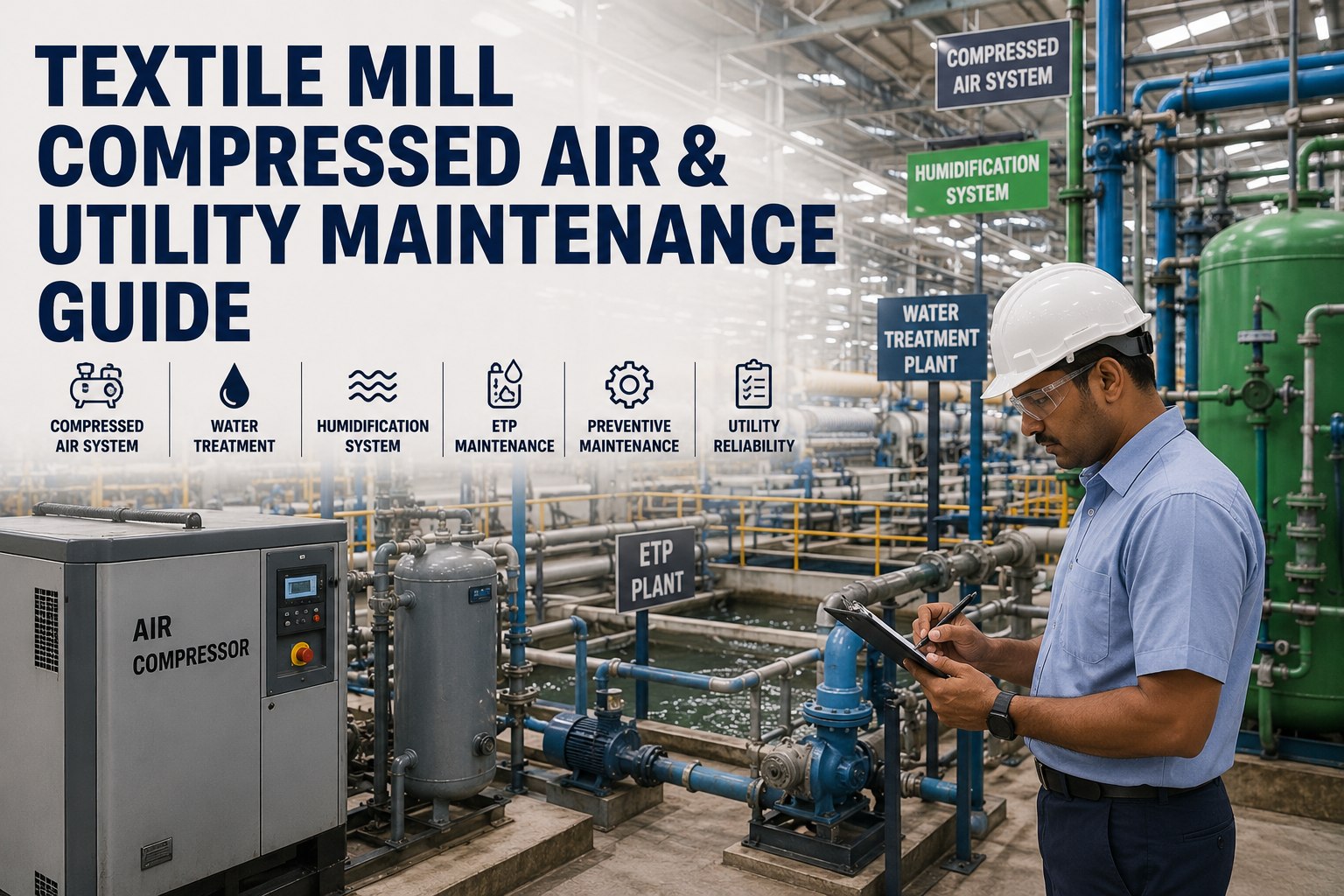
In a textile mill, the utilities are not background services — they are production equipment. Humidity is the clearest case: relative humidity is a process input that sets yarn tensile strength, breakage rate, and static, and because yarn is sold by weight, a 4% drop in humidity can mean roughly 4% less salable mass. Spinning cotton wants 50–65% RH, weaving 60–70%, and drifting outside that band raises end breaks, machine stops, and scrap on the floor. Compressed air runs the pneumatics, splicers, and cleaning across every machine; the effluent treatment plant keeps the mill inside its discharge permit. When any of the three degrades, the mill does not just lose a utility — it loses yarn quality, throughput, or compliance. This shorter guide covers the maintenance that keeps them dependable: compressed air PM, humidification upkeep, and ETP maintenance. Start a free Oxmaint trial and schedule every utility asset on its own cadence, or book a demo to see RH, air pressure, and ETP condition tracked together.
Textile · Mill Utilities · Compressed Air & Water
Textile Mill Compressed Air & Utility Maintenance Guide
Compressed air system PM, humidification maintenance, and effluent treatment upkeep — the utility maintenance that protects yarn quality, throughput, and discharge compliance in a textile mill.
-
50–70%
RH band across spinning and weaving zones
-
4% RH
drop can cut ~4% of salable yarn weight
-
±3% RH
control tolerance for consistent regain
-
Weekly
lint cleaning on coils, filters, and fan blades
Three Utilities, Three Consequences
What Each Utility Actually Protects
Map each utility to what it loses when it degrades, and the maintenance priority is obvious — because in a mill these are not comfort systems, they are quality, throughput, and compliance systems.
- Humidification → yarn quality RH sets tensile strength and breakage. Drift below band brittles the yarn and raises end breaks; a 10-point RH rise can lift cotton stretch ~15%. Control to ±3% RH is a maintained condition, not a set-and-forget one.
- Compressed air → throughput Pneumatics, splicers, and blow-cleaning depend on stable pressure and dry, clean air. Leaks and pressure sag stall machines and waste the mill's most expensive utility.
- Effluent plant → compliance Dye-house and wet-process wastewater must meet discharge limits. The ETP — aeration, dosing, clarifier, instruments — is what keeps the mill permitted, and its degradation is invisible until a sample fails.
Humidification and air-washer maintenance also suppresses airborne lint and fly — a housekeeping and fire-load benefit on top of the process one. Book a demo to see each utility mapped to the outcome it protects.
The Compressed Air Program
Air PM That Holds Pressure and Dryness
Textile compressed air fails in familiar ways: leaks, moisture carryover, and clogged filters that force the compressor to overwork. A short recurring routine keeps it dependable.
| Task | Cadence | Prevents |
|---|---|---|
| Leak survey & repair | Recurring | Pressure sag, wasted energy |
| Filter differential pressure | Monitored | Overwork, higher energy draw |
| Dryer dew point | Trended | Moisture on pneumatics and yarn |
| Condensate drains | Checked | Water carryover downstream |
| Receiver & setpoint | Reviewed | Cycling, artificial demand |
Run the loop to true end-use pressure — every 2 psi of unnecessary pressure adds roughly 1% to compressor energy. Sign up for Oxmaint to run a zoned compressed air leak program.
Humidification & ETP
Keeping the Process Utilities Dependable
The humidification plant and the effluent plant are the two utilities most specific to a mill. Both reward tight, scheduled upkeep — and both fail quietly.
-
Humidification
Nozzles, Water, Sensors
Clean spray nozzles and air-washer decks to hold droplet quality, treat feed water to prevent scaling and clogging, and calibrate RH sensors on schedule — because control accuracy depends on the sensor being right. Clear lint from coils, filters, and fan blades weekly.
-
Effluent Plant
Aeration, Dosing, Instruments
Maintain aeration blowers and diffusers, keep dosing pumps calibrated, service clarifier mechanisms, and calibrate the pH and flow instruments whose readings become the numbers reported against the discharge permit.
Distribute RH monitoring per zone — stagnant air leaves some areas wet and others dry, so uniform circulation is part of the maintenance goal. Book a demo to see humidification and ETP PM scheduled per asset.
Oxmaint for Textile Utilities
How Oxmaint Runs Utility Maintenance
-
Air Program
Leaks and Dew Point
Zoned leak surveys, filter differential-pressure monitoring, and dryer dew-point trending — keeping air dry, clean, and at true end-use pressure across the mill.
-
RH Control
Sensors and Nozzles
Schedule nozzle cleaning, feed-water treatment, and RH sensor calibration so humidity holds to ±3% and yarn quality stays inside its regain band.
-
ETP Upkeep
Permit-Critical PM
Aeration, dosing, and clarifier PM with traceable instrument calibration, so the plant meets its discharge limits and holds the evidence a regulator expects.
-
Lint Routines
Weekly, Logged
Recurring lint-cleaning routes for coils, filters, and fan blades captured on mobile — the housekeeping that protects both efficiency and fire load.
-
One Register
Every Utility Asset
Compressors, humidifiers, blowers, dosing pumps, and instruments in one asset register with condition and history, not scattered across separate logs.
-
Mobile Close-Out
Signed On the Floor
Technicians close utility work orders at the equipment with readings and photos, building the record without a shift spent on paperwork.
Frequently Asked
Textile Utility Maintenance Questions
Why is humidity a process input in a textile mill?
Because fiber properties depend on moisture regain, which tracks ambient relative humidity. RH sets yarn tensile strength, flexibility, and static — spinning cotton typically wants 50–65% RH and weaving 60–70%, held to about ±3%. Drift below band brittles the yarn and raises end breaks and stops; drift affects salable weight too, since yarn sells by weight and a 4% RH drop can mean roughly 4% less mass. That is why humidification is production equipment, not comfort conditioning. Sign up for Oxmaint to keep RH control on a maintenance schedule.
What are the main compressed air maintenance tasks?
Recurring leak survey and repair, filter differential-pressure monitoring, dryer dew-point trending, condensate drain checks, and receiver and setpoint review. The goals are stable pressure, dry clean air, and no artificial demand. Running the system to true end-use pressure matters because every 2 psi of unnecessary pressure adds roughly 1% to compressor energy, and moisture carryover from a failing dryer reaches pneumatics and yarn.
What keeps a textile ETP compliant?
Scheduled maintenance of the equipment that treats dye-house and wet-process wastewater: aeration blowers and diffusers, dosing pumps kept calibrated, clarifier mechanisms serviced, and the pH and flow instruments calibrated on a traceable schedule — because their readings become the numbers reported against the discharge permit. ETP degradation is invisible until a sample fails, so condition-based upkeep and calibration are what prevent an exceedance. Book a demo to see ETP PM and calibration tracked together.
How often should lint be cleaned from utility equipment?
Weekly inspection with monthly deeper cleaning is typical for lint accumulation on coils, filters, and fan blades in a mill environment. Lint buildup reduces heat-transfer and airflow efficiency, forces fans and coils to work harder, and adds to the fire load — so the routine protects energy performance, humidity control accuracy, and safety at once. Capturing it as a recurring logged route keeps it from slipping when the floor gets busy. Sign up for Oxmaint to run logged lint-cleaning routes.
Humidify · Pressurize · Treat · Log
Treat the Utilities Like Production Equipment
Every drifting RH sensor, leaking air line, and neglected ETP pump is yarn quality, throughput, or compliance at risk in a mill where the utilities are part of the process. Oxmaint gives textile teams one platform to run the compressed air program, hold humidity to band, keep the effluent plant permit-ready, and log the lint routes — so the utilities stay as dependable as the machines they feed.