A turbine-generator rarely fails without warning — it fails without anyone reading the warning. A bearing starts shedding iron into the oil, a vibration peak creeps up at running speed, a winding runs a few degrees hotter than its neighbors — each signal small, each one weeks ahead of the trip that takes the unit offline. The trouble is that these signals live in three separate places: a vibration analyst's route, an oil lab report, a temperature log. Read alone, each is ambiguous. Read together, they name the failure and how long you have. Turbine failure prediction is the discipline of fusing vibration, temperature, and lubrication data into one early warning — and turning that warning into a work order before the forced outage. OxMaint AI trends all three signals against each asset and raises the corrective work order the moment they converge.
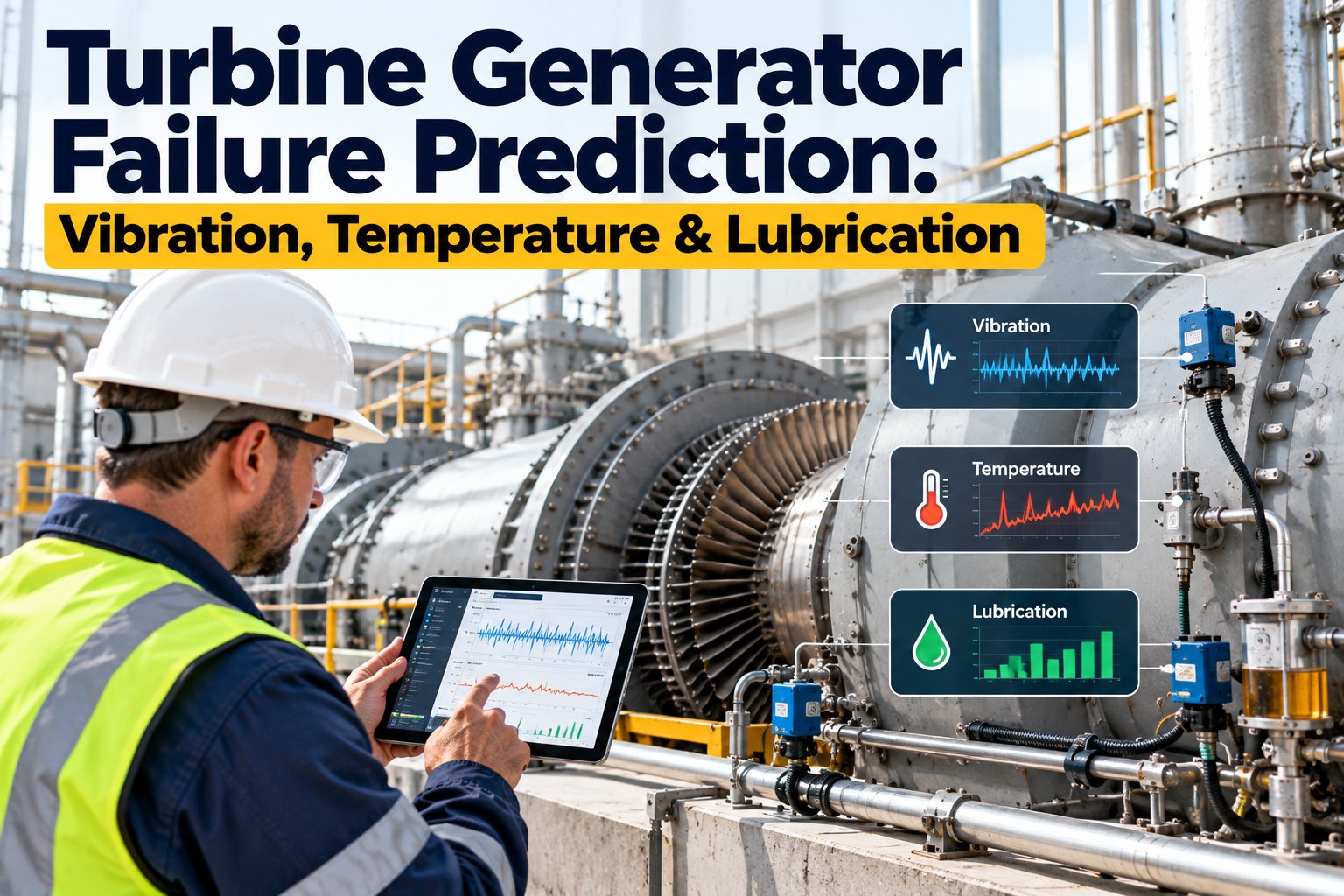
Turbine Generator Failure Prediction: Vibration, Temperature & Lubrication
Most turbine-generator failures announce themselves weeks early — in vibration, in temperature, and in the oil — but only to whoever is watching all three at once. Any single signal is ambiguous; together they pinpoint the failure mode and the time you have to act. This guide maps each signal to the faults it predicts and shows how fusing them gives the earliest, most reliable warning. OxMaint trends vibration, temperature, and lubrication per asset and turns a converging alert into a prioritized work order.
Why One Signal Is Never Enough
A single rising reading tells you something is changing — not what, and not how urgently. A vibration bump could be a loose foot or a failing bearing; a temperature rise could be load or lubrication. The confidence comes from correlation: when vibration, temperature, and oil all move in a pattern, the failure mode is no longer a guess. That's why prediction means fusing the three, not watching them in separate silos. Start free and trend all three against each asset in OxMaint AI.
The Three Signals and What Each Predicts
Each data stream is strongest at catching a particular class of fault. Here's what each one sees first. Book a demo to see all three on one asset timeline in OxMaint.
- 1× running speed rise — typically signals rotor unbalance
- 2× running speed — points to shaft misalignment
- Envelope / defect frequencies — catch bearing wear 4–8 weeks before it's audible
- Blade-pass or rub harmonics — flag blade rub or mechanical looseness
- EGT spread of ~15°C — often precedes combustor or fuel-nozzle issues
- 2–4°C deviation — enough to trigger investigation
- EGT 5–15°C above baseline — typical of compressor fouling
- EGT vs. discharge-temp trend — separates fouling from efficiency loss early
- Iron above 10–15 ppm — in a 500-hour window, often precedes journal-bearing failure
- Magnetic chip detectors — real-time debris alerts between lab samples
- Rising particle counts — flag accelerating wear before concentration thresholds
- Sample every 500–1,000 hours — or monthly, whichever comes first
Where the Signals Converge: Reading the Fault
The power is in the overlap. When two or three signals move together, they don't just raise an alarm — they name the failure mode and sharpen the response. Start free and let converging signals confirm the fault in OxMaint.
| Signals that move together | Likely failure mode | What it points to |
|---|---|---|
| Vibration defect-freq + rising iron in oil | Journal / rolling bearing wear | Confirmed bearing degradation — schedule before spalling |
| 1× vibration rise + bearing temperature up | Rotor unbalance loading a bearing | Balance and inspect before secondary damage |
| 2× vibration + coupling-area temperature | Shaft misalignment | Realign before coupling and seal wear accelerate |
| EGT spread widening + no vibration change | Combustor / fuel-nozzle issue | Combustion-path inspection, not a mechanical fault |
| Oil debris spike + vibration envelope rise | Accelerating bearing failure | Dual confirmation — act in minutes, not after a second check |
Dual confirmation is what cuts response from hours to minutes — a single alert waits for a second opinion; two correlated signals are the second opinion. Book a demo of correlated-signal alerting in OxMaint.
The Forced Outage Was Predictable. The Data Just Lived in Three Places.
Most unplanned turbine outages trace back to signals that were detectable weeks earlier — in vibration, temperature, or oil. They were missed not because the sensors failed, but because no one was reading the three together against the same asset. Fuse the streams and the trip becomes a planned repair on your schedule, not the grid's.
From Signature to Work Order
Prediction only pays off when the alert becomes action. Here's the path from a breached threshold to a technician on the machine. Start free and run this path on your critical units in OxMaint.
Vibration Severity: The ISO 20816 Frame
Raw vibration numbers need a reference, and ISO 20816 provides the standard severity framework for rotating machinery — grouping measured vibration into zones from newly commissioned condition through unacceptable. Trending a machine's position across those zones, rather than reading one number, is what turns vibration into prediction. Book a demo to trend vibration against severity zones in OxMaint.
How OxMaint Predicts and Acts
Multi-signal trending, correlation, and condition-based work orders all live in one CMMS — so the three data streams become one managed prediction program against each asset. Start free and turn three signals into one early warning.
Frequently Asked Questions
Catch the Failure While It's Still Three Quiet Signals.
A turbine-generator gives weeks of warning before it trips — in vibration, in temperature, and in the oil. The units that avoid the forced outage are the ones reading all three together, against the same asset, with an alert that becomes a work order. OxMaint fuses the signals, confirms the fault, and schedules the repair before the grid schedules it for you.