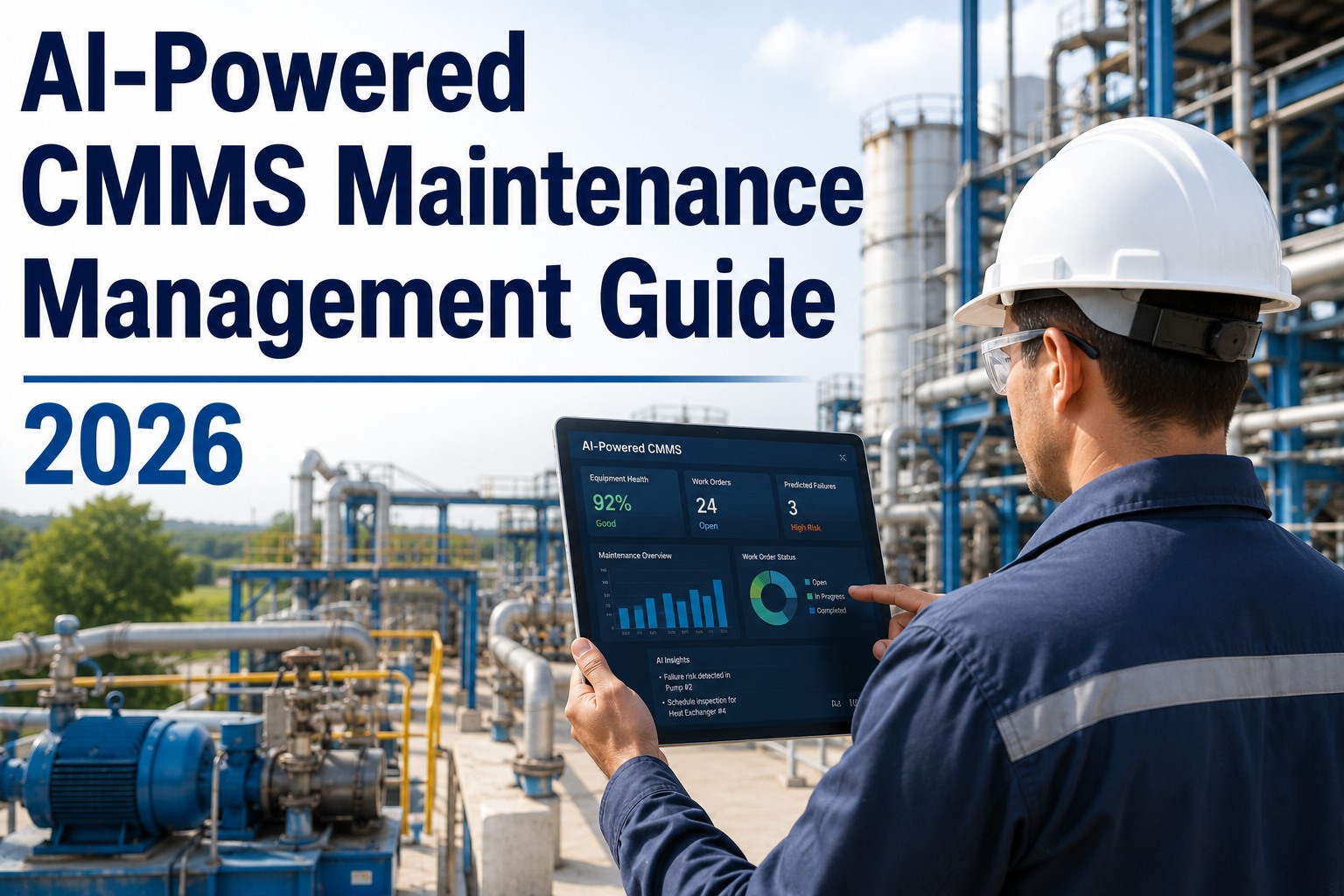
If your maintenance team still relies on spreadsheets, paper logs, or "that one guy who knows everything," you are leaving money and uptime on the table. A Computerized Maintenance Management System (CMMS) is the software backbone that digitizes every maintenance activity—from work orders and preventive schedules to asset histories and spare parts—into a single platform your entire team can access in real time. With AI and IoT now embedded in modern CMMS solutions, the software does not just record what happened—it predicts what will happen next. The global CMMS market is projected to grow from $1.46 billion in 2025 to over $5.37 billion by 2035, and for good reason: manufacturers using CMMS report 25-40% lower maintenance costs and 200-400% ROI within two years. Book a free demo to see how Oxmaint cuts your maintenance costs within weeks of deployment.
$1.46BGlobal CMMS Market (2025)
59%Of Facilities Already Use CMMS
200-400%Typical ROI Within 24 Months
10.4%Annual Market Growth (CAGR)
How Does a CMMS Work? The Core Engine Behind Smart Maintenance
At its foundation, a CMMS connects three pillars—assets, work, and inventory—into a closed-loop system. Every piece of equipment gets a digital identity containing its specifications, maintenance history, warranty details, and real-time condition data. When something needs attention, the system generates a work order, assigns the right technician, checks parts availability, and tracks completion—all without a single phone call or clipboard.
Asset Registry
Every machine, vehicle, and building component cataloged with full specs, OEM manuals, warranty tracking, and a complete timestamped service history from day one.
Work Execution
Automated work order generation, smart technician assignment based on skill and proximity, step-by-step procedures, and real-time status tracking across every task.
Parts and Inventory
Real-time stock levels, automatic reorder triggers, vendor management, and direct parts-to-asset mapping so the right part is always available when needed.
Key Features to Look for in a CMMS (2026 Checklist)
Not all CMMS platforms are built equal. The best solutions for manufacturing in 2026 combine traditional maintenance management with AI intelligence, IoT connectivity, and mobile-first access. Here is what separates a modern CMMS from a glorified spreadsheet.
AI-Powered Predictive Maintenance
Machine learning analyzes vibration, temperature, and performance patterns to predict failures weeks in advance—cutting unplanned downtime by up to 50%.
Automated Work Order Lifecycle
From request to completion—auto-generated, prioritized by criticality, assigned by skill match, and closed with full documentation. No paper involved.
Preventive Maintenance Scheduling
Time-based, meter-based, or condition-based triggers ensure every asset gets serviced at the right interval—not too early, not too late. AI continuously refines intervals based on actual wear data.
Mobile-First Technician App
Receive tasks, scan QR codes, log time, attach photos, access SOPs, and close work orders from a phone—eliminating end-of-day paperwork entirely.
IoT Sensor Integration
Connect vibration monitors, thermal sensors, and flow meters directly into your CMMS. Real-time condition data triggers work orders automatically—no human monitoring required.
Compliance and Audit Reporting
OSHA, ISO 55000, ISO 13485—automated inspection logs, safety checklists, and one-click audit reports keep you compliant without drowning in paperwork.
See Every Feature in Action
Oxmaint packs all these capabilities into one intuitive platform built specifically for manufacturing and facility teams.
CMMS vs. Spreadsheets vs. EAM: What Is the Right Fit?
Choosing the wrong tool costs more than choosing no tool at all. Here is a clear breakdown of where each option fits—and where it falls short—so you can make a confident decision for your operation.
How Much Does CMMS Software Cost? (Pricing Breakdown)
CMMS pricing varies widely based on deployment model, user count, and feature set. Understanding the cost structure helps you budget accurately and avoid hidden expenses that inflate total ownership cost over time.
Cloud-Based CMMS
$30 - $150
per user / month
No hardware or IT infrastructure requiredAutomatic updates and security patchesAccessible from any device, anywhere30-40% lower total cost vs. on-premise
Best for most manufacturers
Recommended
Oxmaint CMMS
Free to Start
scales with your team
All AI and IoT features includedUnlimited assets on all plansMobile app with offline capabilityDedicated onboarding support
Requires dedicated IT team6-12 month implementationHeavy customization availableBest for highly regulated enterprises
Enterprise-only
Reactive vs. Preventive vs. Predictive: Where Does Your Plant Stand?
Most manufacturing plants operate somewhere on the maintenance maturity spectrum. Understanding where you are today—and where a CMMS can take you—reveals the true value of making the switch.
Stage 1
Reactive (Run-to-Failure)
60%+of maintenance is unplanned
Equipment runs until it breaks. Repairs are emergency-driven, expensive, and disruptive. Maintenance teams spend most of their time firefighting rather than improving.
Stage 2
Preventive (Scheduled)
30-40%reduction in breakdowns
Regular PM schedules based on time or usage keep equipment healthier. CMMS automates scheduling, assignment, and compliance tracking—eliminating missed PMs entirely.
Stage 3
Predictive (AI + IoT Driven)
Up to 50%less downtime vs. preventive alone
Sensors and AI detect degradation patterns before failure occurs. Maintenance happens at exactly the right time—not too early (wasting resources), not too late (causing breakdowns). This is where the biggest cost savings and uptime gains are unlocked.
Move Up the Maturity Curve Faster
Oxmaint helps you transition from reactive chaos to predictive precision—starting in weeks, not months.
Implementation is where most CMMS projects succeed or fail. Research shows success rates jump from 40-50% to 80-90% when organizations follow a structured approach that prioritizes data quality and user adoption over rushing to go live. Here is the proven path.
1
Before You Start
Define Goals and Audit Current State
Identify your top 3 maintenance pain points. Measure current downtime, response times, and costs. These become your benchmarks for proving ROI after deployment.
2
Week 1
Asset Discovery and Data Migration
Catalog every critical asset—equipment type, location, serial number, OEM manuals. Import existing records. Oxmaint's guided setup wizard handles bulk data import without IT involvement.
3
Week 2-3
Configure Workflows and PM Schedules
Build preventive maintenance calendars, define work order approval flows, assign technician roles and permissions. AI helps optimize initial PM intervals based on manufacturer data.
4
Week 3-4
Train Your Team and Go Live
Hands-on sessions for technicians, supervisors, and managers. Mobile app deployment ensures field teams are productive immediately. Start with a pilot area before expanding plant-wide.
Real-World Results: What Manufacturers Actually Achieve with CMMS
These are not theoretical projections. Industry deployment data across manufacturing facilities shows consistent, measurable returns within the first year of proper CMMS implementation.
60%
Faster maintenance response times through automated notifications and mobile access
40%
Reduction in total maintenance costs through optimized scheduling and resource allocation
35%
Decrease in equipment downtime via preventive maintenance and faster response
70%
Improvement in compliance documentation and audit readiness
Implementation success depends more on organizational readiness, change management, and ongoing optimization than software selection alone. Facilities achieving superior ROI invest in data quality, user training, and continuous improvement.
-- Industry Maintenance Management Report, 2025
Your Maintenance Deserves More Than a Spreadsheet
Oxmaint gives you AI-powered work orders, predictive maintenance, real-time asset tracking, and mobile access for your entire team—all in one platform that deploys in weeks, not months. Whether you manage 50 assets or 5,000, the result is the same: less downtime, lower costs, and a maintenance operation that finally runs ahead of problems instead of behind them.
CMMS stands for Computerized Maintenance Management System. It is software used by any organization that maintains physical assets—manufacturing plants, hospitals, hotels, property management firms, fleet operators, and more. If your team tracks work orders, schedules preventive maintenance, or manages spare parts, a CMMS replaces manual processes with an automated, centralized system.
How is an AI-powered CMMS different from a traditional one?
Traditional CMMS platforms store and organize maintenance data but require manual decision-making for every step. AI-powered CMMS like Oxmaint actively analyzes your data—predicting equipment failures before they happen, auto-prioritizing work orders by criticality, optimizing PM intervals based on actual wear patterns, and surfacing cost-saving insights humans would miss. Book a demo to see how Oxmaint's AI predicts failures and auto-prioritizes your work orders.
How long does CMMS implementation take?
With cloud-based platforms like Oxmaint, most manufacturing teams are operational within 2 to 4 weeks. The first week focuses on asset data import, weeks two and three on workflow configuration and PM scheduling, and week four on team training. No hardware installation is required, and the mobile app works immediately after setup.
What ROI can I realistically expect from CMMS?
Manufacturing facilities typically achieve 200-400% ROI within 12-24 months. The fastest returns come from reduced emergency repairs (25-40% lower maintenance costs) and improved technician productivity (30-50% gains through mobile access and workflow automation). Most organizations recover their CMMS investment within 6-9 months. Sign up free and start measuring your maintenance baseline to track real ROI from day one.
Can CMMS integrate with our existing ERP and production systems?
Yes. Modern CMMS solutions offer API integrations, standard protocols (OPC-UA, Modbus), and pre-built connectors for major ERP systems like SAP and Oracle, as well as SCADA, MES, and IoT platforms. This enables automatic work order generation from production data, synchronized inventory, and unified reporting across operations and finance.
By oxmaint
✨
Experience Oxmaint's Power
Take a personalized tour with our product expert to see how OXmaint can help you streamline your maintenance operations and minimize downtime.