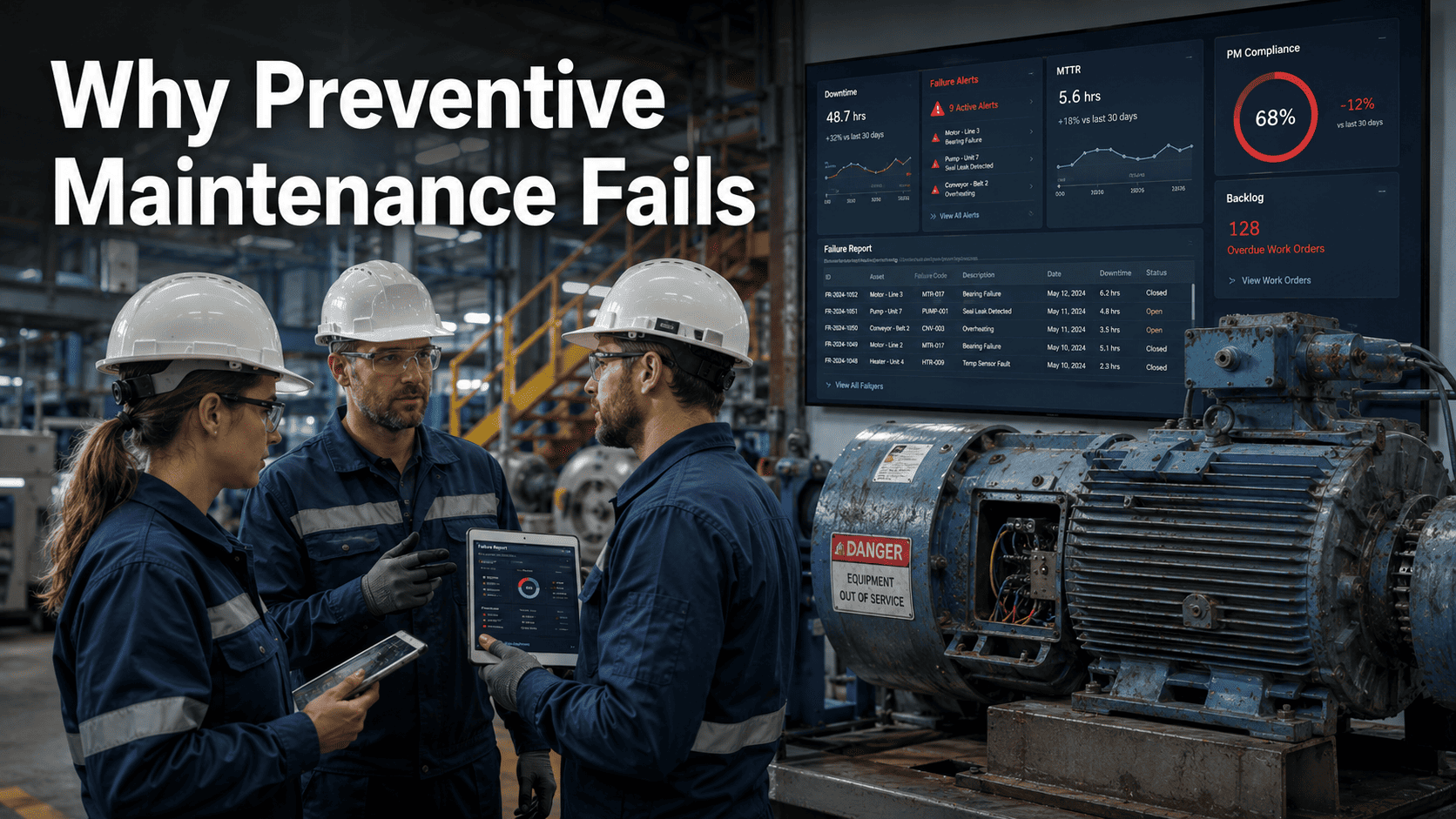
Preventive maintenance failure is the silent budget killer most facilities never see coming — teams schedule PM, technicians go through the motions, but equipment still breaks down unexpectedly and reactive costs keep climbing. If your PM program isn't delivering the uptime and cost savings it promised, you're not alone: industry data shows that 60–80% of PM programs underperform within the first two years, not because the concept is flawed, but because the execution breaks down in predictable, fixable ways. This guide maps exactly where PM programs fail — and shows how AI-driven maintenance platforms like Oxmaint's preventive maintenance system close each gap permanently.
See which PM failure points are costing your facility the most — and fix them in under 30 minutes.
AI-generated PM schedules based on real asset runtime data
Automated compliance tracking and technician accountability
62% average reduction in unplanned downtime across 1,000+ clients
Trusted by maintenance teams managing 10,000+ assets · Live in days, not months
Preventive maintenance failure is when a scheduled PM program stops preventing failures — equipment still breaks down reactively, costs stay high, and the team is perpetually firefighting despite having a maintenance calendar. A PM program is failing when PM completion rates drop below 80%, reactive work orders outnumber planned ones, or the same assets keep breaking after PM has been logged as complete.
The core issue is almost never the maintenance plan itself. It's the system around the plan: how tasks are assigned, tracked, escalated, and updated over time. Without real-time visibility, automated scheduling, and AI-driven asset intelligence, even a well-designed PM program degrades within months. The result is a false sense of control — teams believe maintenance is happening while the data tells a very different story.
Understanding where the failure originates is the first step. The good news: every common PM failure mode has a well-documented fix, and most can be resolved without overhauling your entire maintenance operation. Start a free trial to see how Oxmaint's analytics dashboard surfaces PM failure patterns on your actual assets, or book a demo and we'll map the gaps to your specific facility.
60–80%
PM programs underperform within 2 years
Industry benchmark, maintenance operations research
$240K
Avg annual cost of unplanned downtime per facility
Aberdeen Group, manufacturing operations study
3–5×
Emergency repair costs vs planned maintenance
U.S. Department of Energy, O&M Best Practices Guide
62%
Less unplanned downtime with Oxmaint AI-CMMS
Documented across 1,000+ Oxmaint client facilities
Most facilities spend 30–50% of their maintenance budget on emergency repairs — work that should never happen if PM is working.
Section 02
The 8 Root Causes of PM Program Failure
Every PM program that fails does so for one or more of these eight reasons. Most facilities experience three or four simultaneously — which is why patching one problem rarely fixes the system.
01
Fixed Intervals Ignore Reality
Scheduling PM every 30 days regardless of actual asset runtime, load, or condition means over-maintaining low-use equipment and under-maintaining high-stress assets. Neither serves reliability.
02
No Technician Accountability
When work orders are paper-based or logged manually, it's easy to mark tasks complete without doing them. Without digital proof-of-work, PM compliance is a guess, not a measurement.
03
Poor Task Prioritization
Treating a critical compressor PM the same as a light fixture check leads to the wrong work being done first. Low-priority tasks get done; high-criticality PMs slip because they require more time and skill.
04
No CMMS — or Unused CMMS
Spreadsheets and paper logs can't auto-schedule, escalate missed PMs, or track completion rates over time. And a CMMS nobody uses is worse than no CMMS — it creates a false record.
05
Missing KPIs and Reporting
If you're not measuring PM completion rate, mean time between failures, and reactive vs planned work order ratio, you can't see the program degrading until a major failure forces the conversation.
06
Parts Not Ready When Needed
Technicians arrive for a PM, find the required part is out of stock, and either skip the task or perform an incomplete job. Inventory misalignment is a silent PM killer in almost every facility.
07
PM Tasks Never Updated
Assets age, operating conditions change, and manufacturer recommendations evolve — but PM task lists often stay static for years. Outdated procedures don't protect the equipment they're meant to maintain.
08
Reactive Culture Overrides Planning
When a breakdown happens, scheduled PMs get bumped to respond to the emergency. If this pattern repeats, the PM backlog grows until the schedule becomes fiction and the program collapses entirely.
Section 03
Where PM Programs Actually Break Down
The failure isn't abstract — it shows up in four specific operational pain points that every maintenance manager recognizes. Each carries a direct financial consequence.
PM Backlog Compounds
Missed PMs don't disappear — they stack. Within 60 days, a 20% slip rate becomes a backlog that takes months to clear, during which equipment operates without the protection the PM was designed to provide.
Avg cost: $18,000/month in accelerated wear and emergency readiness spend
False Compliance Records
Paper or manually-logged PM completion is unverifiable. OSHA and ISO audits increasingly require digital proof-of-work. A compliance gap that surfaces during inspection can trigger fines, shutdowns, and insurance issues.
OSHA citations range from $15,625 to $156,259 per violation
Unexpected Critical Failures
When PM looks like it's working on paper but isn't protecting equipment in practice, failures come without warning. Emergency replacements cost 3–5× planned repair costs, and production downtime multiplies the financial impact.
Average emergency repair premium: $14,200 per event above planned cost
Technician Time Wasted on Admin
Without a mobile CMMS, technicians spend 25–35% of their shift on paperwork, manual scheduling lookups, and status reporting — time that should go toward actual maintenance work that protects equipment life.
At $35/hr fully loaded, that's $12,000+/month per tech in lost productive time
These pain points are measurable and fixable — use the Oxmaint ROI calculator to quantify what PM failures are costing your facility, or start a free trial and see the data on your own assets within 48 hours.
A PM work order marked "complete" without digital verification is not compliance — it's a liability waiting to surface in an audit or a catastrophic failure.
Section 04
How Oxmaint Fixes Every PM Failure Point
Oxmaint is an AI-native CMMS built specifically to address the systemic reasons PM programs fail. Every feature maps directly to a root cause — not generic software repurposed for maintenance.
Fix 01
AI-Driven PM Scheduling
Oxmaint's predictive maintenance engine uses IoT/sensor data to schedule PMs based on actual asset runtime, vibration, and temperature — not arbitrary calendar intervals. Equipment gets maintained when it needs it, not when a spreadsheet says so.
Fix 02
QR-Verified Proof of Work
Every work order is completed via QR scan on the physical asset. Technicians log completion, attach photos, and record readings on mobile — creating a tamper-proof digital audit trail for every PM task performed.
Fix 03
AI Priority Routing
Oxmaint's AI automatically ranks open PMs by asset criticality, failure risk, and technician proximity. Critical PMs surface at the top; low-priority tasks can't crowd out work that actually protects production.
Fix 04
Live PM Compliance Dashboard
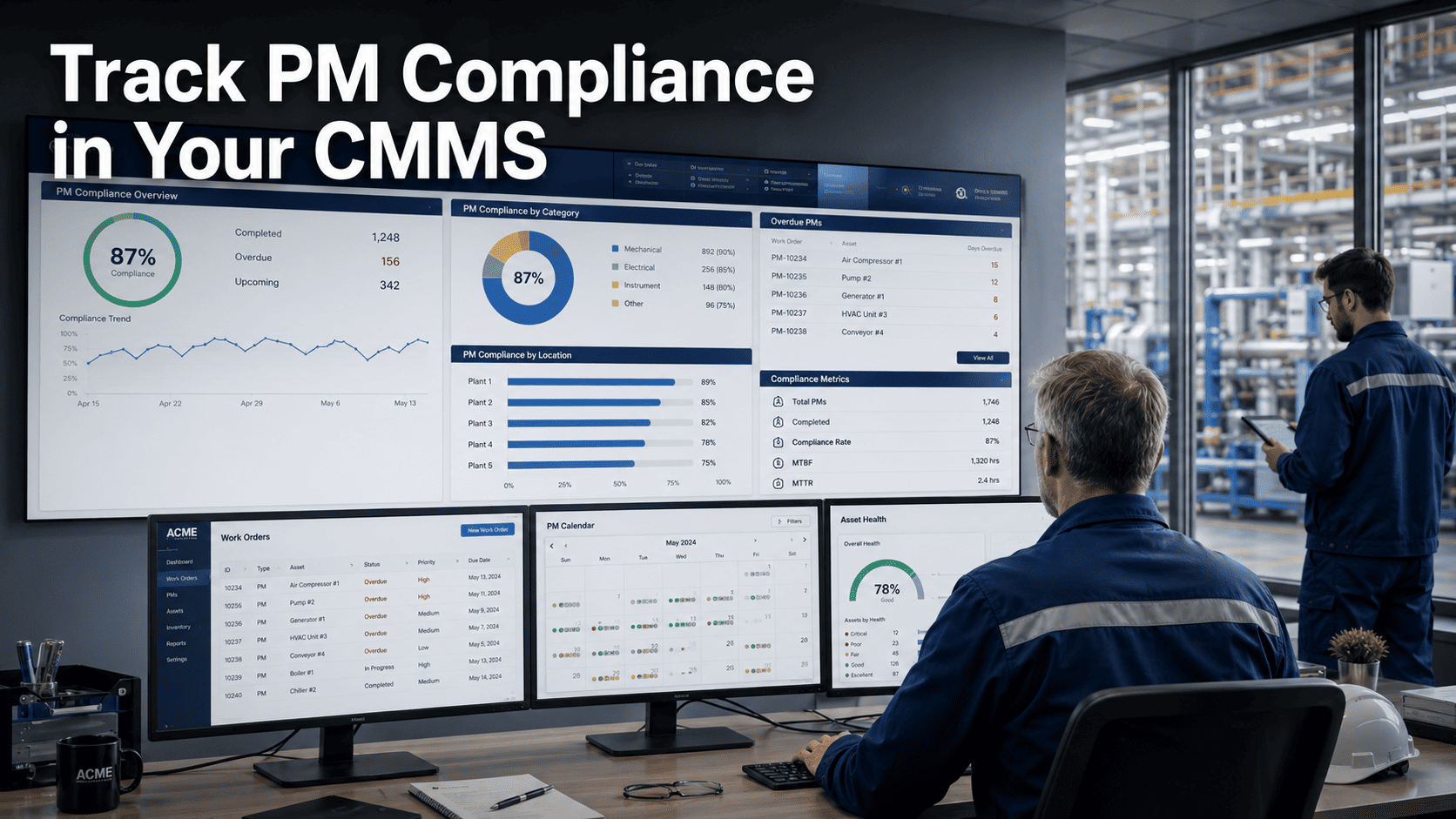
Real-time analytics and reporting show PM completion rates, overdue tasks, technician performance, and backlog trends — so managers see degradation before it becomes a failure, not after.
Fix 05
Auto Parts Reservation
When a PM work order is created, Oxmaint's parts and inventory system checks availability and reserves required components. If stock is low, auto-reorder triggers. Technicians never arrive at a PM without the parts they need.
Fix 06
AI Vision Camera Detection
Oxmaint's AI Vision Camera — powered by NVIDIA — detects cracks, corrosion, leaks, and thermal anomalies 24/7 with 99.2% accuracy, auto-creating work orders for issues PM rounds might miss entirely.
Every one of these fixes is live and in use across 1,000+ facilities today — start a free trial to activate them on your assets, or book a demo and we'll show you exactly how they map to your specific PM failure points.
Section 05
Reactive vs Planned Maintenance: The Real Cost Difference
The financial case for fixing a broken PM program is direct and quantifiable. This comparison uses industry-standard benchmarks and reflects what Oxmaint clients measure before and after deployment.
Performance Area
Reactive / Broken PM Program
AI-Driven PM with Oxmaint
PM Completion Rate
Below 70% — tasks slip, backlog grows
90%+ with AI escalation and mobile verification
Repair Cost per Event
$14,200 avg emergency repair premium
Planned repairs at 20–30% of emergency cost
Unplanned Downtime
10–20% of scheduled production time
62% reduction — avg 4–6% after deployment
Compliance Audit Risk
Manual records — no verifiable proof of work
Digital QR-verified audit trail, OSHA/ISO ready
Parts Availability
14+ stockout events per quarter on average
Auto-reorder — under 2 stockouts per quarter
Tech Admin Time
25–35% of shift lost to paperwork and logging
Under 8% — mobile-first, QR-scan driven
Failure Prediction
Zero early warning — reactive by definition
94% AI prediction accuracy, 2–6 weeks lead time
Manager Visibility
No real-time data — problems found after failure
Live dashboard — PM rates, MTBF, backlog, trends
Teams using AI-driven CMMS platforms see the ROI within 90 days — not because the technology is magic, but because it closes gaps that have been leaking budget for years.
Section 06
PM Program Results — What the Numbers Look Like
Across 1,000+ Oxmaint client facilities spanning manufacturing, food processing, healthcare, and facilities management, these are the documented outcomes when PM failure points are closed with AI-driven maintenance intelligence.
62%
Less Unplanned Downtime
Average reduction across all Oxmaint deployments
94%
AI Prediction Accuracy
Failure forecasts from IoT/PLC sensor analysis
90%+
PM Compliance Rate
vs typical 60–70% before AI-CMMS deployment
80%
Less Inspection Time
AI Vision Camera replaces manual walk-rounds
99.2%
AI Detection Accuracy
Cracks, leaks, corrosion, thermal anomalies
Days
Time to Go Live
No heavy onboarding — operational in days
These results come from facilities that identified their PM failure points and fixed them systematically — calculate your facility's ROI potential or book a demo to see the projection for your specific asset mix.
Section 07
Frequently Asked Questions
Why do preventive maintenance programs fail even when teams follow the schedule?
Following a schedule is necessary but not sufficient. PM programs fail even with high schedule adherence when the intervals are wrong (too long or too short for actual asset condition), when technicians perform tasks incompletely due to time pressure, when required parts aren't available, or when the program never gets updated as assets age. The schedule creates the appearance of PM activity while the root causes of failure continue operating underneath it. Real PM effectiveness requires condition-based intervals, digital proof-of-work, and real-time KPI tracking — not just a calendar.
How do I measure whether my preventive maintenance program is actually working?
The four metrics that matter most are: PM completion rate (target 90%+), ratio of planned to reactive work orders (target 80% planned or higher), mean time between failures (MTBF) on critical assets, and maintenance cost as a percentage of replacement asset value (target below 3% for well-maintained facilities). If your reactive work orders outnumber planned ones, or if MTBF isn't improving year over year, your PM program is underperforming. Oxmaint's analytics dashboard surfaces all four metrics in real time.
Can switching to a CMMS fix a broken preventive maintenance program quickly?
A modern AI-native CMMS like Oxmaint can show measurable PM compliance improvement within 30–60 days of deployment — especially if the current program is paper-based or spreadsheet-managed. The fastest wins come from automated scheduling (eliminating manual planning errors), mobile work order completion (proof of work), and live dashboards (immediate visibility into backlog and completion rates). Full program stabilization — with AI-optimized intervals and predictive maintenance integrated — typically takes 90–120 days. Most clients see ROI before month three.
What is the right preventive maintenance frequency for industrial equipment?
The right PM frequency depends on manufacturer recommendations, actual runtime hours, operating load, environmental conditions (temperature, dust, humidity), and failure history. Fixed calendar-based intervals are the industry default but rarely optimal — they over-maintain low-use equipment and under-protect assets running in high-stress conditions. AI-driven systems like Oxmaint's predictive maintenance engine dynamically adjust PM intervals based on real sensor data, which is why clients see both lower maintenance costs and higher asset reliability simultaneously.
Fix It Before the Next Failure
Stop Losing Budget to a PM Program That Isn't Working
Every month a broken PM program runs unchecked is another month of emergency repair premiums, compliance gaps, and equipment aging faster than it should. Oxmaint closes every root cause — AI scheduling, mobile proof-of-work, live compliance dashboards, auto parts reservation, and 99.2% accurate vision inspection — in one platform your team can use from day one.
62% average reduction in unplanned downtime — documented across 1,000+ clients
OSHA/ISO-ready digital audit trail from day one
Live in days, not months — no heavy IT project required
Trusted by maintenance teams across manufacturing, facilities, healthcare, food processing, and fleet · 9+ industries · 1,000+ active clients