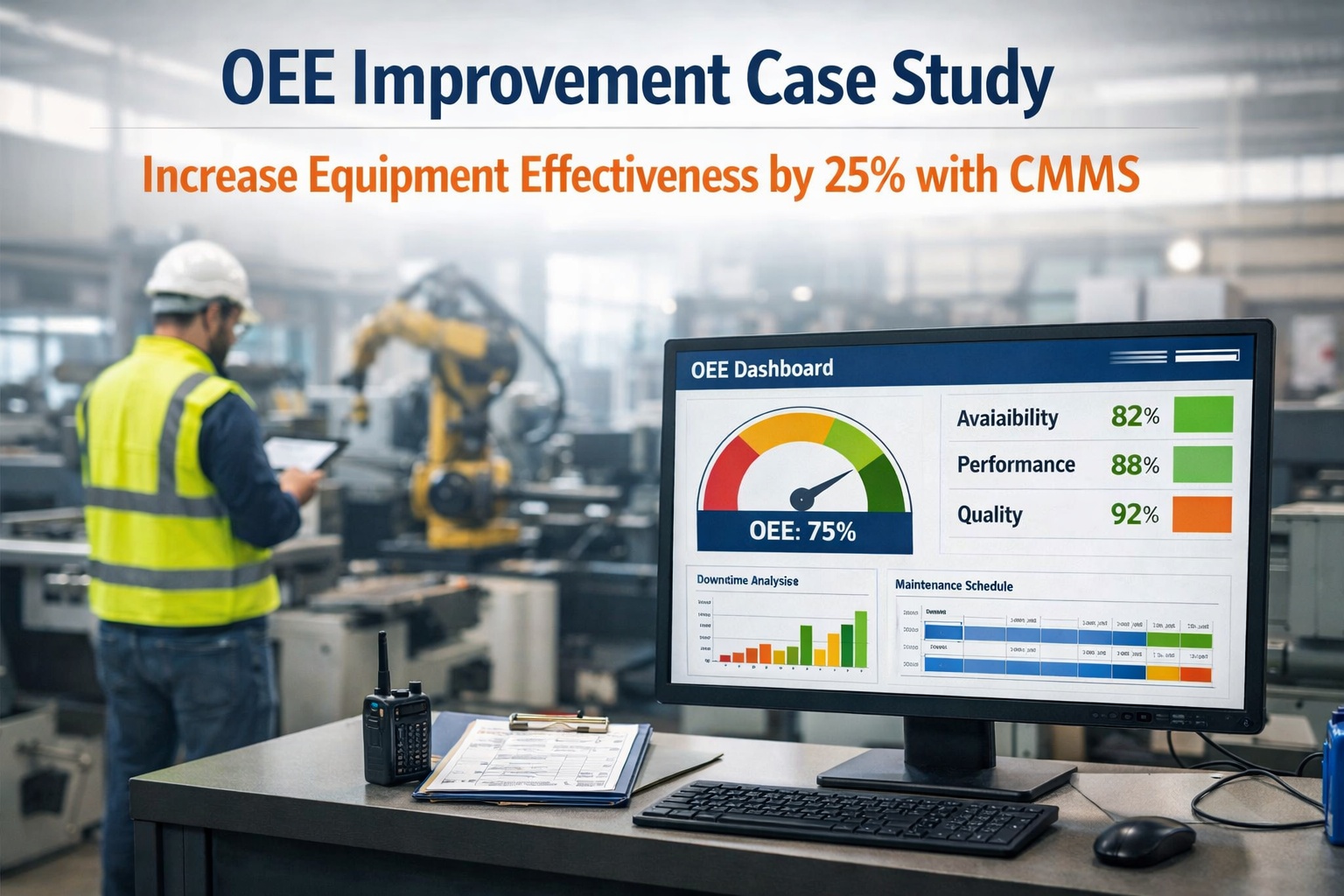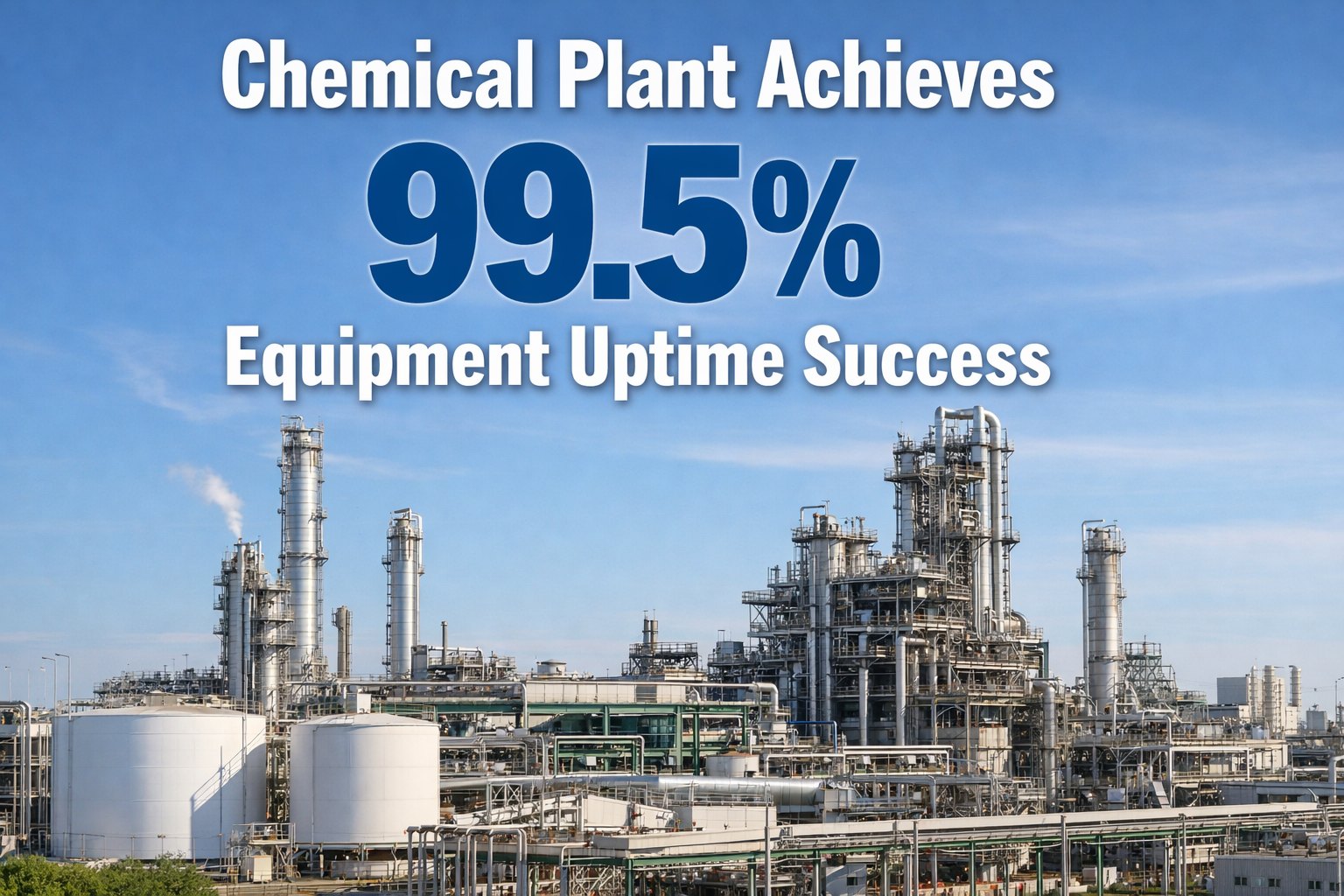
A petrochemical processing facility was hemorrhaging $9.4M annually from unplanned equipment failures—averaging 312 hours of lost production across critical reactors, distillation columnsand rotating equipment. With uptime hovering at 87.3%, every failure risked not just revenue but catastrophic safety incidents in a high-hazard environment. Within 16 months of implementing modern predictive maintenance and asset management, the plant achieved 99.5% equipment uptime—transforming from an industry laggard into a reliability benchmark.
In chemical manufacturing, equipment failure isn't just expensive—it's dangerous. A failed seal on a reactor vessel can release toxic chemicals. A degraded pump bearing can trigger a process upset cascading across interconnected systems. Unlike discrete manufacturing where a breakdown stops one line, chemical process failures can shut an entire facility for days while safety protocols are executed and systems are restarted.
This case study examines how one plant moved from reactive chaos to predictive reliability by replacing paper-based maintenance, disconnected SCADA systems, and tribal knowledge with a unified digital maintenance platform that gave operators and managers real-time visibility into every critical asset.
Ready to Maximize Your Plant's Equipment Uptime
Schedule a consultation to discuss your reliability challenges, see OxMaint in action, and get a customized uptime improvement plan. No sales pressure—just honest assessment.
The Crisis: 87.3% Uptime Was Costing Millions and Risking Lives
The facility operated 1,800+ process assets including reactors, heat exchangers, compressors, pumps, distillation columns, and instrumentation systems running 24/7/365. Years of deferred maintenance, aging infrastructure, and a reactive culture had created systemic reliability failures that compounded with every passing quarter.
Critical Reliability Issues Identified
- Reactive Maintenance Dominance: 76% of all maintenance was unplanned break-fix work, with technicians constantly firefighting rather than preventing failures
- Safety Near-Misses: 23 recordable safety incidents in 24 months linked directly to equipment degradation and failure
- Process Upsets: Average 26 unplanned shutdowns per year, each requiring 8-72 hours for safe restart
- No Predictive Capability: Critical rotating equipment ran to failure with no vibration monitoring, thermography, or oil analysis programs
- Paper-Based Work Orders: Maintenance history existed in filing cabinets—inaccessible during troubleshooting when seconds matter
- Spare Parts Chaos: 34% of repair delays caused by unavailable parts, with $2.1M in excess inventory sitting unused while critical items were out of stock
Pre-Implementation Performance Metrics
- Overall Equipment Uptime: 87.3% (industry best-in-class: 96%+)
- Unplanned Downtime: 312 hours annually across critical equipment
- Mean Time Between Failures (MTBF): 840 hours for rotating equipment
- Mean Time to Repair (MTTR): 6.2 hours average
- Maintenance Cost: $14.8M annually ($8.22/unit produced)
- Safety Incidents (Equipment-Related): 23 recordables in 24 months
- PM Compliance Rate: 52% of scheduled PMs completed on time
- Annual Lost Production Value: $9.4M from unplanned outages
The Solution: Integrated Predictive Maintenance Platform
The plant implemented a comprehensive cloud-based CMMS with predictive maintenance capabilities that connected process data, equipment condition monitoring, maintenance workflows, and spare parts management into a single intelligent system purpose-built for continuous process environments.
Key Technology Components Deployed
Condition-Based Monitoring Network
Wireless vibration sensors, infrared thermography, ultrasonic leak detection, and oil analysis integration across 180 critical rotating and static equipment assets—feeding real-time condition data into predictive failure algorithms.
Process Safety Integration
Direct CMMS connection to Safety Instrumented Systems (SIS) and process safety management documentation, ensuring every maintenance activity on safety-critical equipment follows Management of Change (MOC) protocols automatically.
Mobile-First Operator Rounds
Tablet-based operator inspection routes replacing paper checklists, with automatic anomaly flagging, photo documentation, and instant work order generation when issues are identified during rounds.
Intelligent Spare Parts Management
Criticality-based inventory optimization linking spare parts to equipment failure modes, auto-reorder thresholds, and vendor management—eliminating both stockouts and excess inventory simultaneously.
Implementation Timeline: 16 Months to 99.5% Uptime
Phase 1: Foundation & Critical Asset Focus (Months 1-4)
- Complete asset criticality ranking of all 1,800+ assets using risk-based methodology
- CMMS deployment with process safety templates and chemical industry compliance workflows
- Digitization of 15 years of maintenance history from paper records
- PM schedule optimization for top 120 critical assets based on failure mode analysis
- Immediate backlog elimination—completed 280+ overdue PMs and inspections
Phase 2: Predictive Layer & Mobile Deployment (Months 5-10)
- Condition monitoring sensor installation on 180 critical assets (compressors, pumps, agitators, heat exchangers)
- Mobile app rollout to 68 maintenance technicians and 24 process operators
- Spare parts inventory rationalization—reduced SKUs by 28% while improving availability to 97%
- Predictive analytics activation with machine learning failure prediction models
Phase 3: Optimization & Excellence (Months 11-16)
- Reliability-centered maintenance (RCM) analysis on 40 highest-impact equipment systems
- Turnaround planning integration for scheduled maintenance windows
- Real-time reliability dashboards for plant manager, shift supervisors, and maintenance planners
- Continuous improvement loops using failure data analytics and root cause trending
Results: 99.5% Equipment Uptime Achieved
Breakthrough Reliability Achievements
- 99.5% Overall Equipment Uptime: Up from 87.3%—a 12.2 percentage point improvement
- $8.1M Annual Savings: Combined production recovery, maintenance cost reduction, and safety improvements
- 86% Reduction in Unplanned Shutdowns: From 26 to just 4 annually
- Zero Safety Incidents: Equipment-related recordable incidents dropped from 23 to 0 over 12 months
- MTBF Tripled: Rotating equipment MTBF improved from 840 to 2,680 hours
- MTTR Cut 61%: Average repair time reduced from 6.2 to 2.4 hours
- ROI of 1,840%: On total $440K implementation investment
Detailed Performance Comparison
| Reliability Metric | Before Implementation | After Implementation | Improvement |
|---|---|---|---|
| Equipment Uptime | 87.3% | 99.5% | +12.2 points |
| Unplanned Shutdowns/Year | 26 | 4 | -86% |
| MTBF (Rotating Equipment) | 840 hours | 2,680 hours | +219% |
| MTTR | 6.2 hours | 2.4 hours | -61% |
| PM Compliance | 52% | 96% | +85% |
| Safety Incidents | 23 per 24 months | 0 per 12 months | -100% |
| Maintenance Cost | $14.8M/yr | $9.2M/yr | -38% |
| Spare Parts Availability | 66% | 97% | +47% |
Financial Impact Summary
- Recovered Production Value: $4.8M annually from eliminated unplanned downtime
- Maintenance Cost Reduction: $5.6M saved (from $14.8M to $9.2M)
- Spare Parts Inventory Optimization: $680K freed from excess stock reduction
- Safety Cost Avoidance: $1.2M estimated from zero recordable incidents
- Insurance Premium Reduction: $340K from improved safety and reliability record
- Total Implementation Cost: $440K (platform, sensors, training, integration)
- Payback Period: 19 days
- 5-Year Projected Savings: $40.5M
5 Strategies Behind 99.5% Uptime
1. Criticality-Based Maintenance Strategy
Not every asset deserves the same attention. The plant ranked all 1,800+ assets by safety risk, production impact, and repair cost—then applied predictive monitoring to the top 10% and optimized PM schedules for the next 30%. The remaining 60% received simplified condition-based checks during operator rounds.
2. Condition Monitoring That Predicts, Not Reacts
Vibration trending on compressors detected bearing degradation 6 weeks before failure. Thermography on electrical systems caught hotspots before they caused trips. Oil analysis on gearboxes flagged contamination before it damaged components. The system predicted 94% of potential failures with enough lead time for planned repairs during scheduled maintenance windows.
3. Operator Rounds as the First Line of Defense
Process operators conduct rounds every shift. By replacing paper checklists with tablet-based inspections—with photo capture, anomaly flagging, and instant work order creation—operators became the plant's most effective early warning system, catching 38% of developing issues before sensors detected them.
4. Spare Parts Intelligence
Linking spare parts inventory directly to equipment failure modes and criticality eliminated the two biggest MTTR drivers: "waiting for parts" and "wrong parts ordered." Critical spares were always in stock. Non-critical items were ordered just-in-time. Result: parts availability jumped from 66% to 97% while total inventory value dropped 28%.
5. Root Cause Elimination, Not Just Repair
Every failure triggered a structured root cause analysis captured in the CMMS. After 6 months, failure pattern analytics revealed that 5 recurring failure modes caused 43% of all downtime. Targeted engineering solutions eliminated these chronic issues permanently—shifting from "fix it again" to "fix it forever."
Lessons Learned and Recommendations
Critical Success Factors for Chemical Plants
- Safety Integration is Non-Negotiable: CMMS must connect with process safety management, MOC, and safety instrumented system documentation
- Start with Criticality Analysis: Don't instrument everything—focus predictive resources on assets that matter most
- Operators Are Your Best Sensors: Equip them with digital tools that make anomaly reporting effortless
- Turnaround Planning Integration: Connect predictive findings to planned outage windows for maximum efficiency
- Measure Reliability, Not Just Maintenance: Track MTBF, uptime, and production losses—not just wrench time and PM counts
Recommendations for Process Industry Facilities
- Conduct a reliability gap assessment comparing current performance to industry benchmarks for your specific process type
- Deploy mobile CMMS for operator rounds and maintenance execution within the first 60 days
- Install condition monitoring on the top 10% of critical rotating equipment as Phase 1
- Integrate spare parts management with equipment criticality and failure modes
- Establish root cause analysis discipline for every unplanned failure from day one
- Build reliability dashboards visible to operations, maintenance, and plant leadership
Achieve 99%+ Uptime at Your Chemical Plant
Schedule a free reliability assessment to identify your biggest uptime opportunities and see how modern asset management can eliminate unplanned shutdowns. No sales pressure—just honest assessment.