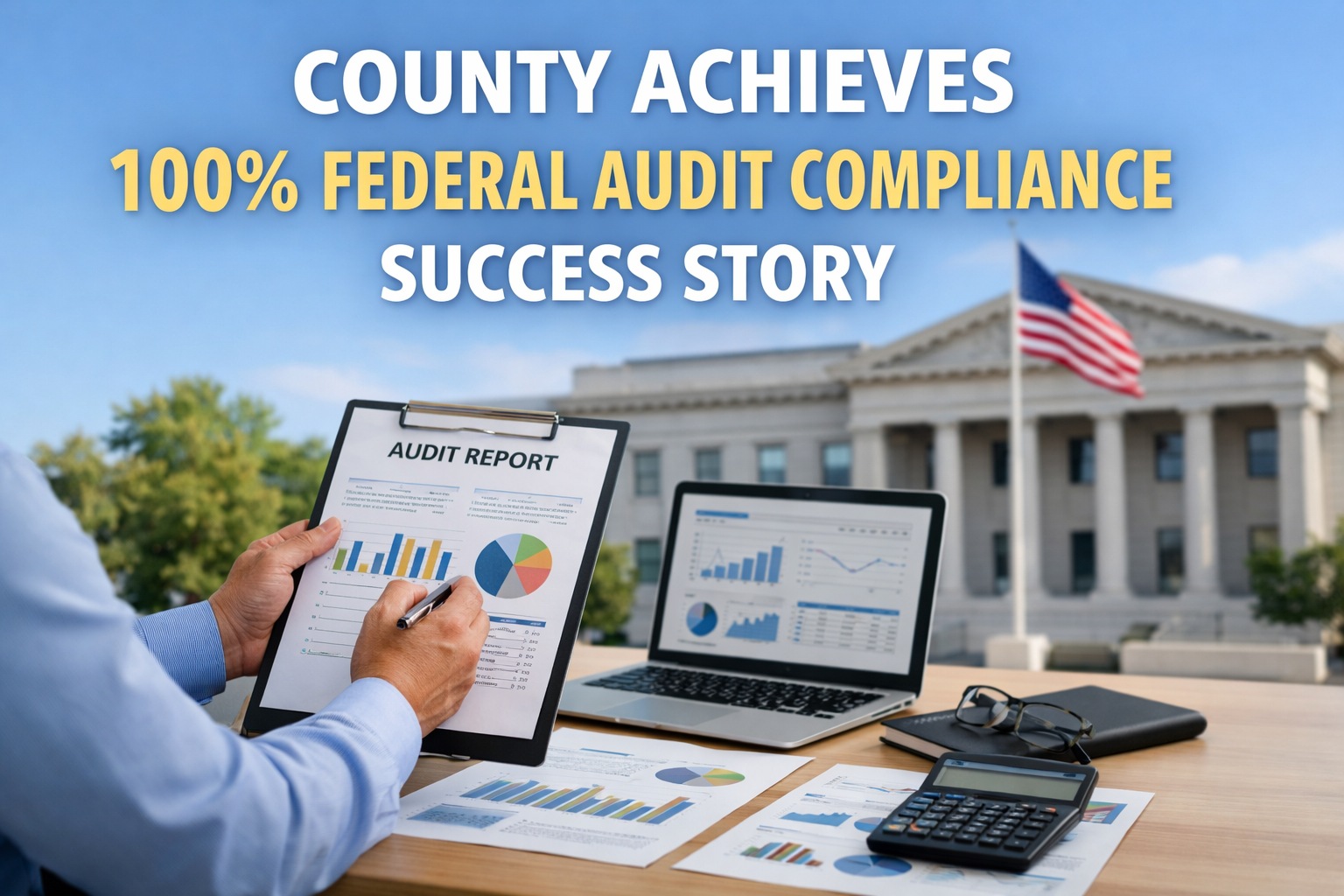
A mid-sized county of 420,000 residents faced a critical moment: three consecutive federal audit findings totaling $4.7M in questioned costs and a looming threat of funding suspension. Within 14 months of implementing modern asset management and compliance tracking the county achieved 100% federal audit compliance—the first clean audit in 8 years. Here's the complete story of how they transformed their operations.
Federal compliance isn't optional for counties managing public infrastructure, transit systems, and government facilities. With HUD, FEMA, DOT, and EPA auditors demanding increasingly detailed asset documentation, digital compliance tracking has become essential for avoiding costly findings, penalties, and funding clawbacks that can cripple county budgets.
This success story examines how one county moved from audit failure to full compliance by replacing fragmented spreadsheets, paper records, and siloed departmental systems with a unified cloud-based asset management and compliance platform that automated documentation, standardized processes, and created a permanent audit trail across every department.
Ready to Achieve Audit-Proof Compliance
Schedule a consultation to discuss your compliance challenges, see OxMaint in action, and get a customized audit-readiness plan. No sales pressure—just honest assessment.
The Compliance Crisis: Three Failed Federal Audits in a Row
The county managed $1.2 billion in public assets across 14 departments—including roads, bridges, water treatment plants, public buildings, transit vehicles, and parks infrastructure. Federal funding accounted for 38% of the county's capital budget, making audit compliance a financial lifeline rather than a bureaucratic formality.
Critical Audit Findings That Triggered Transformation
- Missing Asset Documentation: 34% of federally funded assets lacked required maintenance records, condition assessments, or lifecycle tracking documentation
- Inconsistent Maintenance Logs: Paper-based work orders across 14 departments with no centralized tracking or verification
- Non-Compliant Inspection Schedules: 41% of required safety inspections were overdue or undocumented
- Asset Inventory Discrepancies: $18.2M gap between reported and actual asset values due to poor tracking
- Inadequate Preventive Maintenance Proof: Unable to demonstrate federally mandated PM compliance for bridges, transit vehicles, and water systems
- Grant Reporting Failures: Late or incomplete federal grant utilization reports across FEMA, HUD, and DOT programs
Pre-Implementation Compliance Metrics
- Federal Audit Score: 62% compliance (below 85% threshold)
- Asset Documentation Rate: 66% of assets properly documented
- Inspection Compliance: 59% of scheduled inspections completed on time
- Questioned Costs: $4.7M across three audit cycles
- Grant Reporting Accuracy: 71% of reports submitted complete and on time
- Maintenance Record Accessibility: Average 3.2 days to retrieve historical records
- Departments Using Standardized Processes: 3 of 14 departments
The Solution: Unified Compliance-Ready Asset Management
County leadership recognized that compliance failures weren't caused by negligent staff—they were caused by fragmented systems that made proper documentation nearly impossible. The solution required a single platform connecting all 14 departments with automated compliance workflows, real-time audit trails, and mobile-accessible documentation for field teams.
Key Technology Components Deployed
Automated Compliance Documentation Engine
Every work order, inspection, maintenance activity, and asset change automatically generates timestamped, geo-tagged, photo-verified compliance records that meet federal documentation standards without requiring additional staff effort.
Federal Inspection Scheduling & Tracking
Automated scheduling system aligned with DOT bridge inspection cycles, EPA water system requirements, FTA transit vehicle mandates, and OSHA facility safety standards—with escalation alerts preventing any inspection from falling through the cracks.
Real-Time Asset Registry & Valuation
Centralized digital inventory of all 28,000+ county assets with automated depreciation tracking, condition scoring, and lifecycle cost analysis matching GASB 34 and federal reporting requirements.
Grant Management & Reporting Automation
Integrated tracking of 47 active federal grants with automated utilization reports, expenditure documentation, and milestone tracking ensuring every dollar is accounted for and reported on time.
Implementation Timeline: From Crisis to Compliance
Phase 1: Emergency Foundation (Months 1-3)
- Complete asset inventory audit and digitization across all 14 departments
- CMMS platform deployment with federal compliance templates pre-configured
- Critical inspection backlog elimination—completing 340+ overdue inspections
- Core team training for 28 department supervisors and compliance officers
Phase 2: Department-Wide Rollout (Months 4-8)
- Mobile app deployment to 215 field technicians and inspectors
- Automated PM scheduling activated for all federally funded assets
- Grant reporting automation connected to financial management systems
- Real-time compliance dashboards for department heads and county administrators
Phase 3: Optimization & Audit Preparation (Months 9-14)
- Internal mock audit using federal audit criteria—identified and resolved 23 remaining gaps
- Advanced reporting configurations for DOT, HUD, FEMA, and EPA requirements
- Continuous compliance monitoring with automated corrective action workflows
- Comprehensive documentation package prepared for federal audit review
The Results: 100% Federal Audit Compliance Achieved
Breakthrough Compliance Outcomes
- 100% Federal Audit Compliance: First clean audit in 8 years with zero findings
- $4.7M in Questioned Costs Eliminated: Complete resolution of all prior audit findings
- $12.8M in Federal Funding Secured: New grants awarded based on compliance track record
- 98% Inspection Completion Rate: Up from 59% pre-implementation
- Zero Overdue Safety Inspections: Automated scheduling eliminated all compliance gaps
- 14-Month Implementation to Full Compliance: Rapid transformation timeline
Detailed Compliance Performance Comparison
| Compliance Metric | Before Implementation | After Implementation | Improvement |
|---|---|---|---|
| Federal Audit Score | 62% | 100% | Full compliance achieved |
| Asset Documentation Rate | 66% | 99.2% | 50% improvement |
| Inspection Compliance | 59% | 98% | 66% improvement |
| Questioned Costs | $4.7M | $0 | 100% elimination |
| Grant Reporting Accuracy | 71% | 99.5% | 40% improvement |
| Record Retrieval Time | 3.2 days | Under 2 minutes | 99.9% faster |
| Departments Standardized | 3 of 14 | 14 of 14 | 100% adoption |
Financial Impact Beyond Compliance
- $12.8M New Federal Grants Secured: Clean audit record unlocked previously unavailable competitive federal funding opportunities
- $1.9M Annual Administrative Savings: Automated documentation reduced manual compliance labor by 68%
- $3.2M Asset Lifespan Extension: Proper preventive maintenance extended infrastructure useful life
- $840K Insurance Premium Reduction: Documented safety compliance lowered county risk profile
- Total 3-Year Financial Benefit: $24.6M in secured funding, savings, and avoided penalties
Ready to Eliminate Audit Findings
Join counties nationwide that have achieved 100% federal compliance. Schedule a demo to see how OxMaint automates documentation, inspections, and audit trails. No sales pressure—just honest assessment.
5 Key Strategies That Made 100% Compliance Possible
Strategy 1: Centralize Everything Into One Platform
Replacing 14 different departmental tracking methods with a single cloud-based asset management platform eliminated data silos, inconsistent records, and the finger-pointing that plagued previous audit responses. Every asset, work order, and inspection lived in one searchable, auditable system.
Strategy 2: Automate the Audit Trail
Rather than asking field crews to fill out extra compliance paperwork, the system automatically captured timestamps, GPS coordinates, photos, and digital signatures with every maintenance activity. Compliance documentation became a byproduct of normal work—not an additional burden.
Strategy 3: Never Miss an Inspection Again
Automated scheduling with escalation chains ensured every federally mandated inspection was completed on time. If a bridge inspection was 7 days from due, the inspector got notified. At 3 days, the supervisor was alerted. At 1 day, the department director received an urgent escalation.
Strategy 4: Run Internal Mock Audits Quarterly
Using the same criteria federal auditors apply, the county ran quarterly self-assessments that identified gaps before they became findings. This proactive approach turned compliance from a once-a-year panic into a continuous operational standard.
Strategy 5: Make Compliance Visible to Leadership
Real-time dashboards showing compliance status by department, asset class, and federal program gave county administrators instant visibility. When a department fell below 95% compliance, corrective action started immediately—not months later during an audit.
Lessons Learned and Recommendations
Critical Success Factors for County Compliance
- Executive Sponsorship is Non-Negotiable: The county administrator made compliance a top-3 strategic priority with dedicated budget
- Mobile-First for Field Teams: 92% of compliance data was captured by field technicians using mobile apps during routine work
- Start with the Biggest Risk: Addressing bridge inspections and water system compliance first eliminated the highest-penalty findings
- Standardize Before You Digitize: Agreeing on common processes across departments before system configuration prevented rework
- Train for Adoption, Not Just Features: Showing field crews how the system made their jobs easier drove 94% voluntary adoption
Recommendations for Counties Pursuing Federal Compliance
- Conduct a comprehensive gap analysis against your specific federal audit requirements
- Prioritize elimination of overdue inspections and missing documentation as immediate quick wins
- Deploy mobile-accessible compliance tools to field teams within the first 60 days
- Establish automated compliance dashboards visible to department heads and elected officials
- Schedule quarterly mock audits using federal criteria to maintain continuous readiness
- Document your compliance transformation to strengthen future grant applications
- Implementation Cost: $380K total (platform, training, data migration)
- Time to First Clean Audit: 14 months from project start
- 3-Year ROI: 6,374% ($24.6M benefit vs. $380K investment)
- Ongoing Annual Cost: $72K (platform licensing + support)
- Staff Required: 1 part-time compliance coordinator (vs. 4 FTEs previously)
Your County's Clean Audit Starts Here
Schedule a free compliance assessment to identify your biggest audit risks and see how OxMaint can help you achieve 100% federal compliance. No sales pressure—just honest assessment.