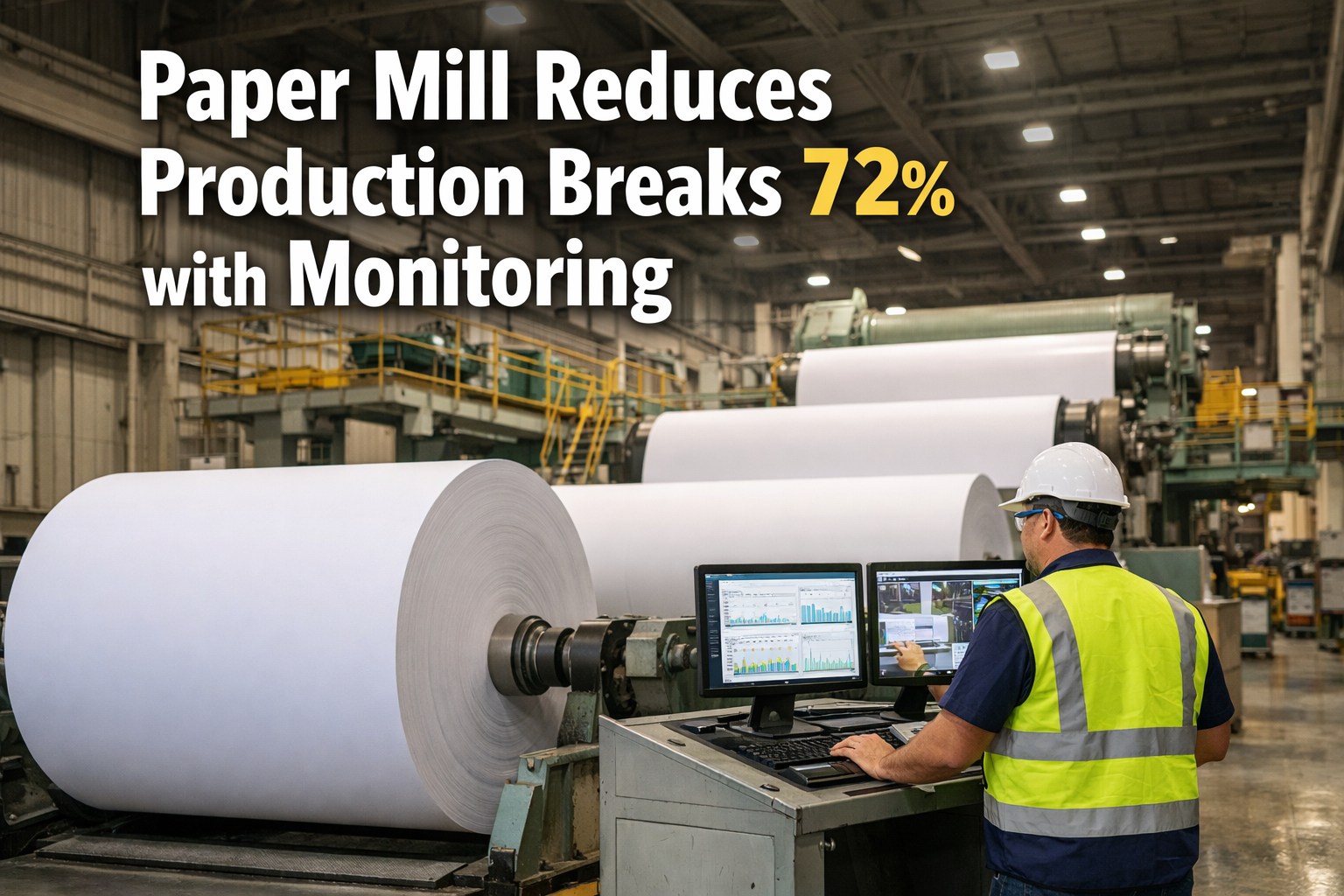
A mid-sized paper mill producing 850 tons per day across two paper machines was losing $4.7M annually to unplanned production breaks—averaging 23 breaks per month with each event costing 4-12 hours of lost output. Within 14 months of implementing real-time equipment monitoring integrated with cloud-based maintenance management, the mill reduced production breaks by 72% and recovered $3.4M in annual production value.
Paper manufacturing runs on tight margins where every hour of machine uptime directly impacts profitability. When a paper machine breaks unexpectedly—whether from a felt failure, bearing seizure, dryer section issue, or press roll problem—the entire production line stops, partially processed stock is lost, and restart procedures waste additional hours. This case study shows how one mill turned reactive firefighting into predictive reliability that virtually eliminated surprise breakdowns.
Stop Losing Production to Unplanned Breaks
See how real-time monitoring and automated maintenance management helps paper mills maximize uptime, reduce breaks, and protect margins.
The Challenge: 23 Production Breaks Per Month Bleeding Profits
The mill operated two Fourdrinier paper machines producing containerboard and corrugating medium for packaging customers. Decades of run-to-failure maintenance culture, manual inspection rounds, and disconnected equipment data had created a cycle of constant firefighting that drained maintenance budgets, frustrated operators, and eroded customer confidence through missed delivery commitments.
Pre-Implementation Performance Profile
- Production Breaks: 23 per month average (276/year)
- Average Break Duration: 6.2 hours per event
- Annual Lost Production: 1,711 hours of machine downtime
- Cost Per Break: $17,000 average (lost output + restart waste + emergency repairs)
- Maintenance Approach: 74% reactive, 26% time-based preventive
- PM Compliance: 58% of scheduled PMs completed on time
- Annual Maintenance Budget: $6.8M with 12% yearly escalation
Root Causes of Production Breaks
- Bearing Failures: 31% of breaks caused by undetected bearing degradation on rolls, dryers, and press sections
- Felt and Wire Failures: Clothing changes triggered reactively after quality defects appeared rather than proactively monitored
- Steam and Dryer Issues: Condensate system problems and siphon failures causing uneven drying and sheet breaks
- Hydraulic System Failures: Press nip pressure fluctuations from degraded pumps and worn valves
- Lubrication Deficiencies: Manual grease routes missed or improperly executed, accelerating equipment wear
- No Trending or Pattern Analysis: Paper-based maintenance logs provided zero visibility into recurring failure modes
The Solution: Integrated Monitoring and Maintenance Platform
The mill deployed a comprehensive cloud-based CMMS with real-time condition monitoring that connected vibration sensors, thermal imaging, process data, and maintenance workflows into one intelligent system—giving operators and maintenance teams early warning of developing problems weeks before they caused production breaks.
Key Technology Components Deployed
- Vibration Monitoring Network: 340 wireless sensors on critical bearings, rolls, gearboxes, and rotating equipment across both machines
- Thermal Monitoring: Infrared sensors on dryer sections, steam joints, and electrical systems detecting heat anomalies
- Centralized Asset Registry: 2,800+ mill assets digitized with condition scoring, failure history, and lifecycle tracking
- Automated PM Scheduling: Condition-based and time-based PMs auto-generated with parts staging and crew assignment
- Mobile Workforce App: Technicians accessing work orders, equipment history, and SOPs directly at the machine
- Production-Maintenance Integration: Planned maintenance windows coordinated with production schedules to minimize impact
Implementation Timeline
Phase 1: Foundation and Critical Assets (Months 1-4)
- Complete asset inventory and criticality ranking across both paper machines and support systems
- CMMS deployment with automated PM scheduling for 195 critical rotating assets
- Vibration sensors installed on top 85 failure-prone bearings and rolls
- Eliminated backlog of 142 overdue preventive maintenance tasks
Phase 2: Expanded Monitoring and Optimization (Months 5-9)
- Full sensor network deployed—340 vibration + 48 thermal monitoring points active
- Predictive analytics algorithms trained on 6 months of baseline equipment data
- Felt and wire lifecycle tracking with automated replacement scheduling based on condition
- Lubrication management system automated with route optimization and confirmation tracking
Phase 3: Predictive Excellence (Months 10-14)
- Machine learning models predicting bearing failures 4-6 weeks before breakdown
- Production break root cause analysis dashboard identifying systemic patterns
- Maintenance-production coordination system scheduling repairs during planned grade changes
- Cross-shift knowledge sharing through digital maintenance logs and equipment notes
Results: 72% Reduction in Production Breaks
Key Performance Achievements
- 72% fewer production breaks (23/month → 6.4/month)
- $3.4M annual production value recovered
- 89% reduction in unplanned shutdowns lasting 4+ hours
- 96% PM compliance up from 58%
- Average break duration reduced 44% (6.2 hrs → 3.5 hrs) for remaining events
- Maintenance budget reduced 19% despite expanded monitoring investment
- ROI of 680% in the first 14 months
Detailed Performance Comparison
| Metric | Before Implementation | After Implementation | Improvement |
|---|---|---|---|
| Production Breaks/Month | 23 | 6.4 | -72% |
| Avg. Break Duration | 6.2 hours | 3.5 hours | -44% |
| Annual Lost Production Hours | 1,711 hours | 269 hours | -84% |
| PM Compliance | 58% | 96% | +66% |
| Bearing-Related Breaks | 85/year | 8/year | -91% |
| Maintenance Approach | 74% reactive | 81% preventive/predictive | Complete reversal |
| Maintenance Cost | $6.8M/year | $5.5M/year | -19% |
| On-Time Delivery | 82% | 97% | +18% |
ROI Analysis and Financial Impact
Investment Breakdown:
- CMMS Platform and Licensing: $84,000 annually
- Sensors and Hardware: $215,000 (one-time)
- Integration and Configuration: $68,000 (one-time)
- Training and Change Management: $32,000 (one-time)
- Total First-Year Investment: $399,000
Annual Savings Delivered:
- Recovered Production Value: $2,440,000
- Maintenance Cost Reduction: $540,000
- Reduced Broke and Restart Waste: $280,000
- Energy Savings (fewer restarts): $85,000
- Extended Equipment Lifespan: $55,000
- Total Annual Savings: $3,400,000
Financial Summary
First-Year ROI: 680%
Payback Period: 6 weeks
Projected 5-Year Savings: $17 million
Cost Per Ton Reduction: 23%
See What Monitoring Can Do for Your Mill
Schedule a free consultation to discuss your production break challenges and see how real-time monitoring with automated maintenance management can protect your output and margins.
Key Strategies That Drove the 72% Reduction
1. Bearing Health Monitoring
Wireless vibration sensors on 340 critical bearings detected degradation patterns 4-6 weeks before failure. Bearing-related breaks dropped 91%—from 85 per year to just 8—as replacements were scheduled during planned grade changes instead of causing emergency shutdowns.
2. Condition-Based Clothing Changes
Replacing calendar-based felt and wire changes with condition-monitored scheduling eliminated premature replacements (saving $180K/year in clothing costs) while preventing the quality-triggered breaks caused by running clothing past its effective life.
3. Automated Lubrication Management
Digital lubrication routes with barcode confirmation at each grease point ensured 100% completion and correct quantities. Lubrication-related failures—previously the second-largest break category—dropped 83% within 6 months.
4. Production-Maintenance Coordination
Integrating the CMMS with production scheduling allowed maintenance windows to align with planned grade changes and roll changes. This converted 68% of what would have been unplanned breaks into scheduled maintenance events with zero additional production loss.
5. Root Cause Pattern Analysis
Digital maintenance records enabled trending and pattern analysis for the first time. The system identified that 41% of dryer section breaks originated from a single condensate return header—a systemic issue invisible in paper-based logs that was resolved permanently.
Lessons Learned and Recommendations
Critical Success Factors for Paper Mills
- Start with Bearings: Vibration monitoring on critical bearings delivers the fastest, most measurable impact on production breaks
- Operators Are Key: Training machine operators to recognize early warning indicators multiplied the effectiveness of sensor data
- Coordinate with Production: The biggest wins came from converting unplanned breaks into planned maintenance during scheduled downtime
- Track Root Causes Digitally: Pattern analysis only works when every break is documented with standardized cause codes in a digital system
- Celebrate Uptime Records: Posting consecutive run-hour records on the floor created healthy competition between shifts and machines
- Invest in Lubrication First: Proper lubrication management is the lowest-cost, highest-impact reliability improvement available—mills ready to see results fast can start a free trial and digitize lubrication routes in days
Frequently Asked Questions
Q: How does condition monitoring reduce paper machine breaks
A: Sensors detect equipment degradation weeks before failure. Vibration patterns, temperature trends, and performance data reveal bearing wear, misalignment, and imbalance long before they cause a production break—allowing repairs during planned windows instead of emergency shutdowns.
Q: What is the typical ROI timeline for paper mill monitoring
A: Most mills see positive ROI within 2-4 months. Bearing monitoring alone typically prevents enough breaks to pay for the entire system. As predictive models improve over 6-12 months, savings compound significantly.
Q: Can this work on older paper machines
A: Yes—wireless sensors and cloud-based CMMS work on any age equipment. Older machines often benefit most because they have more failure-prone components. No machine modifications are required; sensors mount externally on bearing housings and equipment surfaces.
Q: How quickly can sensors be installed without stopping production
A: Wireless vibration sensors are installed during normal operation. Most mills complete full sensor deployment across a paper machine in 2-3 days with zero production interruption. The sensors are magnetic-mount or adhesive-mount requiring no drilling or wiring.
Ready to Reduce Production Breaks at Your Mill
Schedule a free consultation to see how real-time monitoring and automated maintenance management can cut your production breaks and protect your margins.