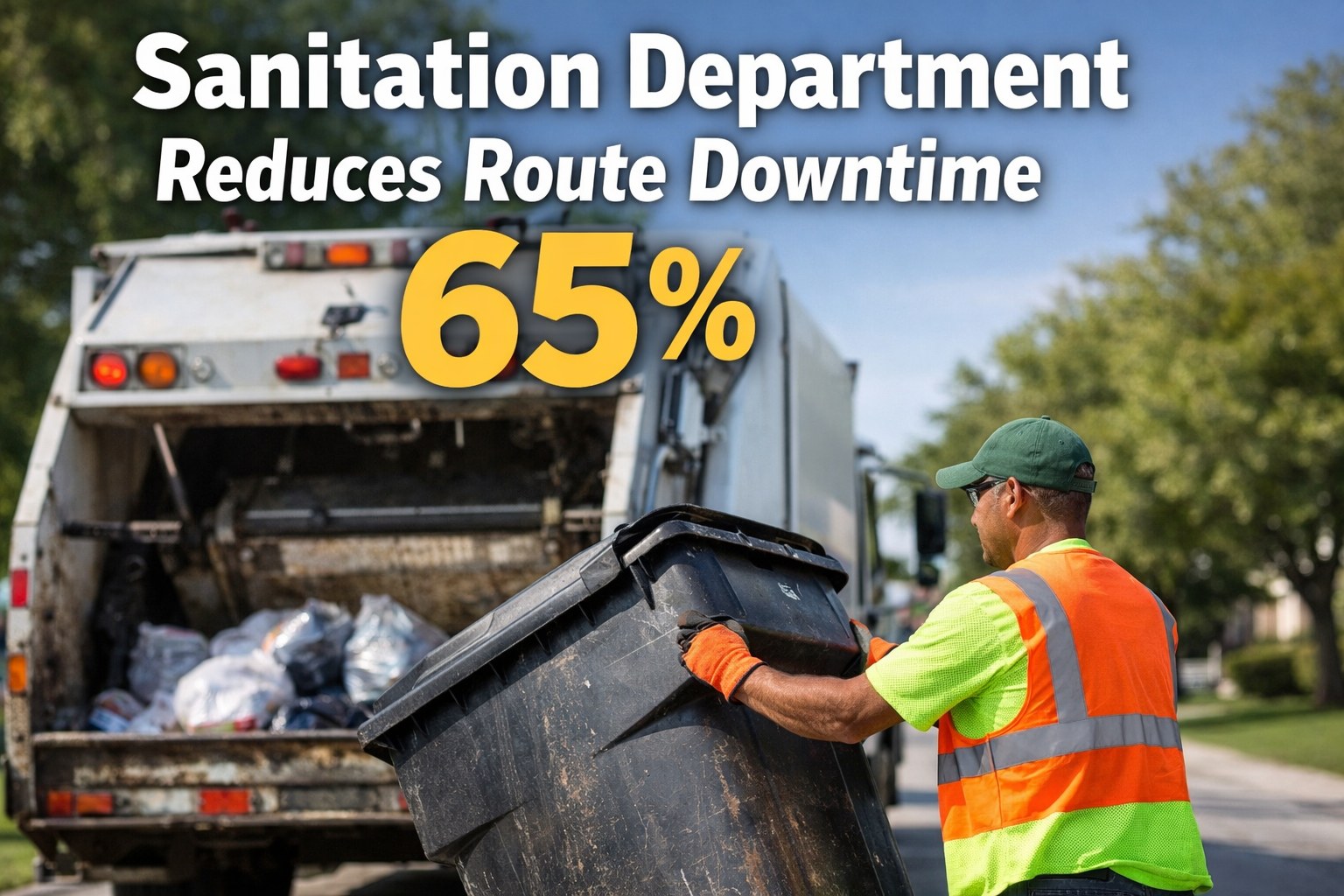
Sanitation departments run on vehicle availability when collection trucks break down mid-route, neighborhoods get missed, complaints surge, and overtime costs spiral. This case study examines how Clearwater Sanitation Departmentoperating 64 collection vehicles across 78 daily routes serving 145,000 households, reduced route downtime by 65% using OXMaint CMMS — boosting fleet uptime to 93%, cutting maintenance costs by 24%, and virtually eliminating missed collection complaints.
Clearwater's transformation from a breakdown-driven maintenance culture to a preventive, data-managed fleet operation shows how municipal sanitation departments can protect service reliability, extend vehicle life, and stretch tight budgets with the right CMMS platform.
Ready to Eliminate Route Downtime
Schedule a consultation to discuss your fleet challenges, see OXMaint in action, and get a customized maintenance plan. No sales pressure—just honest assessment.
The Challenge: Breakdowns Disrupting Collection Routes
Clearwater Sanitation Department manages 64 vehicles — rear-loaders, automated side-loaders, front-loaders, and roll-off trucks — averaging 9 years old. A 7-person shop relied on whiteboard scheduling, paper repair tickets, and driver walk-in requests to manage maintenance. The result: trucks failing on routes daily, a growing missed-pickup complaint backlog, and a maintenance budget consumed by emergency towing and after-hours repairs.
Key Challenges Identified
- Chronic Route Failures: Average 11.2 mid-route breakdowns per week forcing route reassignment or cancellation
- Low Fleet Uptime: Only 74% of vehicles available for service on any given day
- Reactive Maintenance Culture: 81% of work orders generated from breakdowns, not prevention
- No Digital Records: Paper tickets with no searchable history — repeat failures went untracked
- Resident Complaints: 320+ missed-pickup complaints per month eroding public trust
- Budget Overruns: Emergency repairs and towing exceeding annual budget by 34%
Baseline Performance Metrics
- Fleet Uptime: 74% average daily vehicle availability
- Mid-Route Breakdowns: 11.2 per week across all routes
- Reactive Work Orders: 81% of all maintenance requests
- Missed-Pickup Complaints: 320+ per month
- Annual Maintenance Cost: $1.42 million with consistent overruns
- PM Completion Rate: 29% of scheduled preventive tasks completed
- Average Repair Turnaround: 5.8 days per vehicle per event
- Vehicle Documentation: 18% with complete maintenance history
These numbers directly translated to missed collections, angry residents, and council pressure. Start your free trial and put every truck back on the road →
OXMaint CMMS Implementation for Sanitation Fleet
Clearwater selected OXMaint for its mobile-first work orders, fleet-specific PM templates, and intuitive interface that shop mechanics could adopt without IT support. Implementation was completed in 9 weeks across the central maintenance facility and all satellite yards.
Core Technology Components
Digital Fleet Asset Register
Complete inventory of all 64 vehicles with hydraulic systems, packer bodies, automated arms, and chassis components — each with manufacturer specs, warranty data, and full repair history in a single searchable database.
Preventive Maintenance Scheduling
Automated PM schedules based on mileage, engine hours, and calendar triggers aligned with manufacturer guidelines — ensuring oil changes, hydraulic inspections, and body repairs happen before failures occur.
Mobile Work Order Management
Mechanics receive, update, and close work orders from shop-floor tablets. Drivers submit defect reports from the cab via smartphone — eliminating paper tickets and walk-in queues entirely.
Parts Inventory and Vendor Tracking
Real-time parts inventory with automatic reorder alerts for high-turnover components like hydraulic hoses, packer cylinders, and brake parts — cutting emergency parts purchases by 71%.
Implementation Timeline
- Weeks 1–2: Fleet audit, deficiency baseline, and system configuration
- Weeks 3–4: Vehicle data migration, PM schedule creation, and parts inventory setup
- Weeks 5–7: Mechanic and driver training, pilot across 20 highest-failure vehicles
- Weeks 8–9: Full fleet rollout with performance monitoring and optimization
Results: 65% Route Downtime Reduction
Key Performance Improvements
- 65% Less Route Downtime: Mid-route breakdowns dropped from 11.2 to 3.9 per week
- 93% Fleet Uptime: Up from 74% — nearly every truck available every morning
- 24% Cost Reduction: $341,000 annual savings through preventive maintenance approach
- 89% Fewer Complaints: Missed-pickup complaints dropped from 320+ to 35 per month
- 92% PM Completion Rate: Up from 29% — near-total preventive coverage
- 58% Faster Repairs: Average turnaround cut from 5.8 to 2.4 days
Detailed Performance Comparison
| Metric | Before OXMaint | After OXMaint | Improvement |
|---|---|---|---|
| Fleet Uptime | 74% | 93% | 26% increase |
| Mid-Route Breakdowns/Week | 11.2 | 3.9 | 65% reduction |
| Reactive Work Orders | 81% | 19% | 77% reduction |
| PM Completion Rate | 29% | 92% | 217% improvement |
| Missed-Pickup Complaints | 320+/month | 35/month | 89% reduction |
| Annual Maintenance Cost | $1.42M | $1.079M | 24% reduction |
| Repair Turnaround | 5.8 days | 2.4 days | 58% reduction |
| Vehicle Documentation | 18% | 100% | Complete records |
Operational and Community Impact
- Route Reliability: 97% of scheduled routes completed on-time — up from 82%
- Overtime Reduction: 48% decrease in mechanic and driver overtime costs
- Extended Vehicle Life: Preventive maintenance extending fleet service by an estimated 3–5 years
- Council Satisfaction: Zero negative sanitation reports at city council meetings since implementation
Reliable routes start with reliable trucks. Schedule a free demo to see OXMaint built for sanitation fleets →
Financial Analysis and ROI
Investment Summary
- OXMaint Annual License: $11,200 for 64-vehicle fleet
- Implementation & Configuration: $7,400
- Mobile Devices: $3,800
- Training: $3,100
- Total First-Year Investment: $25,500
Annual Benefits
- Reduced Repair Costs: $341,000 (24% maintenance savings)
- Overtime Reduction: $86,000 from fewer emergency callbacks
- Deferred Vehicle Replacement: $142,000 through extended fleet life
- Towing Cost Elimination: $38,000 from fewer mid-route failures
- Parts Inventory Optimization: $29,000 in reduced emergency purchases
- Total Annual Benefits: $636,000
- Payback Period: 15 days
- First-Year Net Savings: $610,500
- Five-Year Total Savings: $3,124,000
- Return on Investment: 2,394%
Key Success Factors and Lessons Learned
Pro Tip: Sanitation departments that digitize driver defect reporting see an average 58% reduction in mid-route breakdowns within the first 90 days.
Critical Success Factors
- Director's Sponsorship: Public Works Director tied the initiative to council's #1 resident complaint
- Driver Buy-In: Smartphone defect reporting replaced handwritten notes drivers had ignored for years
- Mechanic Empowerment: Shop staff helped design work order workflows — adoption was immediate
- Worst-First Pilot: Starting with the 20 most failure-prone trucks showed dramatic results fast
- Parts Visibility: Stocking top-failure parts proactively cut repair wait times in half
Lessons Learned
- Fix Driver Reporting First: Getting defects reported digitally was the single highest-impact change
- Track Hydraulic Systems Separately: Packer and arm hydraulics cause 40% of sanitation breakdowns
- Share Data with Council: Uptime dashboards turned maintenance from a cost center into a success story
- Align PM with Collection Calendar: Scheduling heavy maintenance on light-route days preserved service
Conclusion: Reliable Trucks, Reliable Service
Clearwater Sanitation Department's 65% reduction in route downtime proves that collection reliability is a maintenance problem with a maintenance solution. By replacing paper tickets and whiteboard scheduling with OXMaint's mobile work orders, automated PM scheduling, and fleet asset tracking, the department put 93% of trucks on the road every morning, saved $636,000 annually, and cut resident complaints by 89% — all with a payback period of just 15 days.
For public works directors, fleet managers, and sanitation supervisors facing daily breakdowns and growing complaint backlogs, Clearwater's success offers a clear, replicable path. When every truck rolls on time, the community notices.
Ready to Put Every Truck Back on the Road
Schedule a consultation to discuss your fleet challenges, see OXMaint in action, and get a customized maintenance plan. No sales pressure—just honest assessment.