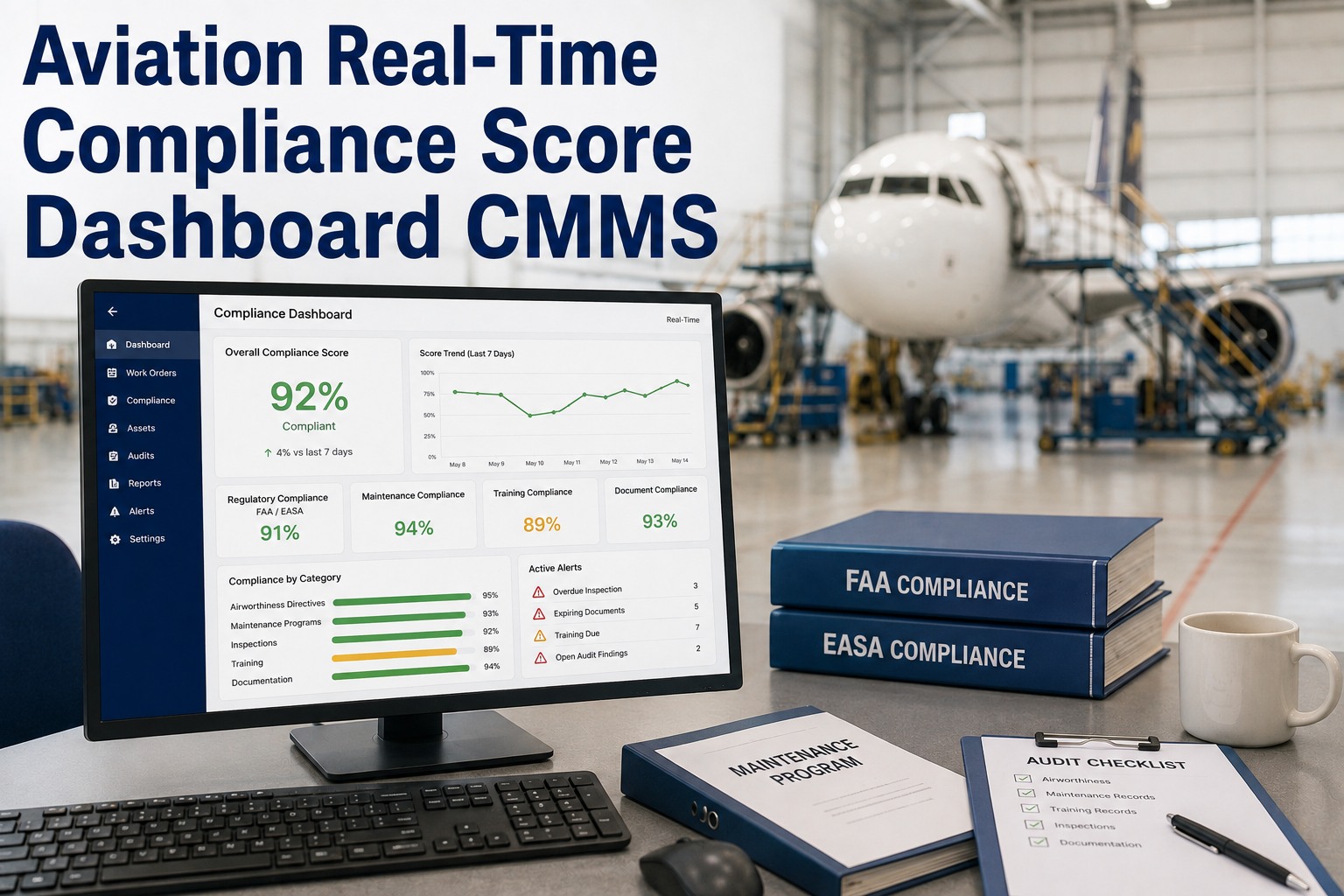
A narrow-body aircraft lands after a transatlantic flight. Before the jet bridge connects, 5G signals have already transmitted 2.4 gigabytes of sensor data to the MRO station — engine temperature trends, hydraulic pressure logs, avionics anomalies, and cabin air quality readings — and a maintenance work order has been auto-generated for the one finding that requires attention before the next departure. The gate turnaround that used to start with a technician climbing into the cockpit to read a fault log now starts with a technician who already knows exactly what needs to be fixed. That is the operational reality 5G connectivity is delivering to aviation maintenance in 2026. Start a free trial for 30 days and connect your aircraft data streams to Oxmaint's real-time monitoring platform — or book a demo with our aviation connectivity team today.
10Gbps
Peak 5G throughput — 100x faster than 4G LTE for aircraft data offload
1ms
5G network latency — enabling real-time sensor telemetry processing at the gate
$2.4B
Projected value of 5G-enabled predictive maintenance savings in aviation by 2028
40%
Reduction in AOG delays achievable through real-time 5G data diagnostics
Connect Your Aircraft Data to Maintenance Action in Real Time
5G is not a future technology for aviation — it is operational today at major hubs in the USA, UK, UAE, Australia, and Germany. Airlines and MRO providers already capturing 5G ground offload data need a maintenance platform that can ingest that data, generate work orders automatically, and push alerts to technicians before the aircraft reaches the gate. Oxmaint's real-time data connectivity platform is built for exactly this workflow. Start a free trial and see how Oxmaint converts aircraft sensor streams into maintenance intelligence — or book a demo for a live integration walkthrough.
Foundation
What 5G Actually Means for Aircraft Connectivity
5G is the fifth generation of cellular network technology, delivering speeds up to 10 Gbps, latency as low as 1 millisecond, and the capacity to connect up to one million devices per square kilometer. In aviation maintenance, those specifications translate into three concrete capabilities that previous generations of wireless technology could not provide: bulk data offload at the gate, real-time sensor telemetry during ground operations, and low-latency command and control for ground support equipment diagnostics.
Previous aircraft connectivity relied on VHF ACARS (narrowband, kilobits per second), satellite datalink (broadband but expensive per megabyte), and Wi-Fi ground offload (fast but short-range and congested at busy terminals). 5G removes the bandwidth and latency constraints that made real-time maintenance data impractical and replaces them with a connectivity layer that treats aircraft sensor data the same way it treats any high-bandwidth industrial IoT stream.
ACARS VHF
2.4 Kbps
Seconds
Text alerts, OOOI messages
Poor — text only
Satellite (SATCOM)
50–200 Mbps
600ms+
In-flight data, QAR offload
Fair — costly per MB
Wi-Fi (802.11ac)
1–3 Gbps
5–30ms
Gate data offload, FOQA
Good — range limited
5G NR (mmWave)
Up to 10 Gbps
1ms
Real-time sensor telemetry, GSE diagnostics
Best — purpose-built for scale
How It Works
The 5G Aircraft Data Pipeline: From Sensor to Work Order
Understanding how 5G transforms maintenance requires following data from its origin — a sensor on an engine, actuator, or environmental system — through to the maintenance action it triggers on the ground. The pipeline has five stages, each enabled by 5G's combination of speed, density, and low latency that no previous connectivity technology could support simultaneously.
S
STAGE 1
Onboard Sensor Collection
Thousands of sensors across engines, hydraulics, avionics, landing gear, and environmental systems generate continuous data streams during flight. Edge processing units onboard pre-filter and compress readings, flagging anomalies for priority transmission.
→
T
STAGE 2
5G Ground Offload on Approach
As the aircraft enters the 5G coverage zone around the airport (typically 1-2 nautical miles from touchdown), the onboard gateway initiates a 5G handshake with the airport's private network. By the time the aircraft taxis to the gate, bulk data transfer is complete.
→
A
STAGE 3
Edge Analytics Processing
Airport-based edge servers process incoming telemetry against aircraft-specific baseline models within milliseconds. Anomalies exceeding defined thresholds are classified by severity — routine monitoring, advisory, or immediate action required.
→
W
STAGE 4
Automated Work Order Generation
Findings above the advisory threshold trigger automatic work order creation in the CMMS — pre-populated with the aircraft tail number, affected system, sensor data context, and applicable AMM task reference. The work order reaches the assigned technician's mobile device before the aircraft reaches the gate.
→
M
STAGE 5
Technician Action and Sign-Off
The technician completes the task using the mobile CMMS interface — with full sensor context, historical trend data, and parts availability visible in real time. Sign-off is digital, timestamped, and immediately visible to the MCC and regulator-accessible audit trail.
This five-stage pipeline compresses what previously took 4-8 hours of post-flight QAR analysis and technician briefing into a process that completes before the aircraft blocks in. For short-haul operators running 6-8 rotations per day per aircraft, that compression is the difference between a 35-minute turnaround that works and one that doesn't. Start a free trial to see how Oxmaint handles real-time data pipelines from connected aircraft — or book a demo for a technical walkthrough of the integration architecture.
Use Cases
Eight High-Impact 5G Applications in Aviation Maintenance
01
Bulk QAR Data Offload at Gate
Full Quick Access Recorder datasets — typically 4-8 GB per flight — offload completely during taxi-in via 5G. FOQA analysis that previously ran overnight now completes before the flight crew reaches the terminal, enabling same-day maintenance decisions for the next departure.
02
Ground Support Equipment Diagnostics
5G-connected GSE — tugs, GPU units, loaders, hydrant carts — transmit real-time health data to a central dashboard. Fault prediction algorithms flag GSE approaching failure thresholds before a ramp assignment creates an AOG situation at the worst possible moment.
03
Predictive Engine Health Monitoring
Exhaust gas temperature (EGT) margins, fuel flow variances, and vibration signatures transmitted via 5G are analyzed against fleet-wide degradation models. Engine events that would previously require borescope inspection on schedule can be identified and addressed specifically — or deferred safely with data justification.
04
Augmented Reality Maintenance Support
5G's low latency enables live AR overlay on maintenance tasks — a technician's smart glasses display the correct AMM procedure, torque values, and sensor readings superimposed on the physical component being serviced, streamed from the cloud with sub-5ms delay.
05
Structural Health Monitoring (SHM)
Fiber optic strain sensors and acoustic emission arrays embedded in wing structures and fuselage panels transmit continuous fatigue data via 5G during ground operations. Real usage-cycle data replaces calendar-based inspection intervals with condition-based maintenance authority.
06
Parts and Inventory Real-Time Sync
5G-connected inventory systems at line stations, hangars, and stores update in real time as parts are issued, installed, or received. When a work order is generated from sensor data, parts availability is checked and reserved automatically — eliminating the 2-3 hour delay of manual inventory calls that plagues current AOG response.
07
Remote Expert Consultation
5G bandwidth enables high-definition video streaming from the hangar to OEM technical support, enabling remote borescope consultations, real-time troubleshooting of complex avionics faults, and virtual expert attendance for first-of-type maintenance events — reducing the cost of flying in specialists by $15,000-$40,000 per event.
08
Autonomous Inspection Drones
5G's combination of speed and low latency enables autonomous drone inspections of aircraft surfaces — fuselage, wings, and empennage — with real-time HD video uplink and AI defect detection. Inspections that previously required 4-6 technicians and elevated access equipment complete in under 20 minutes with one operator.
Pain Points
What 5G Solves That Current Connectivity Cannot
Most aviation maintenance teams operating in 2026 are running on a patchwork of connectivity solutions — satellite for in-flight, Wi-Fi for gate offload, cellular for technician mobile devices — each with different protocols, vendors, and data formats. The integration overhead is enormous and the gaps between systems create exactly the kind of information delays that turn fixable faults into AOG events.
LATENCY PROBLEM
Post-Flight Analysis Delays Cost 4-8 Hours Per Departure
Traditional QAR data analysis happens after the aircraft parks, files are manually extracted or transmitted via Wi-Fi, queued for FOQA processing, and reviewed by an analyst — a workflow that takes 4-8 hours from block-in to maintenance decision. For a short-haul aircraft with a 45-minute turnaround, the analysis result arrives during the next flight. 5G eliminates this lag entirely.
BANDWIDTH PROBLEM
Satellite Costs Cap the Volume of Data Worth Transmitting
At $4-12 per megabyte for satellite datalink, a full QAR dataset would cost $16,000-$96,000 to transmit in-flight. Airlines make hard choices about which data streams are worth the cost — and the streams they omit are often the ones that would have caught the developing fault. 5G airport offload costs cents per gigabyte, removing data prioritization economics from the safety equation.
INTEGRATION PROBLEM
Siloed Connectivity Systems Create Data Format Fragmentation
ACARS delivers messages in ARINC 618 format. QAR data comes in ACMS-specific binary formats. Wi-Fi offload uses proprietary airline system protocols. Each requires a separate integration layer before the data reaches the CMMS. The engineering time consumed maintaining these integrations at large airlines runs to dozens of FTEs annually — capacity that should be focused on maintenance outcomes, not data plumbing.
COVERAGE PROBLEM
Line Stations and Remote Bases Have Zero Real-Time Connectivity
While hub airports have invested in Wi-Fi infrastructure for gate offload, the majority of line stations — where 40-60% of maintenance events occur — have no dedicated aircraft connectivity infrastructure at all. Technicians at outstations work entirely from crew-reported fault descriptions and cockpit printouts. 5G coverage deployed as part of national network rollouts is making real-time connectivity viable at stations that could never justify dedicated Wi-Fi infrastructure investment.
Before vs After
Maintenance Operations: Before 5G vs After 5G
Aircraft lands — QAR data sits onboard until manually extracted at the gate
FOQA analysis queued for overnight batch processing — results available next morning
Technician briefed from pilot defect report — no sensor context, no trending data
Parts availability checked by phone call — 30-90 minute delay for AOG situations
Ground support equipment faults discovered when GSE fails during turnaround
Remote expert consultation requires travel — $15K-$40K per visit
Line station maintenance entirely reactive — no advance data from arriving aircraft
Satellite data costs limit what sensor streams are economically viable to transmit
Aircraft data offloads completely during taxi-in — 4-8 GB transferred before gate arrival
Real-time edge analytics process telemetry in milliseconds — findings available at block-in
Work order pre-generated with sensor data, trend context, and AMM reference before landing
Parts reserved automatically when work order generates — inventory synced in real time
GSE health monitored continuously — predictive alerts before assignment to turnaround
Remote expert joins via HD video call — consultation completed in 30 minutes, zero travel
Line station receives aircraft health brief before the inbound flight lands
Full sensor data streams transmitted at gate — no cost-based data prioritization
Oxmaint Platform
How Oxmaint Converts 5G Aircraft Data Into Maintenance Action
Real-time connectivity is only valuable if the platform receiving the data can act on it intelligently. Raw sensor streams arriving via 5G need to be parsed, compared against baselines, matched to asset records, and converted into specific maintenance tasks — all in seconds, not hours. Oxmaint's real-time data connectivity module is built to handle exactly this workflow at the speed 5G enables.
INGESTION
Multi-Protocol Data Ingestion
Oxmaint accepts aircraft sensor data via REST API, MQTT, OPC-UA, and ARINC 429/664 adapters — covering the full range of aviation data formats from legacy ACMS outputs to next-generation IP-based sensor networks.
TRIGGERS
Condition-Based Maintenance Triggers
Define threshold conditions on any sensor parameter — EGT margin below 20°C, vibration above 3.2 IPS, hydraulic pressure variance greater than 15% — and Oxmaint generates maintenance tasks automatically when live data crosses those limits.
MOBILE
Technician Mobile Alerts
Work orders generated from 5G-transmitted data push immediately to assigned technicians' mobile devices — with full sensor context, historical trend charts, and relevant AMM task references visible at the point of work, no desktop terminal required.
ASSET RECORDS
Automatic Asset History Updates
Every data event received from an aircraft tail number is automatically appended to that aircraft's maintenance history — flight cycles, sensor readings, threshold events, and corrective actions — building a continuous, tamper-evident record without manual data entry.
FORECASTING
Remaining Useful Life Estimation
Sensor degradation trends accumulated via 5G data streams feed Oxmaint's component life models — converting raw telemetry into remaining useful life estimates that drive proactive part replacement planning and 5-10 year CapEx forecasts.
COMPLIANCE
Audit-Ready Data Chain
Every sensor reading, threshold event, work order, and sign-off is stored with cryptographic timestamps in an immutable audit trail. FAA, EASA, and CAAC auditors can verify the complete data chain from raw sensor input to maintenance action in a single export.
Aviation maintenance teams across the USA, UK, UAE, Australia, and Germany are using Oxmaint's platform to turn aircraft connectivity from a data collection exercise into an operational advantage. Start a free trial and connect your first aircraft data source to Oxmaint in days — or book a demo and we'll map your current connectivity architecture to Oxmaint's integration layer.
Measured Outcomes: 5G-Connected Aviation Maintenance
40%
Reduction in AOG delays from pre-arrival maintenance intelligence
When 5G data arrives before block-in, technicians start with a plan, not a question
72%
Faster fault-to-work-order cycle vs post-flight QAR batch analysis
Real-time processing replaces overnight batch queues and manual analyst review
$96K
Saved per aircraft per year in satellite data costs replaced by 5G gate offload
At $8/MB satellite cost vs cents/GB for 5G ground-based transmission
25%
Improvement in first-time fix rate when technicians arrive with pre-analyzed data
Correct parts, correct procedure, correct technician — all set before the aircraft parks
Implementation
Deploying 5G Aircraft Connectivity: A Practical Roadmap
5G connectivity for aviation maintenance is not a rip-and-replace project. It is an additive layer that integrates with existing aircraft systems, ground infrastructure, and CMMS platforms. The deployment follows a phased approach that delivers operational value at each stage without requiring a complete aviation-IT overhaul before the first byte of data flows.
PHASE 1
Airport 5G Infrastructure Assessment (Weeks 1-4)
Assess existing 5G coverage at your primary hub airports. Major airports in the USA (FAA NextGen program), UK (CAA Digital Aviation program), UAE (GCAA smart airport initiatives), and Australia (CASA digital transformation) are ahead of smaller regional hubs. Identify coverage gaps at your top-10 line stations and map 5G availability against your operations.
PHASE 2
Aircraft Gateway Selection and Certification (Months 2-5)
Select a 5G-capable aircraft gateway unit compatible with your fleet's avionics architecture. Options include Honeywell GoDirect, Collins Aerospace Connected Aviation Services, and independent 5G gateway providers. Gateway installation on the first aircraft requires STC or Field Approval depending on integration scope — plan 3-4 months for the certification path.
PHASE 3
CMMS Integration and Threshold Configuration (Months 4-6)
Connect the 5G data stream to Oxmaint via API integration. Map incoming sensor data fields to asset records, define maintenance trigger thresholds for each sensor type, configure work order auto-generation rules, and establish technician alert routing. Oxmaint's integration team completes this configuration in 4-8 weeks for standard fleet types.
PHASE 4
Pilot Operation and Model Validation (Months 6-9)
Operate the 5G data pipeline on a 2-4 aircraft pilot fleet. Validate that auto-generated work orders are accurate and actionable, tune threshold models to reduce false positive rates below 10%, measure turnaround time improvements, and document maintenance cost impact. 80% of implementations achieve ROI validation during the pilot phase.
FAQ
Frequently Asked Questions
Does 5G interfere with aircraft avionics or navigation systems?
This is the most-asked question in aviation 5G discussions, and the answer is nuanced. The interference concern raised extensively in 2022 related specifically to C-Band 5G frequencies (3.7-3.98 GHz) deployed near airports in the USA, which overlap with radar altimeter operating frequencies. Regulators including the FAA, EASA, and the ITU have since established mandatory exclusion zones and power limits around airport approach paths, and aviation-specific 5G deployments at airports use frequency bands (Sub-6 GHz and mmWave above 24 GHz) specifically selected to avoid radar altimeter interference. 5G used for ground-based aircraft data offload operates only during taxiing and ground operations — when altimeters are not in use — eliminating the in-flight interference concern entirely.
How much data can be offloaded via 5G during a typical gate turnaround?
At 5G peak throughput of 10 Gbps (practical throughput in an airport environment is typically 1-4 Gbps depending on congestion and coverage), a 45-minute gate turnaround provides sufficient time to transfer 2.7 TB of data — far more than even the largest current QAR and ACMS datasets, which typically run 4-12 GB per flight. In practice, data offload begins during the final approach phase as soon as the aircraft enters 5G coverage, meaning the full dataset transfers well before block-in. Airport private 5G networks using network slicing can guarantee dedicated bandwidth for aircraft offload, preventing congestion from passenger device traffic impacting the maintenance data transfer.
Which airports currently have 5G infrastructure suitable for aircraft maintenance data offload?
As of 2026, private 5G networks specifically designed for aviation operations are operational at Dallas/Fort Worth, Chicago O'Hare, Atlanta Hartsfield-Jackson, Dubai International, London Heathrow, Singapore Changi, Frankfurt Airport, and Sydney Kingsford Smith — among others. The deployment is accelerating rapidly: IATA's 5G Working Group reported that 47 major international airports had active aviation 5G pilots or deployments as of mid-2025. National 5G coverage in most of these countries also means that commercial carrier 5G is available at many regional airports even without airport-specific private networks, sufficient for non-time-critical data offload applications.
What is the regulatory status of 5G-transmitted maintenance data for FAA and EASA compliance?
Both FAA and EASA accept electronic maintenance records generated from connected aircraft systems, provided the records meet their digital signature, access control, and data integrity requirements. FAA Advisory Circular AC 120-78B and EASA AMC M.A.306 establish the framework for electronic technical records — both are technology-neutral, meaning records generated from 5G-transmitted sensor data that meet authentication and integrity standards are treated identically to records generated through any other means. The key compliance consideration is that the data chain from sensor reading to maintenance action must be traceable, timestamped, and tamper-evident — exactly what Oxmaint's platform provides when integrated with 5G aircraft data streams.
The Connected Maintenance Future Is Operational Now
Turn 5G Aircraft Data Into Maintenance Action Before the Jet Bridge Connects
Oxmaint's real-time data connectivity platform ingests 5G aircraft telemetry, generates condition-based work orders automatically, pushes alerts to technician mobile devices, and builds a continuous audit-ready maintenance record — all before your aircraft reaches the gate. Used by maintenance teams across the USA, UK, UAE, Australia, and Germany to compress fault-to-fix cycles from hours to minutes.