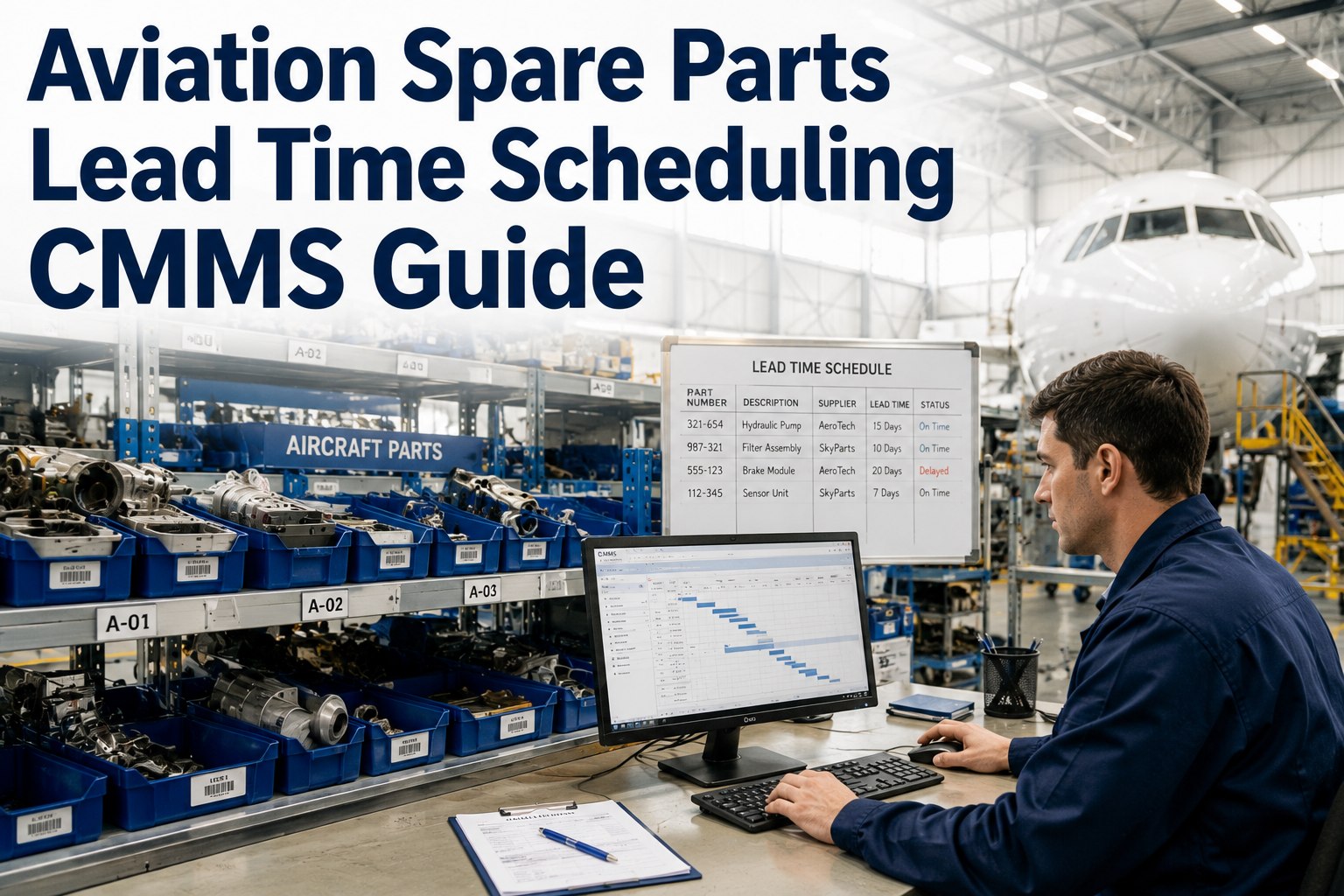
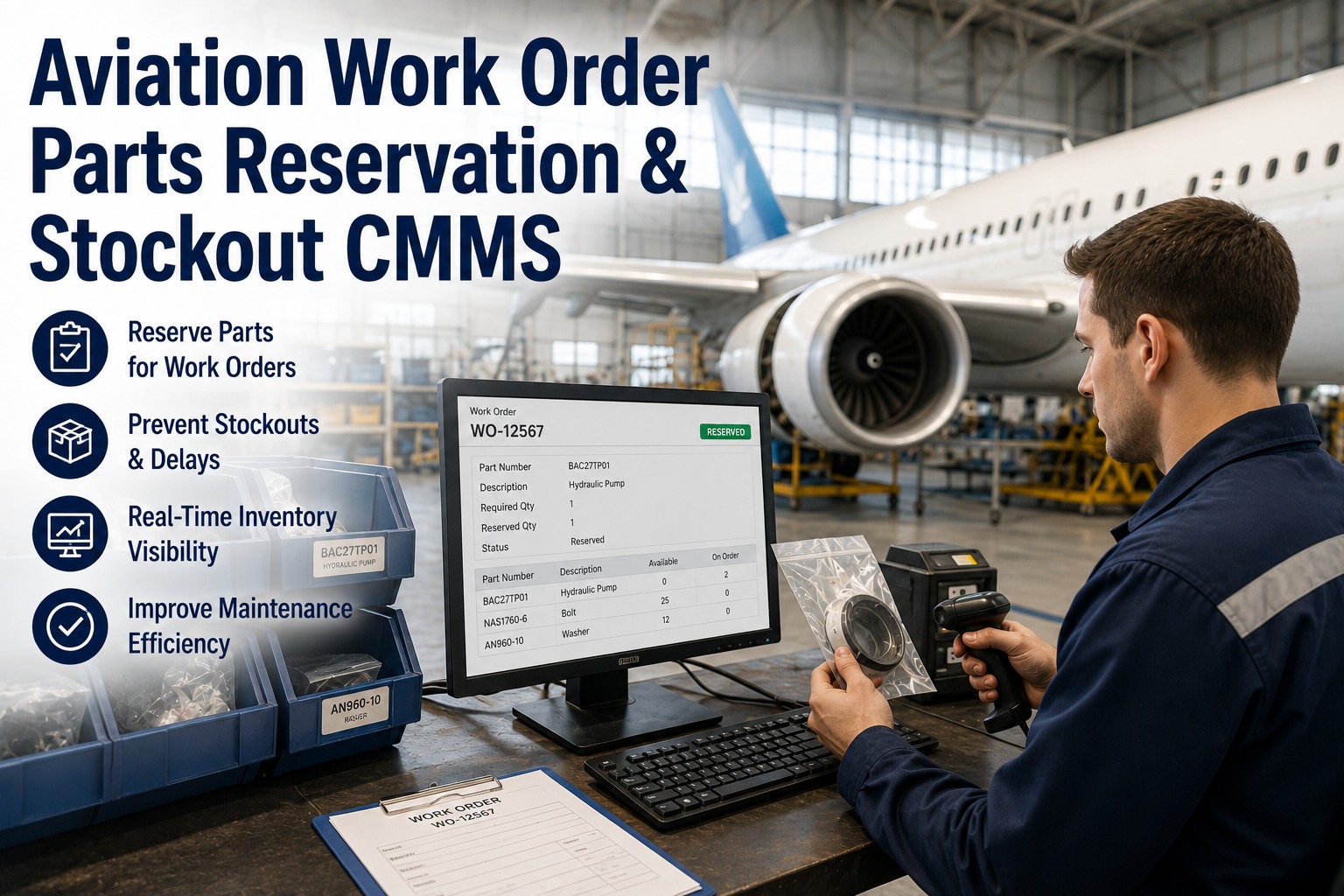
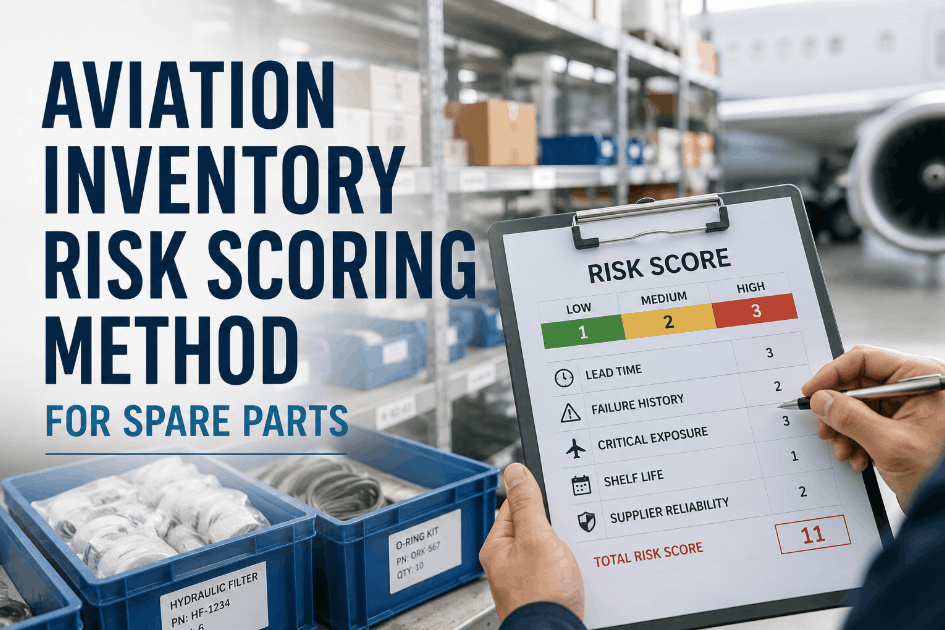
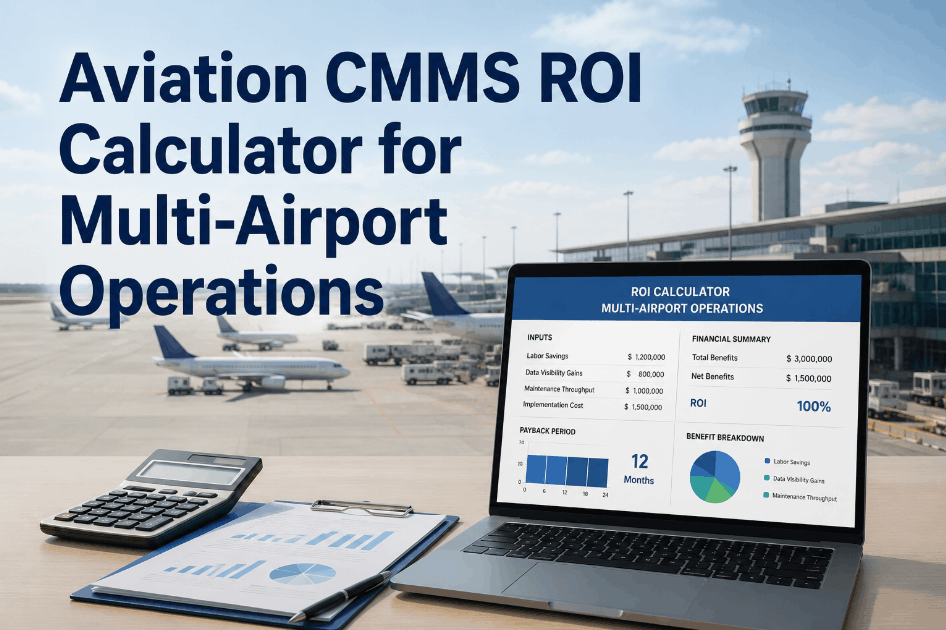
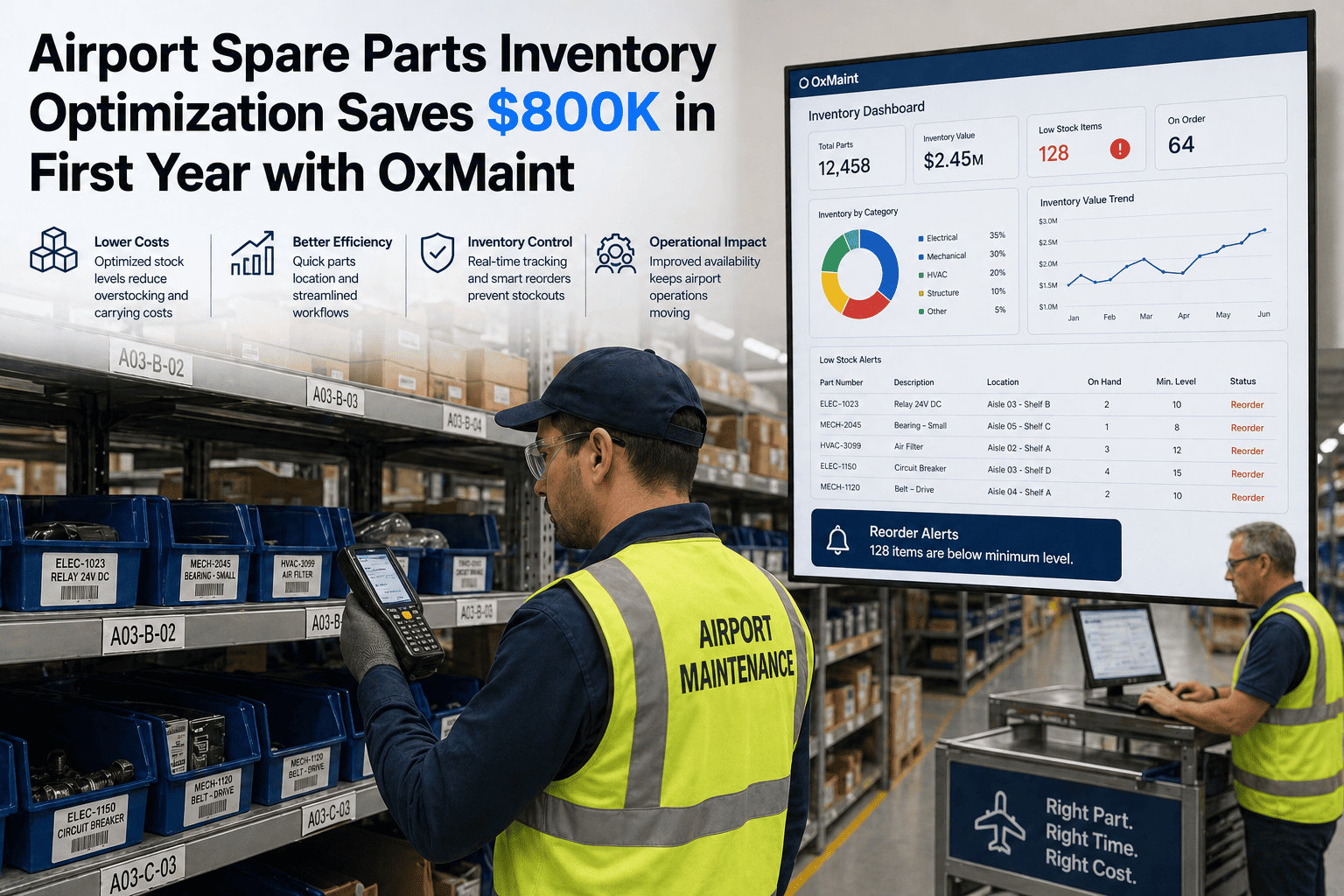
Aviation maintenance teams across the USA, UK, Canada, UAE, Germany, and Australia operate inside one of the most punishing inventory environments in industry — every grounded aircraft burns ten to fifty thousand dollars per hour, every emergency part order multiplies cost four to eight times, and every unserviceable component must be traced through a serialised, regulated audit chain that paper systems quietly fail. Smart inventory management for aviation maintenance is no longer a procurement upgrade — it is the difference between a fleet that flies on schedule and a fleet that loses millions to AOG events, surplus stock obsolescence, and reactive purchasing cycles that erode every margin in the operation. This guide shows maintenance directors, MRO managers, and inventory controllers how a modern CMMS-driven inventory framework eliminates stockouts, controls holding cost, and produces the kind of parts visibility that turns aviation maintenance from a cost centre into a measured, predictable operation — start a free trial to configure your aviation parts library in Oxmaint, or book a demo to see live parts tracking against your fleet.
See Your AOG Risk in 30 Minutes
Identify hidden parts gaps, surplus obsolescence exposure, and stockout patterns across your maintenance hangars and outstations — before the next aircraft sits grounded waiting for a part.
No heavy implementation required — works across multi-site portfolios — live in days, not months.
What Is Smart Inventory Management for Aviation Maintenance?
Smart inventory management for aviation maintenance is the use of digital CMMS-driven parts tracking, condition-based stocking models, and real-time consumption analytics to maintain the exact spare-parts position required to prevent AOG events without absorbing the surplus carrying cost that destroys MRO margins. It replaces the legacy aviation pattern — overstocking critical line stations, understocking rotables at outstations, and counting consumables on a spreadsheet — with a single source of truth where every rotable, repairable, and consumable is serialised, condition-tagged, location-tracked, and consumption-modelled against actual flight cycles and PM schedules.
For aviation operations, smart inventory is not just better warehousing. It is the integration of asset records, work-order consumption, regulator-mandated traceability, and supplier lead-time intelligence into a unified parts platform that aviation auditors recognise as a compliance control — not an inventory document. start a free trial and configure your first aviation parts inventory in Oxmaint within a single working day.
The Six Pillars of Aviation Smart Inventory
Serialised Part Tracking
Every rotable and life-limited part tracked by serial number, cycles, hours, and condition tag — never by SKU alone.
Multi-Location Visibility
Main base, line stations, and outstations on one live inventory view — no hidden stock, no parallel ledgers.
Consumption-Driven Reorder
Reorder triggers driven by actual work-order consumption and flight cycles — not static min/max levels set in 2019.
Regulatory Traceability
Full FAA, EASA, CAA, GCAA, CASA Part-145 traceability — Form 8130-3, EASA Form 1, dual release on every line.
Surplus & Obsolescence Control
Slow-mover and obsolescence reports generated automatically — surplus identified before it becomes write-off.
Barcode & RFID Workflows
Mobile scanning at issue, receipt, and condition change — every transaction timestamped, technician-signed, audit-ready.
Most aviation operations carry 20–40% surplus inventory yet still hit stockouts on critical AOG-driving parts every quarter.
The Pain Points Killing Aviation Inventory Programmes
AOG Events From Predictable Stockouts
High-failure-rate parts sitting at zero stock at the exact line station that needs them — costing $10K–$150K per AOG hour while expedited shipping is arranged.
Surplus Cash Locked in Slow Movers
Years-old rotables and life-limited components depreciating on shelves while finance pressures procurement to cut budgets — IATA values 2025 airline surplus holding cost at $1.4 billion.
Untracked Cycles on Life-Limited Parts
LLP cycle counts maintained on spreadsheets that disagree with hangar reality — direct airworthiness exposure and a guaranteed audit finding when a regulator asks for the source data.
Lead-Time Surprises From OEM Suppliers
Quoted 30-day lead times stretching to 90–180 days with no supplier-performance data to argue from — and no reorder horizon long enough to absorb the slip.
Parallel Inventory Ledgers
Procurement system says one thing, stores spreadsheet says another, technician finds a third reality on the shelf — every reconciliation cycle absorbs days of supervisor time.
Lost Traceability on Returned Cores
Repaired rotables returning from shops without complete certification chain — disrupting installation, triggering airworthiness rework, and adding hidden hangar time to every job.
Maintenance teams that switch from clipboard-managed parts to a structured digital aviation inventory routinely cut stockouts by 60–80% in the first quarter — start a free trial to experience this shift, or book a demo to see it run on your actual fleet structure.
How Oxmaint Operationalises Smart Aviation Inventory
Rotable & LLP Serial Tracking
Every rotable, repairable, and life-limited part registered as a serialised asset with cycles, hours, condition tag, and complete maintenance history — visible against the airframe in real time.
Portfolio Inventory Visibility
Main base, hangar, line stations, and outstations on a single live inventory map — instantly answer where the part is, what condition it is in, and what is committed to which work order.
Barcode Issue & Receipt
Technicians scan parts at issue, receipt, and condition change — every transaction timestamped and tied to the work order, the asset, and the technician for total accountability.
Consumption-Driven Reordering
Reorder points calculated from actual work-order consumption, flight-cycle forecasts, and PM schedule — not static numbers maintained by hand. Surplus reduction averaging 18–30% within the first year.
Form 8130-3 & EASA Form 1 Storage
Every certification document attached to its part record — pulled in seconds during an FAA, EASA, GCAA, or CASA audit, eliminating the binder-search ritual that derails aviation inspections.
Slow-Mover & Obsolescence Dashboard
Slow-mover, no-mover, and obsolescence reports generated automatically — finance and operations agreeing on inventory write-down candidates instead of arguing about them at year-end.
Multi-site portfolio inventory, condition-based stocking, and audit-grade traceability are core Oxmaint features — not add-ons. book a demo to see your specific aviation parts library running in the platform.
Used by operations teams managing 10,000+ aviation assets — see measurable results in the first 30 days.
Reactive Inventory vs Smart Inventory: The Cost Difference
| Inventory Dimension | Reactive (Paper / Spreadsheet) | Smart (Oxmaint CMMS) |
|---|---|---|
| Parts visibility | Stock count valid at last spreadsheet update — hours or days stale | Live, transaction-driven, every issue and receipt reflected instantly |
| AOG response | Phone calls across stations to locate a part — hours wasted | Cross-site search returns location, condition, and cert status in seconds |
| Rotable cycle tracking | Spreadsheet maintained manually — frequently out of sync with actual usage | Cycles update automatically against flight hours and work order completions |
| Reorder method | Static min/max levels set years ago — overstock and stockouts simultaneously | Consumption-based auto-reorder tuned to actual demand and supplier lead time |
| Certification documents | Form 8130-3 stored in binders, often misplaced during audit prep | Cert documents attached to part record — exported by serial in seconds |
| Surplus identification | Discovered at year-end inventory count — write-down comes as a surprise | Slow-mover dashboard flags surplus monthly — proactive disposal decisions |
| Audit preparation | Days of binder hunting and reconciliation before each FAA / EASA visit | Inspection-area export by date range — minutes, not days |
| Cost outcome | Surplus carried + stockout-driven AOG events — both costs simultaneously | 15–30% inventory cost reduction with simultaneous stockout elimination |
Limited onboarding slots available this quarter — secure your aviation deployment now.
Measured ROI From Smart Aviation Inventory
Frequently Asked Questions
What does smart inventory management mean specifically for aviation maintenance teams?
In aviation maintenance, smart inventory management means tracking every rotable, repairable, consumable, and life-limited part by serial number against the specific airframe and component register — with cycles, hours, condition tag, certification documents (Form 8130-3, EASA Form 1), and consumption history visible in real time. Generic warehouse inventory practices do not satisfy aviation requirements because they do not capture cycle-controlled life-limited parts, do not enforce dual-release traceability, and do not link parts movement to work order completion. A smart aviation inventory system enforces these regulatory and operational rules automatically so technicians cannot complete a work order without correct serialised parts data — making compliance a byproduct of normal work rather than an audit-prep exercise.
How does Oxmaint handle FAA and EASA traceability for aviation parts?
Every part record in Oxmaint stores its release-to-service documentation — FAA Form 8130-3, EASA Form 1, and equivalent regulator certification — attached to the serial number. When a part is issued to an aircraft, its full certification chain is linked to the work order. During FAA Part 121, EASA Part-145, CAA, GCAA, or CASA audits, the maintenance team exports the complete traceability record for any serial number, any work order, or any aircraft within seconds — eliminating the binder hunt that traditionally consumes days before each audit visit. Dual release, return-to-service authorisation, and certification status are all enforced at the point of part movement, so compliance is structurally maintained rather than retrospectively reconstructed.
What is the typical inventory cost reduction after deploying CMMS-driven smart inventory?
Aviation operations transitioning from spreadsheet-based or legacy inventory systems to a modern CMMS-driven approach typically see 15–30% inventory cost reduction within the first year — driven by three simultaneous mechanisms. First, surplus slow-movers and obsolescence are identified proactively and disposed of before they become write-down events. Second, consumption-driven reorder logic eliminates the over-purchasing that static min/max settings cause when demand patterns shift. Third, AOG-driving stockouts decrease 60–80% as critical-parts visibility improves across line stations and outstations. The IATA MRO SmartHub data shows an additional 10–15% material cost reduction available through transparent surplus aftermarket access — a benefit only realisable when a digital inventory record exists to support it.
How does Oxmaint support multi-site aviation operations with line stations and outstations?
Oxmaint's portfolio architecture is built for multi-site aviation operations from day one. Each line station, outstation, MRO base, and central warehouse maintains its own inventory record with location-specific stock levels, condition tags, and reorder logic — while the central operations and finance teams see a unified portfolio view of all parts across all sites. Cross-site search returns location and condition status for any serial number in seconds, enabling instant rerouting of available stock during AOG response. Common consumption patterns across stations are flagged automatically — a fleet-wide bearing failure pattern, for example, is detected even when individual stations would see only isolated events. Multi-site is a core architectural capability, not an enterprise upgrade.
Stop Losing Millions to AOG Stockouts and Surplus Cash
Turn every aviation part — rotable, repairable, consumable, life-limited — into a tracked, condition-scored, traceable asset with Oxmaint. Real-time multi-site visibility, FAA and EASA-grade traceability, and consumption-driven reordering in one platform.
- Real-time parts visibility across all line stations and outstations
- Predictive stockout alerts before AOG events occur
- Full FAA, EASA, CAA, GCAA, CASA Part-145 traceability built-in