AI for Airport Operations & Decision Support Systems
By Riley Quinn on January 22, 2026
At 6:47 AM, an AI system detects an anomaly in weather patterns 200 miles away. It calculates
the storm will reach the airport in 93 minutes, affecting 47 scheduled flights. Before any human notices, the
system has already reassigned gates, rerouted ground equipment, notified crew schedulers, and adjusted baggage
handling priorities. By the time operations managers arrive at their desks, contingency plans are ready for
approval. This isn't science fiction—it's how AI-powered airports operate today, making thousands of
micro-decisions per hour that keep operations flowing smoothly even when conditions change rapidly.
AI's Impact on Airport Operations
Real-time intelligence transforming aviation
73%
Reduction in delay prediction errors
2.8M
Decisions processed daily by AI systems
41%
Improvement in resource utilization
Why Airports Are Turning to AI Now
Airport operations generate massive amounts of data—flight schedules, passenger flows, equipment sensors, weather
feeds, baggage tracking, security checkpoints, and more. For decades, this data sat in isolated systems,
analyzed manually or not at all. AI changes everything by connecting these data streams, identifying patterns
humans can't see, and making predictions that enable proactive rather than reactive management. The airports
adopting AI aren't just getting faster—they're fundamentally changing how decisions get made.
From Reactive Chaos to Predictive Control
Traditional Operations
Manual data analysis across siloed systems
Reactive responses to disruptions
Limited visibility into future conditions
Decisions based on incomplete information
Delayed response to cascading issues
AI-Powered Operations
Unified real-time data integration
Predictive disruption management
Hours or days of advance warning
Data-driven decision recommendations
Automated preventive actions
Five Ways AI Transforms Airport Operations
Disruption Prediction
AI analyzes weather patterns, historical delay data, and real-time flight
information to predict disruptions before they occur. Machine learning models identify which flights
are at risk and recommend preemptive actions.
Example:
System predicts 78% probability of 45-minute delays for afternoon
departures due to incoming weather, triggering early gate reassignments.
Resource Optimization
AI algorithms optimize gate assignments, ground support equipment allocation, and
staff scheduling in real-time. The system balances competing priorities to maximize efficiency
across all resources.
Example:
AI reassigns gates dynamically based on aircraft size, passenger
connections, and turnaround requirements, reducing taxi time by 23%.
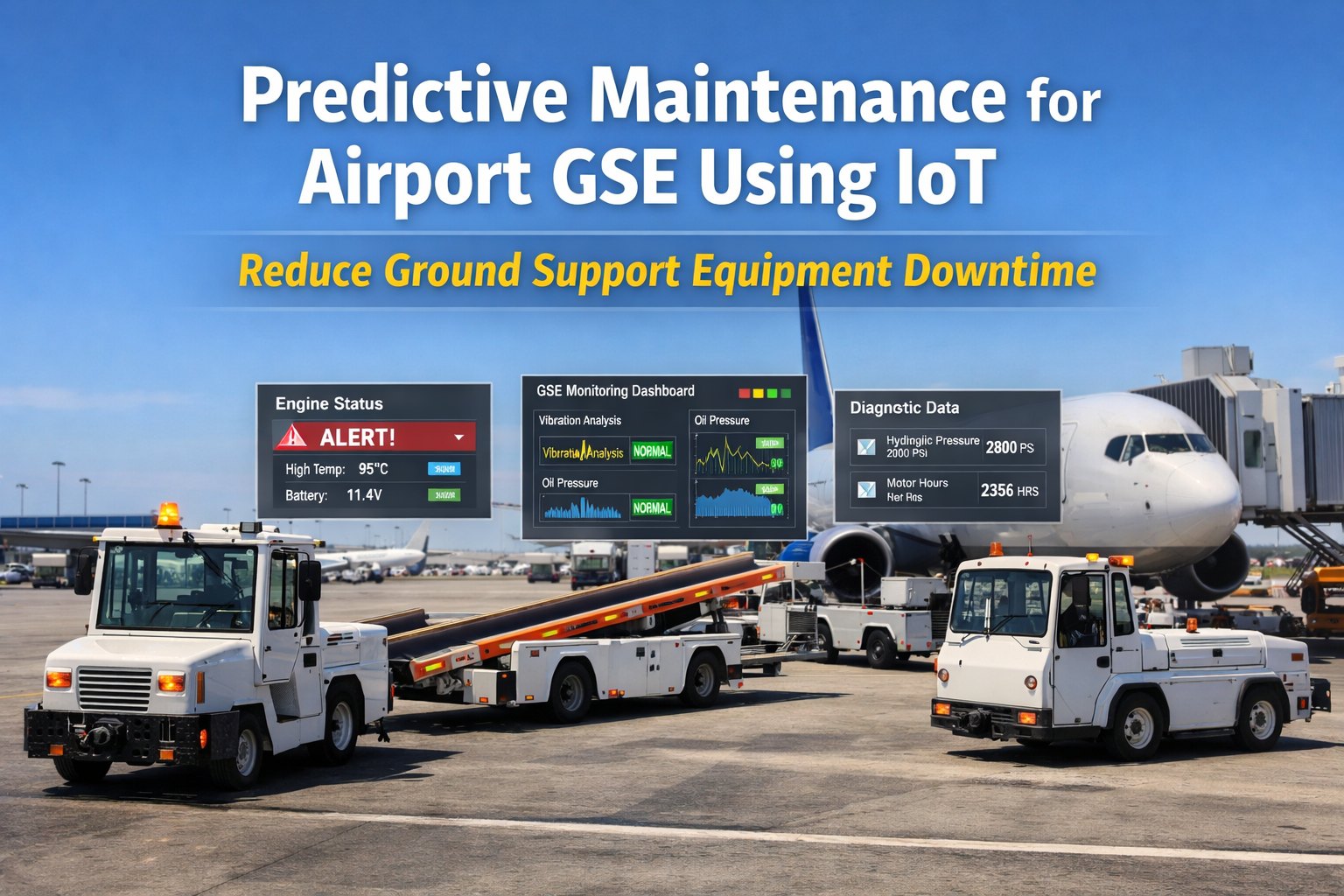
Predictive Maintenance
Machine learning models analyze sensor data from baggage systems, jet bridges,
and ground equipment to predict failures before they happen. Maintenance gets scheduled during
planned downtime.
Example:
Vibration sensors detect bearing degradation in baggage conveyor motor,
triggering work order 12 days before predicted failure.
Passenger Flow Analytics
Computer vision and sensor networks track passenger movement through terminals.
AI predicts congestion at security checkpoints, immigration, and gates, enabling proactive crowd
management.
Example:
System detects building queue at security checkpoint 15 minutes before
peak, automatically opening additional lanes.
Decision Support Systems
AI provides operations managers with real-time recommendations based on current
conditions and predicted outcomes. The system simulates multiple scenarios and suggests optimal
actions.
Example:
During irregular operations, AI recommends specific gate swaps and crew
changes to minimize total delay minutes across all affected flights.
The AI Decision-Making Process
How AI Makes Airport Decisions
From data to action in milliseconds
Data Ingestion
Collect real-time data from all airport systems
→
Pattern Recognition
Identify anomalies and trends
→
Prediction
Forecast future conditions
→
Recommendation
Suggest optimal actions
See AI-Powered Operations in Action
Discover how Oxmaint's AI decision support system helps airports predict
disruptions, optimize resources, and improve operational efficiency.
AI models predict flight delays with 75% accuracy up to 6 hours in advance
62%
Resource Utilization Gain
Optimized gate and equipment allocation increases utilization by 62%
55%
Maintenance Cost Reduction
Predictive maintenance cuts emergency repair costs by 55%
Real-World AI Implementation
Leading airports worldwide are deploying AI systems that integrate with existing infrastructure. These systems
don't replace human decision-makers—they augment them with data-driven insights and predictive capabilities.
Operations managers receive recommendations they can accept, modify, or override based on their expertise and
local knowledge. The combination of AI speed and human judgment creates better outcomes than either could
achieve alone.
AI Integration Architecture
Data Sources
Flight Info
Weather
Sensors
Schedules
↓
AI Processing
ML Models
Analytics
Predictions
↓
Decision Support
Recommendations
Alerts
Automation
Getting Started with AI in Your Airport
1
Assess Current State
Evaluate existing data infrastructure, identify pain points, and define
success metrics for AI implementation.
2
Start with High-Impact Use Cases
Begin with disruption prediction or resource optimization where ROI is
clearest and data is readily available.
3
Integrate Data Sources
Connect flight information systems, weather feeds, sensor networks, and
operational databases into unified platform.
4
Deploy and Refine Models
Train AI models on historical data, validate predictions, and continuously
improve accuracy through feedback loops.
Frequently Asked Questions
How accurate are AI predictions for airport disruptions?
Modern AI systems achieve 70-80% accuracy for delay predictions 4-6 hours in advance,
significantly better than traditional methods. Accuracy improves as models learn from more data and as
prediction windows shorten. For immediate disruptions (1-2 hours out), accuracy often exceeds 85%.
Does AI replace human decision-makers in airport operations?
No. AI serves as a decision support tool that provides recommendations based on data
analysis. Human operators retain final authority and can override AI suggestions when local knowledge or
exceptional circumstances warrant different actions. The best results come from combining AI's
analytical power with human expertise and judgment.
What data is required to implement AI in airport operations?
Essential data includes flight schedules, historical delay records, weather
information, gate assignments, and equipment status. Additional value comes from passenger flow data,
baggage tracking, maintenance records, and sensor data from critical systems. Most airports already
collect this data—the challenge is integrating it into a unified platform.
How long does it take to see ROI from AI implementation?
Initial benefits typically appear within 3-6 months as predictive models begin
identifying optimization opportunities. Full ROI usually materializes within 12-18 months as systems
mature, models improve with more training data, and operational teams develop proficiency using AI
recommendations. Quick wins often come from predictive maintenance and resource optimization.
Can AI systems integrate with existing airport infrastructure?
Yes. Modern AI platforms are designed to integrate with existing systems through APIs
and standard data protocols. They can connect to flight information systems, baggage handling platforms,
maintenance management software, and other airport operations technology without requiring
infrastructure replacement. Integration typically takes weeks to months depending on system complexity.
Transform Your Airport with AI
Join forward-thinking airports using Oxmaint's AI-powered platform to predict
disruptions, optimize operations, and make better decisions in real-time.