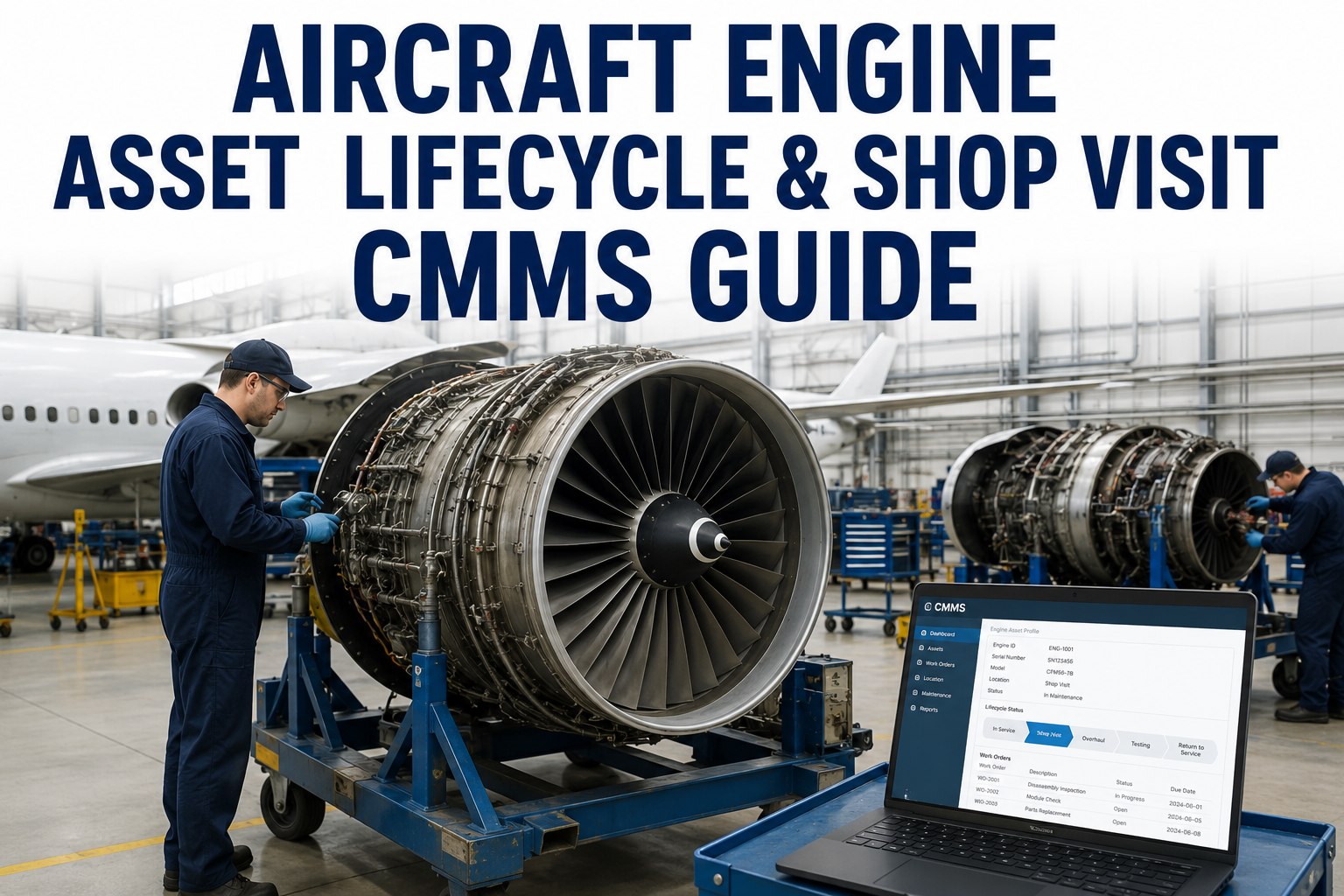
An aircraft engine is the single most expensive rotating asset an airline or lessor manages — a single widebody engine can cost $25–$45 million, and the timing of its shop visit decides millions in cash flow, lease compliance and fleet availability. This guide covers the aircraft engine asset lifecycle end to end: on-wing time optimization, LLP stack management, EGT margin tracking, shop visit forecasting, and how a CMMS like OxMaint aligns engine strategy with fleet plans and lessor requirements. If your team still tracks engine shop visit history in spreadsheets, the risk of missed performance restoration records and lease-end penalties grows every cycle — you can Start Free Trial to see how a purpose-built engine asset CMMS changes that within days.
Engine Asset Lifecycle & Shop Visit Guide 2026
Is one unplanned engine shop visit costing your airline $4M+ in cash flow?
A single widebody engine generates 8,000–12,000 flight hours between performance restoration visits. Missing that window by even 90 days can trigger AOG groundings, lease-return penalties, and millions in expedited MRO costs. OxMaint's engine asset CMMS tracks every cycle, margin and LLP limit — so you forecast the next shop visit months before it bites.
Engine Asset Lifecycle Phases
The 6 phases of an aircraft engine asset lifecycle
A modern turbofan engine moves through six distinct lifecycle phases over 15–25 years. Each phase has unique CMMS data requirements — from induction baseline to scrap reconciliation. Teams that track these phases in disconnected spreadsheets lose 8–12 percent of residual value per engine at lease return.
Induction & Baseline Build
Record serial number, module configuration, LLP stack positions and baseline EGT margin at entry into service. OxMaint creates a digital twin of every engine with module-level traceability.
Years 0–1On-Wing Performance Monitoring
Track EGT margin deterioration, oil consumption trend, vibration signatures and cycle accumulation against the first performance restoration target of 8,000–12,000 EFC.
Years 1–6Shop Visit Forecasting
Trigger induction planning 180–270 days before EGT margin exhaustion or LLP limit. OxMaint CMMS auto-generates work-order forecasts and material pre-positioning.
Month −9 to −3Performance Restoration & LLP Replacement
Execute teardown, module-level repair, HPT blade replacement, LPT disk swaps and test-cell validation. Every work order feeds the engine's permanent shop visit history record.
60–120 days in shopLease-Return & Records Reconciliation
Compile full back-to-birth records, LLP traceability certificates, AD/SB compliance log and EGT margin at redelivery. Missing records cost $200K–$800K in lessor penalties per engine.
Month −3 to 0Retirement & Parts Harvesting
Salvage serviceable modules and LLPs for the pool. OxMaint tracks residual value recovery and feeds scrap reconciliation into engine lifecycle cost analytics.
Year 15–25Shop Visit Forecasting Formula
How to forecast engine shop visit timing with CMMS analytics
Shop visit forecasting is the highest-leverage calculation in engine asset management. A one-month improvement in forecast accuracy across a 40-engine fleet saves $1.5–$3 million annually in avoided AOG, spares rental and expedited MRO costs. The formula below is what OxMaint's predictive engine module runs continuously for every engine in your fleet.
EGT Margin Exhaustion Forecast
SVdate = Current Date + [ ( EGTcurrent margin − EGTred-line buffer ) / EGTdegradation rate per cycle ] × Avg. Cycles per Day
Trigger: SVdate ≤ 180 days OR LLP stack remaining ≤ 1,200 cycles — whichever comes first.
CFM56-7B engine, 24-month rolling window
With OxMaint tracking these inputs automatically from ACARS and engine health monitoring feeds, the reliability team sees this forecast update daily — and receives a work-order trigger 270 days out, giving MRO planning 4 extra weeks of lead time versus spreadsheet-based tracking.
CMMS vs Spreadsheets
Engine asset tracking: CMMS vs spreadsheet management
Most airlines and lessors still manage engine lifecycle data in Excel workbooks shared via email. The comparison below shows why that approach leaks millions across a fleet — and why a CMMS engine asset platform pays for itself within a single lease cycle.
| Lifecycle Capability | Spreadsheet Tracking | OxMaint Engine CMMS |
|---|---|---|
| EGT margin trend visibility | Manual entry, 30–60 day lag | Real-time feed, auto-updated daily |
| LLP stack position tracking | Separ sheets per engine, error-prone | Module-level digital twin, full trace |
| Shop visit forecasting accuracy | ±90 days typical | ±15 days with predictive analytics |
| Lease-end records compilation | 4–8 weeks manual assembly | Auto-generated report in minutes |
| AD/SB compliance tracking | Manual log review | Automated alerts and audit trail |
| Lifecycle cost per engine / year | $3.8M average | $2.9M average (24 percent reduction) |
Cost Analytics
Engine lifecycle cost breakdown — where the money goes
A single widebody engine accrues $18–$28 million in lifecycle costs over 15 years. Understanding where those dollars concentrate is the first step toward controlling them with engine cost analytics in your CMMS.
"A 40-engine fleet using OxMaint CMMS for engine lifecycle tracking recovered $2.8M in Year 1 by shifting two shop visits into forecasted windows and eliminating $600K in lessor penalty fees at redelivery."
— Regional carrier, 22-aircraft narrowbody fleet
How OxMaint Helps
How OxMaint's CMMS solves engine asset lifecycle management
OxMaint is an AI-powered CMMS and EAM platform built for maintenance and reliability teams that need to manage high-value rotating assets with full traceability. Here is how four specific capabilities map to your engine lifecycle challenges — each with a measurable outcome.
Predictive Shop Visit Forecasting
AI models ingest EGT margin trend, cycle accumulation and vibration data to forecast induction dates within ±15 days — 6× more accurate than spreadsheet planning.
LLP Stack Digital Twin
Every life-limited part is tracked by serial number, position and remaining cycles — with automatic alerts when any LLP crosses 1,200-cycle remaining threshold.
Shop Visit History Records
Every work order, teardown photo, test-cell result and AD/SB compliance entry is permanently attached to the engine record. Compile lease-return packages in minutes, not weeks.
Engine Lifecycle Cost Analytics
Real-time dashboards break down cost per flight hour, cost per cycle and cost per engine — so you can benchmark performance restoration intervals and optimize spare pool sizing.
See OxMaint on Your Engines
Stop forecasting engine shop visits in spreadsheets
Book a 30-minute demo and see how OxMaint's engine asset CMMS tracks every LLP cycle, EGT margin trend and shop visit record — so your next induction is planned, not panicked.
Frequently Asked Questions
Aircraft engine asset lifecycle & CMMS — FAQs
What is an aircraft engine asset lifecycle?
An aircraft engine asset lifecycle spans 15–25 years across six phases: induction and baseline build, on-wing performance monitoring, shop visit forecasting, performance restoration and LLP replacement, lease-return records reconciliation, and retirement with parts harvesting. A CMMS like OxMaint tracks every phase with module-level digital twin records, ensuring full traceability from entry into service to scrap reconciliation.
How does a CMMS track engine shop visit history?
A CMMS creates a permanent record per engine serial number and attaches every work order, teardown finding, test-cell result, AD/SB compliance entry and LLP replacement to that record over time. OxMaint goes further by linking each shop visit to the engine's EGT margin trend before and after restoration, so reliability teams can measure performance recovery and forecast the next visit with ±15-day accuracy. You can Start Free Trial to see this in action on your own engine data.
What is EGT margin and why does it matter for shop visit planning?
EGT (exhaust gas temperature) margin is the difference between the current operating EGT and the engine's red-line limit. It shrinks as the engine degrades — when it approaches zero, a performance restoration shop visit is required. Tracking EGT margin trend per cycle lets you forecast the shop visit date months in advance, avoiding AOG groundings and expedited MRO costs that can exceed $4 million per unscheduled widebody engine event.
How does CMMS-based engine asset tracking reduce lease-return penalties?
Lessors require complete back-to-birth records, LLP traceability certificates, AD/SB compliance logs and EGT margin documentation at redelivery. Missing or incomplete records typically cost $200K–$800K per engine in penalties. OxMaint compiles the full lease-return package automatically from accumulated work orders and compliance entries — turning a 4–8 week manual process into a minutes-long report generation.
Can OxMaint integrate with our existing engine health monitoring system?
Yes. OxMaint accepts ACARS feeds, engine health monitoring data exports and manual sensor inputs to keep EGT margin, vibration and oil consumption trends updated automatically. The platform also integrates with most airline MRO and ERP systems via API, so engine lifecycle data flows into your existing fleet planning and finance tools without double entry. Book a Demo to discuss your specific EHM integration.
Start Your Engine Lifecycle Transformation
Every engine in your fleet deserves a digital twin
Join the airlines and lessors using OxMaint to forecast shop visits, track LLP stacks and cut engine lifecycle costs by 24 percent in Year 1. Your first engine is live in days — not months.
Free 14-day trial · No credit card