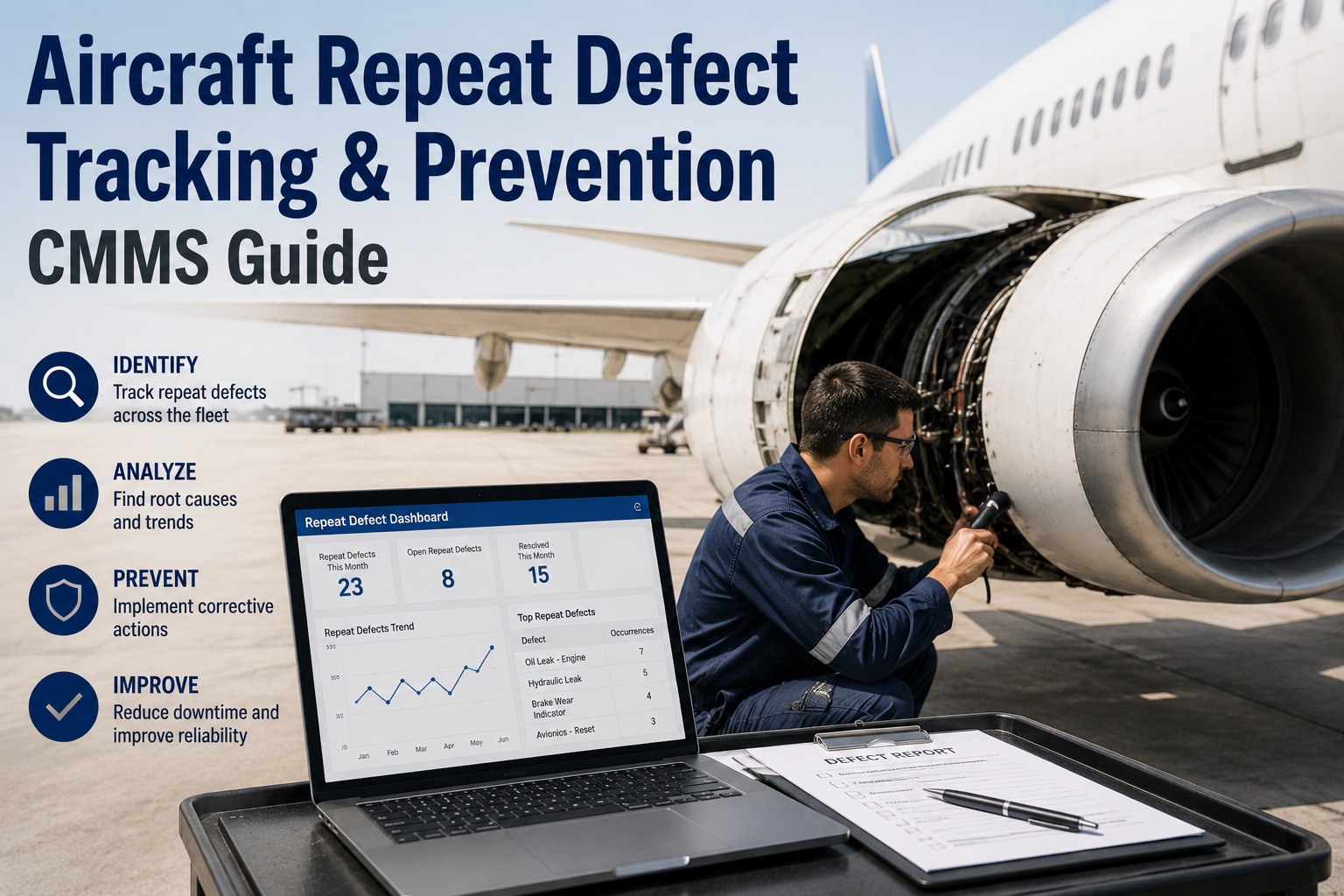
Repeat defects are the silent tax on every aviation maintenance operation — the same snag written up flight after flight, each entry burning another 2–6 engineer-hours while the underlying cause stays hidden in disconnected logbooks. Industry studies put the chronic-repeat-defect rate at 8–12 percent of all technical dispatch interruptions, and a single recurring snag on a narrow-body can quietly consume $30,000–$80,000 per year in parts, labour and AOG exposure. A CMMS built around complete defect histories, repeat-count logic and root-cause escalation breaks that cycle by turning scattered write-ups into a single, queryable pattern. This guide walks through defect classification, escalation rules and the RCA workflows that let airlines retire chronic snags for good — and you can Start Free Trial to put it into action on your own fleet today.
How many times can the same snag ground the same tail before your CMMS notices?
Most maintenance systems log defects. Very few recognise them. Repeat defect tracking turns the third write-up of an identical fault into an automatic escalation — not just another troubleshooting card buried in the queue.
A recurring snag is rarely a maintenance problem — it is a detection problem
When the same defect resurfaces across flight cycles, the cost compounds far beyond the obvious parts and labour line. Below is what a single unresolved repeat defect typically drains from a narrow-body operation over 12 months.
All-in cost of one chronic repeat defect on a narrow-body — parts, repeated labour, AOG exposure, slot re-sequencing and crew knock-on.
Average engineer-hours consumed re-troubleshooting a fault whose root cause was never isolated, logged or escalated in the defect history.
Share of technical delays and cancellations traceable to defects that had already been written up at least twice in the preceding 90 days.
A regional operator tracking 47 tails identified 38 repeat-defect chains in the first 90 days after activating CMMS-based pattern detection — 23 of them were cleared permanently within two maintenance cycles by forcing root-cause review at the third write-up.
— Worked scenario based on narrow-body fleet deployment
Every snag gets classified before it gets counted
Repeat tracking only works when every defect enters the system with a consistent, machine-readable identity. ATA chapter, ATA section, symptom code, affected LRU serial and corrective action must be captured identically every time — otherwise the CMMS cannot match the third write-up to the first.
| Classification field | What it captures | Why it matters for repeat detection |
|---|---|---|
| ATA chapter / section | System and subsystem where the defect was reported | Enables like-for-like grouping across tails and fleets |
| Symptom code | The reported discrepancy in standardised terms | Distinguishes a BITE fault from a crew-reported intermittent anomaly |
| LRU serial / part number | Physical unit removed, inspected or re-installed | Detects the same rotable cycling through repeat removals |
| Corrective action code | What maintenance actually did to clear the snag | Flags repeated re-seats, re-boots and BITE clears as non-resolutions |
| Repeat flag | Auto-set when count logic matches a prior defect | Triggers escalation, RCA workflow and engineering review |
The escalation ladder — from routine snag to engineering review
A defensible repeat-defect policy uses count-based thresholds, each tied to a concrete escalation action. The model below mirrors the logic baked into modern aviation CMMS platforms and aligns with the safety reporting expectations of IOSA and SMS frameworks.
Routine defect logged
First occurrence enters the defect history with full classification. Troubleshooting proceeds per the aircraft maintenance manual. No escalation.
First repeat flag
Within a 90-day rolling window, the CMMS auto-flags the second identical write-up. Shift supervisor is notified; previous corrective action is reviewed for adequacy.
Mandatory RCA trigger
Structured root-cause analysis opens automatically. Maintenance engineering is assigned; the defect cannot be closed without a documented root cause and corrective action plan.
Fleet-level review
Chronic defect escalates to the reliability programme. Fleet-wide query runs across all tails; MPD task intervals and AMM procedures come under formal review.
Closing the defect without closing the cause is the failure mode
The reason a snag recurs is almost never that maintenance did the wrong thing — it is that the defect record was signed off without a verified root cause. A CMMS enforces this by making the RCA workflow a mandatory gate before a repeat-flagged defect can be closed.
The repeat cycle
- Snag written up, BITE cleared, system re-seated, signed off
- No root cause recorded — defect history shows only the corrective action
- Same fault reappears 5–30 flight cycles later
- Engineer re-troubleshooting has no prior context beyond the work card
- Average resolution: 6+ recurrences before engineering is involved
The broken cycle
- Third write-up auto-triggers a structured RCA workflow
- Five-whys or fishbone template opens with full defect history pre-populated
- Root cause and corrective action plan are mandatory close-out fields
- Defect cannot be signed off without engineering sign-off
- Average resolution: 1.8 recurrences before permanent fix is applied
Stop signing off the same snag five times
Activate repeat-defect tracking across your fleet and turn chronic snags into structured engineering reviews — not more troubleshooting cards.
From single-tail snags to fleet-wide intelligence
Once every defect enters the CMMS with consistent classification, the system can query across tails, fleets and time windows to surface patterns no individual line engineer would ever see. Below are the four pattern types that deliver the highest reliability return.
Temporal clustering
Same defect code spiking across multiple tails within a 14-day window — the signature of a bad batch of parts, a contaminated fluid supply or a shared ground-power issue.
Cross-tail recurrence
Identical ATA chapter defects appearing across 3+ aircraft of the same type within 90 days — the signature of a procedure gap, a training shortfall or an MPD task interval that has drifted.
Rotable churn
The same LRU serial number cycling through removals and re-installations across tails — the signature of a unit that was never actually repaired, only re-seated and returned to stock.
Environmental correlation
Defect frequency rising with specific temperature, humidity or station data — the signature of climate-driven wear, ramp handling practices at a particular outstation or seasonal fluid degradation.
A 90-day rollout from activation to fleet-wide pattern detection
Most operators can stand up repeat-defect tracking without a rip-and-replace of their existing MRO systems. The timeline below reflects a typical deployment across a 40–80 tail fleet.
Classification standardisation
Unify ATA coding, symptom codes and corrective action codes across all stations. Backfill 12 months of defect history into the CMMS so pattern detection has a baseline to query against.
Escalation rule activation
Configure the count-based trigger thresholds, the 90-day rolling window and the RCA close-out gate. Pilot on one fleet type; validate that repeat flags fire correctly against live defect entries.
Fleet-wide rollout + reliability review
Extend to all fleets. Begin weekly reliability reviews of open repeat-defect chains. Most operators surface 20–40 active chains in the first review and clear 60–70% within two maintenance cycles.
Common questions about aircraft repeat defect tracking
The practical concerns that come up most often when maintenance teams evaluate CMMS-based repeat-defect prevention.
How does a CMMS define a repeat defect versus a new one?
A repeat defect is flagged when a new write-up matches an existing defect record on ATA chapter, ATA section, symptom code and affected system within a configurable rolling window — typically 90 days for line defects and 365 days for shop-level rotable issues. The match logic runs automatically on every defect entry, so the flag is set before the engineer closes the work card rather than discovered in a later reliability report.
What escalation threshold should we start with?
The most widely adopted starting point is a three-strike rule: routine at count one, supervisor review at count two, and mandatory root-cause analysis at count three. This aligns with IOSA reliability programme expectations and gives maintenance engineering a concrete trigger without flooding them with false positives. You can Book a Demo to see how the thresholds are configured for different fleet types and defect categories.
Can repeat defect tracking work with our existing MRO system?
Yes, in most cases. A modern CMMS can ingest defect data from existing MRO platforms via API or scheduled file imports, apply its own classification and count logic on top, and push escalation flags back into the original system. The key prerequisite is that your existing defect records contain structured ATA codes and LRU serials — if they are free-text only, a classification cleanup pass is required first.
How long does it take to see a measurable reduction in repeat defects?
Most operators see active repeat-defect chains surface within the first 30 days of activation, once 12 months of historical data has been backfilled. Measurable reduction in repeat-defect count typically appears within 60–90 days as RCA workflows close out the existing backlog. Operators that enforce the RCA close-out gate rigorously report 50–70% fewer chronic snags within two maintenance cycles.
What happens if a defect cannot be permanently resolved?
Some defects have no immediate permanent fix — a known intermittent sensor, a parts availability constraint or an airworthiness limitation. In these cases the CMMS tracks the defect as a managed repeat with a documented engineering disposition, an interim mitigation plan and a scheduled review date. This converts an uncontrolled recurring snag into a monitored, audited reliability item that satisfies SMS and regulatory reporting obligations.
Turn the third write-up into the last write-up
Deploy repeat-defect tracking, RCA enforcement and fleet-wide pattern detection across your operation — and stop paying for the same snag six times over.
Free 14-day trial · No credit card