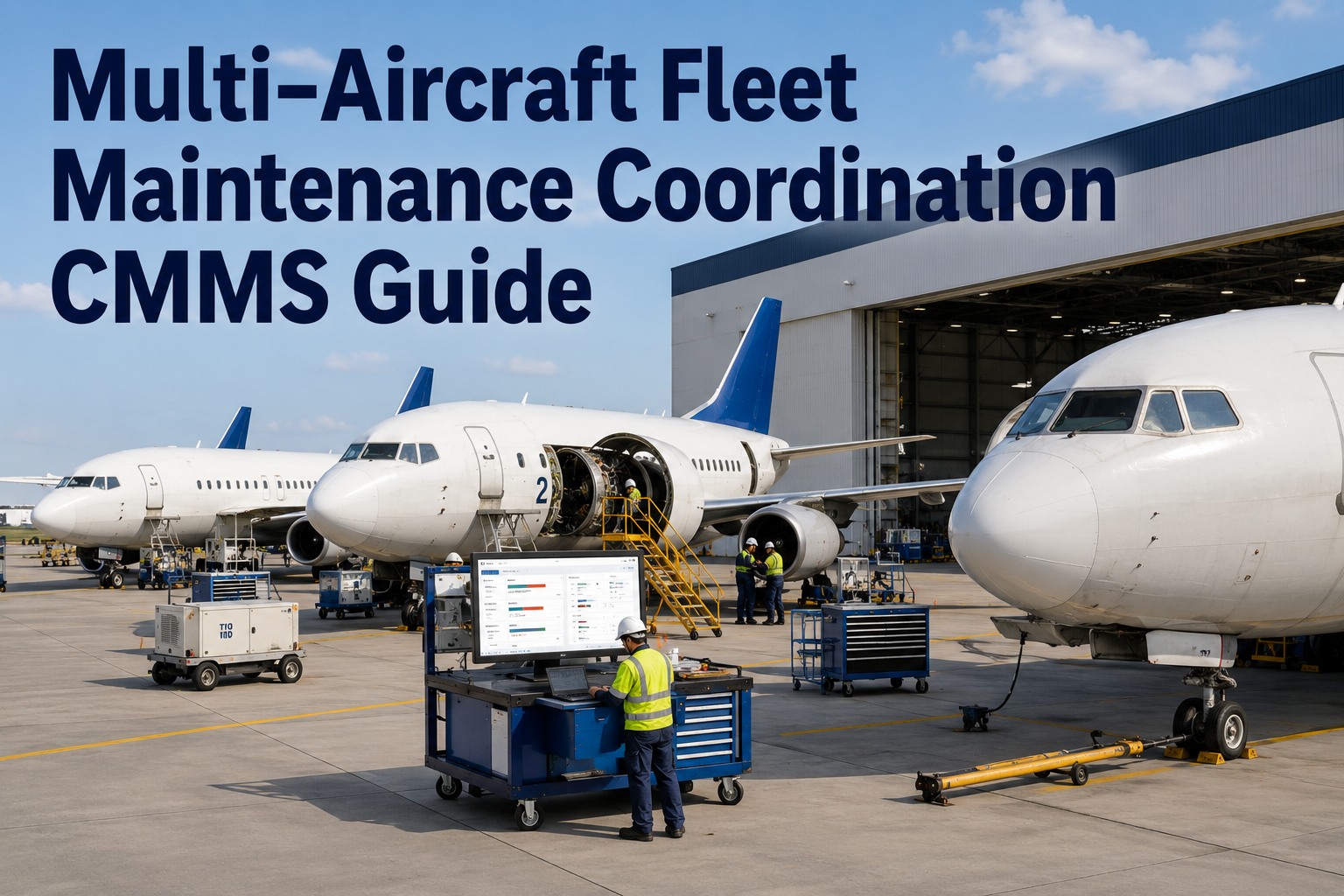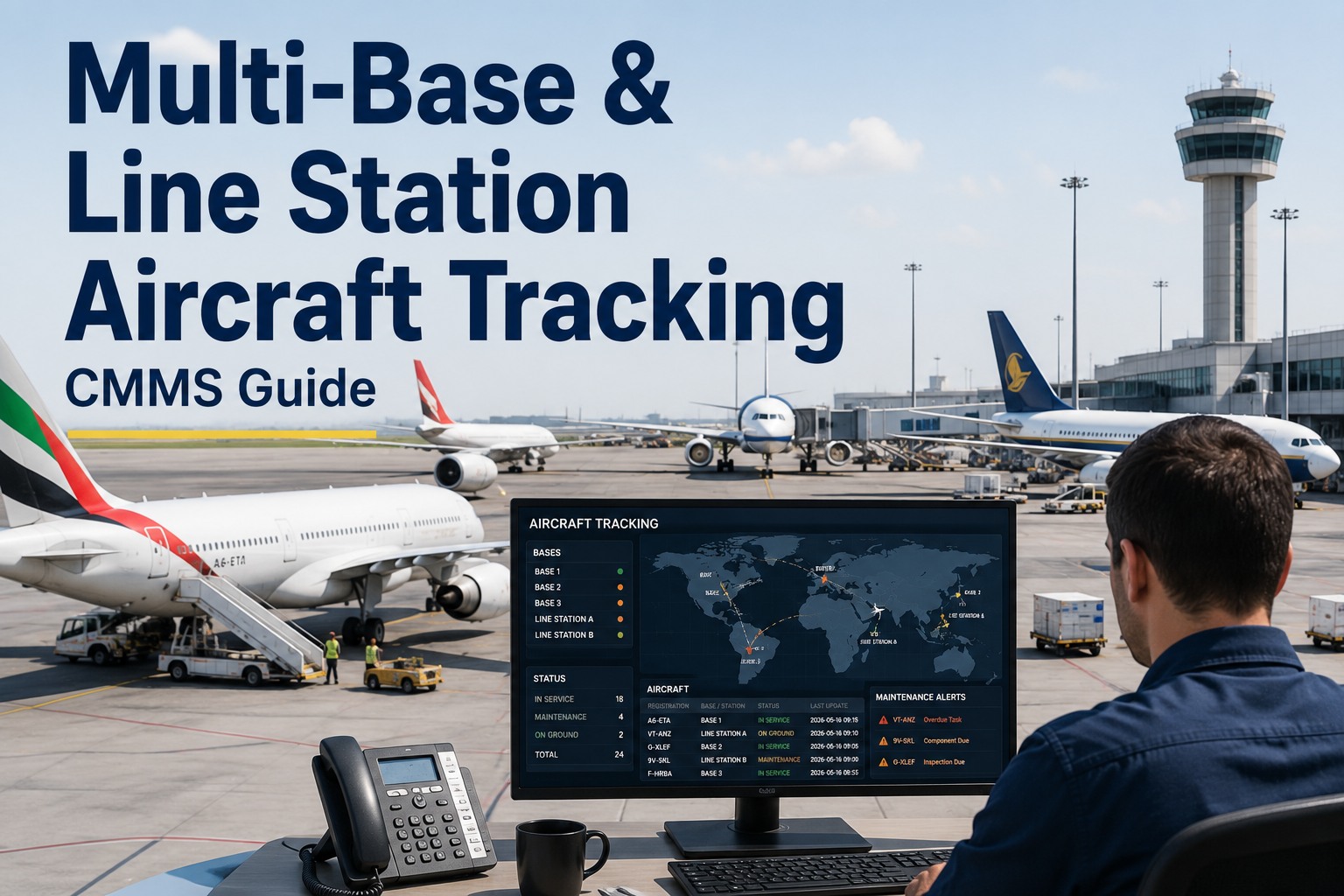
Multi-base and line station operations generate some of the most complex data challenges in aviation maintenance: the same airframe rotating through different technicians, different Part-145 procedures, and different national authority rules, all needing to reconcile against a single continuous record per tail. A modern CMMS built for multi-site aviation maintenance closes that gap by giving line stations, base maintenance, and contract MRO providers one shared work-order ledger, automatic certifying-staff checks, and transit-check compliance that survives network disruptions. Teams that deploy a purpose-built multi-base tracking platform typically cut duplicate data entry by 30–50% and recover 8–12 hours per week of AOG coordination time. You can Start Free Trial to see how a single tail-level ledger behaves across every station.
Same Tail. Six Stations. One Record.
When an A320 rotates through a main base, three line stations, and two contracted Part-145 facilities in a single month, fragmented spreadsheets and email logbooks cost operators an average of 14 hours per aircraft per cycle in reconciliation alone. A multi-base CMMS collapses that to minutes.
Why distributed maintenance breaks legacy tracking
A typical narrow-body operating a regional network logs maintenance events at 6–9 distinct locations in a 30-day cycle. Without a unified CMMS, each station keeps its own record — and the operator carries the integration risk.
Split records per station
Line stations maintain local Excel logs while base maintenance runs a separate MRO system. Auditors find an average of 4.2 un-reconciled discrepancies per tail during quarterly CAMO reviews.
Certification gaps
A certifying engineer at an outstation signs a CRS without the base system recording the Part-66 licence validity, type rating, or recent recency check — a finding that grounds aircraft under EASA Part-145.A.50.
Transit-check blind spots
Daily transit checks performed at remote stations never reach the CAMO in structured form. When a recurring defect appears three flights later, the linkage is lost and repeat defects spike 18–25%.
A 4-month path to one tail-level ledger
Operators that standardise on a multi-base CMMS follow a predictable rollout arc. Here is the typical timeline for a 40-aircraft fleet across two bases and eight line stations.
Tail registry + station mapping
Import every aircraft master record, build the station hierarchy (base / line / contracted), and map each location's authorisation scope. Targets 100% tail coverage before any work order goes live.
Line station work orders go live
Three line stations begin raising transit, daily, and weekly checks in the CMMS. Certifying-staff licence checks fire automatically on every CRS signature. Duplicate-entry rate drops within the first 10 days.
Base maintenance + Part-145 partners
Base hangar and two contracted Part-145 facilities join the same ledger. Work packages, defect deferments, and component removals now flow into one record per tail — visible to every station in near real time.
Compliance dashboards + KPI closure
Audit-ready exports, MEL/CDL aging, and repeat-defect analytics go live. CAMO reporting time falls from 6 hours per aircraft per month to under 45 minutes.
Six capabilities that hold a multi-base network together
Line station work order visibility
Every raised, in-progress, and closed work order is visible to base, CAMO, and contracted MRO in a single filterable view — no overnight batch sync, no emailed PDFs.
Technician certification checks
Part-66 licence, type rating, company authorisation, and recency are validated at the moment of CRS signature. Expired credentials block the signature and alert the base quality manager.
Transit check compliance
Daily and transit check templates enforce step-by-step sign-off with photo evidence. Missed steps trigger an escalation to the line maintenance supervisor before the next sector.
Part-145 facility sharing
Contracted MROs work inside a scoped tenant of the same ledger. The operator sees real-time status; the partner sees only the work package they are authorised to touch.
Offline-first outstation capture
Stations with unstable connectivity capture work orders, defects, and signatures locally. The system reconciles automatically when the link returns — no data loss, no duplicate records.
Single-tail audit trail
Every event — base check, line defect, component swap, MEL application — rolls up into one chronological, exportable trail per registration. Audit prep collapses from days to hours.
A 40-aircraft regional operator, before and after
Consider a regional operator flying 40 ATR 72-600s across two bases and eight domestic line stations, plus one contracted Part-145 heavy-check partner. Before deploying a multi-base CMMS, maintenance data lived in three systems and roughly 220 shared spreadsheets.
Standards a multi-base CMMS must satisfy
Certifying staff authorisation and CRS issuance controls, with type-rating and recency validated at signature.
Aircraft continuing airworthiness record retention, including the unbroken chain of entries per tail across stations.
Maintenance recording requirements for air carriers, including mechanical reliability reports and airworthiness release signatures.
IATA Operational Safety Audit maintenance programme standards covering contracted maintenance oversight and record accessibility.
See one tail-level ledger across every station
Bring your base, line, and Part-145 records into a single CMMS and recover up to 12 hours of AOG coordination time per week.
Multi-base aircraft tracking, answered
How does a multi-base CMMS keep one record per tail when different stations use different systems?
The tail registration is the single primary key. Every work order, defect, component removal, and signature — whether raised at a base, a line station, or a contracted Part-145 facility — writes to the same chronological ledger. Legacy systems feed in through scheduled integrations, but the CMMS itself remains the system of record, so there is never a competing version of the truth per aircraft.
What happens at a line station with unreliable internet?
The outstation module captures work orders, defect entries, photo evidence, and CRS signatures locally on the device. When connectivity returns, the system reconciles each entry against the central ledger with conflict detection. No record is lost and no duplicate is created — a typical 4-hour outage produces zero manual re-entry.
Can the CMMS automatically check technician certification before a CRS is signed?
Yes. Part-66 licence expiry, type rating validity, company authorisation scope, and recent recency are all validated at the moment of signature. If any check fails, the signature is blocked and the base quality manager receives an alert. You can Book a Demo to see the certification gate in action.
How are contracted Part-145 MRO partners given access without exposing the whole fleet?
Each partner operates inside a scoped tenant. They see only the work packages, tails, and components they are authorised to touch, while the operator sees real-time progress across every partner simultaneously. Permissions are role-based and auditable, satisfying IOSA AMP 1.6 contracted-maintenance oversight requirements.
How long does rollout take for a 40-aircraft multi-base operator?
A typical 40-aircraft operator with two bases and eight line stations reaches full coverage in about four months: Month 1 for tail registry and station mapping, Month 2 for line-station pilots, Month 3 for base and Part-145 partner onboarding, and Month 4 for compliance dashboards and KPI closure. Start your deployment with a Start Free Trial.
Unify every base, line station, and Part-145 partner today
One continuous record per tail. Real-time visibility across your entire maintenance network. Audit-ready in minutes, not days.
Free 14-day trial · No credit card