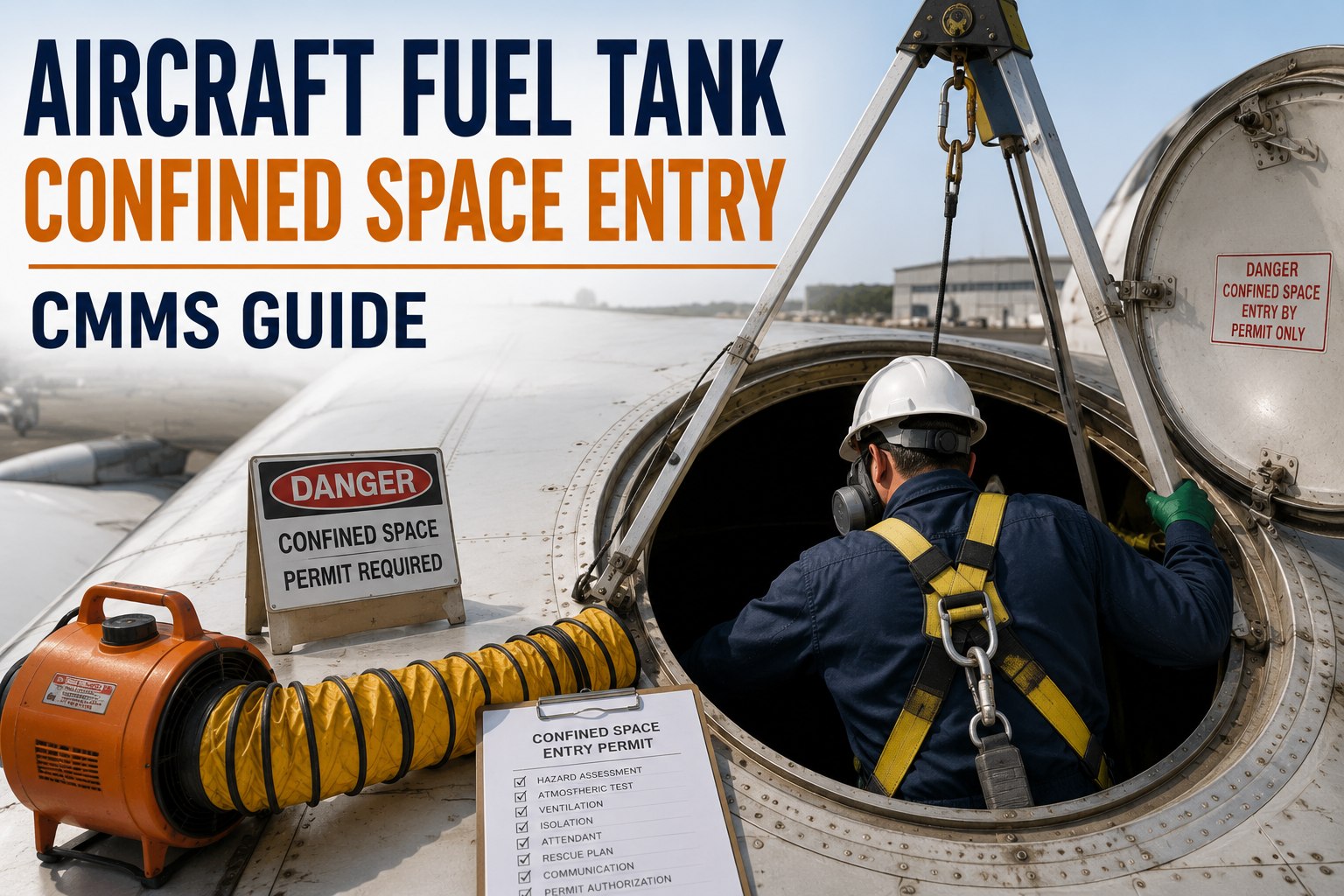
Aircraft fuel tank confined space entry remains the single most hazardous routine task in aviation MRO, with the U.S. Chemical Safety Board linking the majority of fuel-tank fatalities to skipped atmospheric monitoring and absent standby personnel rather than mechanical failures. OSHA 1910.146 and FAA AC 120-110 impose strict permit-to-work, atmospheric testing, and rescue-planning controls that, when embedded directly into a CMMS work order, become enforceable rather than aspirational. This guide breaks down how to wire those controls into every fuel tank entry — from multi-gas sampling to confined-space attendant tracking — so a maintenance manager can prove compliance the instant an auditor asks. To see the workflow live in your own hangar, Start Free Trial of the platform described below.
Is one missed atmospheric test all that stands between your crew and a fatal fuel tank entry?
Most fuel tank fatalities trace back to procedural shortcuts — a skipped gas check, an untrained attendant, a rescue plan that existed on paper but never drilled. Embedding OSHA 1910.146-aligned controls directly inside every CMMS work order closes that gap before an entrant ever crosses the threshold.
The five-stage entry timeline every CMMS work order must enforce
A compliant fuel tank entry is not a single event — it is a sequenced, time-stamped chain in which each stage gates the next. When the CMMS blocks progression until the prior step is signed off, a technician physically cannot enter the tank until testing, ventilation, and rescue assets are verified present.
Pre-Entry Permit Authorization
Entry supervisor completes the digital confined-space permit inside the work order: identifies the tank cell, lists known hazards (residual Jet-A, wing rigging, inerting system status), assigns entrants and attendants by name, and attaches the rescue plan. CMMS blocks the work order from "Released" status until the permit carries three signatures.
Continuous Atmospheric Testing
A calibrated 4-gas monitor samples oxygen (19.5–23.5%), LEL (below 10% for Jet-A vapor), carbon monoxide, and hydrogen sulfide at three depths. Results must be uploaded to the CMMS work order; any reading outside range auto-locks the entry and routes an alert to the shift manager. Testing repeats every 30 minutes while occupied.
Ventilation and Isolation Verification
Fuel supply and transfer lines are double-blocked, bled, and blinded. Explosion-proof ventilation runs a minimum of 10 air-volume exchanges before anyone enters. The CMMS checklist requires photo evidence of the blind installation and a ventilation flow-rate reading before the entrant log opens.
Standby Attendant Check-In
A dedicated, trained attendant — never assigned to concurrent tasks — logs into the CMMS attendant station. The system enforces a 1:1 attendant-to-entrant ratio and verifies the attendant holds a current confined-space rescue certification (renewed annually under OSHA 1910.146(k)). The entry log cannot open without it.
Live Entry with Rescue-on-Call
During entry, the CMMS logs entrant in/out times, communication checks every 15 minutes, and continuous gas readings. The rescue team — with a retrieval line, tripod, and self-contained breathing apparatus staged within 60 seconds of the access point — is geo-tagged in the system. If a communication check is missed, the work order escalates and the rescue protocol auto-launches.
The 12-item confined space checklist that must close before entry
A regional MRO with 14 fuel-tank entries per month averaged 3 near-misses annually — every one tied to an incomplete pre-entry checklist. Moving these 12 items into a hard-stop CMMS gate cut their near-miss count to zero within the first year.
| Permit Element | OSHA 1910.146 Requirement | CMMS Enforcement Point | Verification Cadence |
|---|---|---|---|
| Atmospheric test data | O2, LEL, CO, H2S at three depths | Upload reading to unlock entry log | Every 30 min while occupied |
| Isolation (LOTO) | Energy sources zero, lines blinded | Photo + signature gate | Pre-entry, re-check on shift change |
| Standby attendant | Trained, dedicated, no other duties | Cert. expiry check + 1:1 rule | Per entry, continuous |
| Rescue plan | Written, practiced annually | Attached PDF + drill date logged | Annual drill + per-entry review |
| Communication | Two-way voice maintained | 15-min check-in timer | Every 15 min |
| Permit closure | Cancel when entry complete | Auto-close on entrant sign-out | End of entry |
What a single procedural shortcut actually costs an MRO
Consider a mid-sized MRO facility averaging 14 fuel tank entries per month — roughly 168 entries per year across a mixed fleet of narrow-body and regional jets. The numbers below illustrate why a paper-based permit system is the most expensive "cheap" option available.
Annual exposure calculation
Stop auditing paper permits after the incident.
Embed OSHA 1910.146 entry controls directly into every fuel tank work order — atmospheric gates, attendant verification, and rescue-plan attachment become hard stops, not hopeful checkboxes.
What changes when confined-space controls live inside the work order
A Part 145 repair station with 220 technicians deployed a CMMS-embedded confined-space permit module across three hangars. Within nine months they recorded measurable shifts across every compliance and efficiency metric that matters to a safety audit.
Every entry logged a completed permit with sign-out, eliminating the 12–15% of paper permits that previously disappeared into a toolbox.
Hard-stop atmospheric and attendant gates caught 6 potentially unsafe entries before they began, versus 4 near-misses the prior year.
Auto-populated asset data, prior-entry history, and digital signatures replaced manual form-filling across 168 entries per month.
Every permit, gas reading, and attendant certification was retrievable in a single filtered export, replacing days of binder reconstruction.
"Before the CMMS module, our confined-space permits were a binder and a prayer. Now the work order literally will not release until the gas test is uploaded and the attendant's certification is current. That is the difference between hoping and proving."
Fuel tank confined space entry — the questions auditors ask first
Does OSHA 1910.146 apply to aircraft fuel tanks in an MRO setting?
Yes. Aircraft fuel tanks meet every OSHA criterion for a permit-required confined space: limited entry/exit, not designed for continuous occupancy, and a potential atmospheric hazard from residual Jet-A vapor. MRO facilities fall under 29 CFR 1910.146 regardless of FAA oversight — the two regulatory frameworks are complementary, not mutually exclusive, and inspectors will cite the OSHA standard during a facility audit.
How does a CMMS enforce atmospheric testing before an entrant enters the tank?
The work order is configured with a hard-stop gate: the entry log cannot be unlocked until a 4-gas reading (O2, LEL, CO, H2S) at three tank depths is uploaded and falls within acceptable range. If any reading is outside range, the work order auto-locks, an alert routes to the shift manager, and the entry permit status flips to "Hold." The gate is software-enforced, not a verbal handshake. You can see this workflow in a live environment — Start Free Trial to test the gate logic on a sample fuel tank work order.
What records must the CMMS retain for a confined-space entry audit?
At minimum: the signed permit, all atmospheric readings with timestamps, entrant and attendant logs with in/out times, isolation (LOTO) verification with photos, the rescue plan attachment, and the attendant's current certification expiry. OSHA expects these records available for review; a CMMS that timestamps every field and prevents retroactive edits gives you a defensible audit trail that paper simply cannot match.
Can a single attendant monitor multiple fuel tank entries simultaneously?
No. OSHA 1910.146 requires the attendant to monitor entrant status continuously and perform no duties that interfere with that responsibility. The CMMS enforces a 1:1 attendant-to-entry ratio — if an attendant is already logged against an active permit, the system will reject assignment to a second concurrent entry and flag the conflict for the entry supervisor.
How often should confined-space rescue drills be conducted and logged?
OSHA requires that rescue service personnel practice making permit-space rescues at least once every 12 months, using mock-ups that simulate the actual entry configuration. The CMMS should store the drill date, participants, scenario, and debrief notes against each confined-space asset, and auto-flag any asset whose rescue drill is past due — preventing an entry on a tank cell with an expired rescue practice record. To map this to your own facility's tank configurations, Book a Demo and we will walk through the drill-tracking setup.
Make your next fuel tank entry provably safe.
Embed OSHA 1910.146-aligned confined-space permits, atmospheric gates, attendant verification, and rescue-plan tracking directly inside every CMMS work order. Your auditors get a clean trail. Your technicians get home.
Free 14-day trial · No credit card