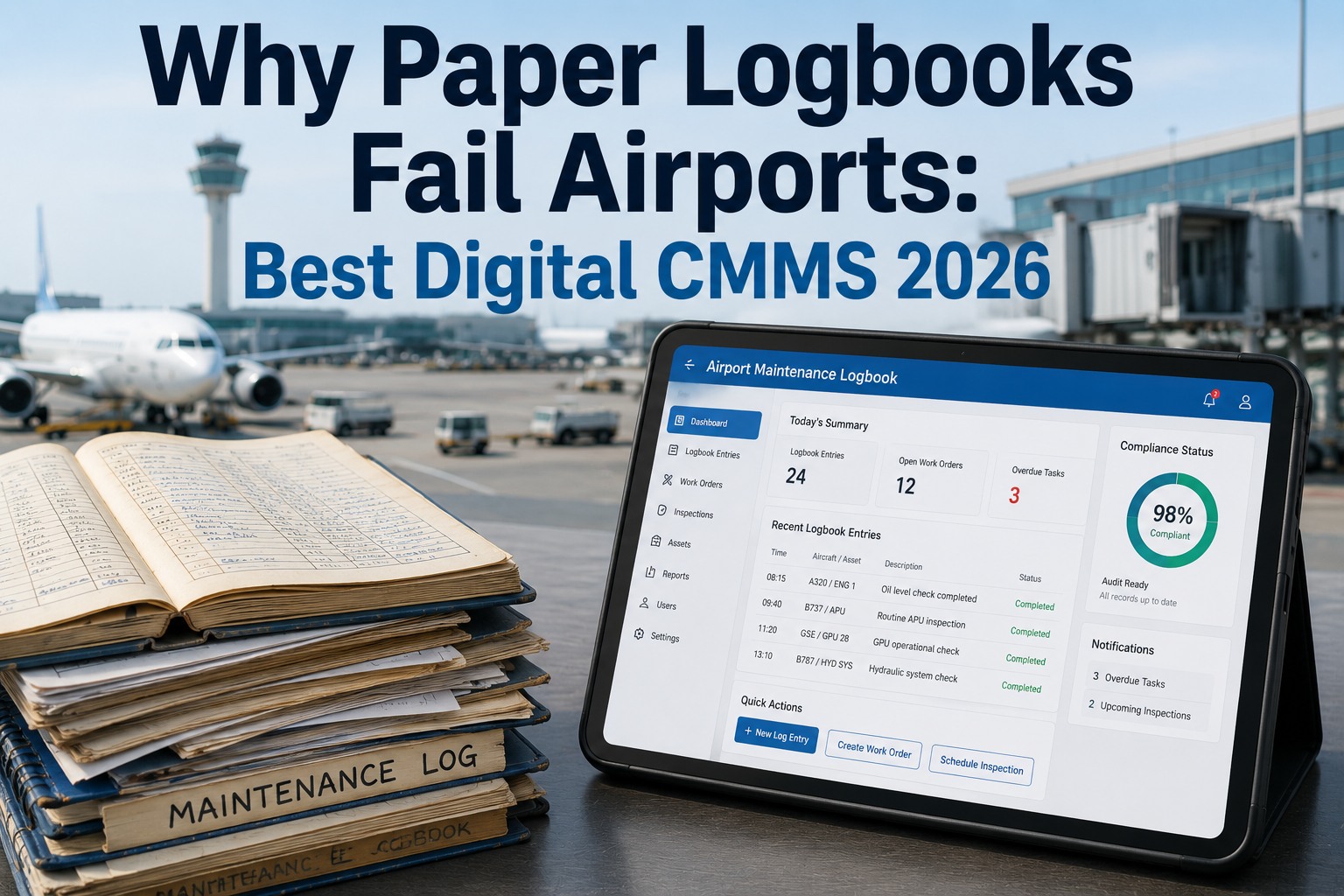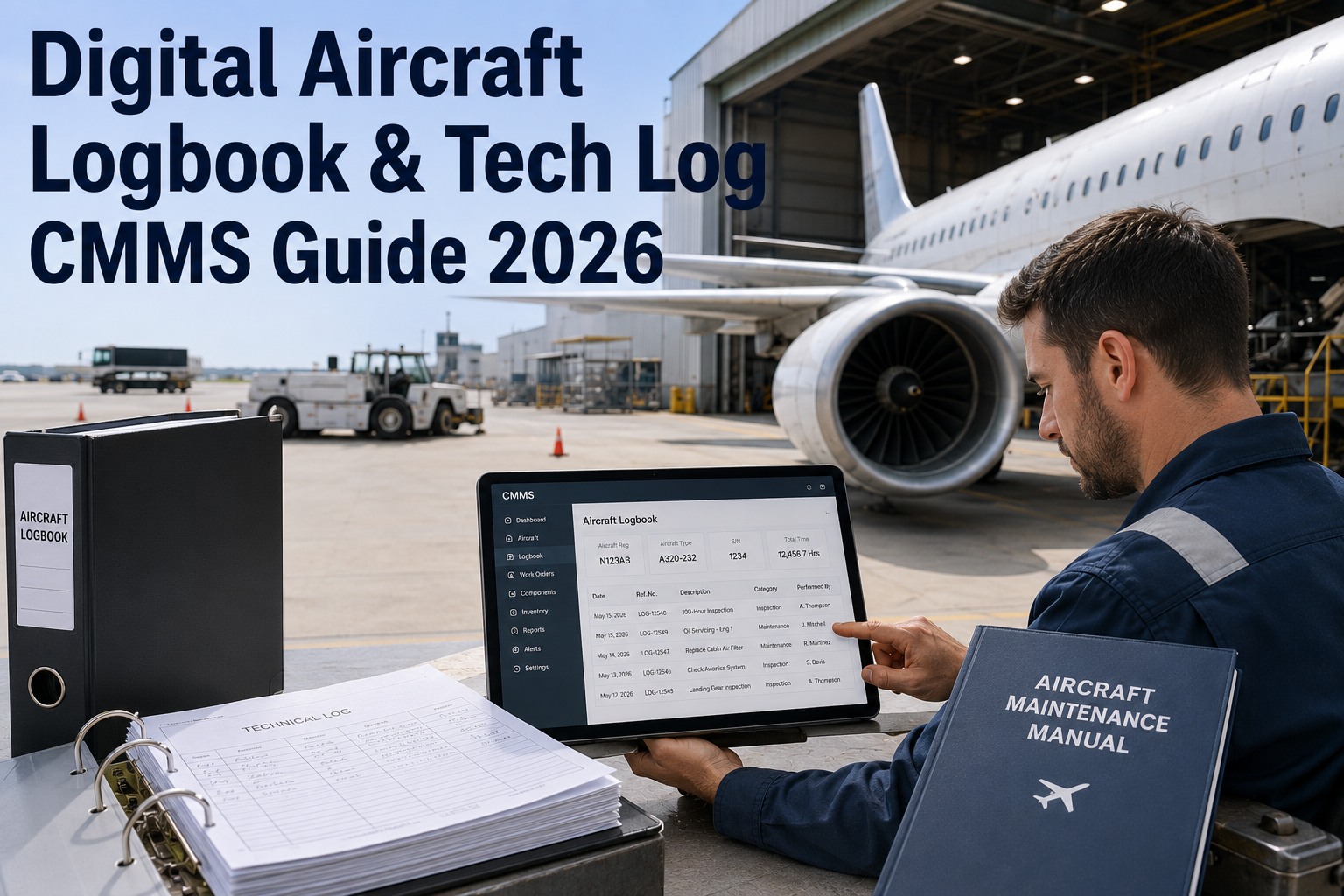
Paper aircraft tech logs quietly cost operators millions every year in delayed dispatch, lost records and audit findings — yet most fleets still rely on carbon pages that get mislaid between line stations and archive rooms. A digital aircraft logbook built inside a CMMS closes that gap by capturing flight, journey and maintenance events at the point of execution, with e-signatures, offline sync and automatic fleet-management integration. This 2026 guide walks through EASA and FAA acceptance, offline capture, migration from paper and how to preserve regulatory continuity throughout the cutover. When you are ready to pilot the platform, you can Start Free Trial and configure a sandbox against your own aircraft types.
Still flying paper tech logs that cost you dispatch reliability every single turn?
A digital aircraft logbook inside a CMMS replaces carbon-paged tech logs with e-signed, offline-capable, audit-ready records — accepted by EASA and FAA, and integrated with your MRO and fleet management stack.
The real cost of a paper tech log in 2026
A single delayed AOG dispatch caused by a missing tech-log page costs a narrow-body operator $10,000–$150,000 per hour in lost block revenue, repositioning and passenger care. Multiply that across a year and paper becomes one of the most expensive line items in maintenance operations.
A regional operator flying 48 Q400s was spending roughly $42,000 per year on printed tech-log books, courier shipping of completed pages to archive, and three FTEs reconciling entries into their legacy MRP. After moving to a digital tech log CMMS, reconciliation labor dropped by 71%, page-loss incidents fell to zero, and average tech-log sign-off time at outstations fell from 14 minutes to under 3 minutes per sector.
EASA and FAA acceptance for digital aircraft logbooks
Both regulators now accept electronic tech logs provided the system meets specific integrity, signature and retention criteria. The table below maps the core requirements you must satisfy before retiring paper.
| Requirement | EASA reference | FAA reference | What a CMMS must deliver |
|---|---|---|---|
| Electronic record integrity | Part-CAMO / Part-145 | 14 CFR Part 43 / 91.417 | Immutable, time-stamped, tamper-evident entries with full audit trail |
| Electronic signatures | eIDAS qualified / advanced | 21 CFR Part 11 equivalent | Per-user identity, dual-factor sign-off, signature manifest per entry |
| Offline capture and sync | AMC M.A.305 | AC 120-78 | Local encrypted store on device, conflict-resolution on reconnect |
| Record retention | 3 years after aircraft withdrawal | 1 year after work / 1 year after aircraft sold | Redundant cloud archive with exportable PDF/A bundles |
| Access by competent authority | Part-CAMO.A.220 | 14 CFR 91.417(b) | Read-only inspector portal with filtered search and export |
How to migrate from paper without losing regulatory continuity
A phased 6-month cutover is the proven path. Each phase is designed so that, at any moment, the authority can inspect either the paper trail or the digital trail without a gap in continuity.
System validation and SOP mapping
Validate the CMMS against EASA Part-145 and FAA AC 120-78. Map every existing tech-log field — fuel uplift, oil uplift, defects, rectifications, sector times — to the digital schema so no historical field is orphaned.
Pilot on two aircraft types
Run the digital tech log in parallel with paper on two aircraft for 30 days. Capture every discrepancy, measure sign-off time, and confirm the offline sync works at remote line stations with no connectivity.
e-Signature and authority notification
Configure per-user e-signatures, file the required notification with your CAA, and obtain written acceptance of the electronic record system. Most authorities respond within 30–45 days.
Crew and engineer training rollout
Train pilots, cabin crew and line engineers on the mobile capture app. Average training time is 90 minutes per user, with a competency sign-off recorded in the LMS.
Fleet-wide parallel run
Deploy across all aircraft with paper running in shadow mode. Reconcile both records daily for 30 days; any divergence becomes a configuration fix before full cutover.
Paper retirement and archive ingest
Retire paper tech logs, scan historical pages into the CMMS archive, and link each scanned bundle to the corresponding aircraft record for the full retention period.
What a compliant digital tech log CMMS must include
Not every CMMS is built for aviation. The features below are the minimum bar for a system that will actually replace paper — and integrate with your fleet management platform.
Offline capture with conflict-free sync
Encrypted local store on the ramp device captures every entry without connectivity. On reconnect, a CRDT-based sync resolves conflicts so two engineers logging against the same aircraft never overwrite each other.
Per-role e-signature workflows
Pilot, engineer and certifying staff each sign with their own credential. The CMMS enforces sign-off sequence — defect raised, then rectified, then certified — and refuses to close a sector until the chain is complete.
Fleet management system integration
Two-way sync with the fleet management system pushes sector times, APU hours and defect codes into the maintenance planner, so a snags raised at an outstation appears in the planning backlog within seconds.
Authority-ready audit portal
A read-only portal lets inspectors search by aircraft, date range or defect code and export a PDF/A bundle with every signature, timestamp and attachment in one click.
Defect-to-deferral automation
Raised defects automatically check the MEL against aircraft configuration and suggest the correct deferral item, with a one-tap creation of the deferred-defect record and required follow-on task.
Historical page ingest and linking
Scanned legacy pages are OCR-processed, indexed by aircraft and date, and linked to the corresponding digital record so the full life history remains in one place.
What a digital tech log pays back — and how fast
For a 60-aircraft operator, the combined savings from eliminated re-keying, faster dispatch and zero page-loss findings typically recover the implementation cost inside the first year.
| Cost / Saving Line | Paper (annual) | Digital CMMS (annual) | Delta |
|---|---|---|---|
| Re-keying labor (3 FTEs) | $240,000 | $48,000 | −$192,000 |
| Printed log books & courier | $54,000 | $3,000 | −$51,000 |
| Dispatch delay cost (paper-log caused) | $610,000 | $95,000 | −$515,000 |
| Audit finding remediation | $180,000 | $22,000 | −$158,000 |
| CMMS license & support | $0 | $168,000 | +$168,000 |
| Net annual position | $1,084,000 | $336,000 | −$748,000 |
Ready to retire paper tech logs across your fleet?
Spin up a configured trial against your aircraft types, or walk through the e-signature workflow with our aviation team in a 30-minute demo.
Digital aircraft logbook & tech log — your questions answered
Is a digital tech log legally accepted by EASA and FAA in 2026?
Yes. Both authorities accept electronic aircraft logbooks and tech logs provided the system meets integrity, e-signature and retention requirements. You must file a notification with your CAA and obtain written acceptance before retiring paper — the CMMS vendor should provide a validation pack that maps each requirement to system evidence.
What happens when a line station has no internet connection?
The mobile capture app stores every entry in an encrypted local database on the device. Engineers and pilots continue raising defects, recording fuel uplifts and signing off sectors offline. On reconnect, a conflict-free sync reconciles entries so nothing is lost or overwritten — you can Start Free Trial and test this at a simulated remote station.
How long does a paper-to-digital migration take for a 60-aircraft fleet?
A typical phased migration runs 4–6 months: validation and SOP mapping in month 1, a two-aircraft pilot in month 2, authority notification in month 3, training and parallel run through months 4–5, and paper retirement with archive ingest in month 6. Continuity is preserved because paper runs in shadow mode until the digital trail is fully reconciled.
Can the digital tech log integrate with our existing fleet management system?
A purpose-built aviation CMMS exposes a REST API and pre-built connectors for the major fleet management and MRO platforms. Sector times, APU hours, defect codes and deferred items sync both ways, so a snag raised at an outstation appears in the maintenance planner within seconds.
What does it cost, and how fast is payback?
For a 60-aircraft operator, license and support typically runs $140K–$180K per year. Against the $748K average annual saving from eliminated re-keying, faster dispatch and fewer audit findings, most operators achieve full payback inside the first 12 months. You can Book a Demo to get a modeled ROI for your specific fleet size.
Fly a paperless tech log by next quarter
Configure a digital aircraft logbook against your fleet, validate it with your authority, and retire carbon pages with full regulatory continuity.
Free 14-day trial · No credit card