Airfield lighting faults rarely fail all at once — they cluster quietly in specific runway zones long before an outage becomes visible during a low-light approach. Airport maintenance teams using Sign Up Free on OxMaint can track fixture-level fault history by zone and circuit, turning scattered repair calls into a clear map of where lighting risk is concentrated across the airfield.
Why Lighting Faults Cluster Silently Across Runway Zones
Most teams track total lighting outages but rarely segment fault history by runway zone or circuit. That gap is where aging fixtures, circuit loading, and inspection cadence quietly diverge from actual risk. Book a Demo to see how OxMaint maps fault frequency against zone criticality to expose where lighting risk is highest before it affects flight safety.
Five Dimensions of Airfield Lighting Fault Distribution
A complete fault distribution view connects zone clustering, circuit aging, and inspection cadence into one airfield-wide picture. Sign Up Free to start logging fixture-level data in OxMaint and give every runway zone the same visibility.
Zone-Based Fault Clustering
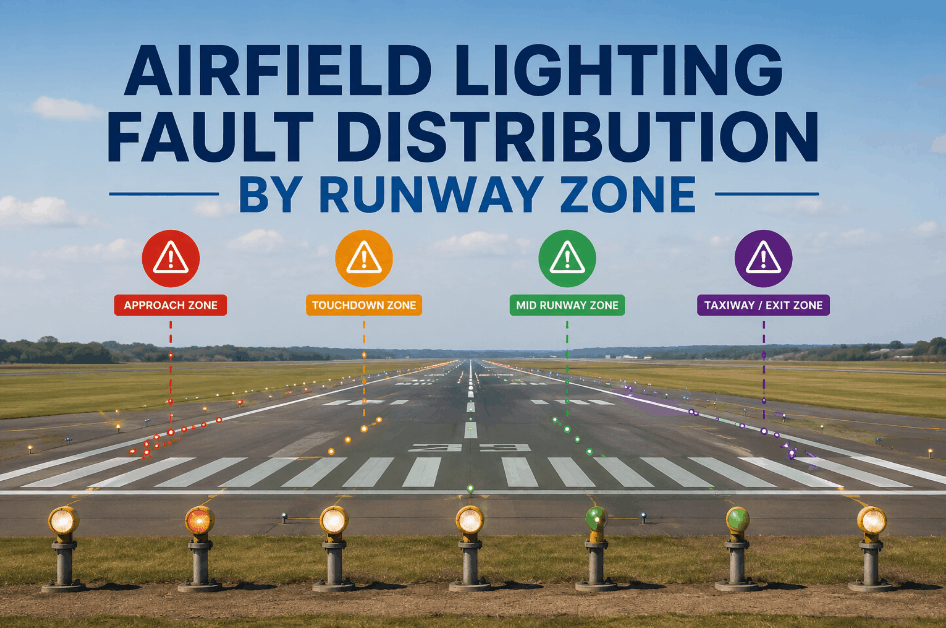
Mapping fault history by runway zone — touchdown, centerline, approach, taxiway — reveals whether failures are scattered randomly or concentrated in specific high-stress segments of the airfield.
Circuit and Fixture Aging Patterns
Fixtures on the same circuit often age together. Tracking fault frequency by circuit, not just by lamp, identifies which circuits are approaching end of service life as a group.
Inspection Cadence by Zone Criticality
Touchdown zone and approach lighting carry a different safety weight than apron lighting. Matching inspection frequency to zone criticality keeps the highest-risk fixtures checked most often.
Outage-to-Repair Response Time
The time between a fault being detected and the fixture being restored determines how long a runway operates under reduced lighting margin. Response time data by zone shows where crew coverage gaps exist.
Compliance Documentation Mapping
Regulatory inspection records need to tie back to specific fixtures and zones. Structured documentation makes audit trails retrievable by zone instead of buried in generic maintenance logs.
Lighting Fault Benchmarks by Runway Zone Type
Different lighting zones carry distinct fault patterns and safety weight. Comparing your fault history against these benchmarks helps prioritize where inspection resources matter most. Book a Demo to explore how OxMaint tracks fixture-level fault data alongside compliance documentation in one platform.
| Zone Type | Common Fault Driver | Typical Inspection Cadence | Safety Risk Level | OxMaint Maintenance Lever |
|---|---|---|---|---|
| Touchdown Zone Lighting | High-impact loading, frequent vibration | Daily to weekly checks | High | Zone-priority fault alerts |
| Centerline and Edge Lighting | Long circuit runs, cumulative aging | Weekly circuit checks | High | Circuit-level fault clustering reports |
| Approach Lighting Systems | Weather exposure, remote fixture access | Weekly to bi-weekly checks | High | Criticality-weighted inspection scheduling |
| Taxiway Guidance Lighting | Surface traffic wear, signage interaction | Bi-weekly checks | Medium–High | Fixture-level history tracking |
| Apron and Stand Lighting | Ground equipment proximity, lower priority | Monthly checks | Medium | Aging-based escalation rules |
How Lighting Faults Compound Across Airfield Operations
A single undetected lighting fault rarely stays isolated. It interacts with weather exposure, traffic loading, and inspection schedules to widen risk over time. Book a Demo to see how OxMaint connects fault history with asset records to surface compounding lighting risk before it affects operations.
Building an Airfield Lighting Fault Distribution Practice with OxMaint
Putting fault distribution mapping into daily practice starts with structured asset records. Sign Up Free to register your airfield lighting fixtures in OxMaint and begin tracking fault history by zone from day one.
Map Fixtures by Zone and Circuit
Register every lighting fixture in OxMaint with zone assignment, circuit grouping, and installation date as the foundation for fault distribution analysis.
Configure Fault and Outage Alerts
Set thresholds in OxMaint that flag repeat faults within the same zone or circuit so maintenance can investigate the underlying cause rather than the individual symptom.
Track Inspection Cadence by Criticality
Use OxMaint's inspection management tools to apply different checklist frequencies to touchdown, approach, and apron zones based on their safety weight.
Monitor Outage-to-Repair Response Time
Compare fault detection and repair timestamps across zones to identify where response time consistently lags the rest of the airfield.
Report Fault Trends for Compliance
Use OxMaint's reporting dashboards to generate zone-level fault trend reports that double as audit-ready documentation for regulatory review.
Frequently Asked Questions: Airfield Lighting Fault Distribution
What is airfield lighting fault distribution mapping?
It is the practice of tracking fixture and circuit-level fault history by runway zone to identify where lighting risk is concentrated, rather than treating every outage as an isolated event.
Why does zone-level tracking matter more than fixture-level tracking alone?
Fixtures on the same circuit or in the same zone often share aging patterns and environmental exposure. Zone-level data reveals systemic issues that single-fixture records can miss.
How does OxMaint support airfield lighting maintenance?
OxMaint tracks fixtures by zone and circuit, schedules inspections by criticality, monitors outage response time, and generates audit-ready fault trend reports.
What is the difference between fault frequency and outage-to-repair time?
Fault frequency measures how often a fixture or circuit fails. Outage-to-repair time measures how long it takes to restore it once a fault is detected. Both affect overall lighting reliability.
How often should airfield lighting be inspected by zone?
High-criticality zones such as touchdown and approach lighting typically warrant more frequent checks than apron or taxiway lighting. OxMaint helps apply different cadences across zones automatically.