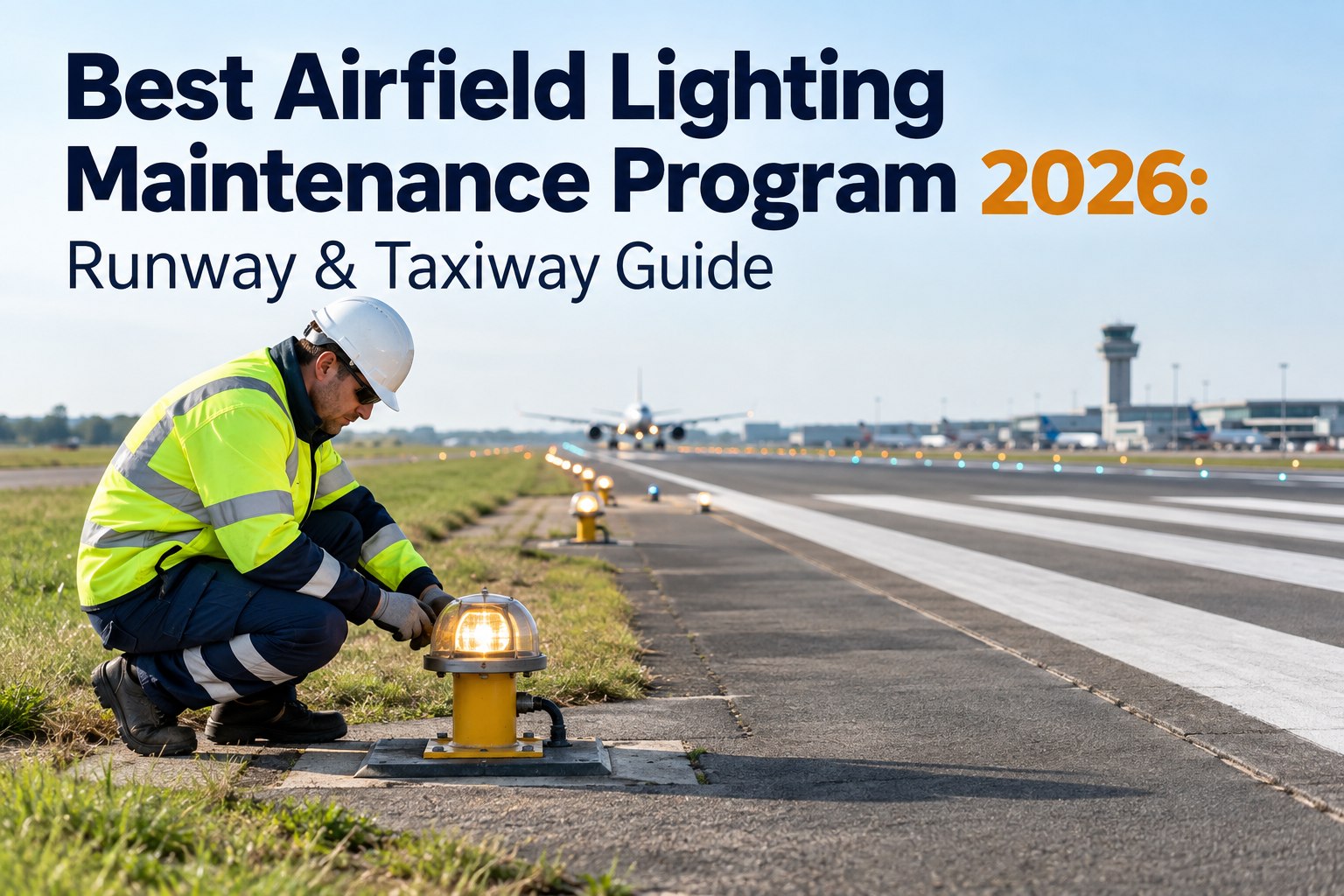
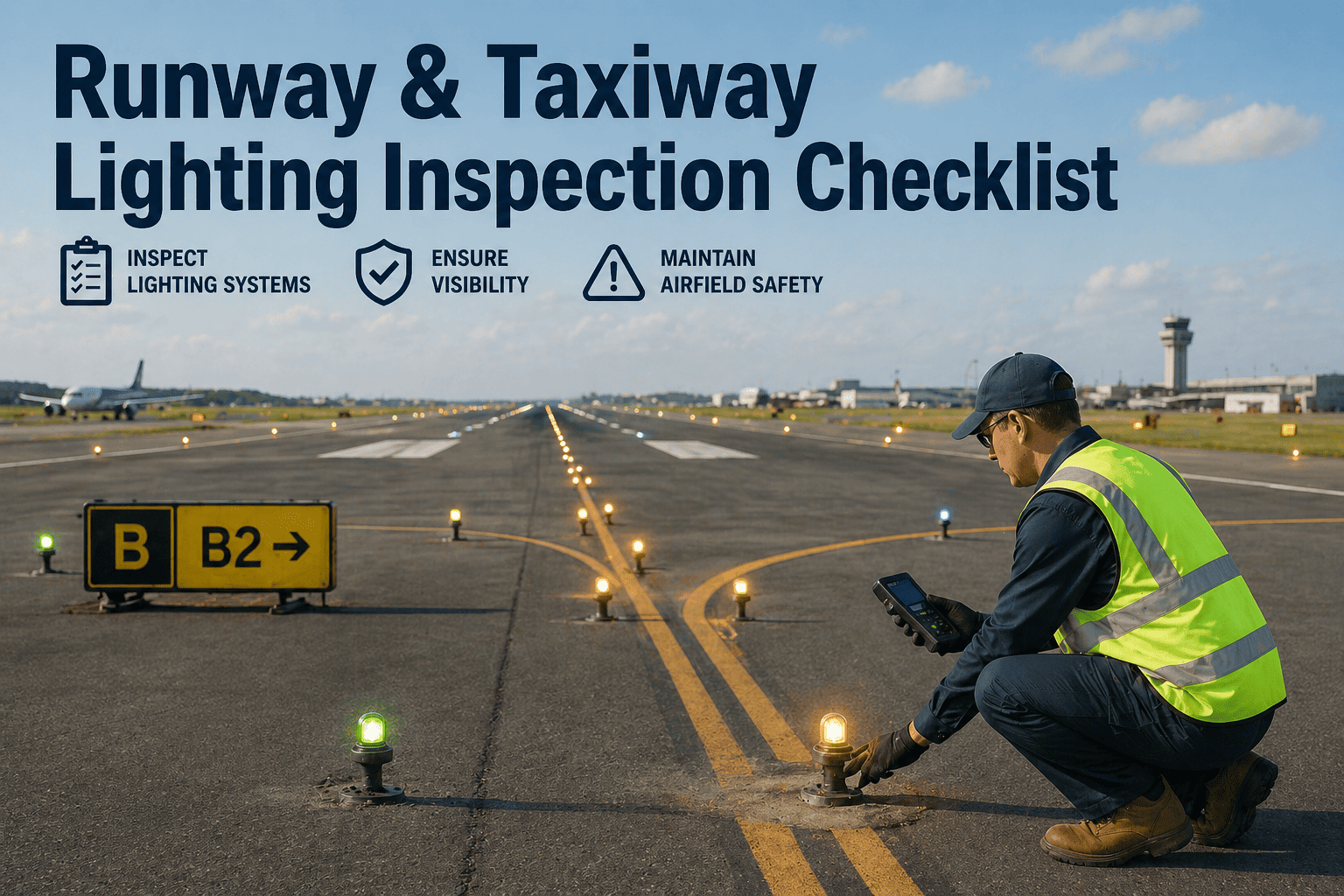
Airfield lighting isn't wired like the rest of the airport. A terminal's parallel circuits let one fixture fail without touching its neighbors — a runway's series circuit puts every edge light on a loop through a single constant current regulator, which means a fault anywhere on that loop can take out fifty or more fixtures at once if the isolation transformers aren't doing their job. That's the piece of this maintenance program most general electrical teams get wrong: the failure mode isn't the lamp, it's the circuit. This guide covers how series circuits, CCRs and isolation transformers actually work, what inspection cadence FAA AC 150/5340-26C calls for, and where LED transition changes the maintenance picture.
Airfield Lighting · Runway & Taxiway · Series Circuits & PAPI · 2026
One Bad Isolation Transformer Shouldn't Take Out Fifty Fixtures
A fixture flagged during a nightly inspection, a resistance reading drifting off baseline, a CCR brightness step not holding — each one is a warning sign before it's an outage. OXMAINT AI tracks every runway and taxiway fixture, circuit and regulator as its own asset, and turns an inspection finding or resistance-test trend into a work order — so a circuit fault gets found and fixed before it grounds a photometric check or forces a NOTAM.
2× annually
minimum photometric testing frequency for precision approach runways per AC 150/5340-26C
3 or 5 steps
standard brightness steps a constant current regulator (CCR) must hold precisely
500–1,000 MΩ
typical insulation resistance baseline for new series circuit cable
10–20%/yr
commonly considered a normal insulation resistance decline rate with circuit age
How a Series Circuit Actually Works
Runway and taxiway lighting runs on constant current, not constant voltage — every fixture is wired in sequence through its own isolation transformer, so a single lamp failure doesn't break the loop for the rest of the circuit. Understanding this is what separates airfield lighting maintenance from ordinary building electrical work. Start free and map your circuits down to the transformer level.
⚡
CCR
Constant current regulator sends a fixed current through the entire series loop.
→
🔌
Isolation Transformer
One per fixture — steps current down to the lamp, and keeps the loop closed if that lamp fails.
→
💡
Fixture
Edge, centerline, PAPI or approach light — draws its rated current from the transformer.
→
🔁
Back to CCR
Loop closes — one damaged transformer or cable fault can drag down the whole circuit.
Reading an Insulation Resistance Trend
A single resistance reading tells you little — it's the trend against that circuit's own baseline that flags a developing cable or transformer fault before it causes an outage. Book a demo to see resistance readings trended per circuit automatically.
Healthy
Near baseline, gradual decline consistent with normal cable aging.
Watch
Decline rate accelerating beyond the typical yearly trend — worth closer inspection.
Investigate
Sharp drop over a short period — commonly considered a sign of developing insulation breakdown.
Fault Likely
Steep, rapid decline — circuit fault or moisture ingress likely, needs immediate action.
Fixture Types & What Each One Needs
Not every fixture on the airfield has the same inspection or alignment requirement. Sign up free and set up fixture-specific inspection templates.
PAPI: The Fixture Type With Its Own Rulebook
PAPI systems get their own FAA specification (AC 150/5345-28) because the margin for error is tighter — a misaligned light unit gives pilots wrong glidepath guidance, not just reduced visibility. Systems are classified by type (L-880, four light units; L-881, two units), style (voltage-powered or current/series-powered), and operating class — and every one of those classifications affects how it's tested and maintained.
Every Fixture, Circuit and Regulator — Tracked as Its Own Asset
OXMAINT AI keeps inspection results, resistance test trends, and CCR performance logged against the specific circuit and fixture they belong to — so a drifting reading becomes a scheduled work order, not something discovered during the next FAA certification inspection.
Inspection Cadence at a Glance
AC 150/5340-26C lays out preventive maintenance intervals by task, not a single blanket schedule. This is the general shape most programs follow. Book a demo to see this built into your own inspection calendar.
Daily / Nightly
Visual operational check of fixtures on all brightness steps; vault control operation check.
Monthly
Relay operation, fuse holders and breakers, meter readings recorded at the vault.
Semi-Annual
Photometric testing on precision approach runways; PAPI aim and tilt verification.
Annual
Full insulation resistance testing of series circuit cable at the vault, recorded per circuit.
What LED Transition Changes — and What It Doesn't
LED fixtures reduce lamp-replacement frequency dramatically compared to incandescent, but they don't remove the series-circuit maintenance burden — the CCR still has to hold precise current across the loop, isolation transformers still age, and cable insulation resistance still needs the same testing cadence. The maintenance program shifts toward circuit and driver electronics rather than routine relamping, but it doesn't shrink to nothing.
Vault & Circuit Audit Checklist
✓
Insulation resistance tested and trended per circuit, not just recorded as a single pass/fail.
✓
CCR output verified at each brightness step, not just the step currently in use.
✓
Isolation transformers inspected for moisture ingress and connector condition, especially direct-buried units.
✓
PAPI tilt angle verified against certified calibration, not just visually checked.
✓
Photometric testing scheduled to meet precision-approach-runway frequency requirements.
✓
All records retained at the vault — inspection, resistance test, and CCR results available for FAA review.
Frequently Asked Questions
Why does airfield lighting use series circuits instead of parallel circuits?
A series circuit through a constant current regulator lets one damaged or removed lamp be bypassed by its isolation transformer without breaking the circuit for every other fixture — critical when a single circuit can serve 50 or more fixtures along a runway edge.
How often does FAA require photometric testing on runway lighting?
AC 150/5340-26C establishes photometric testing as a required part of the preventive maintenance framework, with precision approach runways requiring testing at least twice annually — other runway types may follow different intervals depending on their approach classification.
What does a declining insulation resistance reading actually indicate?
New series circuit cable and transformers typically test at 500 to 1,000 megaohms or higher, with a gradual 10–20% annual decline generally considered normal aging. A much steeper decline — commonly cited around 50% in a year or roughly 4% in a month — is often treated as a sign of developing insulation breakdown worth investigating.
Does switching to LED fixtures reduce the maintenance workload?
It reduces relamping frequency significantly, since LED fixtures last far longer than incandescent lamps. It doesn't eliminate circuit-level maintenance, though — CCR calibration, isolation transformer condition, and cable insulation resistance testing are all still required regardless of fixture technology.
What's the difference between PAPI Style A and Style B systems?
Style A systems are voltage-powered with multiple circuits; Style B systems are current-powered, running on a series lighting circuit like runway edge lights. The style affects how the system is wired, tested and maintained, and is specified per FAA AC 150/5345-28.
Track Every Circuit, Fixture and Regulator — Not Just the Lamps.
Keep inspection results, resistance trends and CCR performance on one record per circuit — so a developing fault gets fixed before it takes out fifty fixtures or triggers a NOTAM.