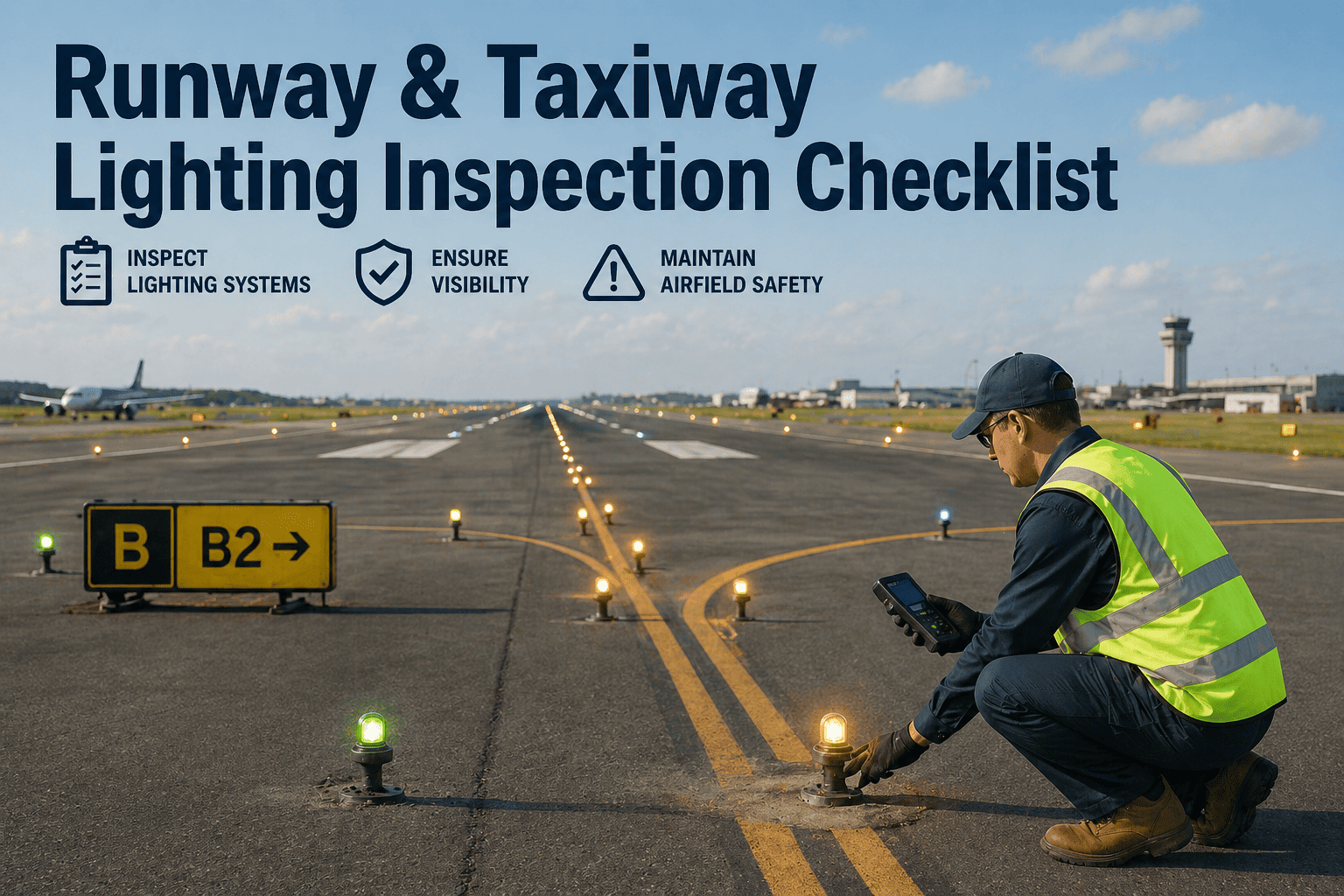
Runway lighting is the most regulated and most operationally consequential lighting system in any airport — a single failed approach light or misaligned PAPI can close a runway, trigger diversions, and translate into airline penalty exposure measured in tens of thousands of dollars per minute. FAA Part 139 airports, ICAO Annex 14 facilities, EASA-certified European airports, GCAA-regulated UAE airports, and CASA-regulated Australian airports all enforce essentially the same operational truth: runway lighting maintenance is not an annual programme — it is a daily inspection cycle with documented findings, photometric verification, and tolerance-based pass-fail criteria that paper logs cannot reliably evidence under audit. This checklist gives airport operations directors, airfield maintenance managers, and Part 139 inspectors the structured runway lighting maintenance framework that converts FAA AC 150/5340-26C, AC 150/5345-46F, and ICAO Annex 14 requirements into scheduled CMMS work orders — not into a binder of daily inspection forms that nobody can find at audit time. start a free trial to deploy this runway lighting checklist in Oxmaint from day one, or book a demo to see airfield lighting compliance management in action.
A Runway Lighting Checklist That Survives Every FAA Audit
Convert FAA Part 139, ICAO Annex 14, and EASA airfield lighting requirements into scheduled, signed, timestamped digital work orders — eliminating the documentation gaps that drive runway closures and audit findings.
No heavy implementation required — live in days, not months.
The Runway Lighting Maintenance Checklist: 8 Core Inspection Areas
A complete runway lighting maintenance checklist covers eight interdependent inspection areas — each with explicit frequency, pass-fail criteria, and documentation expectations under FAA AC 150/5340-26C, AC 150/5345-46F, and ICAO Annex 14 Volume 1. Each area must be systematically managed with timestamped digital evidence, not anecdotal assurances that the inspection took place. start a free trial to configure these inspection areas as scheduled work orders.
A single failed approach light can close a runway — daily, documented inspection is the only thing standing between FAA inspector and a Notice of Proposed Civil Penalty.
The Pain Points That Drive Airfield Lighting Audit Findings
Daily Inspections Recorded on Paper
Part 139 daily inspection forms completed on clipboards then filed in binders — illegible signatures, missing dates, and gaps that surface only when an FAA inspector requests last quarter's records.
Failed Lamp Counts Never Aggregated
Individual failed lamps recorded but never tallied against the tolerance table in AC 150/5340-26C Appendix A — the serviceability ratio that determines whether CAT II/III approaches can continue is unknown until the auditor calculates it.
Circuit Resistance Trends Invisible
Megger readings recorded but never plotted over time — early-warning insulation degradation patterns missed, then surfacing as full circuit failures that close a runway at the worst possible moment.
Photometric Records Lost Between Tests
Semi-annual photometric reports filed and forgotten — no continuity between tests means no degradation trend, no targeted maintenance, and no defensible basis for the airfield lighting modernisation budget request.
Most Part 139 airports moving from paper to digital airfield lighting records cut audit findings by 75 percent or more within the first inspection cycle — start a free trial to experience this shift, or book a demo to see your specific runway lighting structure.
How Oxmaint Operationalises Runway Lighting Compliance
Mobile Part 139 Inspection Work Orders
Mobile daily airfield inspection checklists generated at dawn and dusk with mandatory fields per runway, per taxiway, per lighting system — every check timestamped, GPS-tagged, and electronically signed by the certified inspector.
Tolerance Table Auto-Calculation
Failed lamp counts feed directly into AC 150/5340-26C Appendix A tolerance calculations — system flags when CAT II edge light serviceability drops below 90% or precision runway tolerances are breached, before a NOTAM becomes necessary.
Megger Test Trending
Insulation resistance readings logged against each series circuit and plotted over time — moisture ingress and cable degradation patterns surface weeks before failure, converting reactive circuit outages into planned night-window work.
Photometric Test Record Storage
Photometric reports attached to each fixture record with output trended over time — fixtures approaching the 70% threshold under AC 150/5345-46 surface automatically for cleaning or replacement before they fall out of compliance.
CCR & Vault Asset Management
Every CCR, constant-current vault, standby generator, and ALCMS component registered as an asset with its own PM schedule, calibration cycle, and failure history — vault inspections become structured work orders, not unscheduled visits.
FAA Part 139 Inspection Evidence Export
Generate complete airfield lighting evidence packages by inspection date, runway, or system in seconds. FAA Part 139 inspectors and ICAO auditors receive organised, timestamped, digitally signed records — the kind that produce favourable inspection outcomes.
Identify hidden cost leaks instantly — most airports lose 20–40% of airfield lighting budget to reactive circuit outages preventable with structured inspection.
Paper-Based Inspection vs Oxmaint CMMS: The Compliance Difference
| Inspection Dimension | Paper-Based Airfield Lighting | Oxmaint CMMS Airfield Lighting |
|---|---|---|
| Daily Part 139 inspection | Clipboard form, transcribed end-of-shift if at all | Mobile checklist, GPS-tagged, signed at the runway |
| Failed lamp tracking | Counted but never aggregated against tolerance tables | Auto-calculated serviceability ratio with alert thresholds |
| Megger test records | Filed in binders, no trend visibility | Trended per circuit, predictive alerts on insulation drift |
| Photometric reports | Loose files, lost between test cycles | Attached to fixture record, output trended over time |
| Corrective action records | Verbal handover at shift change, often undocumented | Mandatory fields with photo evidence before closure |
| FAA Part 139 audit prep | Days of binder searching and record compilation | Instant export by date range, system, or runway |
| Notice of Proposed Civil Penalty risk | HIGH — documentation gaps visible to inspectors | LOW — continuous, retrievable evidence base |
| Runway closure response | Reactive — full failure before action | Predictive — degradation caught and scheduled into night work |
Runway Lighting Compliance ROI
Frequently Asked Questions
How often must runway and taxiway lighting be inspected under FAA Part 139?
FAA Part 139 requires daily self-inspection of the entire airport operations area at certificated airports, with airfield lighting inspections typically performed at dawn and dusk to verify illumination, alignment, and serviceability under operational lighting conditions. Mobile photometric testing is required at least twice yearly for precision approach runways under FAA guidance, with more frequent testing during the initial baseline establishment period or when fixture performance is suspect. Runway centerline lights at CAT II and CAT III runways may require weekly inspection due to rubber deposit accumulation. FAA and ICAO both accept digital inspection records provided they are permanent, timestamped, and secured against unauthorised edits — and digital logs typically produce stronger compliance evidence than paper because they enforce checklist completion before submission.
What is the minimum photometric output threshold for runway lights to remain in service?
Under FAA AC 150/5345-46, in-pavement runway lighting fixtures with output measured below 70% of the required minimum are considered ineffective in low-visibility operations and must be cleaned, serviced, or replaced. The detailed serviceability requirements vary by light type and runway category and are specified in AC 150/5340-26C Appendix A tolerance tables — for example, a CAT II runway requires that at least 90% of its edge lights meet photometric standards to continue CAT II ILS approaches. Tracking failed lamp counts and photometric output trends over time is essential for predicting when a runway will fall out of compliance — and CMMS systems calculate this automatically rather than leaving it to the auditor to discover.
What does Megger testing reveal about runway lighting circuits?
Megger (insulation resistance) testing on series lighting circuits provides one of the most valuable predictive maintenance signals available for runway lighting. A circuit with a strong, stable insulation reading is operating healthy. A circuit showing a steady decline in Mega-ohm reading over successive weeks is signalling moisture ingress, cable jacket degradation, or transformer insulation breakdown — typically weeks before a complete circuit failure occurs. By trending Megger readings per circuit over time, airfield maintenance teams convert what would have been a sudden runway-closing failure into a planned overnight work order during a low-traffic maintenance window. Oxmaint captures Megger readings against each circuit asset and surfaces trend alerts when readings drop beyond defined thresholds.
How does Oxmaint support multi-airport airfield lighting compliance programmes?
Oxmaint's multi-site portfolio architecture allows airport groups and authorities operating across multiple Part 139 facilities — and across regulatory frameworks including FAA, ICAO Annex 14, EASA, GCAA, and CASA — to manage airfield lighting compliance independently per site with site-specific inspection checklists, PM schedules, photometric programmes, and audit documentation. Corporate operations and compliance teams see portfolio-level dashboards showing daily inspection completion, open findings, tolerance breaches, and overdue tests across all airfields simultaneously. Pre-audit evidence packages are generated per airport and per regulatory standard in minutes, satisfying FAA Part 139 inspectors, ICAO auditors, and national civil aviation authorities from a single platform.
Stop Losing Operating Hours to Predictable Lighting Failures
Airport operations directors across the USA, UK, Canada, UAE, Germany, and Australia use Oxmaint to maintain daily Part 139 inspection records, photometric test data, circuit health trending, and corrective action documentation — turning runway lighting compliance into the daily operational reality it is supposed to be.
- Mobile daily Part 139 inspection work orders with GPS evidence
- Automatic tolerance-table serviceability calculations
- Predictive circuit health trending and photometric drift alerts