Airfield lighting failures account for 34% of runway incursion incidents during low-visibility operations — yet most airport maintenance teams still track lighting inspections using paper checklists and spreadsheets that cannot predict bulb failures before they create safety exposure. When a PAPI system goes dark 20 minutes before a night landing sequence, the cost is not the replacement bulb — it is the diverted aircraft, the ATC coordination overhead, and the regulatory scrutiny that follows. OxMaint digitizes airfield lighting inspection workflows with predictive maintenance scheduling and instant failure escalation — start a free trial and see compliance-ready inspection records in under 48 hours.
Airfield Lighting · ICAO Compliance · Preventive Maintenance
Runway & Taxiway Lighting Inspection Checklist: Complete Airfield Safety Guide
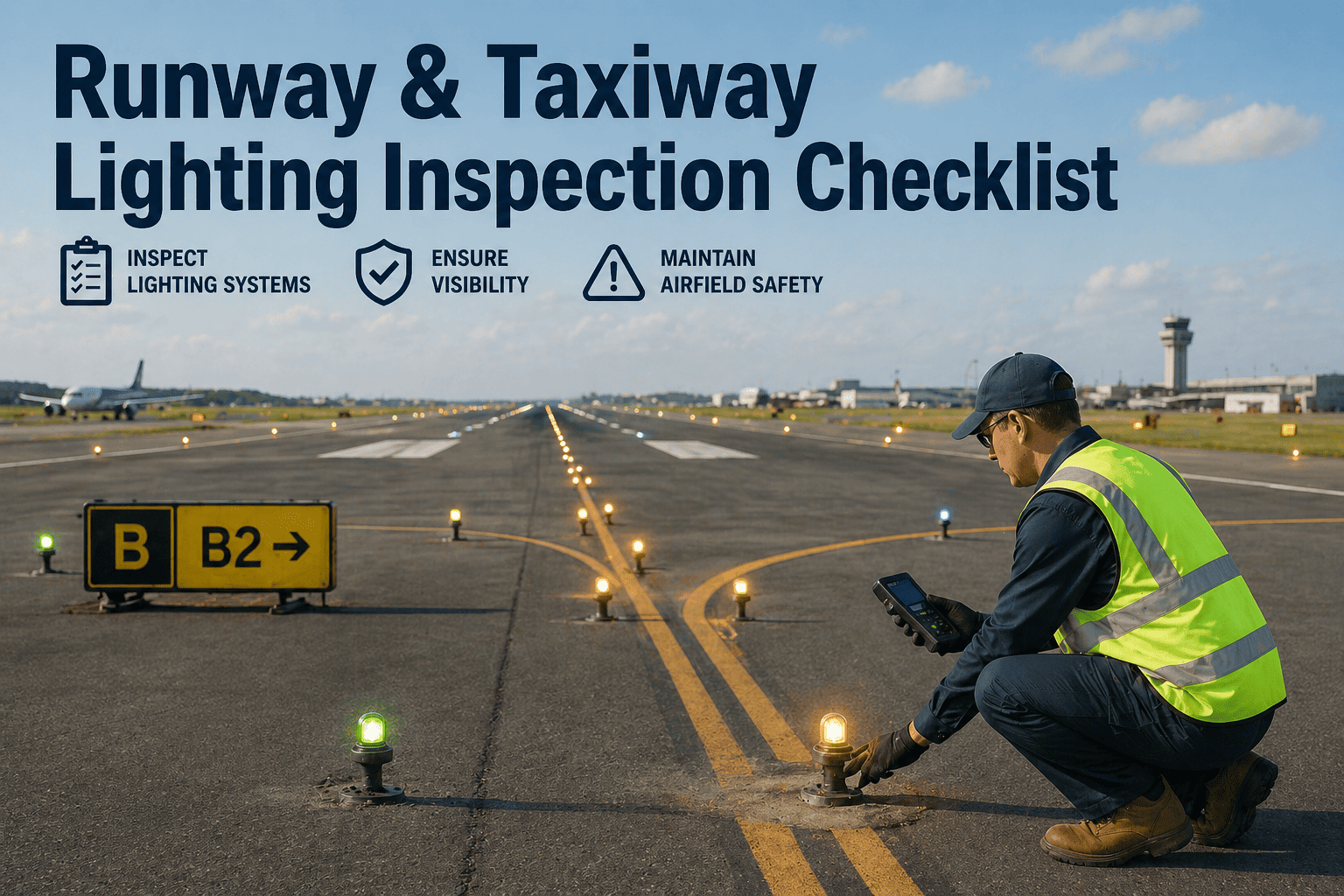
Airfield lighting systems require structured preventive inspection to maintain visibility, safety, and regulatory compliance. This guide covers edge lights, centerline systems, PAPI/VASI units, and guidance signage with inspection frequencies tied to ICAO standards and FAA Advisory Circulars.
34%
Runway incursions linked to lighting failures
72hrs
Average NOTAM duration for unplanned lighting outages
$18K
Cost per emergency airfield lighting repair
8–12
Monthly inspection cycles for Category I–III runways
System Overview
What Is an Airfield Lighting Inspection Program?
An airfield lighting inspection program is a structured maintenance protocol that ensures runway edge lights, taxiway centerline lights, approach lighting systems (PAPI/VASI), and guidance signage remain operational, visible, and compliant with ICAO Annex 14 and FAA AC 150/5340-30J standards. Inspections cover photometric output, circuit integrity, fixture alignment, and emergency power system readiness across the entire airfield lighting network. Want to automate your inspection scheduling and track compliance in real time? Start a free trial with OxMaint or book a demo to see our airfield maintenance module.
Inspection Categories
Core Airfield Lighting Systems — What to Inspect
Airfield lighting systems are divided into six inspection categories, each with different failure modes, regulatory requirements, and safety impact levels.
Edge Lighting
Runway Edge Lights
White elevated fixtures spaced 60m apart along runway edges. Inspect for photometric output, fixture alignment, cable damage, and circuit continuity. Failures create unsafe edge definition during night operations.
Centerline Systems
Taxiway Centerline Lights
Green in-pavement fixtures marking taxiway routes. Check for water ingress, lens clarity, brightness consistency, and cable splice integrity. Critical for low-visibility taxi operations below 350m RVR.
Approach Systems
PAPI & VASI Units
Precision approach path indicators providing glideslope guidance. Inspect optical alignment, color transition accuracy, bulb intensity, and emergency power failover. Misalignment creates approach path hazards.
Guidance Signage
Taxiway Sign Illumination
Internally lit guidance signs showing runway designators and taxiway routes. Check for panel damage, bulb outages, legend clarity, and photocell operation. Sign failures contribute to surface navigation errors.
Threshold Systems
Runway Threshold & End Lights
Green threshold lights and red end lights defining runway usable length. Verify color accuracy, intensity settings, synchronization, and obstacle clearance. Color deviation violates ICAO color specifications.
Power & Control
CCR & Backup Power Systems
Constant current regulators and UPS systems maintaining circuit voltage. Test automatic transfer, battery load capacity, generator run time, and circuit isolation. Power failures trigger immediate NOTAM requirements.
Common Failures
Why Airfield Lighting Systems Fail — Root Causes
Bulb Degradation Without Warning
Halogen and LED fixtures degrade gradually, losing 30–40% output before total failure. Without photometric testing, dimmed lights go unnoticed until multiple units fail simultaneously during weather operations.
Water Ingress in Cable Vaults
Underground cable vaults flood during heavy rain, causing short circuits and ground faults. Reactive maintenance cannot predict vault seal failures — leading to cascading lighting circuit outages that require emergency excavation.
PAPI Alignment Drift
Approach lighting systems shift alignment by 0.1–0.3° annually due to frost heave and pavement settlement. Drift accumulates until the glideslope indication becomes unsafe — yet alignment checks are often skipped during routine inspections.
Missing Inspection Documentation
Paper-based inspection logs create compliance gaps when forms are incomplete, lost, or filed late. Auditors cannot verify inspection frequency or corrective action closure — exposing airports to certification violations during FAA Part 139 reviews.
Digital Solution
How OxMaint Digitizes Airfield Lighting Inspections
OxMaint transforms airfield lighting maintenance from reactive paper checklists to predictive digital workflows with automated scheduling, mobile inspection forms, and audit-ready documentation. Ready to see how it works for your airfield? Book a demo with our airfield operations team or start a free trial and configure your first lighting inspection route today.
Automated Inspection Scheduling
Pre-configured inspection templates trigger work orders based on ICAO-compliant frequencies — monthly for Category I runways, bi-weekly for Category II/III. Mobile technicians receive route-optimized checklists with GPS-tagged fixture locations.
Photometric Failure Prediction
Track bulb runtime and lumen output degradation across every fixture. AI models predict failures 30–45 days before total outage, enabling proactive bulb replacement during planned maintenance windows instead of emergency call-outs.
Digital Inspection Forms
Mobile checklists capture fixture condition, photometric readings, and corrective actions with photo documentation and digital signatures. Completed inspections upload instantly to the audit trail — no paper lag, no missing forms.
NOTAM-Ready Escalation
Critical failures trigger instant escalation workflows to ATC coordination and NOTAM issuance teams. Automated notifications include fixture ID, circuit details, and estimated repair time — reducing NOTAM publication delays from hours to minutes.
Compliance Reporting
Generate audit-ready inspection logs showing completion dates, technician signatures, and corrective action closure for every lighting system. Reports export to FAA Part 139 or ICAO Annex 14 compliance formats with one click.
Parts Inventory Integration
Link lighting fixture models to spare parts inventory. When a bulb type reaches reorder threshold, OxMaint auto-generates purchase requisitions to maintain stock levels — preventing emergency overnight shipping costs.
Approach Comparison
Reactive vs. Preventive Airfield Lighting Maintenance
Inspections scheduled manually using spreadsheets and calendar reminders
Technicians carry paper checklists that get lost, damaged, or completed late
Bulb failures discovered during night operations when aircraft are inbound
No photometric tracking — lights run until total outage occurs
PAPI alignment checked annually or after pavement work — drift accumulates
Inspection records filed manually — missing forms create audit gaps
Emergency repairs require overtime call-outs and expedited parts shipping
NOTAM coordination delayed by phone calls and email chains
Automated work orders trigger based on ICAO-compliant inspection frequencies
Mobile checklists with GPS tagging and photo documentation upload instantly
Predictive models flag dimming fixtures 30–45 days before failure
Runtime and lumen degradation tracked per fixture — proactive replacement
Alignment verification scheduled quarterly with trend analysis alerts
Digital audit trail captures every inspection with timestamp and technician signature
Planned maintenance windows with pre-staged parts eliminate emergency premiums
Instant escalation workflows send NOTAM details to ATC coordination teams
Performance Metrics
Results from OxMaint Airfield Lighting Customers
68%
Reduction in emergency lighting repairs
Predictive bulb replacement eliminated 68% of unplanned after-hours call-outs within 6 months of OxMaint deployment.
42hrs
Average NOTAM duration reduction
Faster failure detection and parts staging reduced lighting NOTAM duration from 72 hours to 30 hours on average.
100%
Inspection documentation compliance
Digital checklists with mandatory photo capture eliminated missing inspection forms during FAA Part 139 certification audits.
$127K
Annual emergency repair cost savings
Mid-size regional airport reduced emergency lighting repair costs from $184K to $57K annually after implementing OxMaint preventive schedules.
Common Questions
Airfield Lighting Inspection FAQs
How often should runway edge lights be inspected according to ICAO standards?
ICAO Annex 14 requires monthly visual inspections for Category I runways, with bi-weekly inspections for Category II/III precision approach runways. Photometric testing should occur quarterly to verify compliance with light intensity specifications. OxMaint automates these schedules and tracks completion rates across your entire airfield lighting network.
Start your free trial to see automated ICAO-compliant scheduling.
What is the most common cause of PAPI system failures?
Optical alignment drift is the leading PAPI failure mode — caused by pavement settlement, frost heave, and thermal expansion cycles. A 0.2° alignment shift can make the glideslope indication unsafe, yet the drift occurs gradually and is invisible without precision measurement. Regular alignment verification with digital records prevents unsafe glideslope indications from accumulating unnoticed.
How does OxMaint handle emergency airfield lighting failures?
Critical lighting failures trigger instant escalation workflows that notify ATC coordination teams, dispatch emergency repair crews, and auto-populate NOTAM templates with fixture ID, circuit details, and estimated repair time. Mobile technicians receive priority work orders with pre-staged parts information, reducing NOTAM duration by an average of 42 hours.
Book a demo to see emergency escalation workflows in action.
Can OxMaint integrate with existing airfield lighting control systems?
Yes. OxMaint supports API integration with major airfield lighting control manufacturers including ADB Safegate, TKH Airport Solutions, and Honeywell. Real-time circuit status, intensity settings, and alarm conditions flow into OxMaint work orders automatically — enabling predictive maintenance based on actual system usage data rather than time-based schedules alone.
Explore integration capabilities — start your free trial today.
Airfield Lighting · ICAO Compliance · Predictive Maintenance
Replace Paper Checklists with Predictive Airfield Lighting Maintenance
OxMaint gives airport operations teams a complete airfield lighting inspection platform — automated ICAO-compliant scheduling, mobile checklists with GPS tagging, predictive bulb replacement, and audit-ready documentation that closes compliance gaps before certification reviews begin.