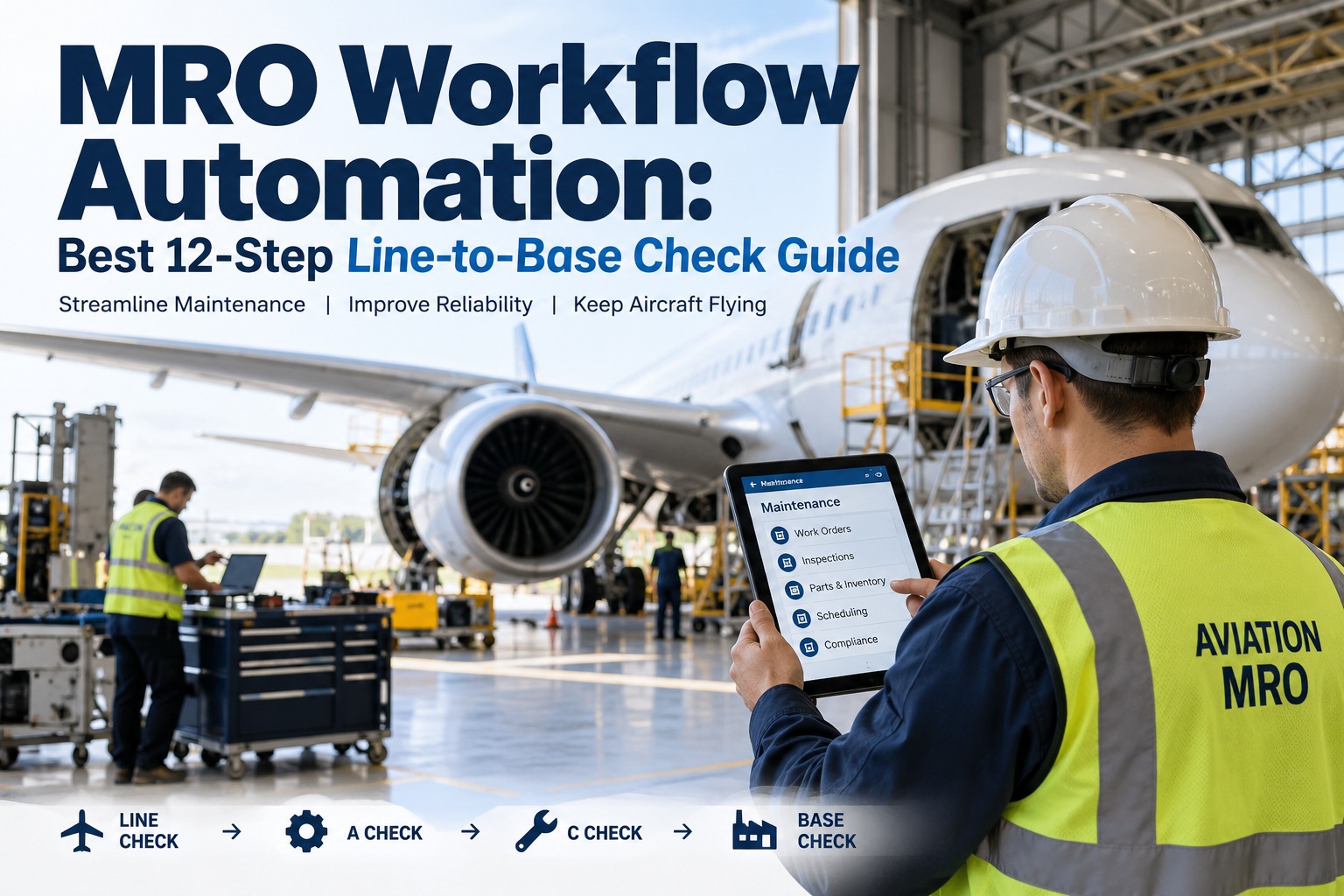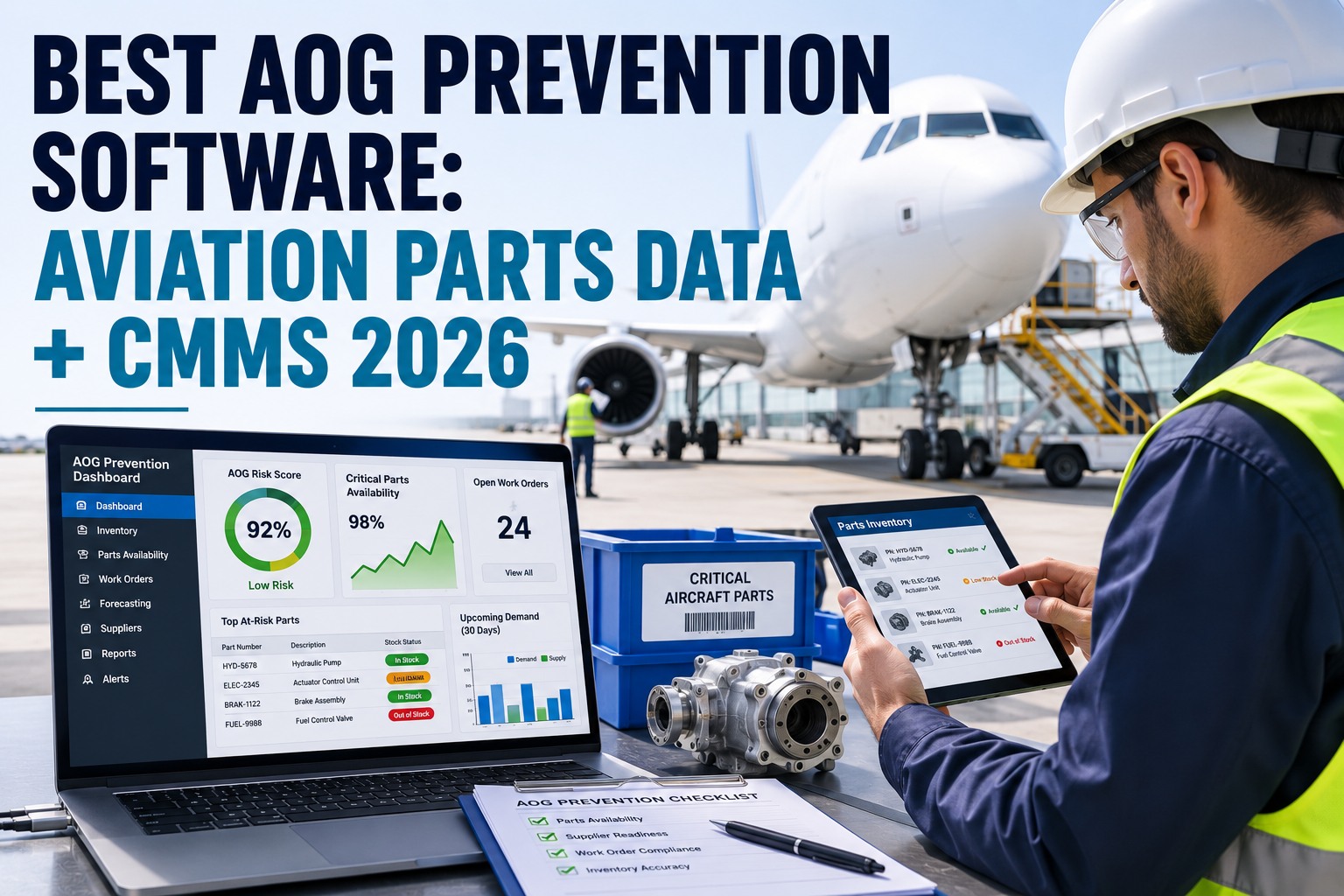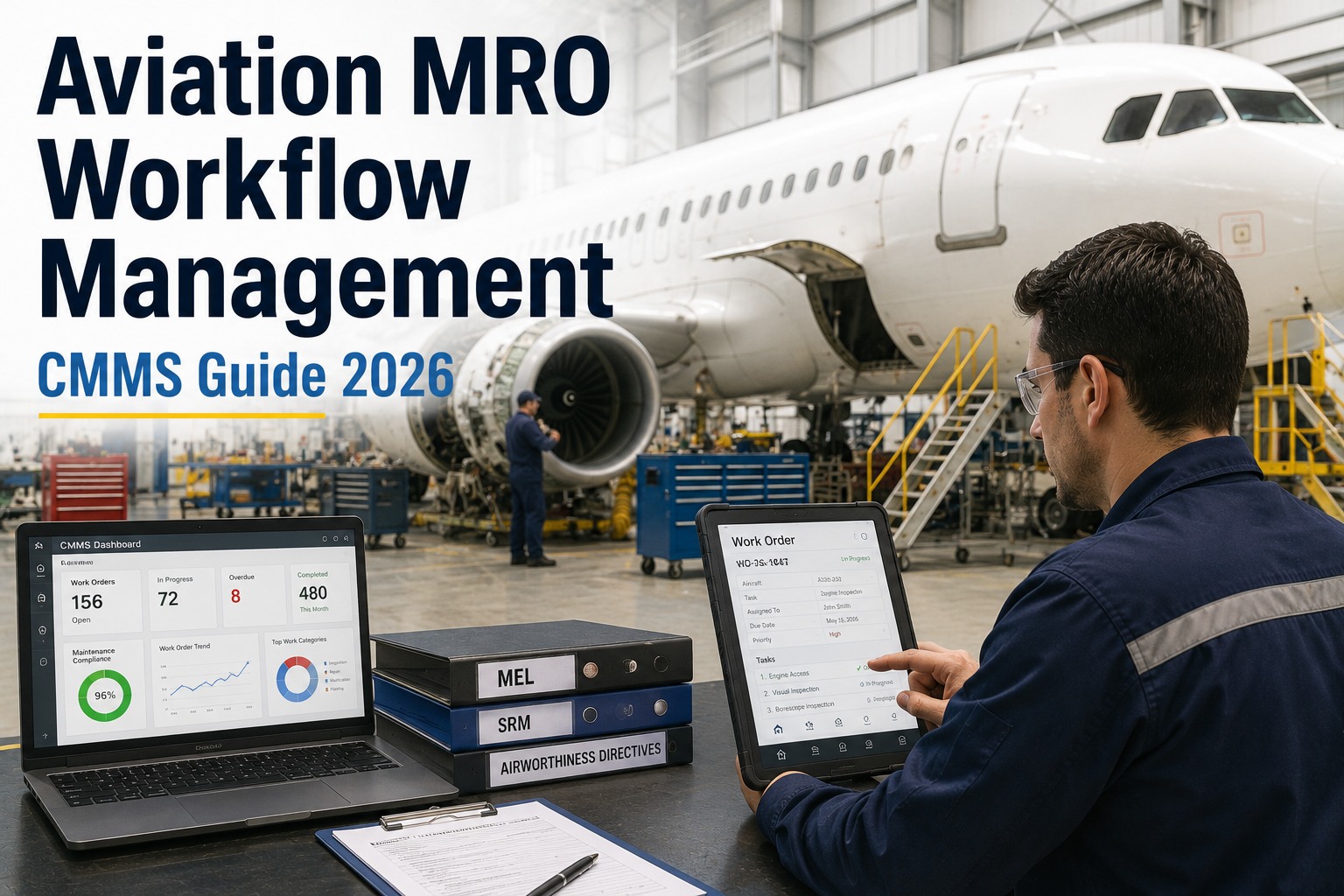
MRO workflow management is where hangar productivity is either preserved or quietly lost — industry benchmarking shows that poorly designed CMMS workflows consume 20–40% of technician time in wait states, hunting for parts, chasing sign-offs, or re-keying defect data. This 2026 guide walks the full arc from defect raise to airworthiness sign-off, covering line maintenance, base maintenance, and component shop-floor control inside a modern aviation CMMS. You will find task-card sequencing logic, hold-point discipline, and the quality-gate patterns that let a station hit turnaround targets without compromising airworthiness. If you want to operationalise this immediately, you can Start Free Trial and configure the workflow templates as you read.
Is your CMMS workflow quietly burning one technician-shift in every three?
Aviation maintenance operations that run on fragmented, paper-bridged workflows lose 20–40% of productive wrench time to wait states, re-keyed data and undocumented hold points. The fix is not more technicians — it is a disciplined, end-to-end MRO workflow inside one CMMS, from defect raise to Certificate of Release to Service.
Where the hours leak out of a maintenance event
A typical C-check on a narrow-body allocates 2,400–3,200 labour hours across 18–25 days. When the CMMS workflow is loose, the leaks are predictable — and they compound at every handoff.
Defect re-keying
Pilot/MEL reports transcribed from paper ACARS printouts into the CMMS lose 8–12 minutes per defect and introduce a 3–5% transcription error rate that surfaces again at the inspection gate.
Tooling & parts wait
Task cards released without a kitting pre-check send technicians to the stores counter an average of 2.3 times per shift — roughly 45 minutes of lost wrench time per mechanic per day.
Hold-point ambiguity
Without enforced hold points, an inspector discovers RII work already closed without dual sign-off, forcing a reopen that costs 2–4 hours of re-inspection and documentation per occurrence.
Sign-off bottlenecks
Paper CRS forms queued on a shift supervisor's desk at end-of-shift can delay aircraft release by 30–90 minutes — and on night-stop lines, that is the difference between an on-time first flight and an AOG.
A regional operator running 18 ATR 72-600s was losing roughly 11 hours per aircraft per A-check to wait states and re-keyed defects — equivalent to about $1.43M in annual lost labour and four missed first-departure slots per month. After re-sequencing task cards around a kitting pre-check gate and enforcing RII hold points digitally, the station recovered 7.5 hours per event and cut reopening defects by 62% within two maintenance cycles.
The eight stages from defect raise to airworthiness sign-off
A defensible MRO workflow is not a checklist — it is a sequenced state machine where each stage has a defined entry condition, owner, and digital handoff. Skip a stage and the airworthiness chain breaks.
Defect Raise & Triage
Pilot report, line walkaround, CAMP scheduling forecast, or borescope finding enters the CMMS as a structured defect record with ATA chapter, effect on dispatch, and MEL cross-reference — no paper, no re-keying.
Work Order Generation
CMMS auto-generates the work order, pulls the MPD-revised task card set, attaches applicable service bulletins, and assigns a maintenance planning group with target start and CRS dates.
Task Card Sequencing
Cards ordered by access zone (panels open top-down), dependency (structural before systems close-out), and RII flag — so a technician never closes a panel that an inspector still needs open.
Kitting & Tooling Pre-Check
A gate that will not release cards to the floor until parts are picked, tooling calibrated, and ground equipment booked — eliminating the 45-minute stores-counter round trip.
Execution & Live Feedback
Technicians log actuals, non-routines and findings in real time on the floor. Anything outside tolerance auto-creates a non-routine card linked back to the parent task — no duplicate entries.
Hold-Point Discipline
Mandatory inspection items and RII tasks freeze downstream work until a qualified inspector electronically signs the hold — the system physically prevents the next card from opening until the gate clears.
Quality Sign-Off
Dual-release for RII, calibrated-tool verification, AD/SB compliance cross-check, and a final independent review by the certifying staff before the work order can move to release.
Certificate of Release to Service
Digital CRS generated inside the CMMS, aircraft status flipped to serviceable, and the full digital twin of the event archived for 24 months under Part 145 record retention.
Three maintenance environments, three workflow patterns
Line, base and component shop-floor maintenance share the same airworthiness spine — but the workflow shape, hold-point density and sign-off chain differ materially. A CMMS that treats them identically will frustrate every one of them.
| Dimension | Line Maintenance | Base Maintenance | Component Shop |
|---|---|---|---|
| Typical event window | 30 min – 4 hrs (transit / night-stop) | 10–30 days (A-, C-, D-check) | 5–45 days per unit (IDG, landing gear, APU) |
| Workflow shape | Linear, fast-close, MEL-driven | Multi-track, zone-based, dependency-rich | Routing-sheet driven, repair-station sub-flow |
| Hold-point density | Low — 1–2 RII gates per event | High — 15–40 mandatory inspection points | Medium — stage inspections per CMM step |
| Sign-off chain | Single certifying mechanic + CRS | Mechanic → inspector → certifying staff → quality | Technician → shop inspector → dual-release (FAA/EASA) |
| Critical CMMS feature | Real-time MEL linkage & AOG flag | Task-card dependency engine & zone access map | Serial-number traceability & CMM revision control |
| Cost of one workflow failure | $8K–$25K AOG delay per hour | $3K–$6K additional ground-day per aircraft | $1.5K–$9K scrap / rework per component |
Quantifying the workflow leak — and the recovery
If you cannot put a number on the leak, you cannot justify the fix. The two formulae below are the ones MRO operations managers should be running every quarter against actual CMMS data, not estimates.
Wait-State Loss (per event)
Where Tplanned is the scheduled event duration, Twrench is verified productive time from CMMS actuals, Rtech is the loaded technician rate, and Ncrew is the average crew size. A healthy line station runs WSL under 18% of planned; anything over 28% signals a workflow design problem, not a staffing problem.
Annualised Recovery (per station)
Eannual is total events per year. Operators that enforce kitting pre-checks, digital hold points and real-time non-routine capture typically move WSL from 33% to 19% within two maintenance cycles — a 14-point swing that translates directly into recovered labour and on-time departures.
Stop losing shifts to workflow wait states
See how a disciplined defect-to-CRS workflow inside OXMaint recovers 7–14% of planned labour hours in the first quarter — without adding headcount or cutting airworthiness corners.
Common questions on MRO workflow management in aviation CMMS
These are the questions station managers and CAMO planners ask most often when evaluating whether a CMMS can actually enforce — not just document — their maintenance workflow.
How does a CMMS enforce hold-point discipline without slowing the floor?
A well-designed CMMS makes the hold point a system gate, not a paper sticker. When a technician marks an RII task complete, the card flips to a "pending inspection" state that physically prevents the next dependent card from opening. The inspector receives a push notification, signs on a tablet at the aircraft, and the gate releases in under two minutes — faster than walking to the office for a paper form.
Can one workflow template serve line, base and component shop maintenance?
No — and trying to force a single template is the most common reason CMMS rollouts stall. The airworthiness spine (defect → plan → execute → hold → sign-off → CRS) is shared, but the stage density, sign-off chain and dependency logic differ. OXMaint ships with three template families tuned to each environment, which you can Book a Demo to see configured for your operation.
What is a realistic payback window for re-engineering an MRO workflow?
Most operators see measurable WSL reduction within the first two maintenance cycles after go-live — typically 30–60 days. Full payback on a mid-size regional fleet usually lands between four and seven months, driven by recovered labour hours, fewer reopen defects and reduced AOG delay costs. The figures compound once the CMMS also feeds reliability and CAMO reporting.
How does the CMMS handle non-routine findings discovered mid-task?
The technician logs the finding against the parent task card, and the CMMS auto-generates a linked non-routine card with the same ATA chapter, access zone and dependency context — no duplicate data entry, no orphan records. The non-routine then flows through its own hold-point and sign-off chain before the parent card can close, preserving the full airworthiness trail.
Does the workflow support both FAA Part 145 and EASA 145 sign-off chains?
Yes. OXMaint supports dual-release configurations where a single maintenance event can carry both FAA and EASA certifying-staff sign-offs, with the CRS generated in the format required by each authority. The workflow engine enforces the correct sign-off sequence per authority, so a dual-release event cannot close with only one signature. You can configure and test this in a Start Free Trial sandbox before going live.
Build a defect-to-CRS workflow that protects airworthiness and turnaround time
Configure the eight-stage MRO workflow, enforce hold-point discipline digitally, and recover 7–14% of planned labour hours in your first quarter.
Free 14-day trial · No credit card