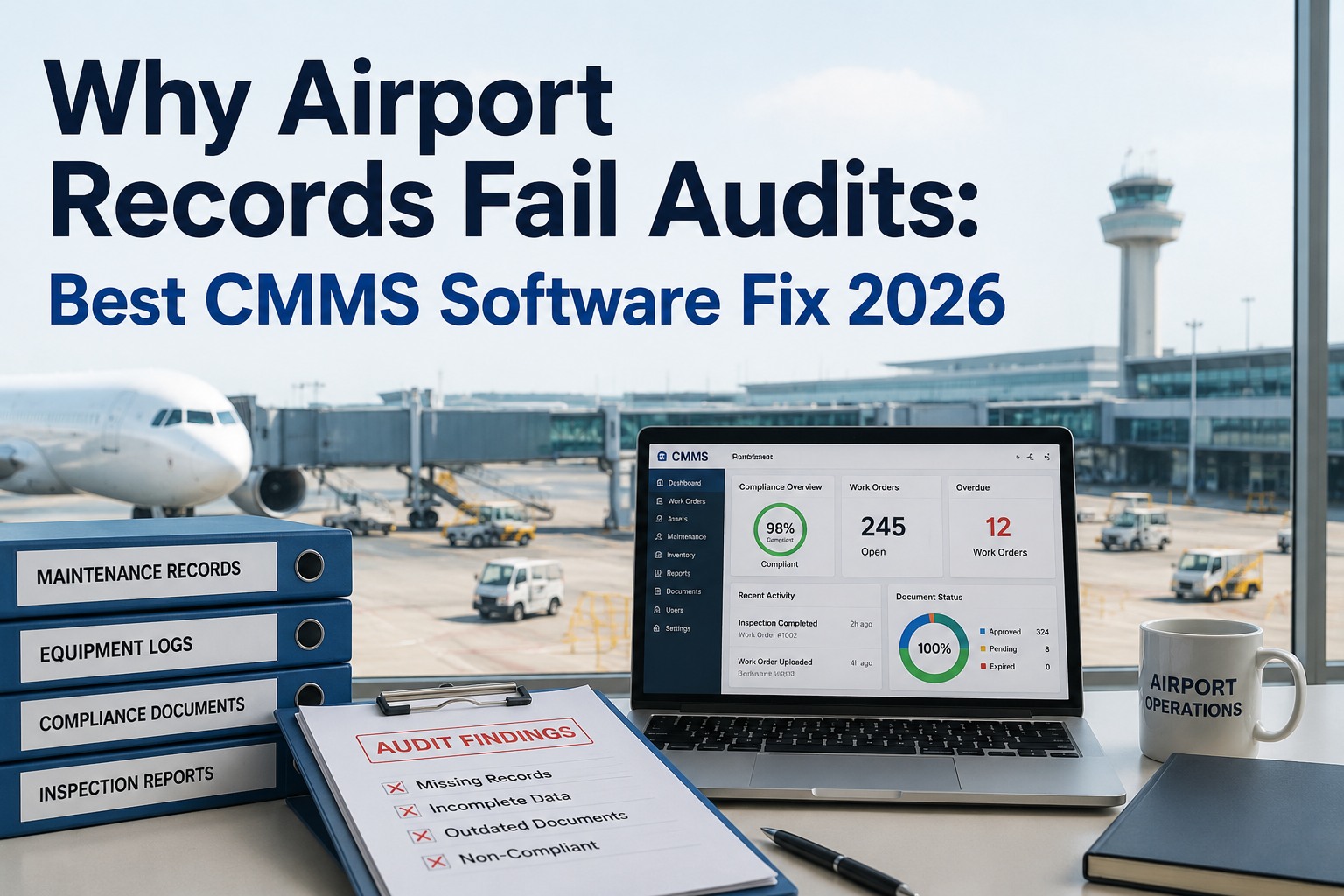
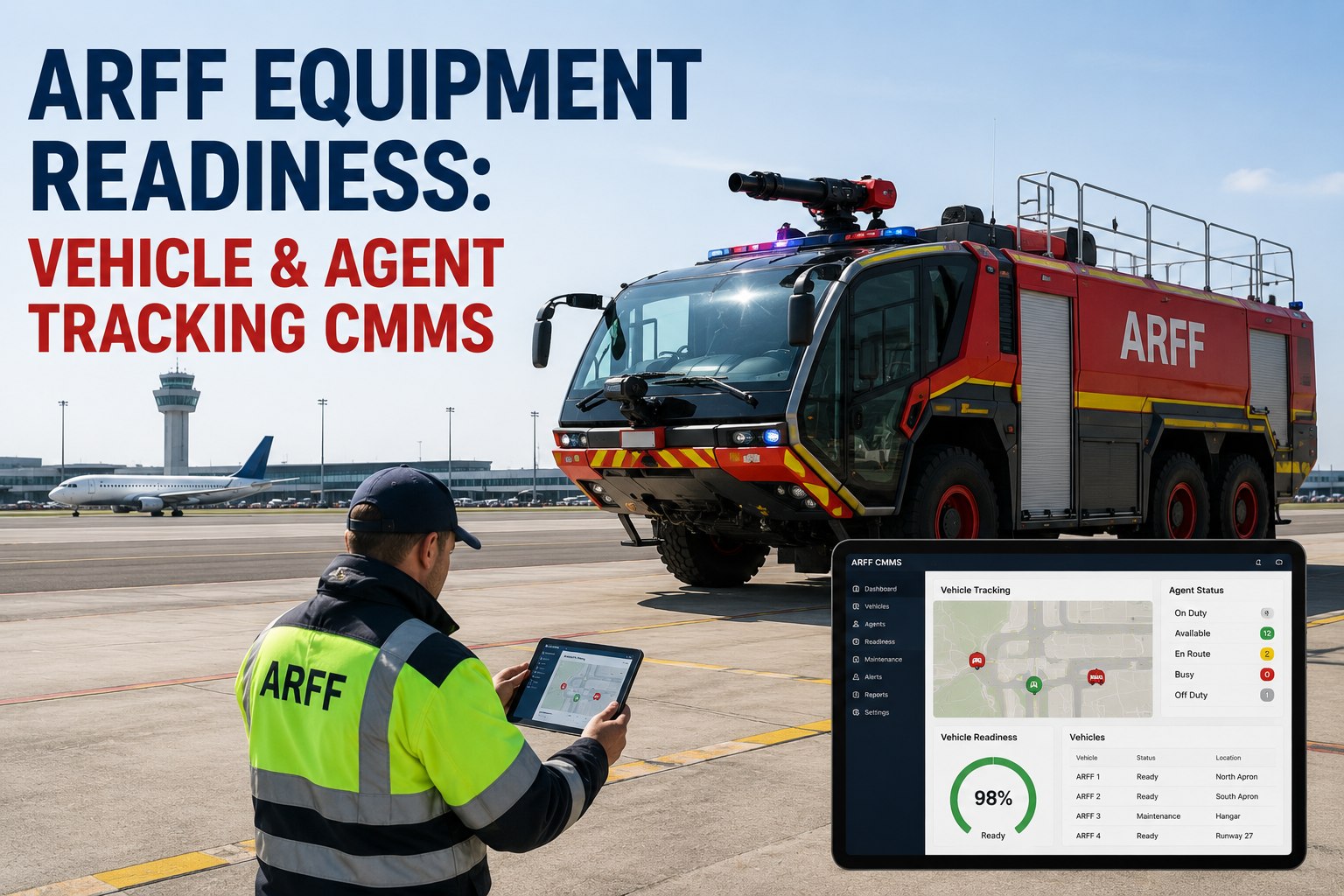
Part 139 inspectors don't ask whether your ARFF fleet can respond in three minutes to the midpoint of the farthest runway — they ask you to prove it happened, with drill data tied to the specific vehicle. Documentation gaps consistently rank among the most common Part 139 inspection findings at certificated airports, and it's rarely the equipment that fails — it's the record. A quarterly pump test that ran but wasn't logged. An annual live-fire drill from thirteen months ago instead of twelve. A foam concentrate level that's drifted 8–14% below the CMMS nameplate figure because nobody updated it after the last top-up. A structured PM playbook closes that gap by tying every daily check, weekly drill and annual certification directly to the vehicle record. This guide lays out that three-tier playbook and how OXMAINT AI keeps it current.
Airport Fire & Rescue · ARFF Vehicle Readiness · Part 139 · 2026
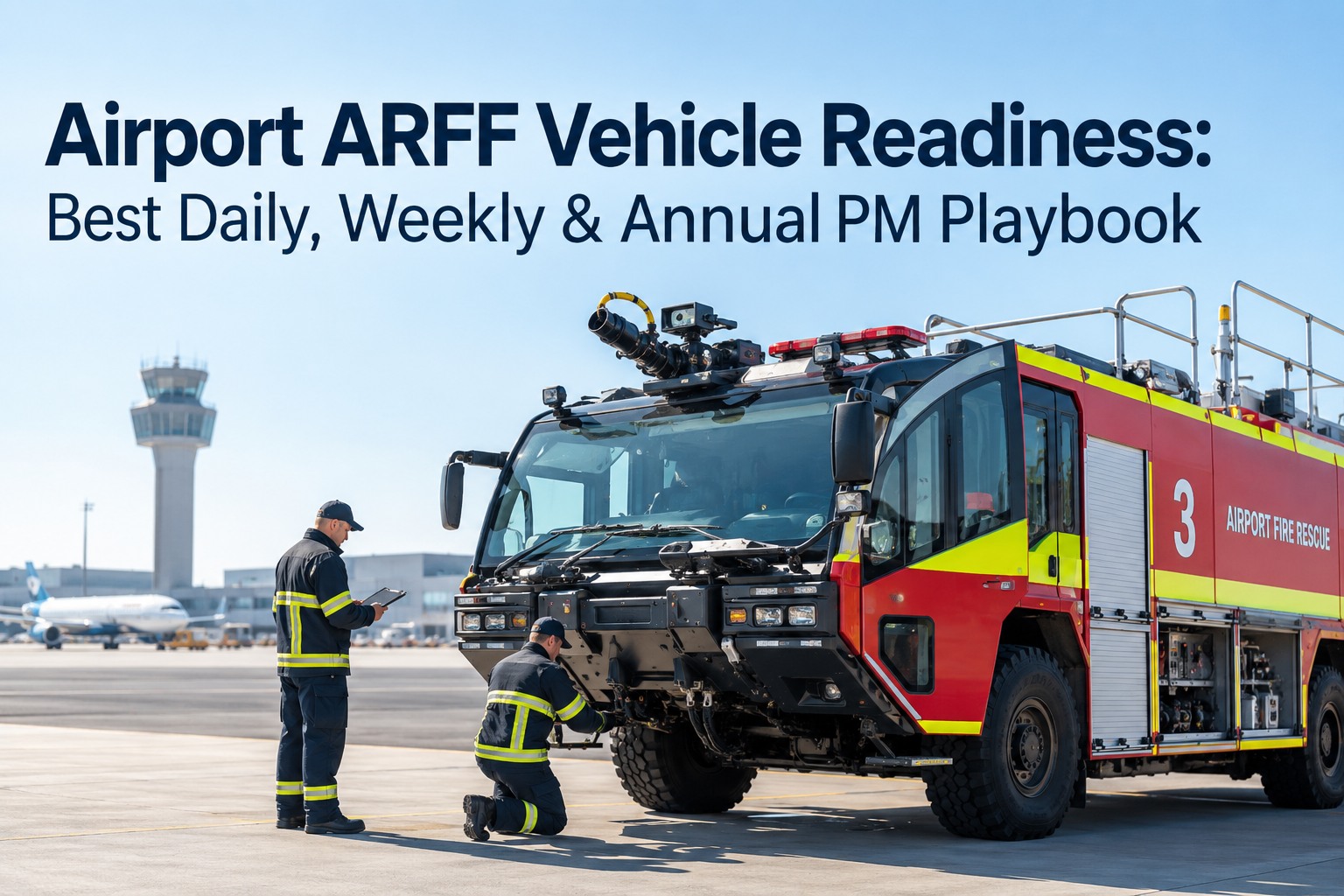
Airport ARFF Vehicle Readiness: Best Daily, Weekly & Annual PM Playbook
An inspector gives you minutes, not days, to produce a vehicle's PM history. OXMAINT AI connects the full readiness workflow: daily starts, weekly foam and pump drills, and annual certifications all log against the specific ARFF vehicle, any deviation becomes a tracked work order, and the full record stays retrievable by vehicle and date the moment it's asked for.
Daily / Weekly Check Logged
→
Deviation Flagged
→
Work Order Created
→
Annual Cert Tracked
3 Minutes
required response time to the midpoint of the farthest runway under Part 139
12 Months
maximum interval between required live-fire drills per vehicle
8–14%
typical foam agent quantity drift between logged and actual levels found by inspectors
Top 5
documentation gaps rank among the most common Part 139 inspection findings
The Three-Tier PM Playbook
Every ARFF readiness program runs on the same three rhythms — what happens every shift, what happens every week, and what happens once a year. Sign up free and start logging your fleet's daily checks today.
Daily — Shift Change Verification
Chassis start, brake, steering, transmission and low-air alarm check
Agent tank levels read and compared against the last top-up log
Pump engagement test and pressure gauge calibration check
SCBA cylinder pressure confirmed at or above required minimum
Wheel chocks, hydrant wrench and adapters present and tagged
Weekly — Operational Readiness Drill
Timed response drill to midfield or the farthest runway endpoint
Foam proportioner flow test, recorded directly to the vehicle record
Dry chemical discharge path visual confirmation
Turret nozzle articulation and handheld line pressure test
Radio interoperability check with Tower and AOCC
Annual — Certification & Audit Cycle
Annual pump certification test per NFPA 414
Output-based foam test per current CertAlert guidance for F3 agents
At least one live-fire drill within every 12 consecutive months
Full recurrent personnel training records refreshed and filed
Complete PM, repair and out-of-service history reviewed per vehicle
Where ARFF Readiness Records Actually Break Down
🧯
Agent Quantity Drift
Foam concentrate drops through top-ups and biennial tank cleanings, but the system still shows the nameplate fill until an inspector finds the gap first.
📆
PM Schedule Slippage
A vehicle overdue for its chassis inspection or pump test by weeks is often still treated as "in service" until someone manually catches it.
⏱
Response-Time Evidence Gap
The three-minute response requirement is demonstrated in practice, but without drill data tied to the vehicle, the proof stays anecdotal.
📋
Clipboard Records
Daily shift checks live on a paper sheet in the cab — easy to complete, hard to produce in minutes when an inspector asks for six months of them.
From Daily Check to Closed Work Order
1
Check performed
Daily start, weekly drill or annual cert test carried out on schedule by crew or a certified tester.
→
2
Logged to the vehicle
Entry timestamped and tied to the specific unit ID, not a shared logbook.
→
3
Deviation flagged
A failed pressure reading, low agent level or missed check surfaces against that vehicle's record.
→
4
Work order created
A corrective work order routes to maintenance, with the original entry attached for context.
→
5
Record retained
Closure evidence links back to the original check, retrievable by vehicle and date on demand.
A Pump Test That Ran but Wasn't Logged Didn't Happen, as Far as an Inspector Is Concerned.
OXMAINT AI ties every daily check, weekly drill and annual cert to the specific vehicle, so the record is what an inspector actually sees — not what you remember happened.
Clipboard Logs vs. Digital ARFF Vehicle Records
Clipboard & Cab Logbook
Daily checks recorded on paper, hard to search by date
Agent levels tracked separately from the actual PM record
Response drill times noted informally, not tied to the vehicle
Overdue PM discovered manually, sometimes weeks late
Digital Record in OXMAINT AI
Every daily check timestamped and tied to the specific vehicle
Agent levels update from actual logged top-ups, not a nameplate figure
Drill times recorded directly to the vehicle's readiness record
Overdue PM flagged on a dashboard before it becomes a finding
What an Inspector Typically Asks to See
✓
Daily operational checks — engine, turrets, brakes, lights, communications — by vehicle
✓
Quarterly pump performance test results with flow and pressure data
✓
Response-time drill results demonstrating the three-minute requirement
✓
Live-fire drill documentation, at least one within the last 12 consecutive months
✓
Agent quantity on hand versus required minimum, with expiration and replacement tracking
What OXMAINT AI Gives ARFF Fleet & Safety Teams
Daily Shift-Check Logging
Chassis, agent, pump and equipment checks logged from a mobile device, timestamped to the specific vehicle.
Weekly Drill Tracking
Response-time drills, foam proportioner tests and turret checks recorded directly against the vehicle's readiness history.
Annual Certification Scheduling
NFPA 414 pump certification and live-fire drill intervals tracked per vehicle, with reminders before the window closes.
Agent Inventory Reconciliation
Foam and dry chemical levels update from logged top-ups and usage, not a static nameplate figure.
Deviation-to-Work-Order Linking
A failed check or overdue PM becomes a tracked work order automatically, with the original entry attached.
Retrievable Records by Vehicle
Pull any unit's full daily, weekly and annual history for a given date range in minutes, not a search through binders.
"
Our daily checks were always getting done — that was never the issue. The issue was proving it during an inspection, because the record lived on a paper sheet in each truck's cab. Now every shift check, every weekly drill and the annual pump cert are all logged against the specific vehicle in OXMAINT AI. When an inspector asked for six months of Truck 3's readiness history, it was a search and an export, not a trip out to the apparatus bay to find the logbook.
ARFF Fleet Maintenance Supervisor · Regional Commercial Airport
Frequently Asked Questions
What's the difference between the daily, weekly and annual PM tiers?
Daily checks confirm the vehicle is ready to respond right now — chassis, agent levels, pump engagement. Weekly drills test operational readiness under near-real conditions — response time, foam flow, turret function. Annual items are formal certifications, like the NFPA 414 pump test and the required live-fire drill, that prove the equipment and crew meet the full standard.
How does OXMAINT AI catch foam agent quantity drift?
Agent levels are calculated from logged top-ups, transfers and usage rather than displaying a static nameplate figure, so the recorded level reflects what's actually been added or drawn down since the last reconciliation.
What happens when a daily or weekly check finds a problem?
A flagged deviation — a failed pressure reading, a low agent level, a missed drill element — creates a work order automatically, linked to the specific vehicle and the original check, so the finding and the fix stay connected.
Can OXMAINT AI track multiple vehicles across a fleet with different certification dates?
Yes. Each vehicle carries its own daily, weekly and annual schedule and history, so certification and drill dates that differ by unit are tracked independently rather than on a single fleet-wide calendar.
Make Every Check a Record, Not Just a Task Completed.
Daily starts, weekly drills, annual certifications — all tied to the vehicle, all retrievable the moment an inspector asks. That's the readiness playbook OXMAINT AI runs.