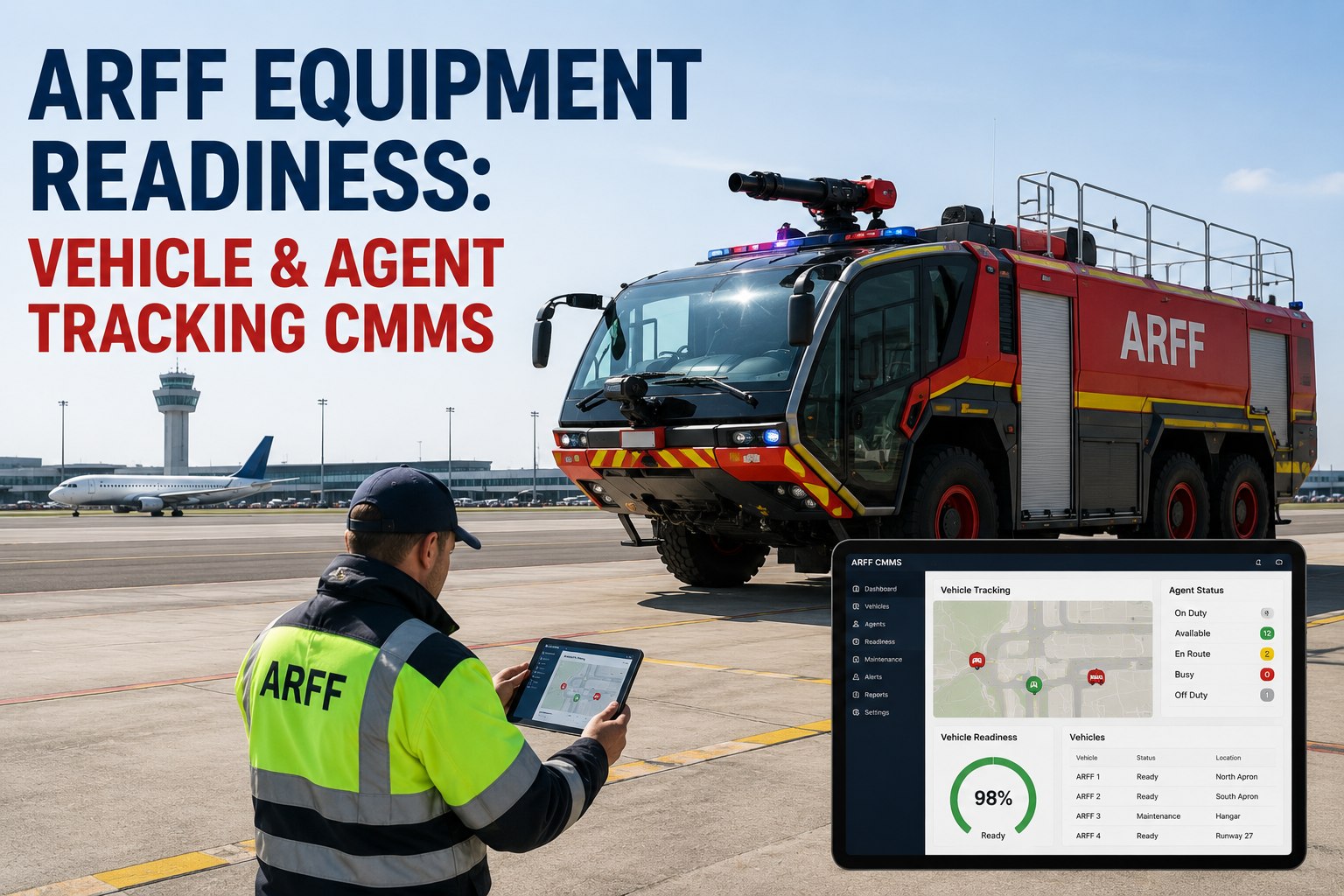
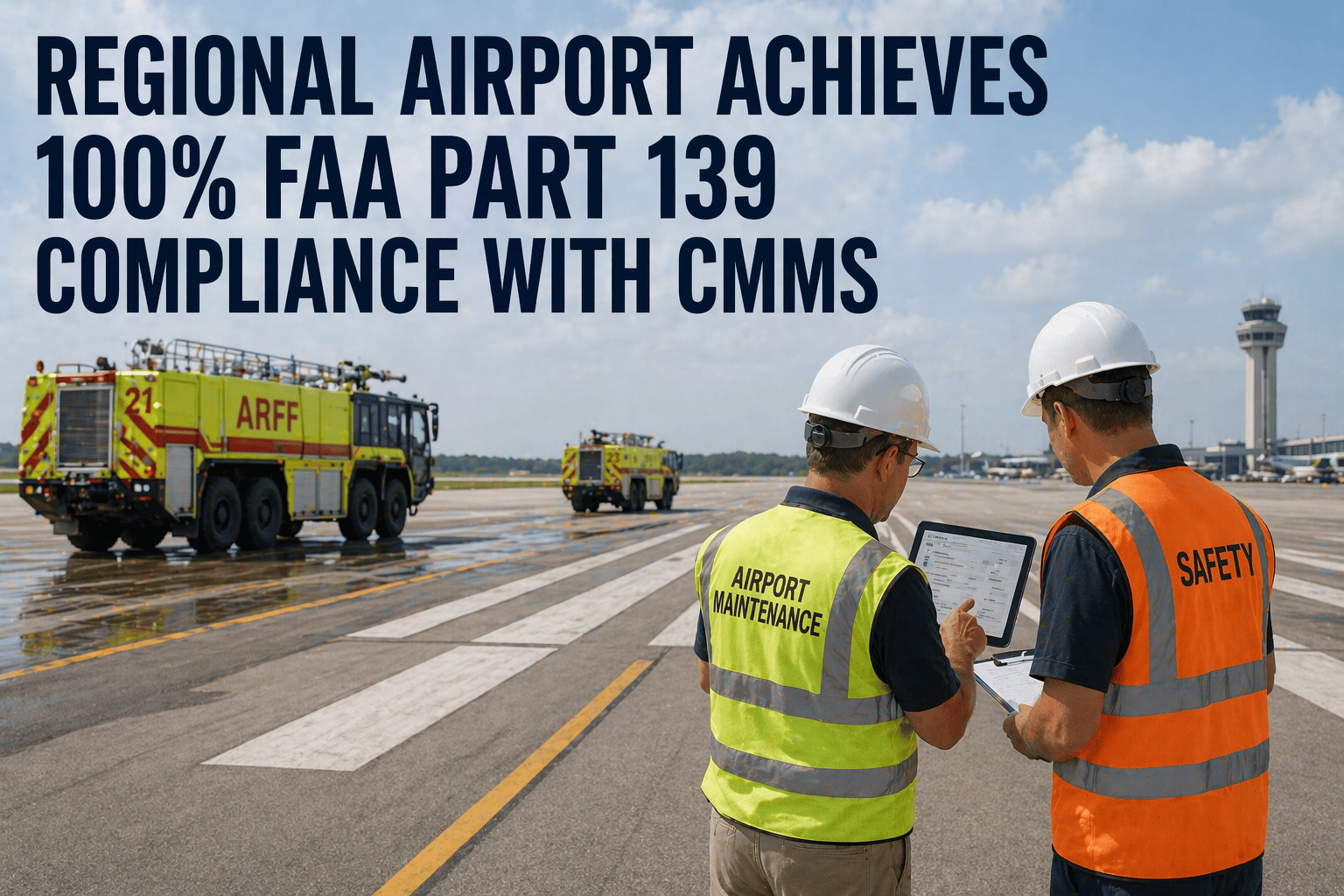
An ARFF station at a Class I Part 139 airport had three trucks rated Index B, a fully manned crew across two shifts, an Airport Emergency Plan reviewed annually, and a binder full of training certifications. They also had an FAA inspector who had just written up a finding: the Truck 2 turret discharge test record was missing for the prior quarter, the foam concentrate sample log had a 47-day gap, and one driver-operator's recurrent training was 11 days past the 12-month cycle defined in 14 CFR Part 139.319(i). None of these were discovered until the inspector arrived. The station was not unsafe — but on paper, on the day, in the eyes of the regulator, they were not 100% ready. Industry data shows the FAA issued over 900 administrative enforcement actions for ARFF and Airport Emergency Plan discrepancies in a four-year span, and most were not equipment failures — they were documentation gaps that compounded silently between inspections. After consolidating every ARFF asset, training record, foam sample, and inspection log into OxMaint, the station reported 100% ARFF readiness across two consecutive Part 139 inspection cycles, zero documentation findings, and a measurable drop in the time crews spent on paperwork instead of training. Start a free trial and configure your first ARFF asset register, or book a demo to see the Part 139 readiness workflow.
100% ARFF Readiness, Two Consecutive Part 139 Cycles, Zero Documentation Findings
An airport fire department transformed Part 139 ARFF compliance from a binder-and-spreadsheet scramble into a continuously verifiable readiness state — every truck, every cert, every foam sample, every checklist living in one CMMS.
Your trucks roll on time. Your crew is trained. Your documentation needs to keep up.
Most ARFF findings on Part 139 inspections are not about whether the station can respond — they are about whether the station can prove it. A modern CMMS replaces the paper chain. Start a free trial or book a demo for a Part 139-aligned walkthrough.
What "ARFF Readiness" Actually Has to Cover
Under 14 CFR Part 139.319(g), every required ARFF vehicle must remain operationally capable of performing its functions during all air carrier operations — and the airport must have replacement equipment or a notification protocol if any vehicle becomes inoperative. Behind that single sentence sit six discrete domains a fire department has to keep simultaneously current. Drop any one and the airport is technically out of compliance.
Every Index-required ARFF truck must run, pump, and discharge agent on demand. This means active tracking of engine hours, pump tests, turret output verification, brake systems, hydraulic systems, and cold-weather provisions for airports with prolonged sub-33°F temperatures.
Foam concentrate, dry chemical, complementary agents, and water — all must be on hand at the Index-required quantities. Foam concentrate samples have specific testing intervals. Storage tank inspections, transfer pump tests, and refill records all live in this domain.
Each firefighter requires recurrent training every 12 consecutive calendar months across the curriculum specified in Part 139.319(i) — airport familiarisation, aircraft fire-fighting, hazmat, emergency communications. Live-fire requirements add additional documentation per 139.319(j).
Part 139.319 requires the first responding ARFF vehicle reach the midpoint of the farthest runway within 3 minutes from the time of alarm, and additional vehicles within 4 minutes. Documented response drills, station siting, and route condition checks all need to be on file.
Under Part 139.325, the airport must maintain an Airport Emergency Plan covering response coordination, mutual aid, sabotage, and unlawful interference scenarios. The fire department's records must align with the AEP — drills, tabletop exercises, communication tests, and revision history.
Daily, weekly, monthly, and annual inspection logs must exist, be timestamped, and be retrievable. The 2024 fluorine-free foam (F3) transition added required output-based testing as another evidentiary layer. Missing or late records are the single most common Part 139 finding.
Where Most ARFF Findings Actually Originate
FAA inspectors do not write findings about firefighters who failed to respond. They write findings about records that could not be produced. Below are the six failure patterns that drive the majority of Part 139 ARFF findings — every one preventable with a properly configured CMMS.
Part 139 requires recurrent training within 12 consecutive calendar months. Most stations track this manually and miss the date by 5–20 days on at least one firefighter per cycle. The fix is a calendar trigger that opens a training work order 60 days before the deadline.
Foam concentrate sampling intervals are easy to miss when no system holds the schedule. A 30-day gap in the sample log creates an immediate finding even if the foam itself is in spec. Per-tank sampling PMs eliminate the gap entirely.
Pump and turret discharge tests are typically required at defined intervals tied to vehicle hours and calendar. When the recordkeeping is paper-based, one missed entry can break the audit chain for the entire vehicle's lifecycle.
Part 139.319(g)(3) requires immediate replacement of any inoperative ARFF vehicle, and notification of the Regional Airports Division Manager and each affected air carrier if replacement is not available. The notification record itself is the audit artifact — and it is frequently undocumented.
The FAA's required output-based testing after the fluorine-free foam transition (Part 139 CertAlert 24-11) added a new test class with specific intervals. Stations that have not built the test cycle into their CMMS PM library will surface this gap on their next inspection.
Part 139.325 requires the Airport Emergency Plan to be reviewed and tested. Drill participation records, tabletop exercise results, communication-test logs, and revision history all need to be on file — and accessible in minutes during an inspection, not days.
Your station's job is to respond. The CMMS underneath it is what makes that responsiveness defensible.
Every truck, every firefighter, every foam tank, every drill, every test result — registered, scheduled, timestamped, and retrievable. That is what 100% ARFF readiness on paper actually looks like.
The ARFF Index Readiness Matrix — How OxMaint Tracks Every Vehicle
Part 139.317 sets the Index requirement for each Part 139 airport based on the longest aircraft in scheduled service. Each Index dictates minimum vehicle count, agent quantities, and capability. OxMaint mirrors this exact structure for every station that uses it — meaning every shift change, every vehicle status update, and every Index check is verifiable in seconds.
How the Station Got to 100% — The OxMaint Workflow
Every ARFF vehicle, foam tank, dry chemical container, breathing apparatus, and tooling item registered with manufacturer data, capacity, certification dates, and Index relevance.
Pump tests, turret discharge verifications, foam concentrate sampling, agent quantity checks, and cold-weather provisioning all built into a PM library that mirrors Part 139.319 obligations explicitly.
Each firefighter has a record of recurrent training, live-fire participation, and driver-operator certifications. Calendar triggers fire 60 days before any cycle expires — no firefighter ever drifts past 12 months silently.
Daily and weekly inspections completed on tablets at the apparatus floor — with photos, signatures, and immediate flagging of any "no" answer. Findings convert into work orders inside the same workflow.
Tabletop exercises, full-scale drills, communication tests, and AEP revision history all logged against the airport's AEP record — turning Part 139.325 from a "where is the latest version" scramble into a single source of truth.
When the FAA inspector arrives, the station director generates a Part 139 readiness pack from OxMaint in under 10 minutes — complete with vehicle status, training currency, agent quantities, and inspection history exports.
Manual Records vs CMMS-Driven Readiness
| Readiness Discipline | Manual / Paper-Based | OxMaint CMMS |
|---|---|---|
| Recurrent training currency | Spreadsheet, often days late | Calendar trigger 60 days before deadline |
| Pump & turret test records | Logbook, retrieval slow | Per-vehicle history, instant retrieval |
| Foam concentrate sample log | Sample-and-write workflow | Scheduled PM, attached lab results |
| F3 output-based testing | Often missed entirely | PM template per 24-11 CertAlert |
| Inoperative vehicle notification | Email after the fact | Auto-generated notification record |
| AEP drill records | Folder of meeting notes | Linked to AEP record with sign-offs |
| Part 139 audit prep time | 5–10 days | Under 10 minutes |
| Findings per inspection cycle | 2–6 typical | 0 (after rollout) |
The Documented Outcome
Frequently Asked Questions
Can OxMaint specifically support Part 139 ARFF compliance documentation?
How does OxMaint handle training records for ARFF firefighters?
Does OxMaint integrate with our existing FAA reporting and AEP processes?
What does it take to roll OxMaint into an existing ARFF station?
100% ARFF readiness is not luck. It is a CMMS configured to mirror Part 139, every day.
OxMaint registers every ARFF vehicle and asset, mirrors Part 139.317 and 139.319 obligations as PM templates, tracks training currency at the firefighter level, captures inspection records on mobile, and produces audit-ready exports in minutes — every day, not just on inspection week.