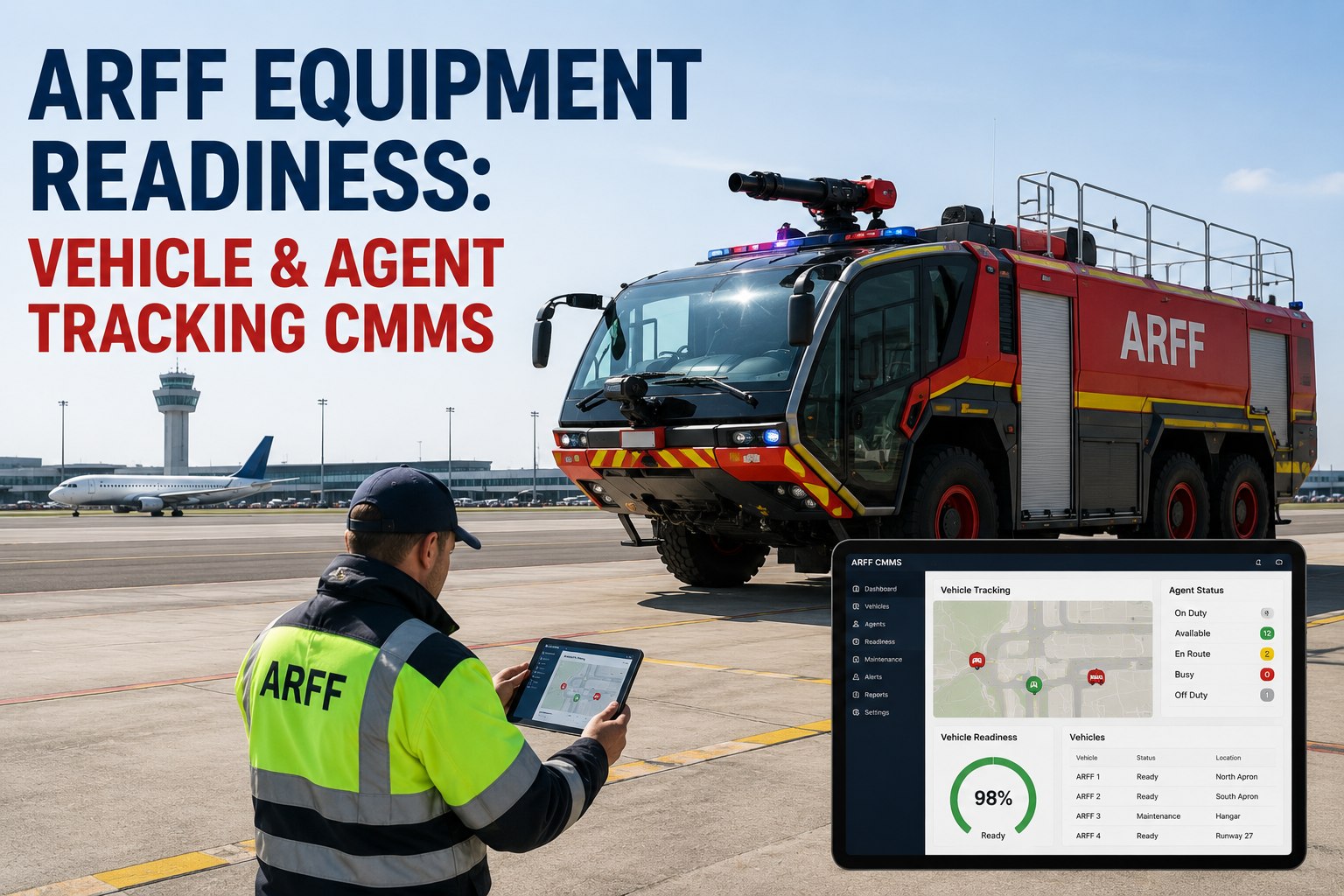
ARFF readiness is one of the few airport operational domains where a single equipment failure can close a runway, trigger a NOTAM, and cost carriers millions in diversions within an hour. For operations directors governed by 14 CFR §139.315, the question is never whether the truck is parked in the station — it is whether every vehicle, agent tank, and response route is provably compliant at the moment an Index-critical event is logged. This guide breaks down how an aviation-grade CMMS turns ARFF readiness from a paper drill into a real-time, auditable record — covering vehicle PM schedules, foam and dry chemical inventory, response-time verification, and the dashboards that make ARFF Index compliance visible to the airport, the FAA inspector, and the airline AOCC at once. The fastest way to see it on your own airfield is to Start Free Trial and import your current ARFF fleet list today.
If your Index dropped tonight, could you prove compliance in under 90 seconds?
A single ARFF vehicle out of service can push an airport below its required Index — forcing a NOTAM that diverts wide-body arrivals and costs carriers upwards of $250K per hour. A CMMS-built ARFF program makes that risk visible in real time, not during the next quarterly audit.
Three silent failures that drop an airport below Index
Most ARFF programs do not fail at the moment of the alarm — they fail in the 30 days before it, when an unlogged foam top-up, a missed PM, or an uncalibrated agent gauge quietly takes a truck out of compliance. These are the three patterns we see most often in pre-audit CMMS data.
Agent quantity drift
Foam concentrate levels drop through top-ups, transfer losses, and biennial tank cleanings — but the CMMS still shows the nameplate fill. Inspectors find the gap first.
PM schedule slippage
A ARFF vehicle overdue for its chassis inspection or pump test by more than 30 days is typically treated as "still in service" until someone manually closes the work order.
Response-time evidence gap
Part 139 requires a demonstrated three-minute response to the midpoint of the farthest runway. Without drill data tied to the vehicle, the proof is anecdotal.
What an ARFF Readiness Score actually measures
A defensible readiness score is not a feeling — it is a weighted composite of four measurable CMMS data streams. Use it as the single number your operations director watches before every shift change.
The ARFF readiness checklist your CMMS should run every shift
This is the tiered checklist a Part 139-compliant ARFF module enforces. Each item is a CMMS record, not a clipboard line — meaning every check is timestamped, geo-stamped to the vehicle, and visible to the inspector the moment it is saved.
- Chassis start, brake, steering, transmission, low-air alarm
- Agent tank levels read against last top-up log
- Pump engagement test, pressure gauge calibration check
- Self-contained breathing apparatus cylinder pressure ≥ 90%
- Wheel chocks, hydrant wrench, adapters present and tagged
- Timed response to midfield or farthest runway endpoint
- Foam proportioner flow test, recorded to vehicle record
- Dry chemical discharge path visual confirmation
- Turret nozzle articulation, handheld line pressure test
- Radio interoperability check with Tower and AOCC
- Annual pump certification test per NFPA 414
- Foam concentrate sample analysis, lot traceability update
- Vehicle weight & axle loading verification for Index category
- Driver/operator ARFF certification renewal tracking
- Spare tire, chassis fluids, APU service interval closure
| Asset | Required Agent (Index C) | CMMS Trigger | Compliance Window |
|---|---|---|---|
| ARFF Truck #1 (Pumper) | 500 gal AFFF + 450 lb dry chem | Level < 90% nameplate | Refill within 24h |
| ARFF Truck #2 (Pumper) | 500 gal AFFF + 450 lb dry chem | Level < 90% nameplate | Refill within 24h |
| ARFF Truck #3 (Rosenbauer) | 3,000 gal water + 420 gal AFFF | Level < 95% nameplate | Refill within 12h |
| Reserve Truck | Index-equivalent load | Activate only on PM overlap | Index maintained continuously |
| Foam Reserve Stock | 100% of largest single vehicle fill | Stock < 1.0 vehicle-fill | Reorder PO auto-created |
How an ARFF program stays green all year — not just at audit time
A CMMS does not just store records; it paces them. Here is the 12-month rhythm that keeps an ARFF fleet at ARS ≥ 92 every quarter, with each milestone pre-scheduled as a work-order trigger.
See your ARFF Readiness Score on your own fleet — before the next inspection cycle.
Import your vehicle list, agent loads, and last drill dates, and the dashboard populates in under an hour. Most airports see their first red-flag gap within the first shift.
Questions operations directors ask before adopting an ARFF CMMS
How does a CMMS prove ARFF Index compliance during a Part 139 inspection?
A CMMS ties each required vehicle, agent quantity, and certification to a live, timestamped record. When the inspector asks for Index evidence, you generate a single dashboard showing the active truck count, agent levels vs. nameplate, last drill timestamp, and any open PM — all within the 90-second window the FAA expects. Reports are exportable as a defensible audit pack, eliminating the paper-binder scramble.
Can the system track both foam concentrate and dry chemical inventory in real time?
Yes. Each ARFF vehicle record carries a foam tank field, a dry chemical agent field, and a reserve-stock field for both. When a top-up or transfer is logged, the CMMS recalculates nameplate percentage, flags any asset below the 90% trigger, and auto-creates a refill work order. Reserve stock below one full vehicle-fill triggers a purchase requisition automatically.
What happens if an ARFF vehicle drops below the readiness threshold mid-shift?
The dashboard turns that vehicle's row amber or red, the shift supervisor gets a push notification, and the system recommends activating the reserve truck to maintain Index. The Airport Operations Manager is copied so a NOTAM decision can be made with full visibility — typically within minutes, not the hours a paper process can consume. To see the alert workflow on your own fleet, Start Free Trial and load your truck list today.
Does the CMMS support response-time drill documentation required by 14 CFR 139.319?
It does. Each drill is logged as a record tied to the responding vehicle, with start timestamp, arrival timestamp, route distance, and a pass/fail flag against the three-minute midpoint standard. Historical drill results are charted per truck and per runway, so an inspector can see a 12-month trend rather than a single point-in-time demonstration.
How long does it take to implement ARFF tracking in an existing airport CMMS?
Most Part 139 airports are live within two to four weeks. The bulk of the work is importing the vehicle inventory, nameplate agent loads, and the last 90 days of PM records — after which daily checks, weekly drills, and annual certifications run on pre-built templates. To scope your rollout with our team, Book a Demo and we will map it to your Index category.
Stop proving readiness with paper. Start proving it with data.
Every ARFF truck, every agent tank, every drill — in one defensible dashboard your FAA inspector will respect and your airline partners will trust.
Free 14-day trial · No credit card