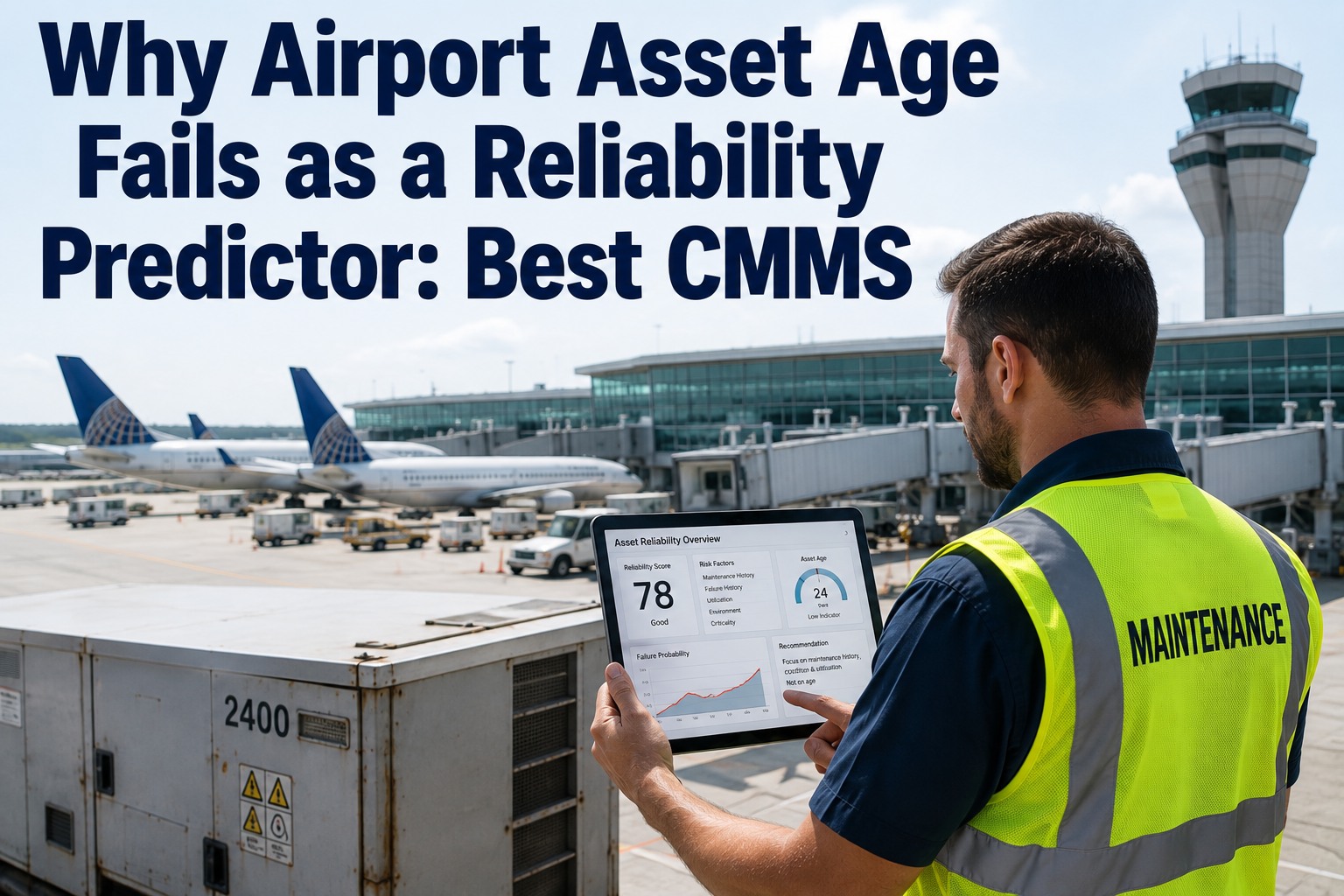
Airport asset criticality assessment fails when budgets get spread evenly across equipment that carries vastly different operational risk. Without a structured consequence ranking model, maintenance planners treat a baggage conveyor motor and a runway lighting controller as equivalent line items — until one failure grounds flights and the other inconveniences one gate. Sign Up Free to see how OxMaint helps airport maintenance teams build a defensible criticality model that ties equipment ranking to real service impact, dependency chains, and recovery burden.
Rank Airport Equipment by What Actually Fails Operations
OxMaint gives airport maintenance teams the asset registry, failure history, and consequence mapping tools to build a criticality framework that holds up under budget review and audit.
Why Airport Asset Criticality Assessment Needs a Structured Framework
Airports operate mixed asset portfolios where a single equipment failure can cascade into delayed departures, regulatory non-compliance, or passenger safety incidents. Without a formal criticality model, maintenance managers rank assets by gut feel or age rather than operational consequence and dependency exposure. Teams that Book a Demo with OxMaint see how structured consequence scoring, linked to real work order history and asset dependencies, replaces subjective priority lists with a reproducible ranking model that finance and operations leadership can both defend.
Score each asset by the operational, safety, and regulatory impact of failure so the ranking reflects actual service exposure, not equipment age or purchase cost.
Identify which systems an asset feeds or relies on, so single-point-of-failure equipment gets flagged before a breakdown disrupts the dependency chain.
Weight criticality by how long recovery takes and what resources it consumes, not just by how often the asset fails.
Group assets into maintenance tiers so PM frequency, inspection depth, and spare parts investment align with criticality score rather than available budget.
Pull failure frequency, MTBF, and repair cost from work order records to validate criticality scores against documented equipment behavior.
Generate a ranked asset list that maintenance, operations, and finance teams can review together to align on investment sequencing before the budget cycle closes.
Airport Asset Criticality Assessment: Step-by-Step Framework
Establish the failure consequence dimensions that matter at your airport — flight operations impact, passenger safety, regulatory compliance, and revenue exposure. Without agreed-upon consequence categories, every team scores assets differently. OxMaint's asset registry lets teams attach consequence classifications directly to equipment records so scoring stays consistent across departments. Teams can Book a Demo to see how consequence categories get configured for airside versus terminal versus ground support equipment.
Document upstream and downstream dependencies for each asset so a criticality score accounts for cascade risk, not just direct failure impact. A fuel hydrant system failure affects multiple aircraft simultaneously — its criticality isn't visible from a single-asset view.
Factor in mean time to restore, spare part lead times, and crew availability when scoring criticality. Two assets with identical failure frequency can carry very different risk profiles if one restores in two hours and the other takes three days. Teams that Sign Up Free can log parts lead times and labor availability against each asset to make recovery burden a calculated input, not an assumption.
Cross-reference criticality scores against actual failure frequency and repair cost data from work order records. Assets that score high on consequence but rarely fail may warrant inspection-based monitoring rather than intensive PM intervals.
Translate criticality tiers into maintenance strategy decisions — predictive, condition-based, time-based, or run-to-failure — so every asset gets a strategy proportional to its risk, not a uniform PM schedule applied airport-wide.
Airport Asset Criticality Framework Reference Table
| Criticality Tier | Consequence Level | Dependency Risk | Recovery Burden | Recommended Strategy |
|---|---|---|---|---|
| Tier 1 — Critical | Flight operations / safety | High — cascade failure | Days / specialist parts | Predictive + redundancy |
| Tier 2 — Essential | Service disruption | Medium — single-system | Hours / stocked parts | Condition-based PM |
| Tier 3 — Important | Passenger experience | Low — isolated | Hours / standard parts | Time-based PM |
| Tier 4 — Support | Operational convenience | Minimal | Short / off-shelf | Run-to-failure |
How OxMaint Supports Airport Asset Criticality Assessment
OxMaint connects asset records, work order history, spare parts data, and maintenance scheduling in one platform — giving airport teams the data foundation a criticality model requires. Asset classifications, consequence scores, and dependency notes attach directly to equipment records, so the criticality framework lives in the same system where PM work orders get generated and completed. Airports can Sign Up Free and begin building their asset hierarchy with criticality attributes before committing to a full rollout.
Building Your Airport Asset Criticality Model: Implementation Steps
Inventory All Asset Classes
Compile a complete asset list across airside, terminal, and ground support before scoring begins — missing assets create gaps in the criticality picture.
Agree Consequence Dimensions
Align maintenance, operations, and safety teams on the consequence categories and weighting before scoring any individual asset.
Score and Map Dependencies
Apply consequence and dependency scores to each asset, flagging single-point-of-failure equipment for elevated tier assignment.
Cross-Reference Failure History
Pull MTBF and repair cost data from existing work order records to validate model scores against documented equipment behavior.
Assign Maintenance Strategies
Map each criticality tier to a defined maintenance strategy and document the rationale so decisions are reproducible at the next budget cycle.
Review and Update Annually
Schedule an annual criticality review to reflect new equipment, fleet changes, and updated failure data. Book a Demo to walk through how OxMaint supports ongoing criticality model maintenance.
Build a Criticality Framework That Holds Up Under Budget Review
OxMaint connects asset records, failure history, and PM scheduling so airport teams can build, validate, and act on a structured criticality model — not a spreadsheet maintained by one person.
Frequently Asked Questions
What is airport asset criticality assessment?
It is the process of ranking airport equipment by its operational consequence, dependency exposure, and recovery burden so maintenance budgets and strategies reflect actual risk rather than asset age or cost.
How does dependency mapping affect criticality scores?
An asset that feeds multiple downstream systems carries higher criticality than its direct failure impact suggests. Mapping dependencies surfaces cascade risk that single-asset scoring misses.
Does OxMaint support criticality-based PM scheduling?
Yes. OxMaint allows maintenance strategy and PM frequency to be configured by asset criticality tier, so high-criticality equipment receives more intensive scheduling without manual overrides.
How often should airport asset criticality scores be reviewed?
Annual review is standard, with interim updates when new equipment is added, fleet composition changes, or a significant failure event reveals gaps in the existing model.
Can criticality assessments cover both airside and terminal assets?
Yes. A unified criticality model should cover all asset classes — airside, terminal, and ground support — scored against shared consequence categories with weighting adjusted for each operational context.
Start Ranking Airport Assets by Operational Risk
OxMaint gives airport maintenance teams the asset data, failure history, and PM tools to build a criticality model that drives smarter budget and strategy decisions.