An airport asset hierarchy built by criticality tier is the structural backbone of every reliable CMMS function — from preventive maintenance scheduling to capital planning and audit readiness. When airports classify assets into safety-critical, operationally important, and non-critical tiers, maintenance teams can direct labor and budget where downtime threatens certification, passenger safety, and on-time performance. ISO 55000-aligned asset registries typically cut unplanned downtime by 20–40% and reduce maintenance overhead by 15–25% within the first year of implementation. Instead of managing equipment through spreadsheets and tribal knowledge, a tiered airport asset structure inside a platform like OxMaint makes every work order, inspection, and spare-part decision traceable to a criticality score. Start your Start Free Trial or read on to learn how to design, score, and deploy a hierarchy that holds up under audit.
Airport Asset Management Guide
Can your airport prove which assets are safety-critical — before an audit or a failure does it for you?
A tiered airport asset hierarchy by criticality is what separates airports that plan maintenance from those that react to it. Build it once, build it right, and every work order, PM, and capital decision inherits the discipline.
Hierarchy Design Principles
How to Structure an Airport Asset Management Hierarchy
A well-designed airport equipment hierarchy mirrors how your facility actually operates — from terminal and airfield systems down to individual components — and feeds clean data into every CMMS module that depends on it.
Top-down functional decomposition
Start with locations (Terminal A, Runway 09/27, Central Plant), then systems (HVAC, Baggage Handling, Airfield Lighting), then individual assets, and finally sub-components. Each level rolls up costs, failures, and PM history so directors see both the forest and the trees.
One asset, one record, one ID
Duplicate asset records are the single biggest source of bad CMMS data. Enforce a unique asset ID convention at setup — typically a location-system-equipment-sequence code — and block duplicates at import. A clean airport asset registry is non-negotiable for ISO 55000 compliance.
Criticality scored at the asset level
Not every pump, belt, and sensor matters equally. Assign a criticality score to each asset record based on safety, operational impact, redundancy, and regulatory exposure. This score drives PM frequency, spare-parts stocking, and escalation rules inside the CMMS.
Parent-child relationships for rollups
When a baggage conveyor motor fails, the CMMS should instantly show its impact on the parent system, the terminal, and the airport's on-time performance metrics. Parent-child links make roll-up dashboards and capital planning possible without manual aggregation.
Criticality Scoring
Scoring Airport Asset Criticality: The 4-Factor Model
Criticality is not a guess — it is a defensible, repeatable score. Use this four-factor model to classify every asset in your airport asset registry into one of four tiers.
Each factor scored 1–5. Total score range: 1.0–5.0. Higher score = higher criticality tier.
Safety & Life-Safety Impact
Does failure risk injury, evacuation, or loss of life? Weighted highest at 40%. Examples: emergency generators, fire suppression, evacuation lighting, fuel hydrant systems.
Operational & Schedule Impact
Does failure delay flights, close gates, or halt baggage processing? Weighted 30%. Examples: baggage belts, jet bridges, runway edge lights, passenger boarding systems.
Redundancy & Repairability
Is there a backup? Can it be repaired quickly? Weighted 15%. An asset with full N+1 redundancy scores lower than a single-point-of-failure chiller feeding Terminal C.
Regulatory & Compliance Exposure
Does failure trigger an FAA finding, TSA non-compliance, or environmental violation? Weighted 15%. Examples: perimeter security, fuel spill containment, airfield signage.
| Tier | Score Range | Classification | PM Frequency | Example Assets |
|---|---|---|---|---|
| Tier 1 | 4.0 – 5.0 | Safety-Critical | Weekly / condition-based | Runway lighting, fire pumps, emergency generators |
| Tier 2 | 3.0 – 3.9 | Operationally Critical | Monthly / quarterly | Baggage belts, jet bridges, HVAC chillers |
| Tier 3 | 2.0 – 2.9 | Support / Non-Critical Operations | Quarterly / semi-annual | Terminal seating, restroom fixtures, signage |
| Tier 4 | 1.0 – 1.9 | Cosmetic / Administrative | Reactive / annual | Office HVAC, decorative lighting, parking lot striping |
Worked Example
Real-World Scenario: A 1,200-Asset Regional Airport
Consider a mid-sized regional airport with 1,200 tracked assets across two terminals, one runway, and a central utility plant. Here is what happens when they move from a flat spreadsheet to a tiered airport asset structure.
Before: Flat Spreadsheet Registry
- No criticality scores — every asset treated equally
- PM schedules based on manufacturer defaults only
- 14% of work orders duplicated or misassigned
- Audit preparation took 3 weeks of manual data gathering
- Safety-critical assets failed without predictive warning
After: Tiered Hierarchy in OxMaint
- Every asset scored and tiered — 186 Tier-1 assets identified
- PM frequency adjusted by tier; Tier-1 assets condition-monitored
- Work order duplication eliminated via unique asset IDs
- Audit reports generated in under 10 minutes
- Predictive alerts flagged 3 bearing failures before they cascaded
"The hierarchy rebuild paid for itself in the first quarter. We stopped wasting PM hours on Tier-4 seating while our Tier-1 runway edge lights finally got the condition-based attention they needed."
— Director of Airport Operations, Regional Hub (1,200 assets, 4M annual passengers)
Timeline
How to Build Your Airport Asset Registry in 5 Phases
A complete airport asset registry setup — from data audit to go-live — typically takes 8–12 weeks for a mid-sized facility. Here is the phased approach that keeps the project on track and avoids the data-quality traps that derail most CMMS rollouts.
Data Audit & Asset Discovery
Walk down every system. Tag assets physically, photograph nameplates, and reconcile against existing spreadsheets. Expect to find 10–15% ghost assets and 5–8% missing ones.
Hierarchy Design & ID Convention
Define location-system-asset-component levels. Lock the asset ID naming convention. Map parent-child relationships. This is the schema that everything else depends on.
Criticality Scoring Workshop
Convene operations, maintenance, safety, and compliance stakeholders. Score every asset using the 4-factor model. Assign Tier 1–4 labels. Document justification for audit traceability.
PM & Work Order Configuration
Build PM templates by tier. Tier-1 assets get condition-based and predictive triggers; Tier-4 gets reactive. Spare-parts min/max levels set by criticality. Escalation rules configured.
Team Training & Go-Live
Train technicians on mobile work orders. Validate dashboards with directors. Run the first full PM cycle. Most airports see measurable improvement in MTTR within 30 days of go-live.
How OxMaint Helps
How OxMaint Powers Your Airport Critical Asset Management
OxMaint is built to operationalize a tiered asset hierarchy — not just store it. Once your criticality scores are in the system, the platform's AI-driven PM, predictive maintenance, and analytics modules use them to automate the right action for the right asset at the right time.
Criticality-Driven PM Automation
OxMaint auto-generates PM schedules based on each asset's criticality tier — weekly condition checks for Tier-1, quarterly for Tier-3. No more one-size-fits-all PMs wasting hours on low-criticality assets.
Outcome: 30–50% reduction in unplanned downtime on Tier-1 and Tier-2 assets
AI Predictive Failure Alerts
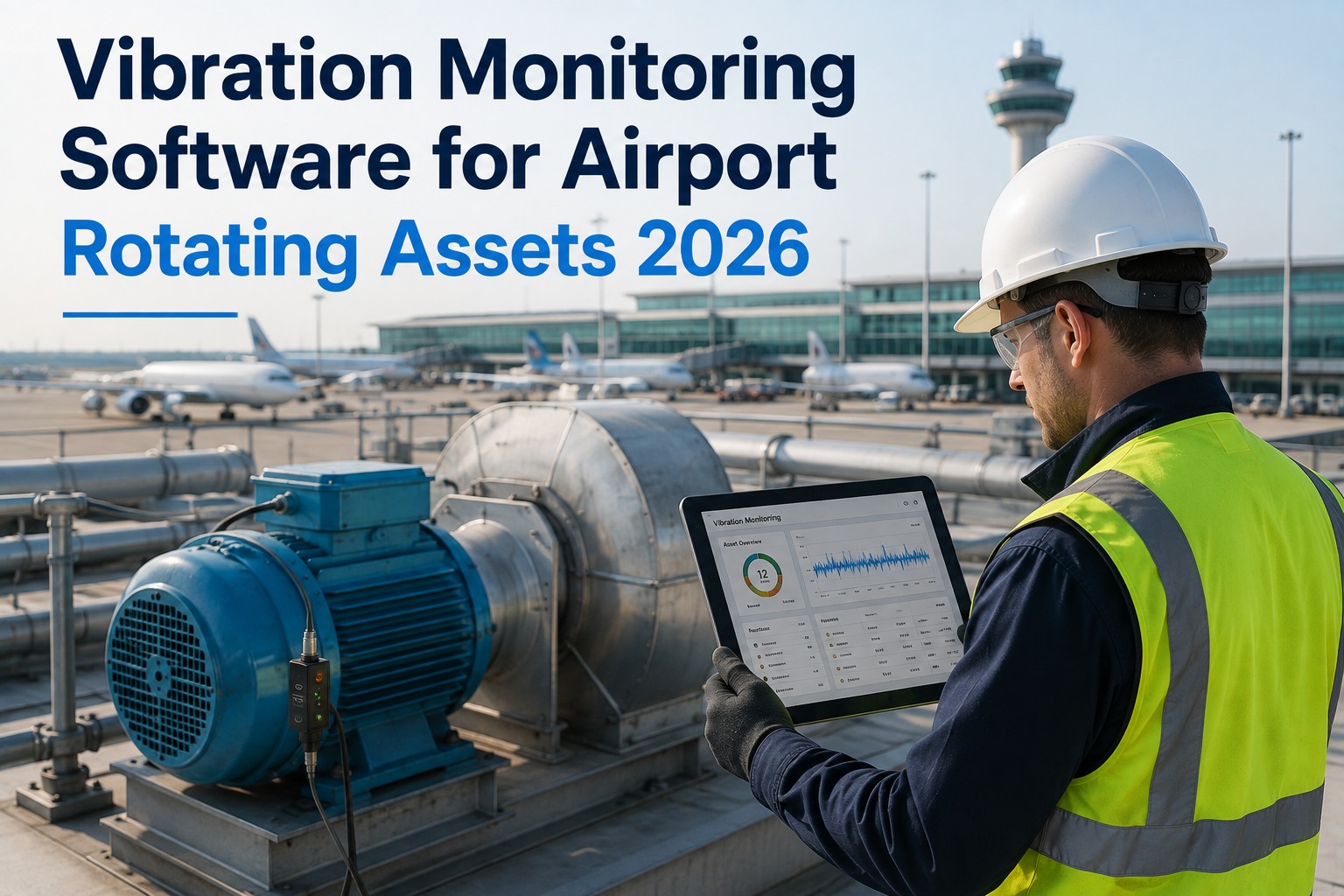
OxMaint's predictive engine analyzes vibration, temperature, and run-time data from IoT sensors on critical assets — flagging bearing wear, motor degradation, and thermal anomalies before they become failures.
Outcome: 70% of catastrophic failures caught 7–21 days in advance
Audit-Ready Asset Registry
Every asset record carries its criticality score, justification, PM history, and compliance documentation. Generate FAA, TSA, and ISO 55000 audit reports in minutes — not weeks of spreadsheet hunting.
Outcome: Audit preparation time cut from 3 weeks to under 1 hour
Spare-Parts Stocking by Tier
OxMaint links each asset's criticality tier to its BOM and spare-parts inventory. Tier-1 spares auto-trigger reorder at higher min levels; Tier-4 parts run lean. Capital is deployed where risk lives.
Outcome: 20–30% reduction in inventory holding costs with zero stockouts on Tier-1
See OxMaint on your assets — book a 30-minute demo
Watch how a tiered airport asset hierarchy, criticality-driven PMs, and predictive alerts work together inside OxMaint. We will build a live model using your asset categories and show you the ROI in real time.
Frequently Asked Questions
Airport Asset Hierarchy & Criticality — Answered
What is an airport asset hierarchy?
An airport asset hierarchy is a structured, parent-child breakdown of every physical asset — from terminals and runways down to individual pumps, motors, and sensors — stored in a CMMS or EAM. It organizes assets by location, system, and component so maintenance teams can track costs, failures, and PM history at every level and roll data up for capital planning and audit reporting.
How do you determine airport asset criticality?
Asset criticality is determined by scoring each asset on four weighted factors: safety impact (40%), operational impact (30%), redundancy (15%), and regulatory exposure (15%). Assets scoring 4.0–5.0 are Tier 1 (safety-critical); 3.0–3.9 are Tier 2 (operationally critical); 2.0–2.9 are Tier 3 (support); and 1.0–1.9 are Tier 4 (cosmetic). OxMaint automates this scoring and uses the tier to drive PM frequency and spare-parts stocking. To see the scoring engine in action, Book a Demo.
How many tiers should an airport asset classification have?
Most airports use four criticality tiers. Fewer than four and you lose the granularity to differentiate a runway edge light from a restroom faucet; more than six and the model becomes administratively unmanageable. Four tiers align well with ISO 55000 asset management standards and map cleanly to PM frequency bands — from condition-based monitoring (Tier 1) to reactive-only maintenance (Tier 4).
How long does it take to set up an airport asset registry?
For a mid-sized airport with 1,000–1,500 assets, a complete registry setup — including physical walk-down, hierarchy design, criticality scoring, PM configuration, and team training — typically takes 8–12 weeks. The most common delay is poor existing data quality; airports migrating from spreadsheets should budget an extra 2 weeks for data cleansing. You can start building your registry today with a Start Free Trial of OxMaint.
What happens if an airport does not tier its assets by criticality?
Without criticality tiering, maintenance teams apply the same effort to every asset — which means safety-critical systems are under-maintained while cosmetic assets are over-maintained. The result is higher unplanned downtime (typically 20–40% higher), longer audit preparation, wasted labor hours, and a higher risk of certification findings. Tiering is the single highest-ROI step an airport can take in its asset management maturity journey.
Build a hierarchy that holds up under audit — and under failure
Your airport's assets deserve more than a spreadsheet. OxMaint's AI-powered CMMS turns a tiered asset hierarchy into automated PMs, predictive alerts, and audit-ready reports — so safety-critical assets get priority attention before they fail.
Free 14-day trial · No credit card