Every airport is a financial ecosystem worth billions—runways, terminals, baggage systems, HVAC networks, power grids, and ground support equipment all depreciating at different rates, funded through different budgets, and maintained by different teams. Without a unified financial view of your infrastructure assets, you're making capital decisions in the dark, overspending on replacements that could wait, underfunding systems about to fail, and reporting depreciation figures that don't reflect reality. OXmaint's Financial Management & Depreciation platform brings CAPEX tracking, OPEX monitoring, asset valuation, depreciation modeling, and AI-driven budget forecasting into one integrated dashboard—so every dollar you spend on airport infrastructure is visible, justified, and optimized. Schedule a demo to see how your airport's financial data comes together in one intelligent platform.
Why Financial Visibility Is Critical for Airport Infrastructure
Airports are among the most capital-intensive operations on earth. A single international terminal can house tens of thousands of assets—each with its own acquisition cost, depreciation schedule, maintenance budget, and replacement timeline. When financial data lives in disconnected spreadsheets, ERP modules, and departmental silos, the consequences compound fast.
When finance teams can't see real-time asset health alongside depreciation curves and maintenance costs, they're budgeting based on assumptions instead of data. The result is capital plans that don't align with operational reality, surprise expenditures that blow quarterly forecasts, and infrastructure that deteriorates faster than the books suggest.
Inside the OXmaint Financial Dashboard
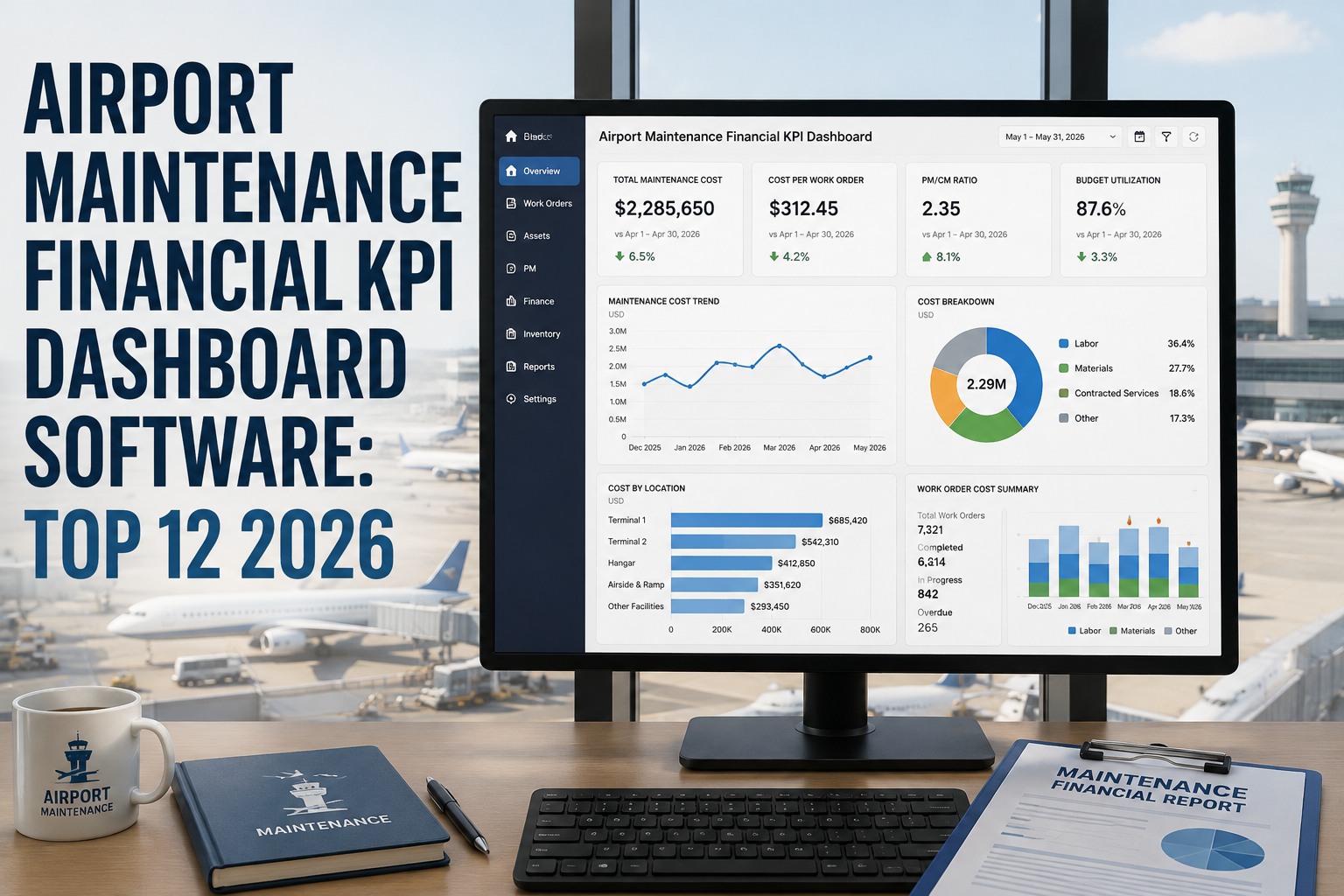
OXmaint's Financial Management & Depreciation module gives airport finance teams, asset managers, and CFO offices a single command center for every financial dimension of infrastructure management. The moment you log in, four live KPI cards deliver instant financial awareness—with SAP S/4HANA integration keeping everything synchronized with your enterprise systems.
Understanding CAPEX vs OPEX in Airport Asset Management
The distinction between capital expenditures and operational expenses is more than an accounting exercise at airports—it fundamentally shapes how infrastructure gets funded, maintained, and replaced. CAPEX covers long-term investments like new baggage handling systems, runway resurfacing, and terminal expansions. OPEX covers the ongoing costs of keeping those assets running—maintenance contracts, energy consumption, labor, and consumable parts.
The challenge is that these two spending categories are deeply interconnected. Underfunding preventive maintenance (OPEX) accelerates asset degradation, which triggers earlier capital replacements (CAPEX). Conversely, investing in high-quality assets upfront can dramatically reduce lifetime operating costs. Without a platform that tracks both simultaneously and models their interactions, airports end up in a cycle of reactive spending that costs more over every asset lifecycle.
Depreciation and Asset Valuation in Aviation
Airport assets don't just age—they depreciate at different rates depending on usage intensity, environmental exposure, maintenance quality, and technological obsolescence. A baggage handling conveyor in a high-traffic terminal depreciates faster than an identical system in a regional facility. Runway lighting exposed to extreme weather cycles loses value differently than indoor terminal HVAC equipment.
Accurate depreciation modeling matters because it directly affects financial reporting, tax obligations, insurance valuations, and capital replacement timing. When depreciation calculations are based on generic industry schedules rather than actual asset performance data, airports either overvalue aging assets (creating hidden financial risk) or undervalue functional equipment (triggering premature replacements that waste capital).
Using AI for Predictive Budget Forecasting
Traditional airport budgeting relies on historical averages and fixed replacement cycles—an approach that ignores the reality that assets degrade at different rates based on actual usage patterns, environmental conditions, and maintenance quality. OXmaint's AI-driven forecasting engine analyzes real-time sensor data, historical failure patterns, maintenance records, and lifecycle degradation curves to generate budget projections that reflect what your assets actually need—not what a generic industry schedule suggests.
The result is a 3-year rolling forecast that accounts for upcoming replacement waves, seasonal maintenance patterns, and the cascading financial effects of major infrastructure projects like HVAC system overhauls or terminal expansion programs. Finance teams can see exactly when capital demands will peak and plan funding strategies accordingly.
Planning Multi-Year Infrastructure Investments
Airport infrastructure doesn't fail all at once—but it doesn't age uniformly either. A 20-year-old terminal might have escalators approaching end-of-life, an HVAC system with five good years remaining, and a fire suppression network that was just modernized. The financial challenge is predicting when clusters of assets will need replacement simultaneously, creating capital demand spikes that can strain budgets and disrupt operations.
OXmaint's lifecycle-based forecasting identifies these convergence points years in advance. By modeling the degradation curves of every asset class against actual performance data, the platform shows finance teams exactly when capital peaks will hit and helps them stagger investments to smooth cash flow. Instead of reacting to emergency replacements with unplanned capital outlays, airports can build multi-year funding strategies that keep infrastructure reliable while managing financial exposure.
Department-Level Budget Allocation and Accountability
Airport infrastructure spending doesn't happen in one department—it flows across airfield operations, terminal management, ground support, building facilities, IT systems, and dedicated maintenance teams. Without department-level budget visibility, it's impossible to identify where spending is efficient, where costs are escalating, and which teams are delivering the best return on their infrastructure investments.
OXmaint breaks down the total airport budget by financial responsibility center, giving each department clear visibility into their allocation, spend rate, and variance against plan. This transforms budgeting from a top-down exercise into a collaborative process where every department head understands their financial contribution to airport infrastructure health.
Integrating Financial Systems with Asset Management Platforms
The most expensive gap in airport financial management isn't a broken asset—it's the disconnect between your ERP system and your maintenance platform. When SAP tracks financial transactions in one database while your CMMS tracks work orders in another, neither system has the full picture. Finance sees depreciation schedules but not real-time asset condition. Maintenance sees equipment failures but not their financial impact.
OXmaint bridges this gap with native SAP S/4HANA integration that synchronizes asset records, financial transactions, depreciation calculations, and maintenance costs in real time. Every work order generates a financial event. Every capital acquisition updates the asset registry. Every depreciation recalculation reflects actual condition data. The result is a single source of truth that both finance and engineering teams can trust.
Reducing Financial Risk Through Data-Driven Asset Decisions
Every unplanned asset failure carries a double cost—the emergency repair expense itself and the operational disruption it causes. A failed baggage handling motor doesn't just cost $15,000 to replace; it delays dozens of flights, triggers passenger compensation claims, and consumes maintenance labor that was scheduled for preventive work elsewhere. Multiplied across hundreds of critical assets, these hidden costs represent the single largest source of unbudgeted financial exposure at most airports.
The Business Case for Integrated Financial Asset Management
The ROI of integrating financial management with asset performance data compounds over time. In the first year, airports typically see measurable improvements in budget accuracy and a reduction in unplanned capital spending. By year two, lifecycle-based forecasting begins to reshape capital planning processes. By year three, the cumulative effect—fewer surprises, smarter timing, better reporting—transforms the relationship between finance and engineering teams from adversarial to collaborative.