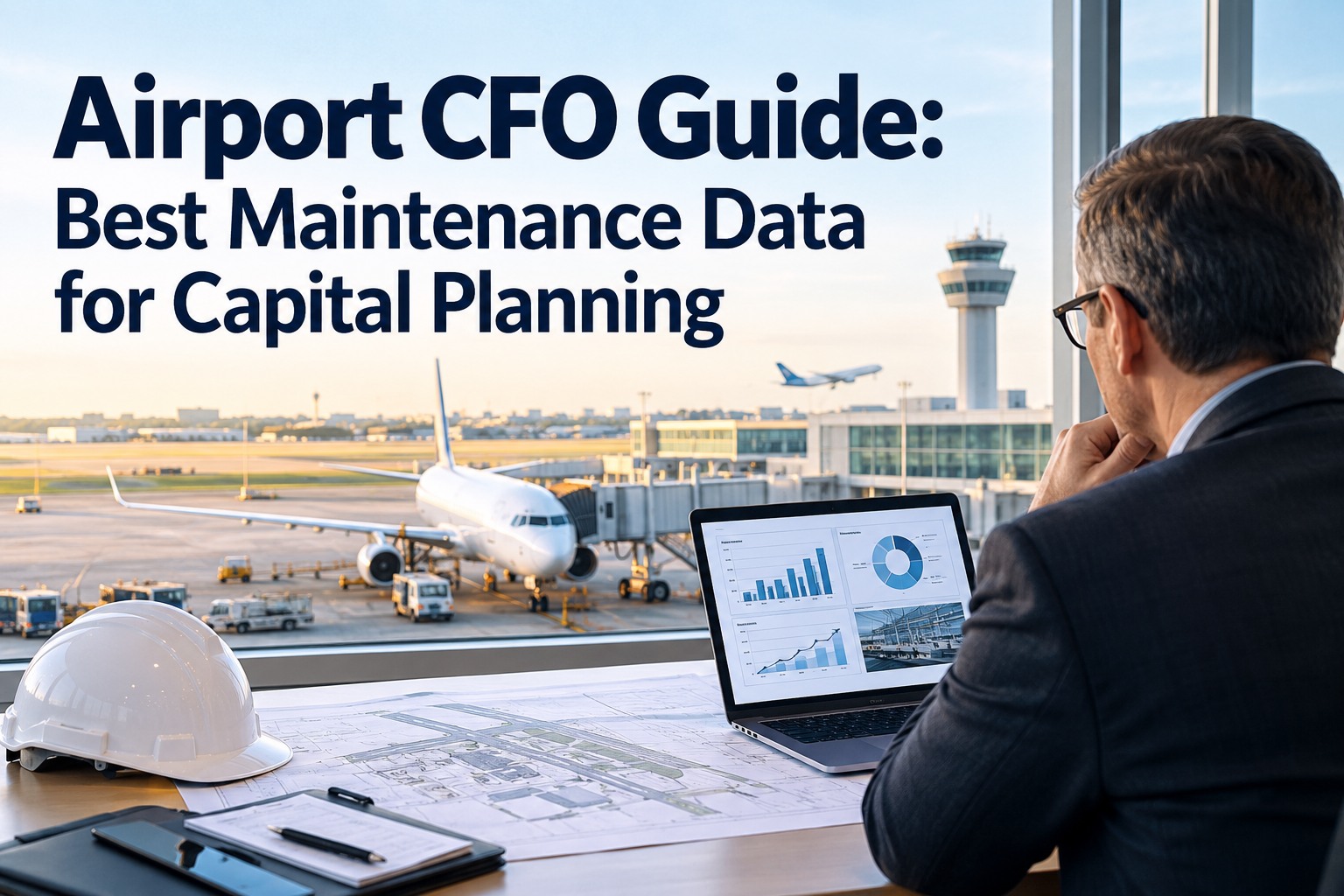
Airport infrastructure makes decisions that cost hundreds of millions of dollars — and most of those decisions are made without reliable data. When a runway resurfacing project competes with a terminal HVAC overhaul and a PBB replacement program for the same capital budget, the decision usually goes to whoever makes the loudest noise rather than whoever has the strongest asset condition case. CMMS data changes that dynamic entirely. Start a free trial for 30 days and book a demo to see how Oxmaint turns maintenance data into defensible capital investment decisions.
Airport Capital Planning and Infrastructure Renewal: Data-Driven Investment Decisions
Every deferred airport infrastructure decision accumulates cost. The question is not whether to invest — it is whether you invest proactively at known cost, or reactively at 4.8x the price after failure.
Turn Your Maintenance History into a 10-Year Capital Forecast
Oxmaint combines asset condition scores, maintenance cost history, and lifecycle models to generate rolling 5–10 year CapEx forecasts that hold up in front of airport boards and government funding bodies.
Why Airport Capital Planning Breaks Down Without Data
A 20-year-old HVAC unit with excellent maintenance history may outperform a 12-year-old unit with a history of neglect. Replacing assets by age alone wastes capital on units still serviceable and defers replacement of units that genuinely need it.
Every year a critical infrastructure renewal is deferred adds 6–12% to the eventual project cost through continued deterioration, energy inefficiency, and increased reactive maintenance spend. Deferred maintenance at US airports exceeds $38 billion.
FAA AIP grants, IIJA infrastructure funding, and state aviation development programs require documented asset condition assessments. Applications without CMMS-backed condition data score lower in competitive grant reviews.
When airside, landside, and terminal teams compete for the same capital budget without objective condition data, the decision defaults to political advocacy rather than infrastructure need — leading to systemic under-investment in critical systems.
Airport Infrastructure Categories: What the Capital Plan Covers
Pavement Condition Index (PCI) scoring, crack seal programs, overlay planning, and full reconstruction projects. Typical lifecycle: 20–40 years depending on traffic volume and climate.
AHU replacement cycles, chilled water plant upgrades, and building automation system overhauls. Equipment reaching 15–20 years of service typically triggers capital review for replacement vs. refurbishment.
PBB lifecycle typically runs 20–25 years. Drive unit replacement, cab refurbishment, and weather seal programs require capital planning 3–5 years before end of serviceable life.
Conveyor drives, sorters, and screening integration. BHS replacement is among the largest capital items at any airport — typically $15M–$80M at mid-size facilities — requiring multi-year capital planning lead time.
Modernization cycles (not replacement) typically occur at 15–20 years. Control system, rope, and drive upgrades extend serviceable life by 15 years at 30–40% of replacement cost.
Transformer replacement, switchgear upgrades, airfield lighting circuits, and backup generation. Utility infrastructure failures are among the highest-consequence events in airport operations planning.
How Oxmaint Builds Your Data-Driven Capital Plan
Every infrastructure asset is registered with install date, design life, and current condition score. Condition scores update automatically with each inspection and maintenance event.
All work orders, parts costs, and contractor invoices are captured against each asset record — building a full cost history that identifies assets approaching economic end of life.
Oxmaint models remaining useful life for each asset class using condition score trajectories. Assets approaching 70% condition deterioration are flagged for capital review in the rolling 5-year window.
The output is a 5–10 year capital expenditure forecast by asset class and infrastructure category — with cost estimates, priority rankings, and documented justification for each project.
Airports using Oxmaint's CapEx forecasting module reduce unplanned capital expenditure by an average 18% in year three by catching infrastructure deterioration before it becomes an emergency project. Start a free trial and book a demo to see a sample 10-year airport CapEx forecast.
Ad Hoc Capital Planning vs. CMMS-Driven Investment
| Planning Dimension | Ad Hoc / Age-Based | Oxmaint Data-Driven |
|---|---|---|
| Investment justification basis | Asset age and management intuition | Condition score + maintenance cost history |
| Capital forecast horizon | 1–2 years (reactive) | Rolling 5–10 year model with annual refresh |
| Grant application data | Estimated condition — weak documentation | CMMS-backed condition assessment — competitive |
| Emergency CapEx frequency | 3–5 unplanned projects per year | Average 0.8 per year — condition flags catch issues early |
| Cross-department prioritization | Budget politics and advocacy | Objective condition ranking — transparent to all teams |
| 10-year CapEx accuracy | +/- 35% variance from projections | +/- 12% variance with condition-based modeling |
What Data-Driven Capital Planning Delivers
Frequently Asked Questions
How does Oxmaint generate condition scores for airport assets?
Can Oxmaint integrate with airport master planning processes?
What is the minimum data history needed to generate a useful CapEx forecast?
Can the CapEx forecast be shared with airport board members or government stakeholders?
Your Infrastructure Data Already Justifies the Investment. Oxmaint Makes That Case For You.
Replace capital planning guesswork with a rolling 10-year forecast built on real asset condition data, maintenance cost history, and lifecycle models — ready for board presentations, grant applications, and government stakeholder reviews.